Heat wave occuring from December 28 2025 to January 03 2026 at 55.0°N 234.0°E

Download data: JSON

Event type: Heat wave

Countries affected (identified with ArcGIS Online; provided only for geographical reference):

  • Canada
  • United States

Duration: 7 days

Time span: December 28 2025 to January 03 2026

Statistics over entire affected area:

  • Mean temperature anomaly: 7.2 °C
  • Mean temperature: 4.0 °C
  • Maximum temperature anomaly: 15.6 °C
  • Maximum temperature: 10.3 °C

Event center: 55.0°N 234.0°E

Area affected: 429433 km$^2$


Fig. 1: Map of most extreme temperature anomalies (standardized) experienced during the event. The purple star indicates the center of the extreme event. Green hatching illustrates all areas under the effect of extremes at some time during the event.


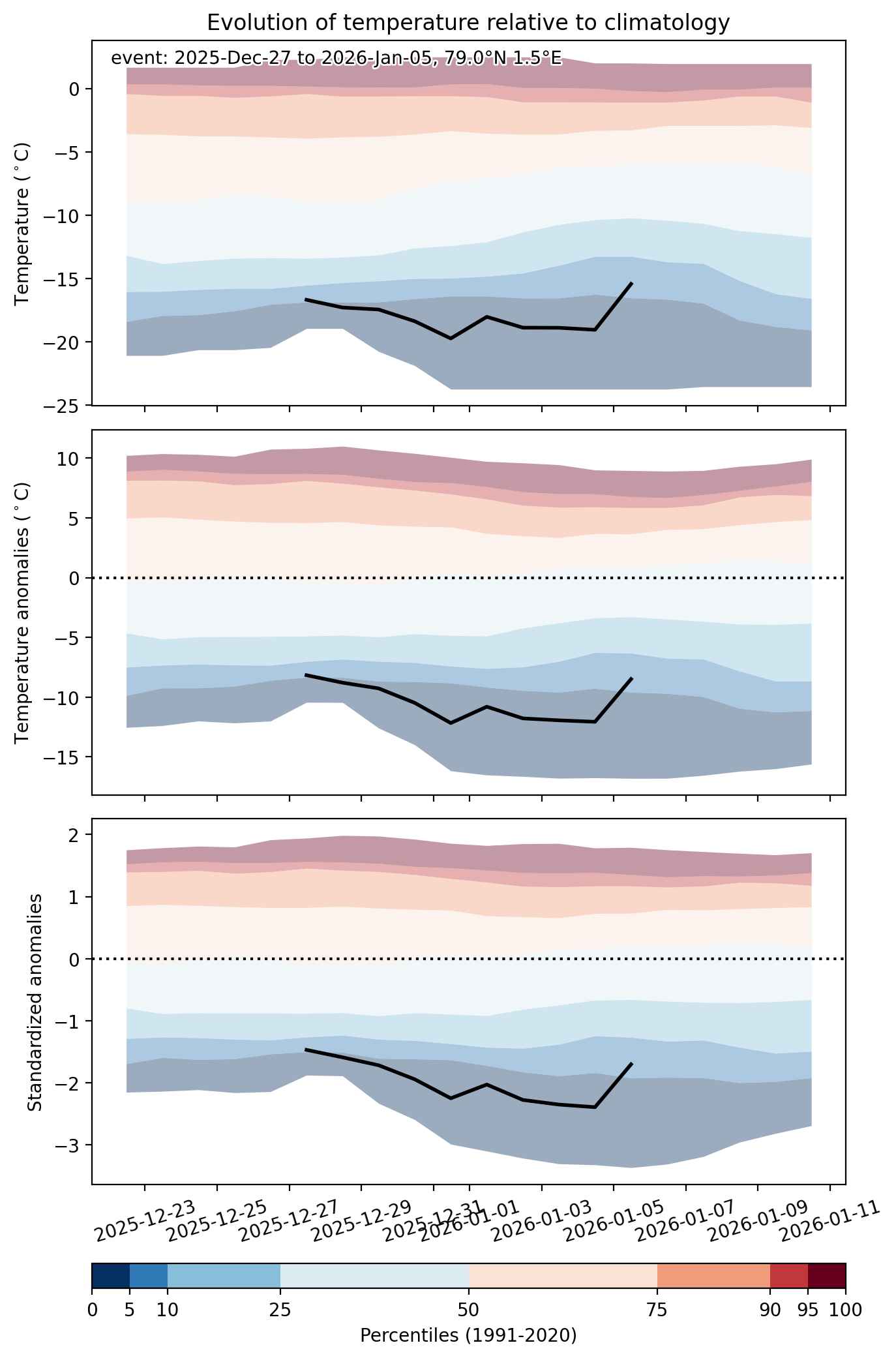
Fig. 2: Evolution of temperature at the center of the event. The climatological percentile distribution is illustrated with color shadings.


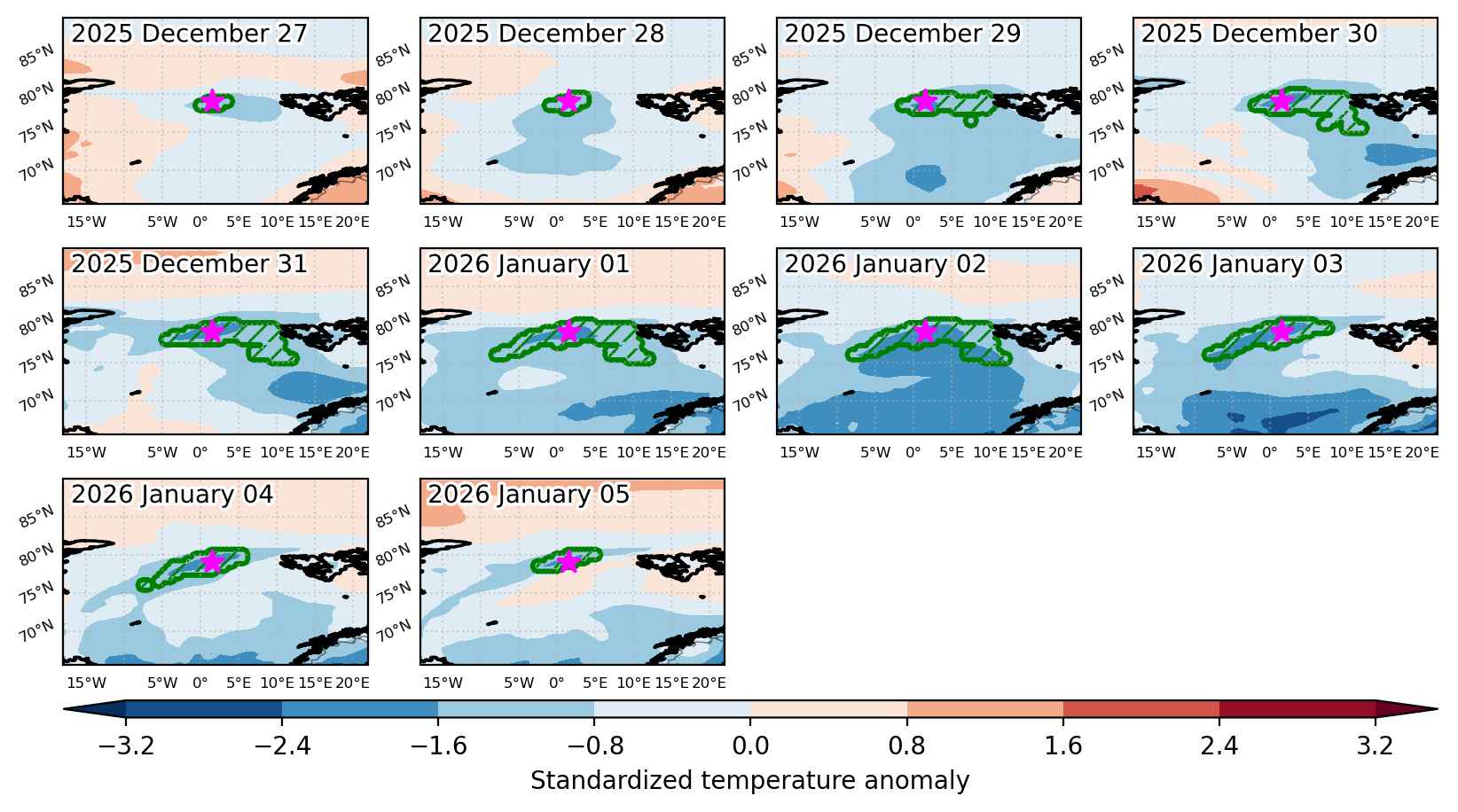
Fig. 3: Maps illustrating the evolution of standardized temperature anomalies during the event.

Event ID: Heat_wave_2025-Dec-28_to_2026-Jan-03_234.0_55.0
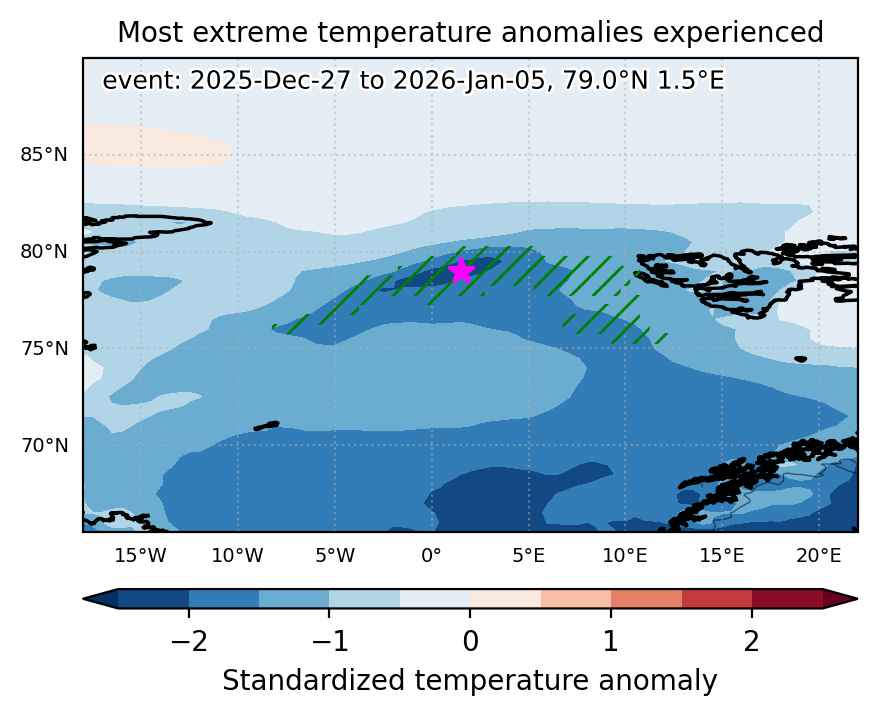
Cold spell occuring from December 27 2025 to January 05 2026 at 79.0°N 1.5°E

Download data: JSON

Event type: Cold spell

Countries affected (identified with ArcGIS Online; provided only for geographical reference):

  • Svalbard and Jan Mayen

Duration: 10 days

Time span: December 27 2025 to January 05 2026

Statistics over entire affected area:

  • Mean temperature anomaly: -7.8 °C
  • Mean temperature: -13.7 °C
  • Minimum temperature anomaly: -12.8 °C
  • Minimum temperature: -22.3 °C

Event center: 79.0°N 1.5°E

Area affected: 98666 km$^2$


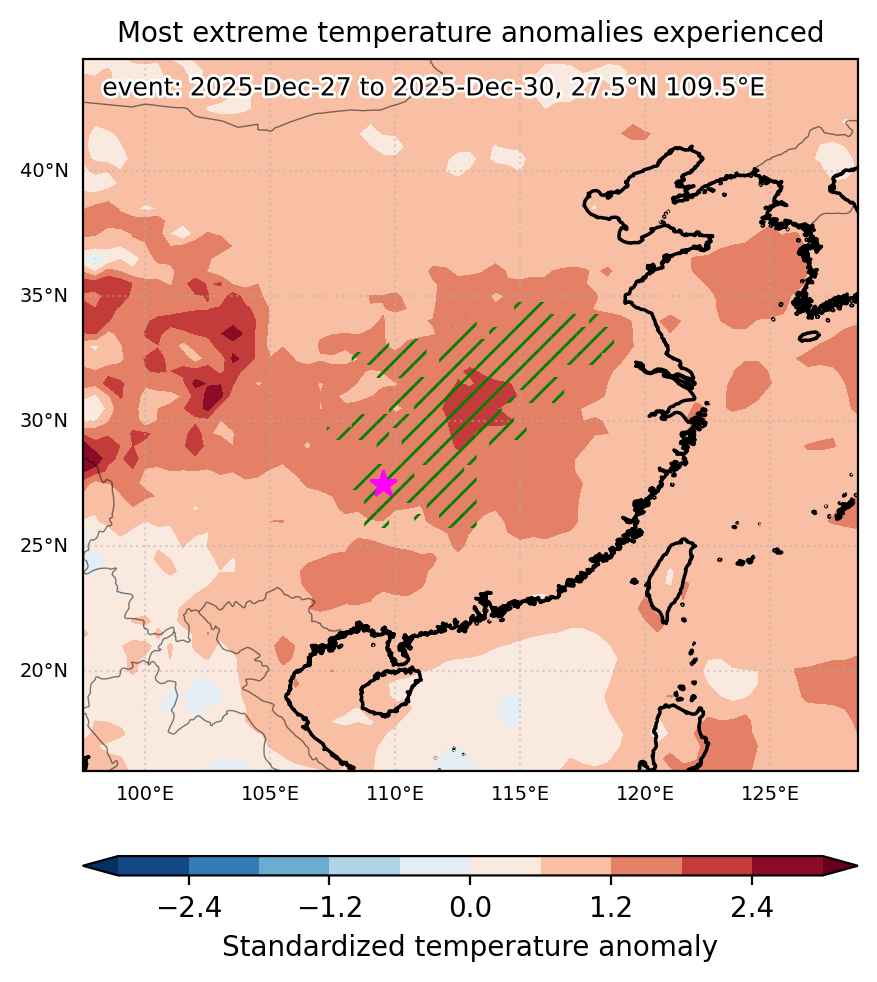
Fig. 1: Map of most extreme temperature anomalies (standardized) experienced during the event. The purple star indicates the center of the extreme event. Green hatching illustrates all areas under the effect of extremes at some time during the event.


Fig. 2: Evolution of temperature at the center of the event. The climatological percentile distribution is illustrated with color shadings.


Fig. 3: Maps illustrating the evolution of standardized temperature anomalies during the event.

Event ID: Cold_spell_2025-Dec-27_to_2026-Jan-05_1.5_79.0

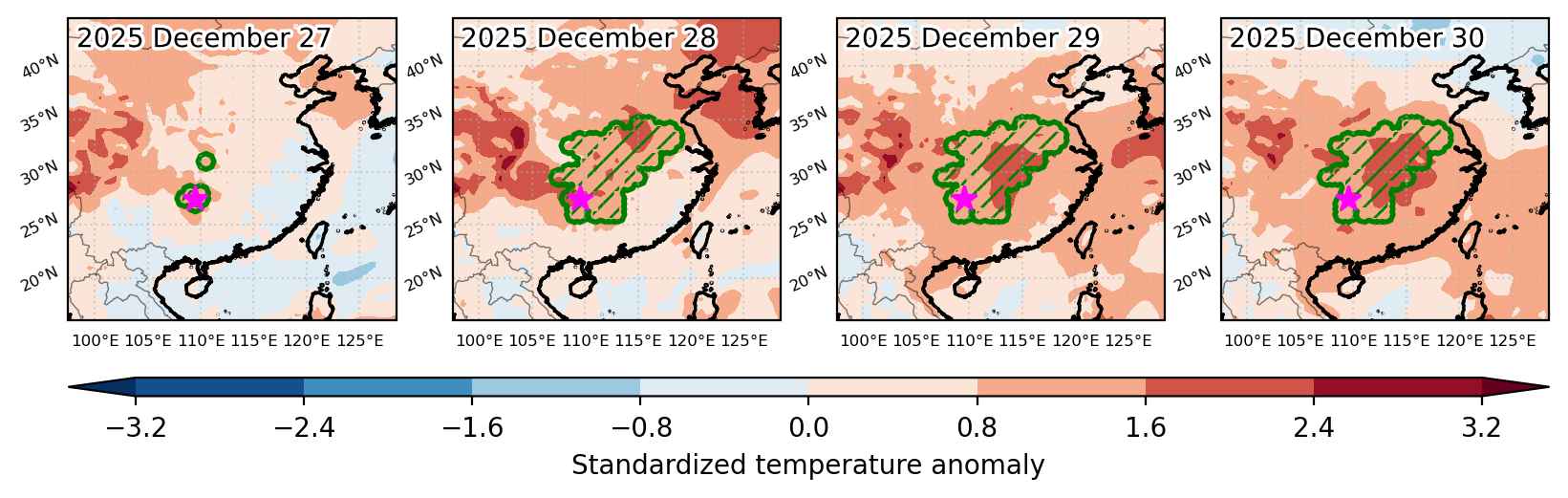
Heat wave occuring from December 27 2025 to December 30 2025 at 27.5°N 109.5°E

Download data: JSON

Event type: Heat wave

Countries affected (identified with ArcGIS Online; provided only for geographical reference):

  • China

Duration: 4 days

Time span: December 27 2025 to December 30 2025

Statistics over entire affected area:

  • Mean temperature anomaly: 5.0 °C
  • Mean temperature: 9.0 °C
  • Maximum temperature anomaly: 7.3 °C
  • Maximum temperature: 13.9 °C

Event center: 27.5°N 109.5°E

Area affected: 489246 km$^2$


Fig. 1: Map of most extreme temperature anomalies (standardized) experienced during the event. The purple star indicates the center of the extreme event. Green hatching illustrates all areas under the effect of extremes at some time during the event.


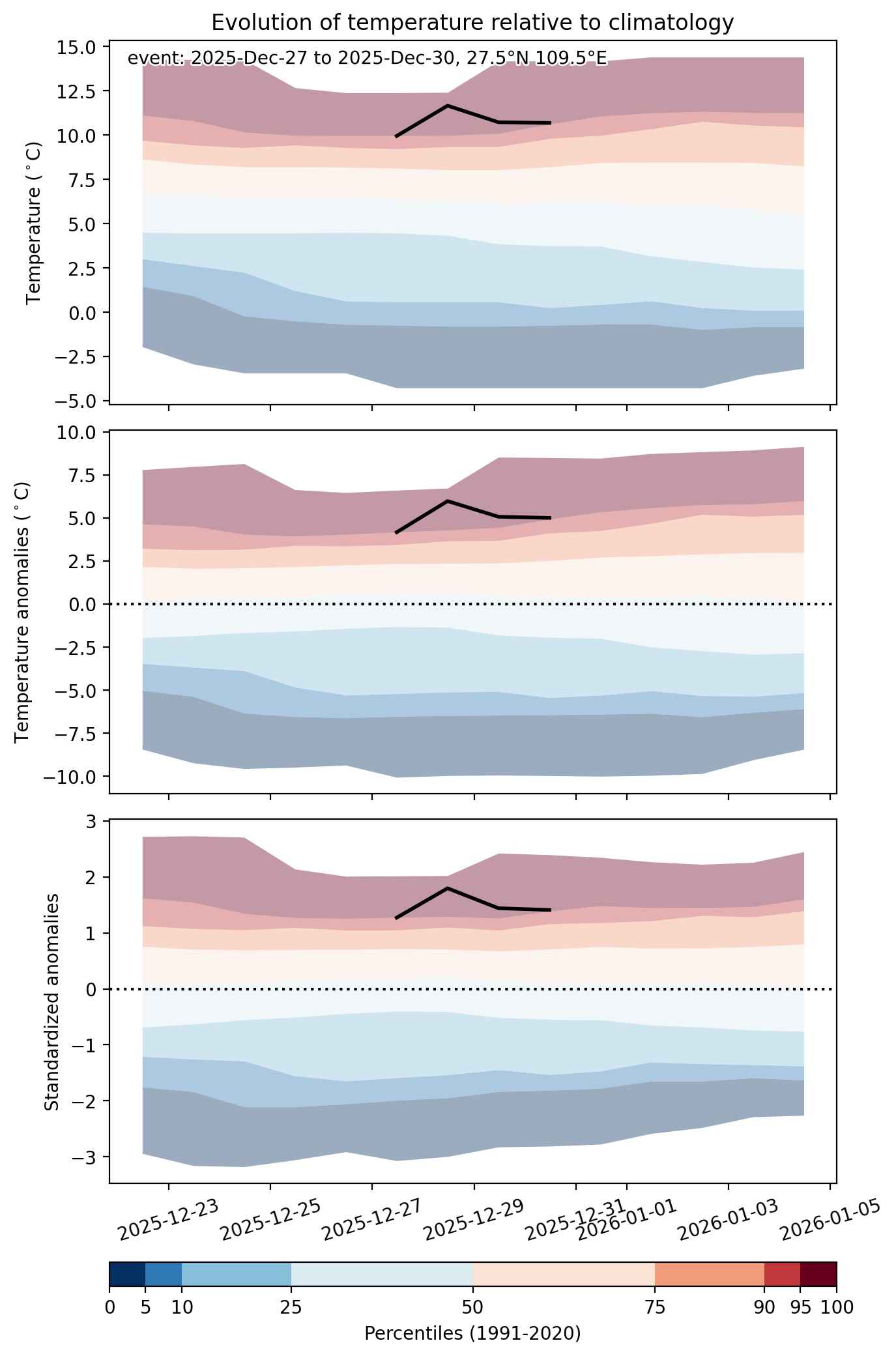
Fig. 2: Evolution of temperature at the center of the event. The climatological percentile distribution is illustrated with color shadings.


Fig. 3: Maps illustrating the evolution of standardized temperature anomalies during the event.

Event ID: Heat_wave_2025-Dec-27_to_2025-Dec-30_109.5_27.5

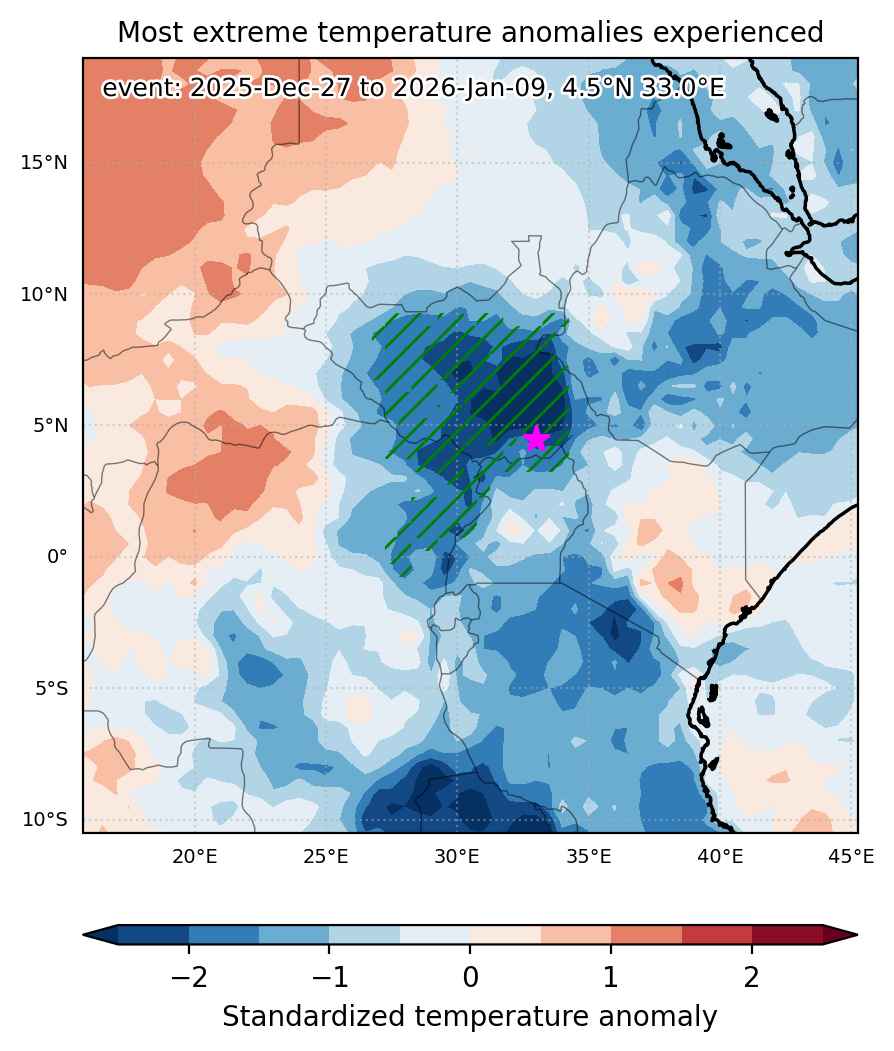
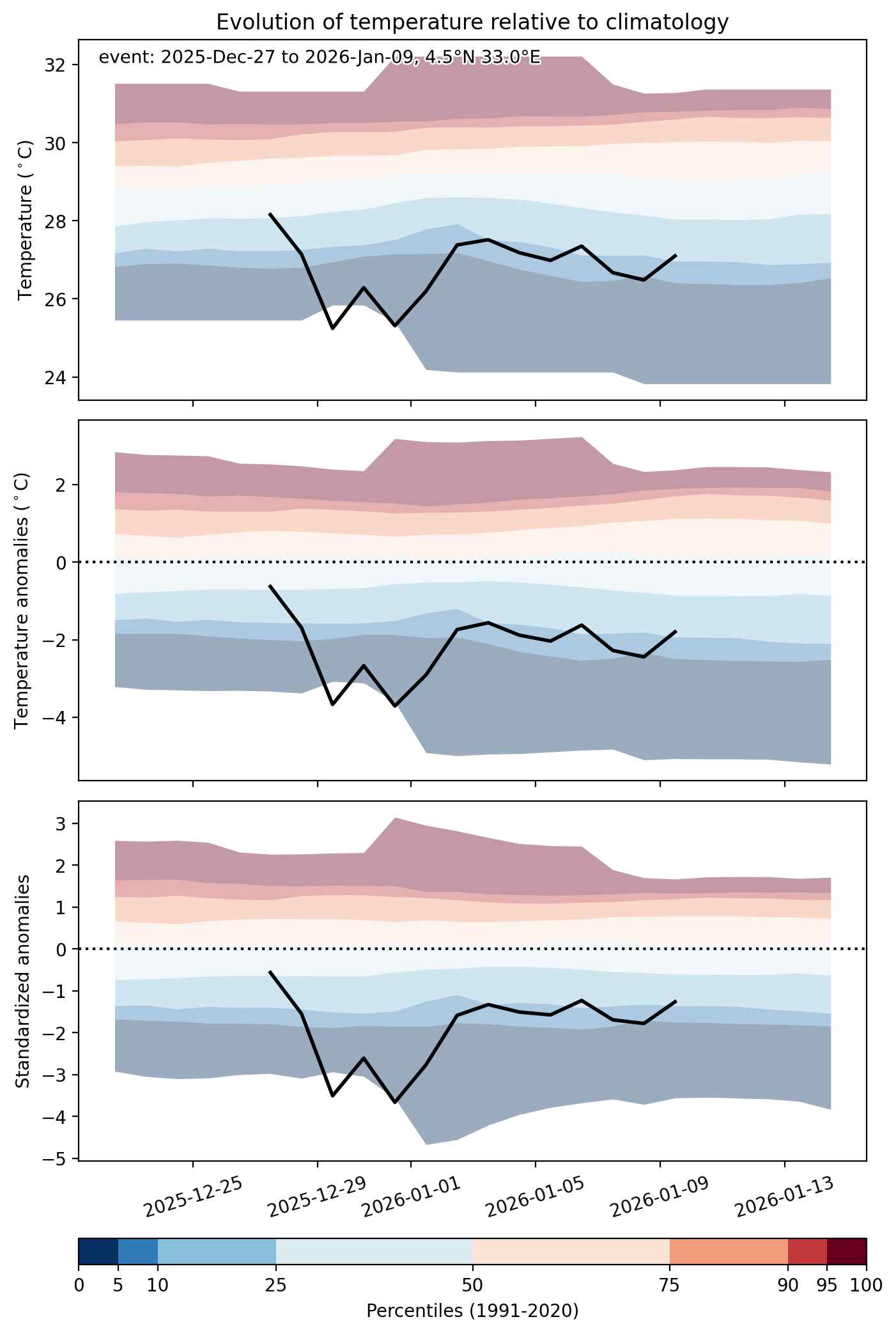
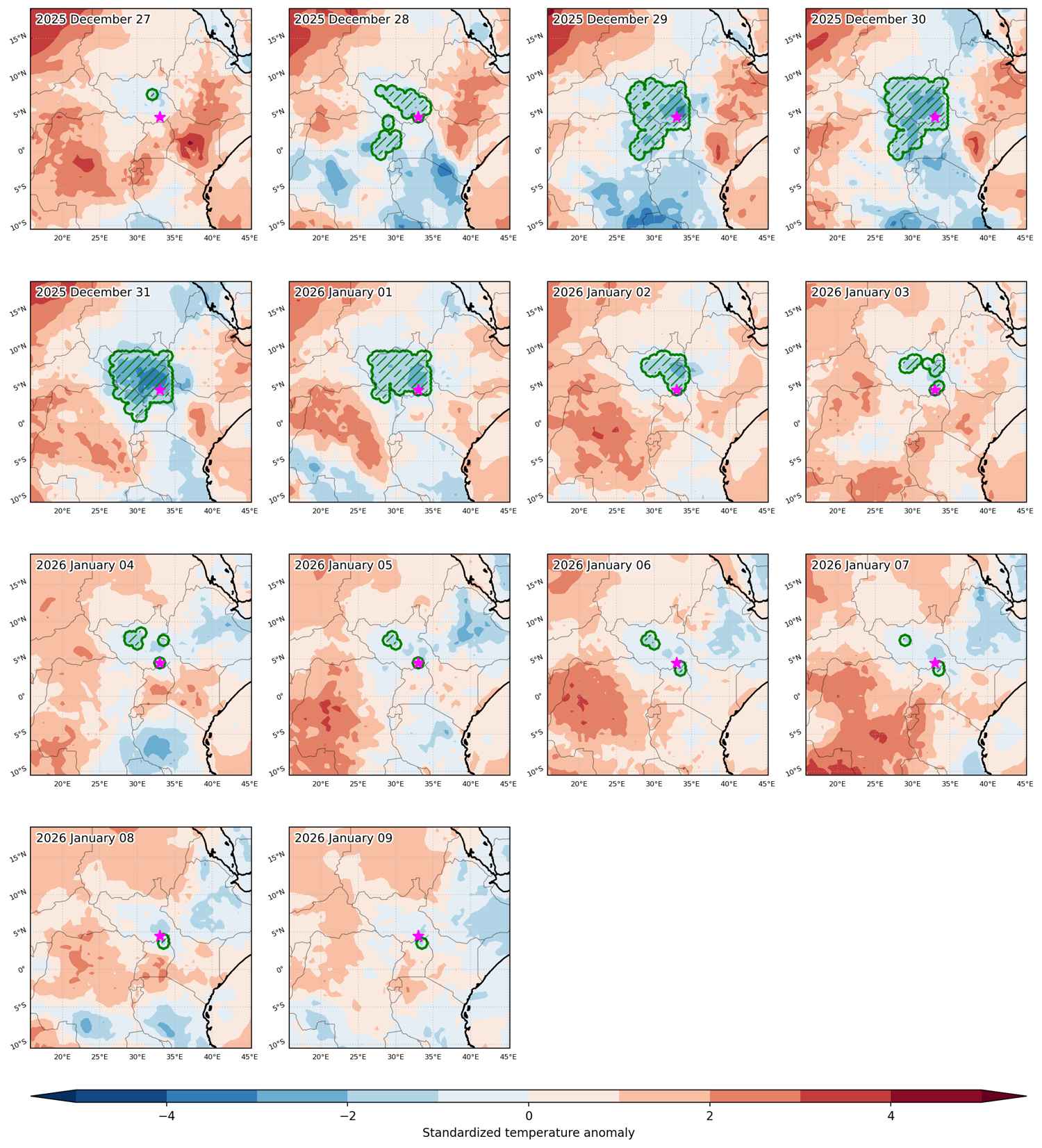
Cold spell occuring from December 27 2025 to January 09 2026 at 4.5°N 33.0°E

Download data: JSON

Event type: Cold spell

Countries affected (identified with ArcGIS Online; provided only for geographical reference):

  • Congo, The Democratic Republic of the
  • Ethiopia
  • South Sudan
  • Uganda

Duration: 14 days

Time span: December 27 2025 to January 09 2026

Statistics over entire affected area:

  • Mean temperature anomaly: -2.7 °C
  • Mean temperature: 25.3 °C
  • Minimum temperature anomaly: -5.4 °C
  • Minimum temperature: 16.5 °C

Event center: 4.5°N 33.0°E

Area affected: 531825 km$^2$


Fig. 1: Map of most extreme temperature anomalies (standardized) experienced during the event. The purple star indicates the center of the extreme event. Green hatching illustrates all areas under the effect of extremes at some time during the event.


Fig. 2: Evolution of temperature at the center of the event. The climatological percentile distribution is illustrated with color shadings.


Fig. 3: Maps illustrating the evolution of standardized temperature anomalies during the event.

Event ID: Cold_spell_2025-Dec-27_to_2026-Jan-09_33.0_4.5

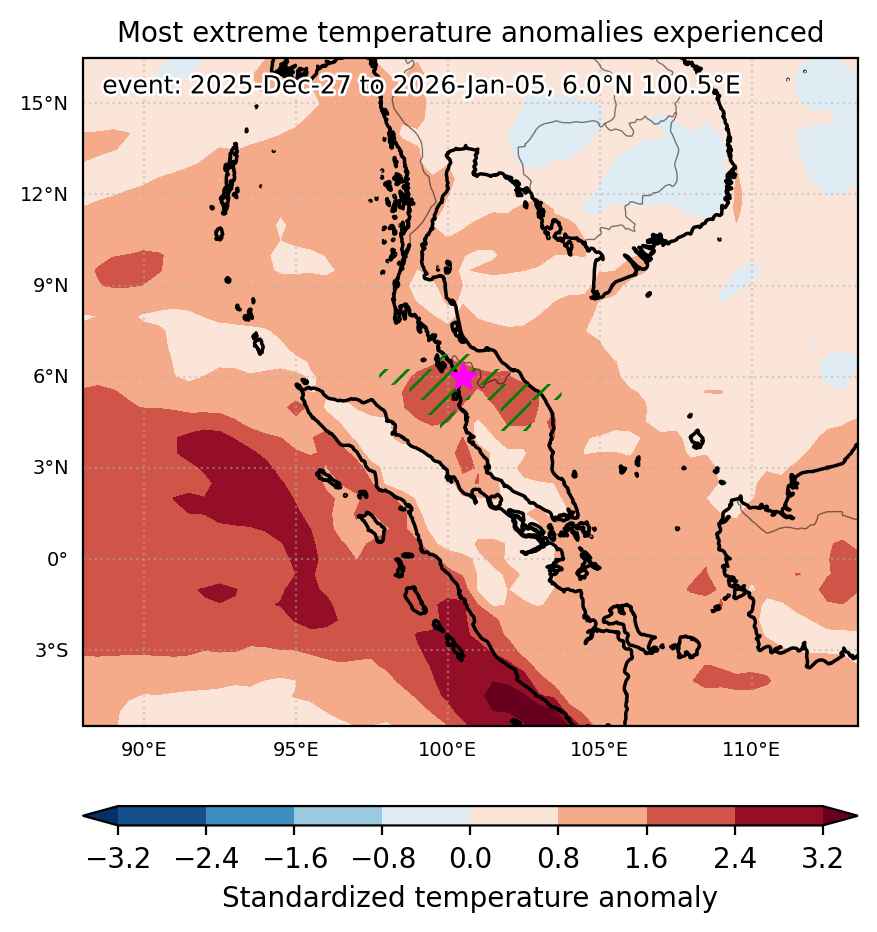
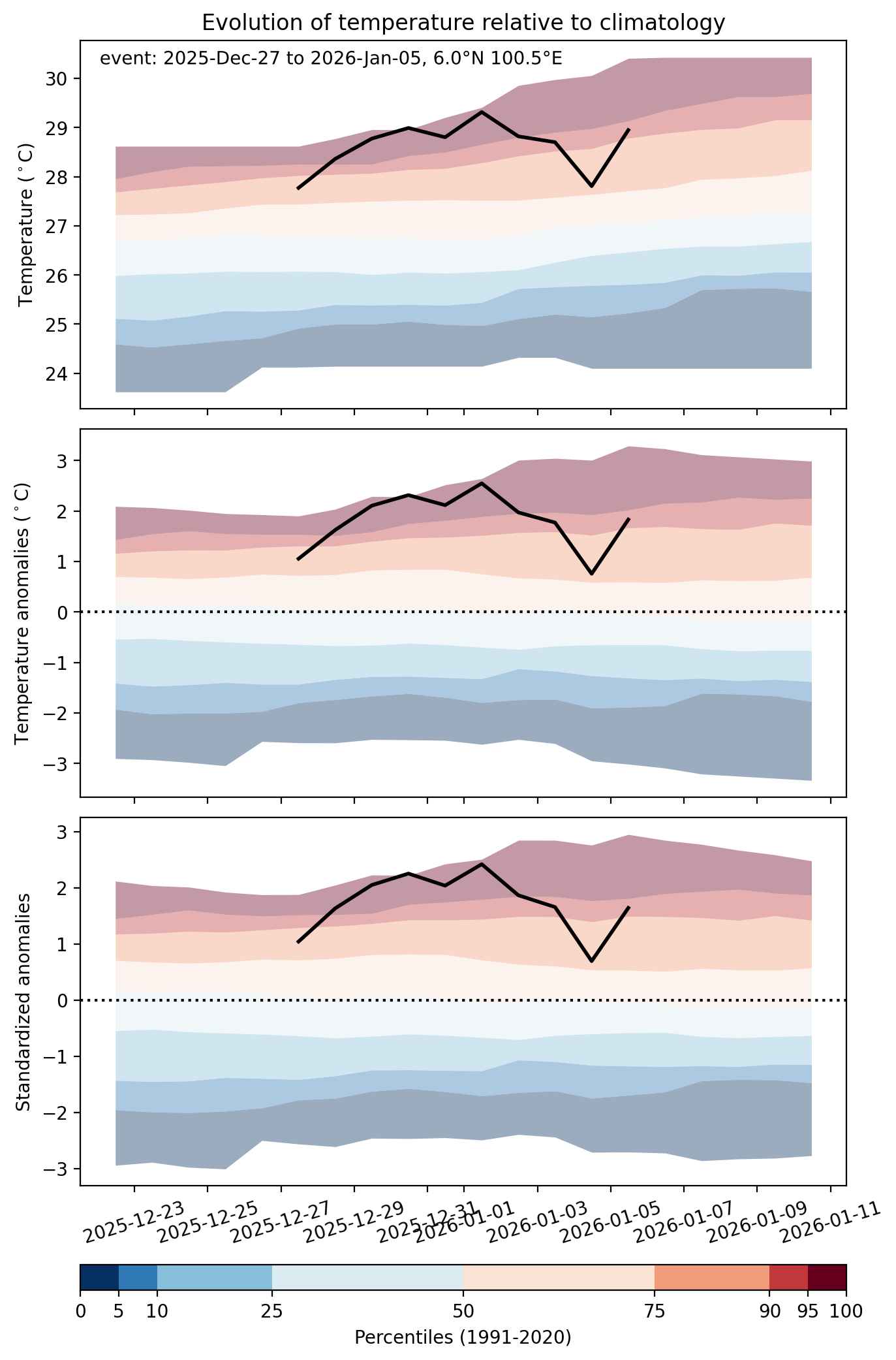
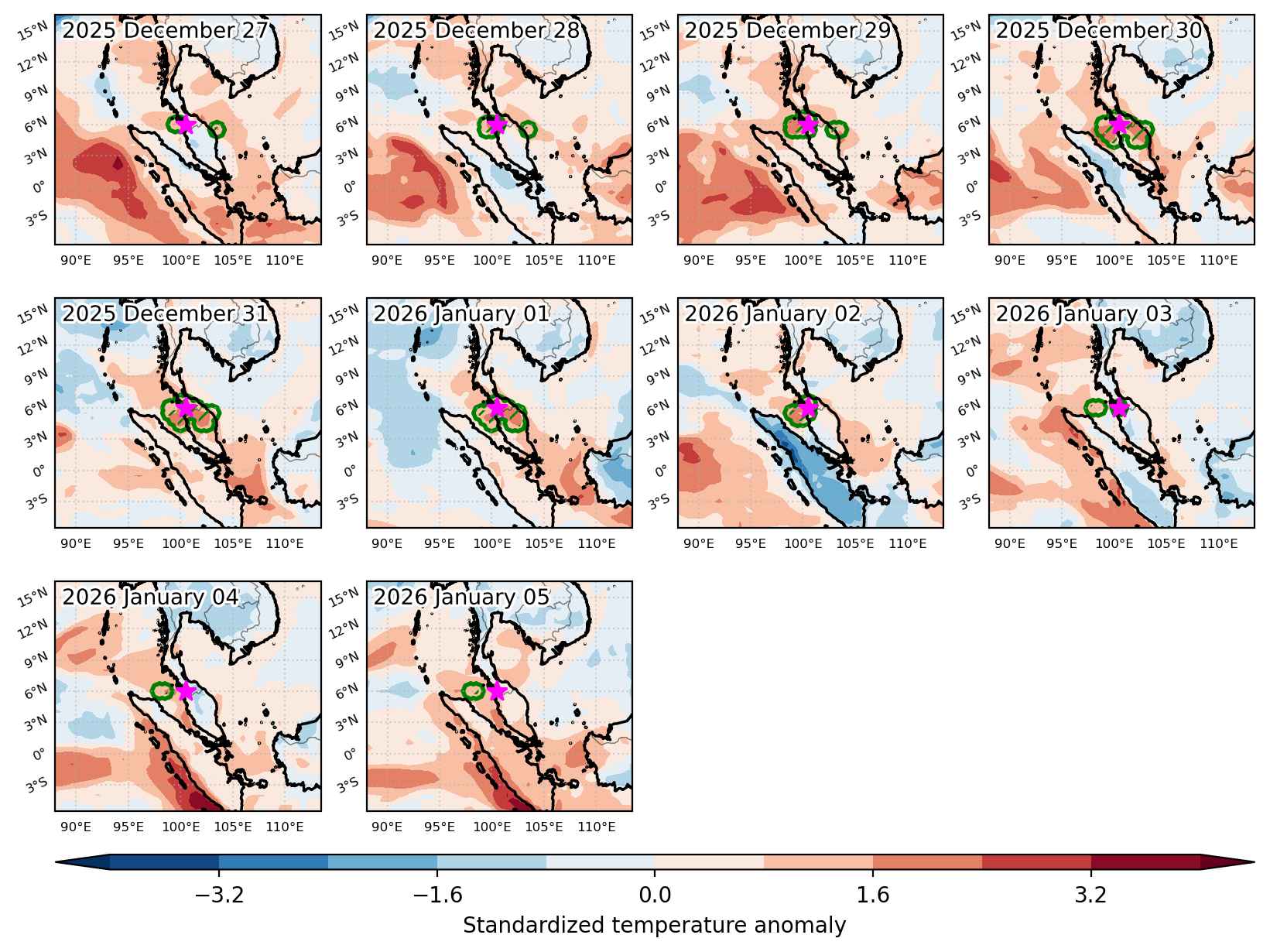
Heat wave occuring from December 27 2025 to January 05 2026 at 6.0°N 100.5°E

Download data: JSON

Event type: Heat wave

Countries affected (identified with ArcGIS Online; provided only for geographical reference):

  • Malaysia
  • Thailand

Duration: 10 days

Time span: December 27 2025 to January 05 2026

Statistics over entire affected area:

  • Mean temperature anomaly: 1.2 °C
  • Mean temperature: 27.1 °C
  • Maximum temperature anomaly: 2.5 °C
  • Maximum temperature: 29.3 °C

Event center: 6.0°N 100.5°E

Area affected: 79989 km$^2$


Fig. 1: Map of most extreme temperature anomalies (standardized) experienced during the event. The purple star indicates the center of the extreme event. Green hatching illustrates all areas under the effect of extremes at some time during the event.


Fig. 2: Evolution of temperature at the center of the event. The climatological percentile distribution is illustrated with color shadings.


Fig. 3: Maps illustrating the evolution of standardized temperature anomalies during the event.

Event ID: Heat_wave_2025-Dec-27_to_2026-Jan-05_100.5_6.0

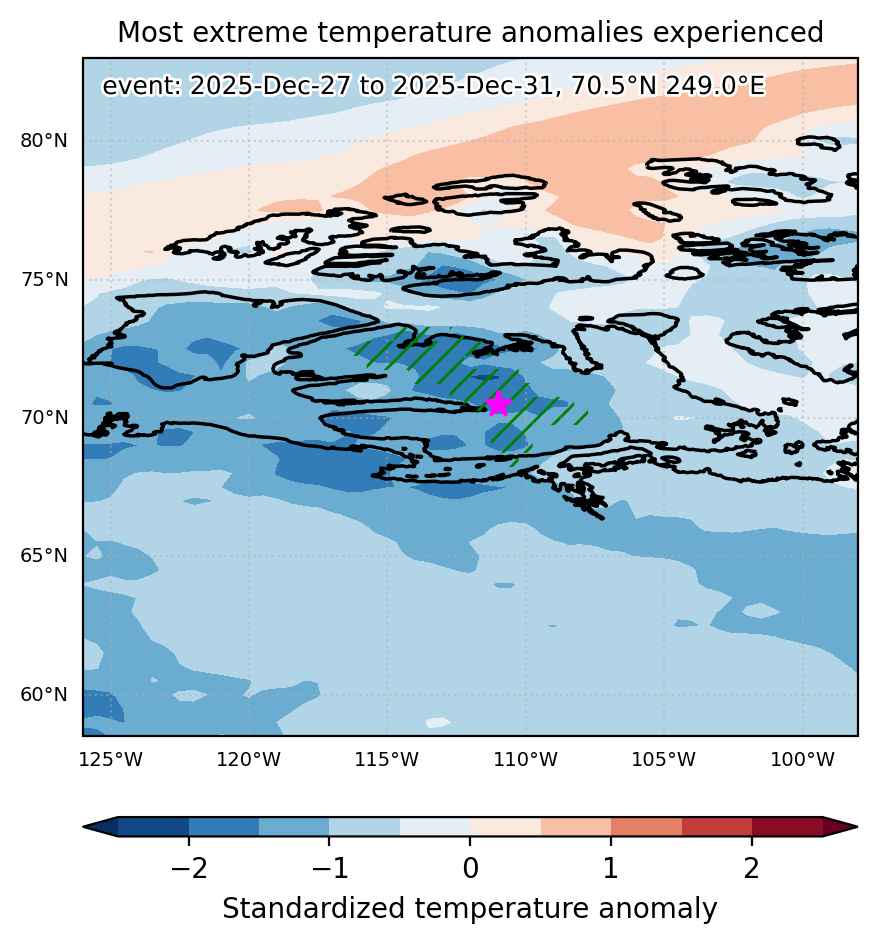
Cold spell occuring from December 27 2025 to December 31 2025 at 70.5°N 249.0°E

Download data: JSON

Event type: Cold spell

Countries affected (identified with ArcGIS Online; provided only for geographical reference):

  • Canada

Duration: 5 days

Time span: December 27 2025 to December 31 2025

Statistics over entire affected area:

  • Mean temperature anomaly: -8.7 °C
  • Mean temperature: -39.3 °C
  • Minimum temperature anomaly: -14.0 °C
  • Minimum temperature: -44.9 °C

Event center: 70.5°N 249.0°E

Area affected: 55782 km$^2$


Fig. 1: Map of most extreme temperature anomalies (standardized) experienced during the event. The purple star indicates the center of the extreme event. Green hatching illustrates all areas under the effect of extremes at some time during the event.


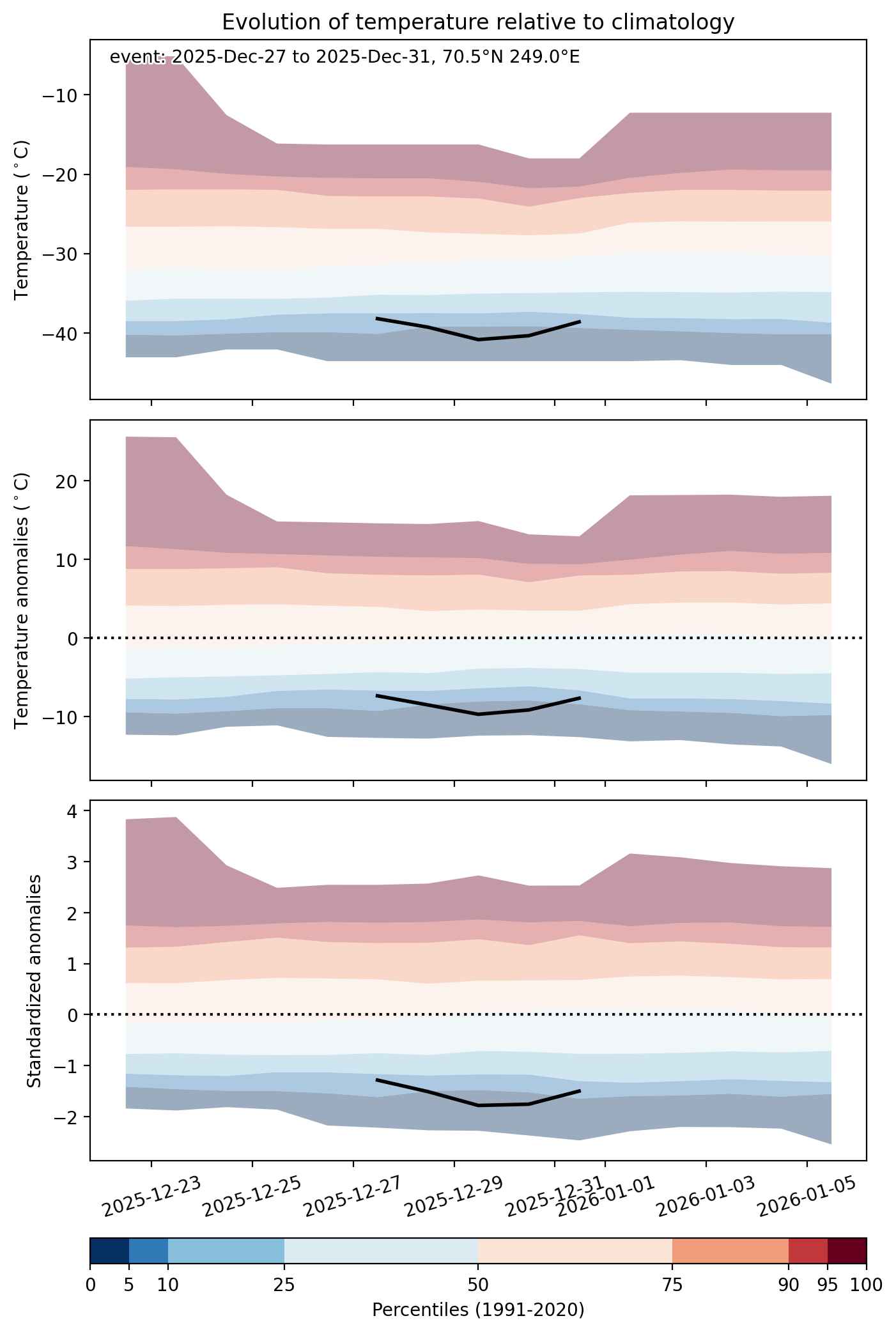
Fig. 2: Evolution of temperature at the center of the event. The climatological percentile distribution is illustrated with color shadings.


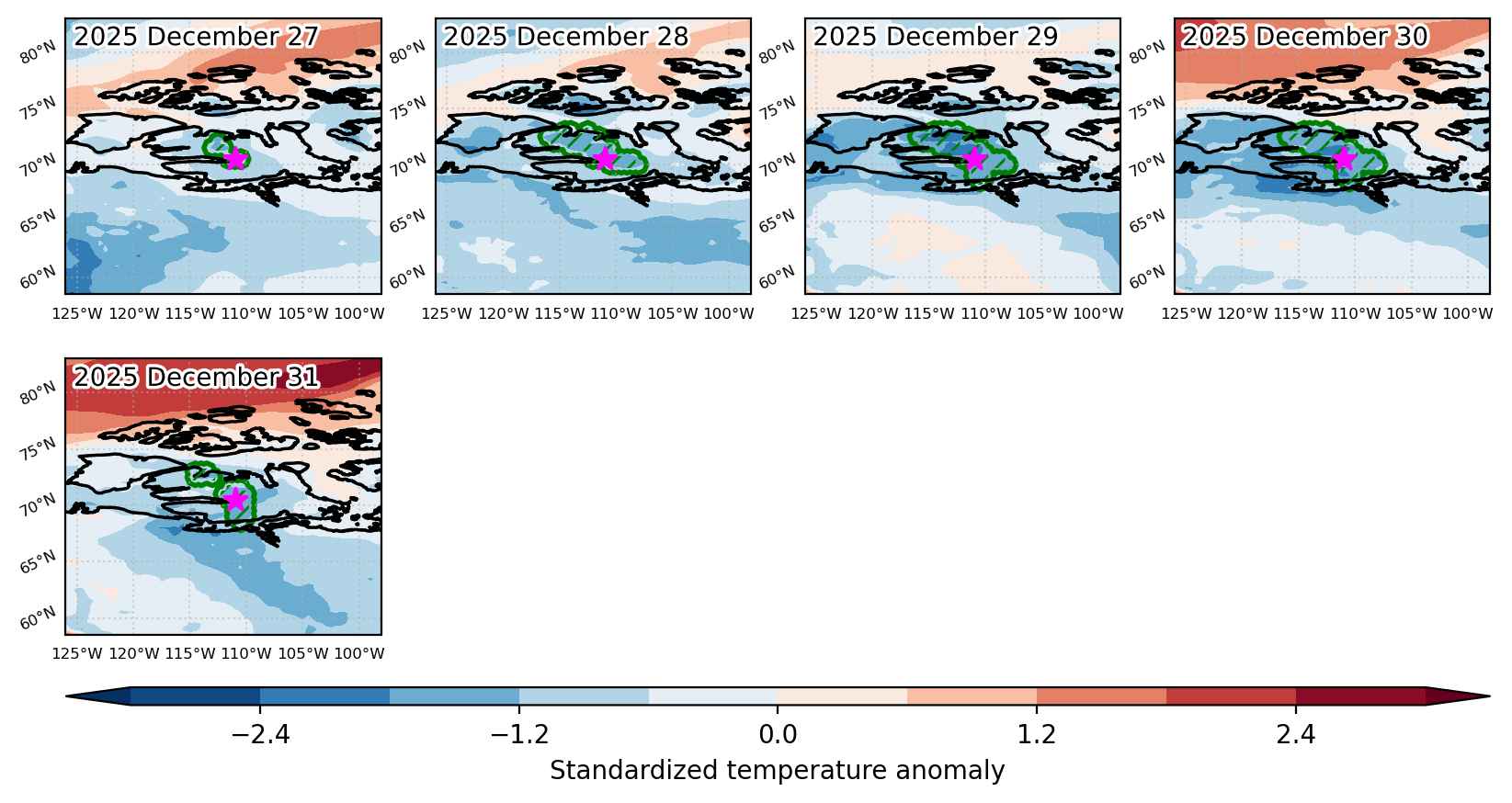
Fig. 3: Maps illustrating the evolution of standardized temperature anomalies during the event.

Event ID: Cold_spell_2025-Dec-27_to_2025-Dec-31_249.0_70.5

Heat wave occuring from December 27 2025 to January 03 2026 at -10.0°S 300.0°E

Download data: JSON

Event type: Heat wave

Countries affected (identified with ArcGIS Online; provided only for geographical reference):

  • Bolivia, Plurinational State of
  • Brazil

Duration: 8 days

Time span: December 27 2025 to January 03 2026

Statistics over entire affected area:

  • Mean temperature anomaly: 1.5 °C
  • Mean temperature: 26.9 °C
  • Maximum temperature anomaly: 2.3 °C
  • Maximum temperature: 28.7 °C

Event center: -10.0°S 300.0°E

Area affected: 263978 km$^2$


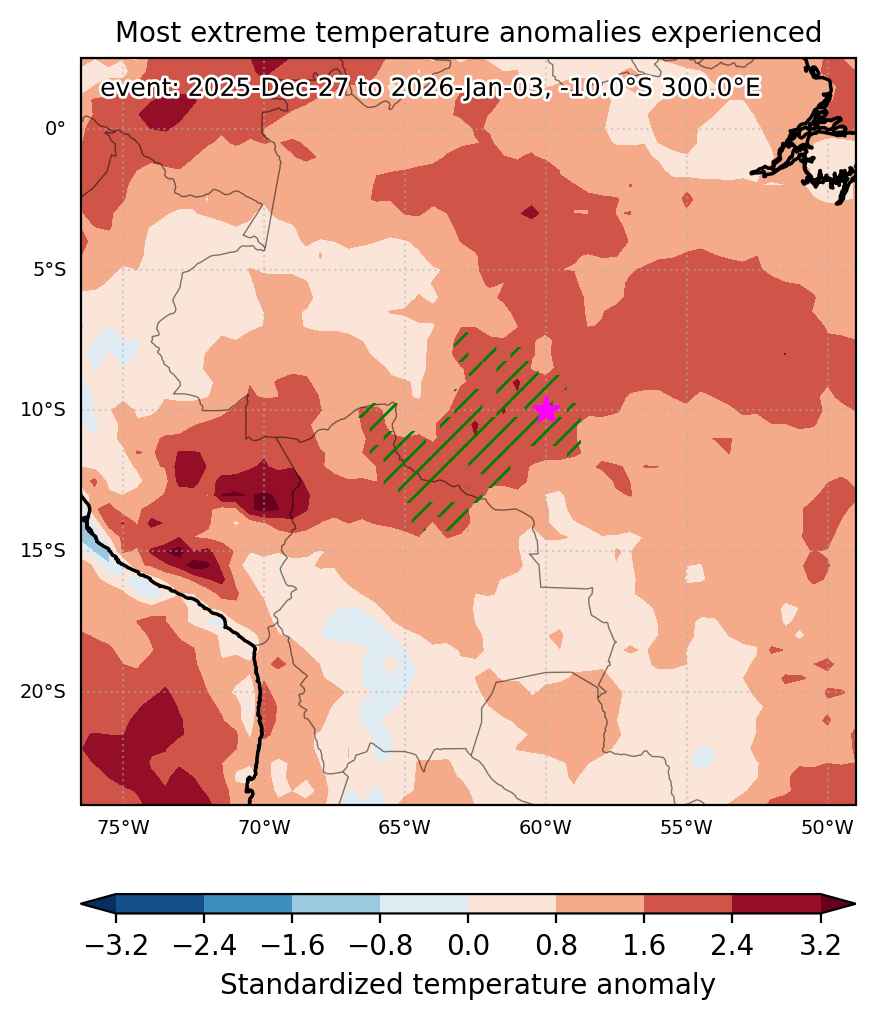
Fig. 1: Map of most extreme temperature anomalies (standardized) experienced during the event. The purple star indicates the center of the extreme event. Green hatching illustrates all areas under the effect of extremes at some time during the event.


Fig. 2: Evolution of temperature at the center of the event. The climatological percentile distribution is illustrated with color shadings.


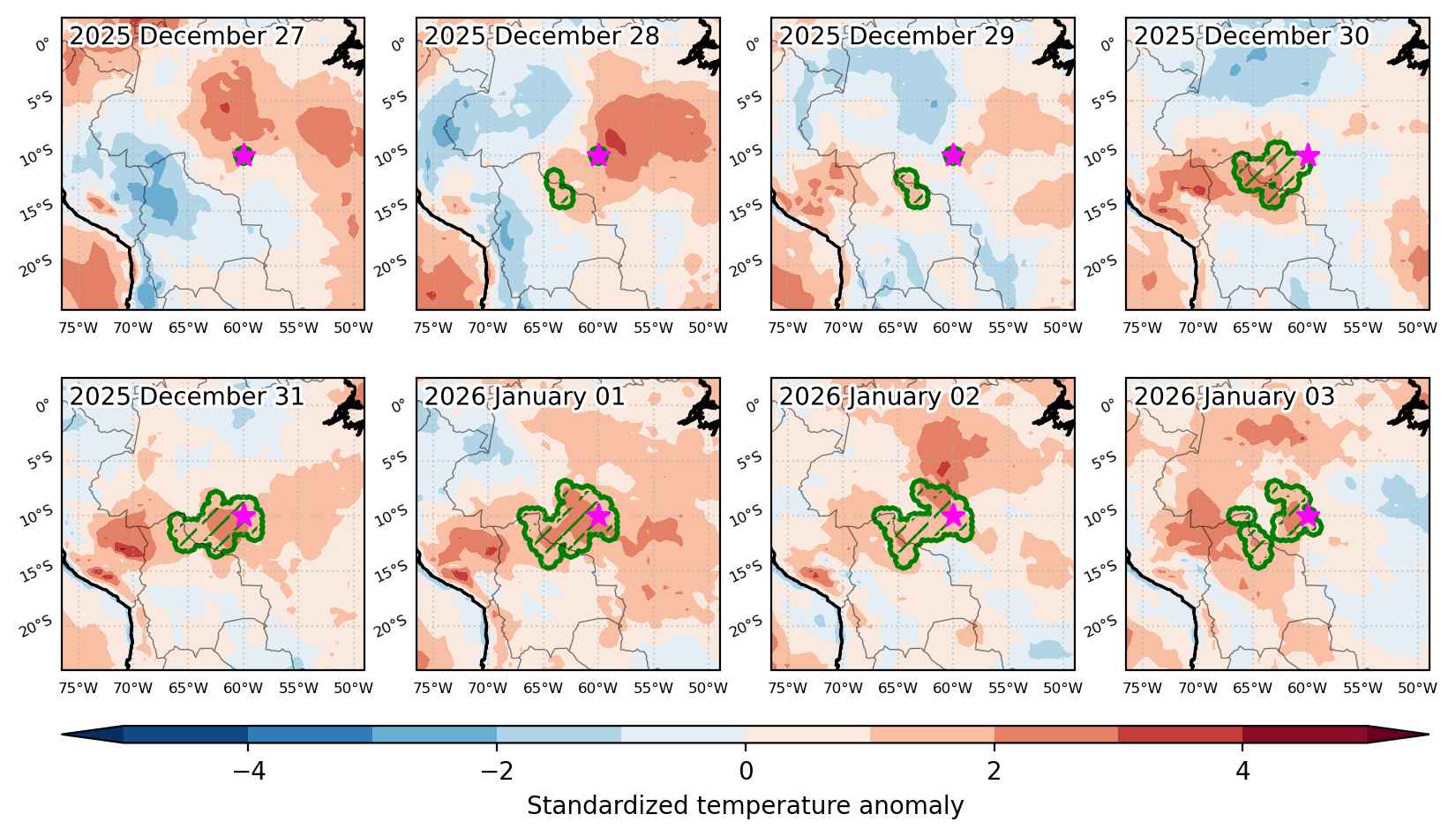
Fig. 3: Maps illustrating the evolution of standardized temperature anomalies during the event.

Event ID: Heat_wave_2025-Dec-27_to_2026-Jan-03_300.0_-10.0

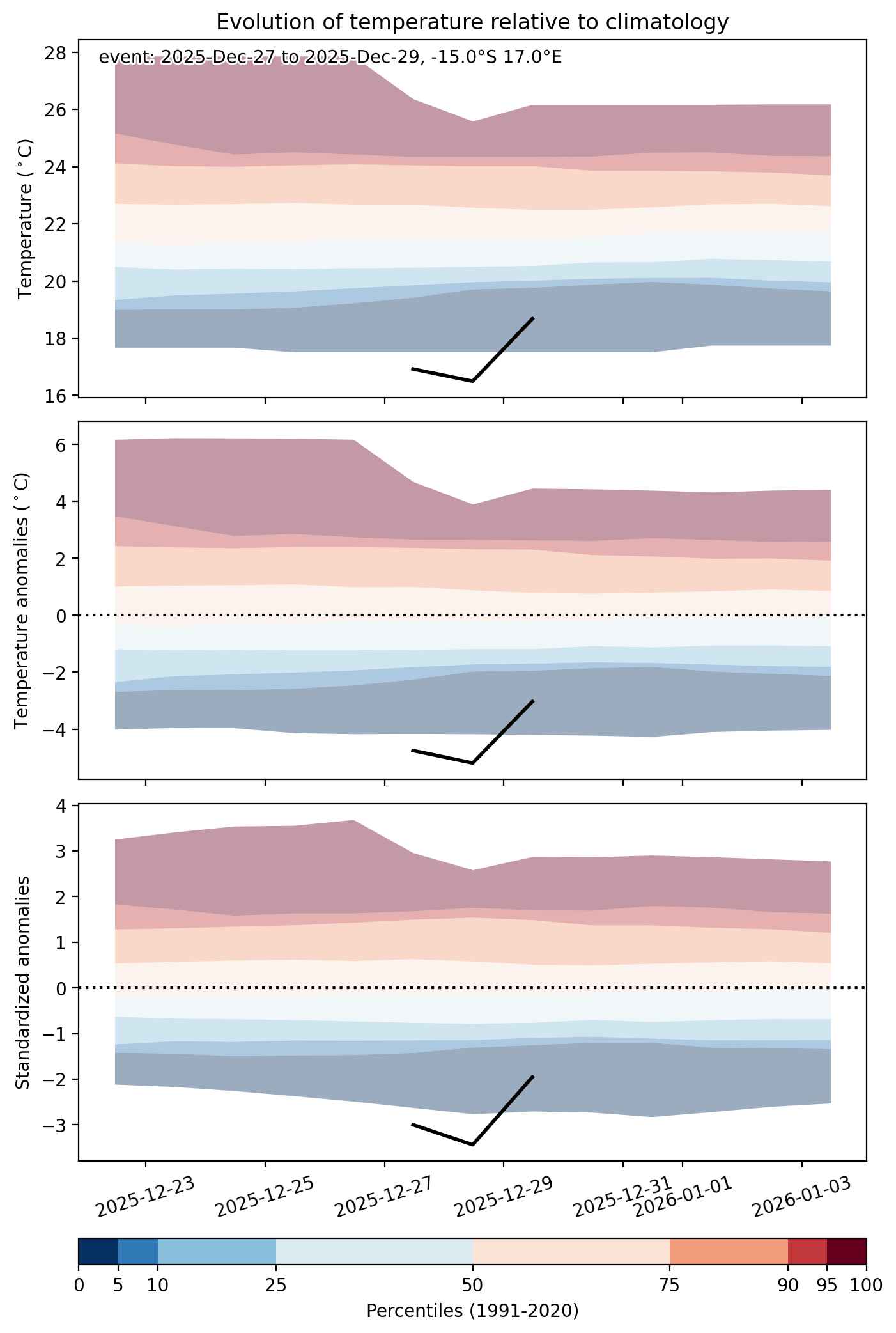
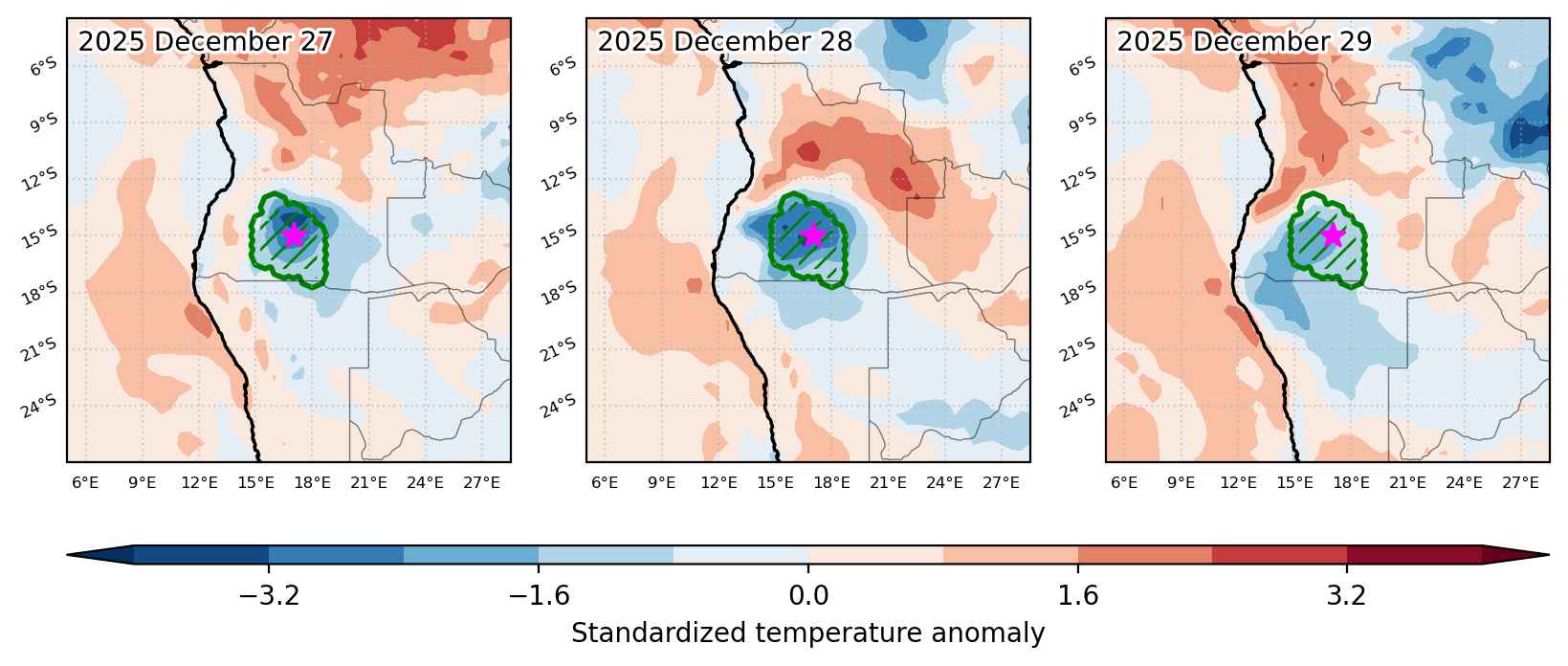
Cold spell occuring from December 27 2025 to December 29 2025 at -15.0°S 17.0°E

Download data: JSON

Event type: Cold spell

Countries affected (identified with ArcGIS Online; provided only for geographical reference):

  • Angola

Duration: 3 days

Time span: December 27 2025 to December 29 2025

Statistics over entire affected area:

  • Mean temperature anomaly: -3.8 °C
  • Mean temperature: 18.4 °C
  • Minimum temperature anomaly: -6.1 °C
  • Minimum temperature: 15.5 °C

Event center: -15.0°S 17.0°E

Area affected: 95392 km$^2$


Fig. 1: Map of most extreme temperature anomalies (standardized) experienced during the event. The purple star indicates the center of the extreme event. Green hatching illustrates all areas under the effect of extremes at some time during the event.


Fig. 2: Evolution of temperature at the center of the event. The climatological percentile distribution is illustrated with color shadings.


Fig. 3: Maps illustrating the evolution of standardized temperature anomalies during the event.

Event ID: Cold_spell_2025-Dec-27_to_2025-Dec-29_17.0_-15.0

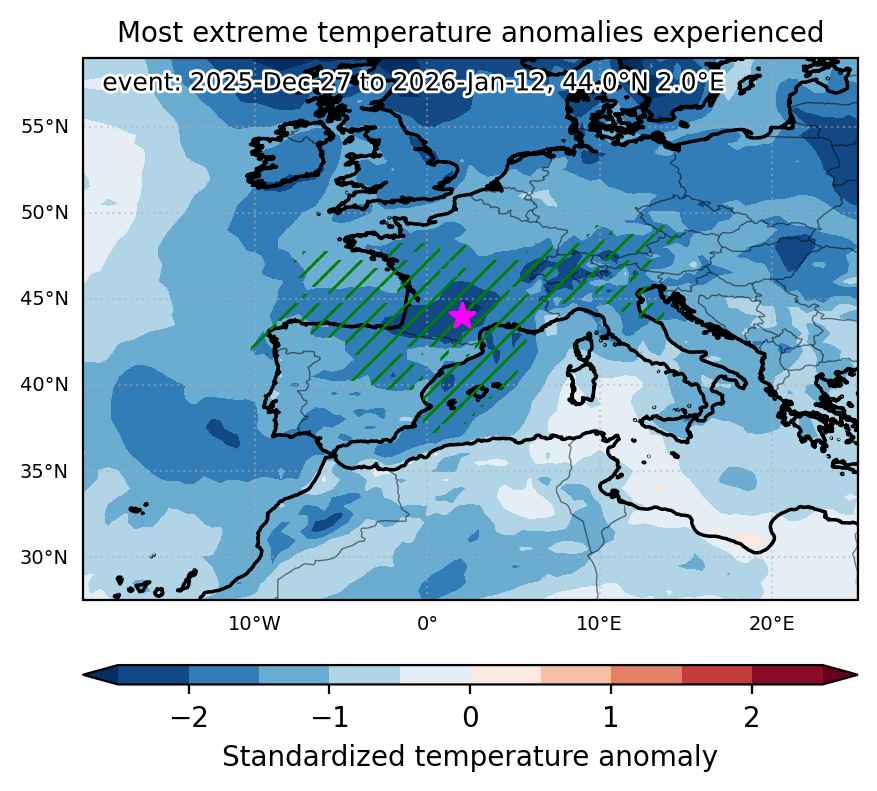
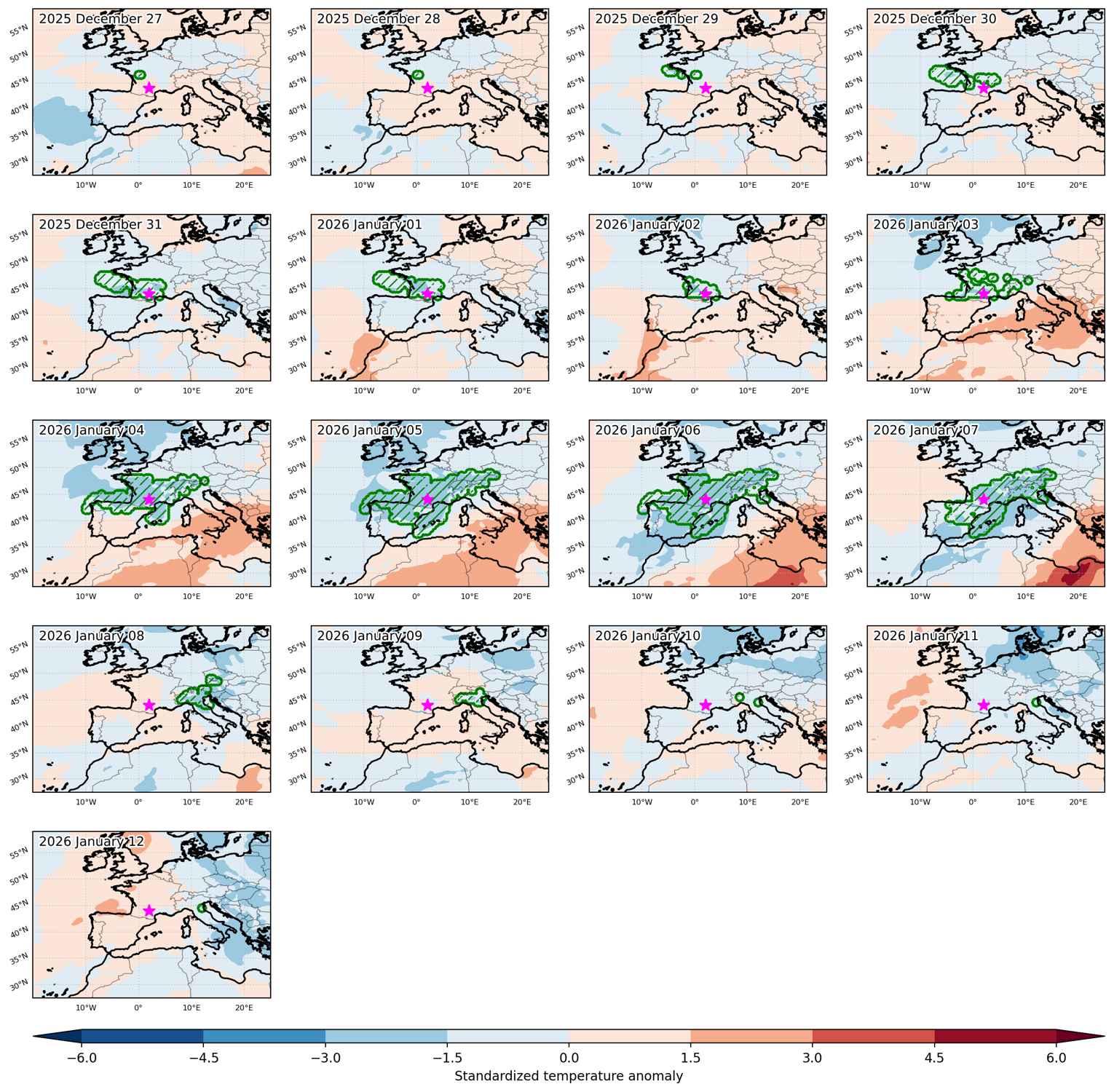
Cold spell occuring from December 27 2025 to January 12 2026 at 44.0°N 2.0°E

Download data: JSON

Event type: Cold spell

Countries affected (identified with ArcGIS Online; provided only for geographical reference):

  • Andorra
  • Austria
  • Czechia
  • France
  • Germany
  • Italy
  • Spain
  • Switzerland

Duration: 17 days

Time span: December 27 2025 to January 12 2026

Statistics over entire affected area:

  • Mean temperature anomaly: -6.3 °C
  • Mean temperature: -1.8 °C
  • Minimum temperature anomaly: -13.6 °C
  • Minimum temperature: -24.4 °C

Event center: 44.0°N 2.0°E

Area affected: 1039488 km$^2$


Fig. 1: Map of most extreme temperature anomalies (standardized) experienced during the event. The purple star indicates the center of the extreme event. Green hatching illustrates all areas under the effect of extremes at some time during the event.


Fig. 2: Evolution of temperature at the center of the event. The climatological percentile distribution is illustrated with color shadings.


Fig. 3: Maps illustrating the evolution of standardized temperature anomalies during the event.

Event ID: Cold_spell_2025-Dec-27_to_2026-Jan-12_2.0_44.0

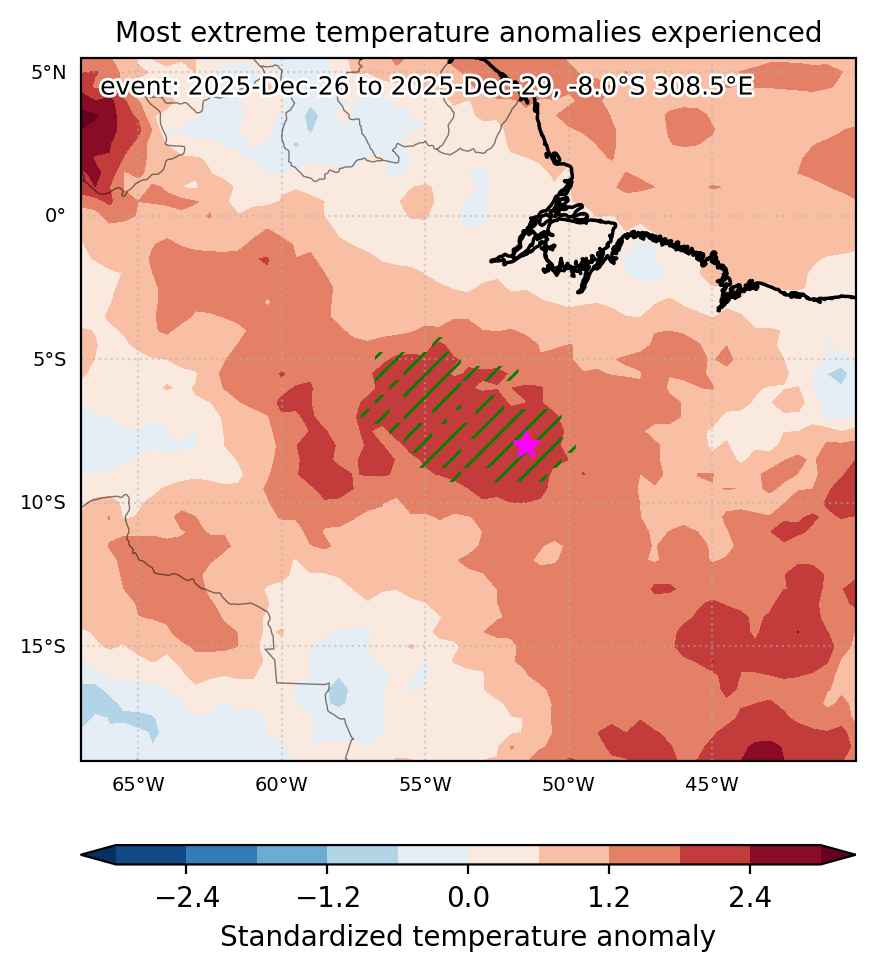
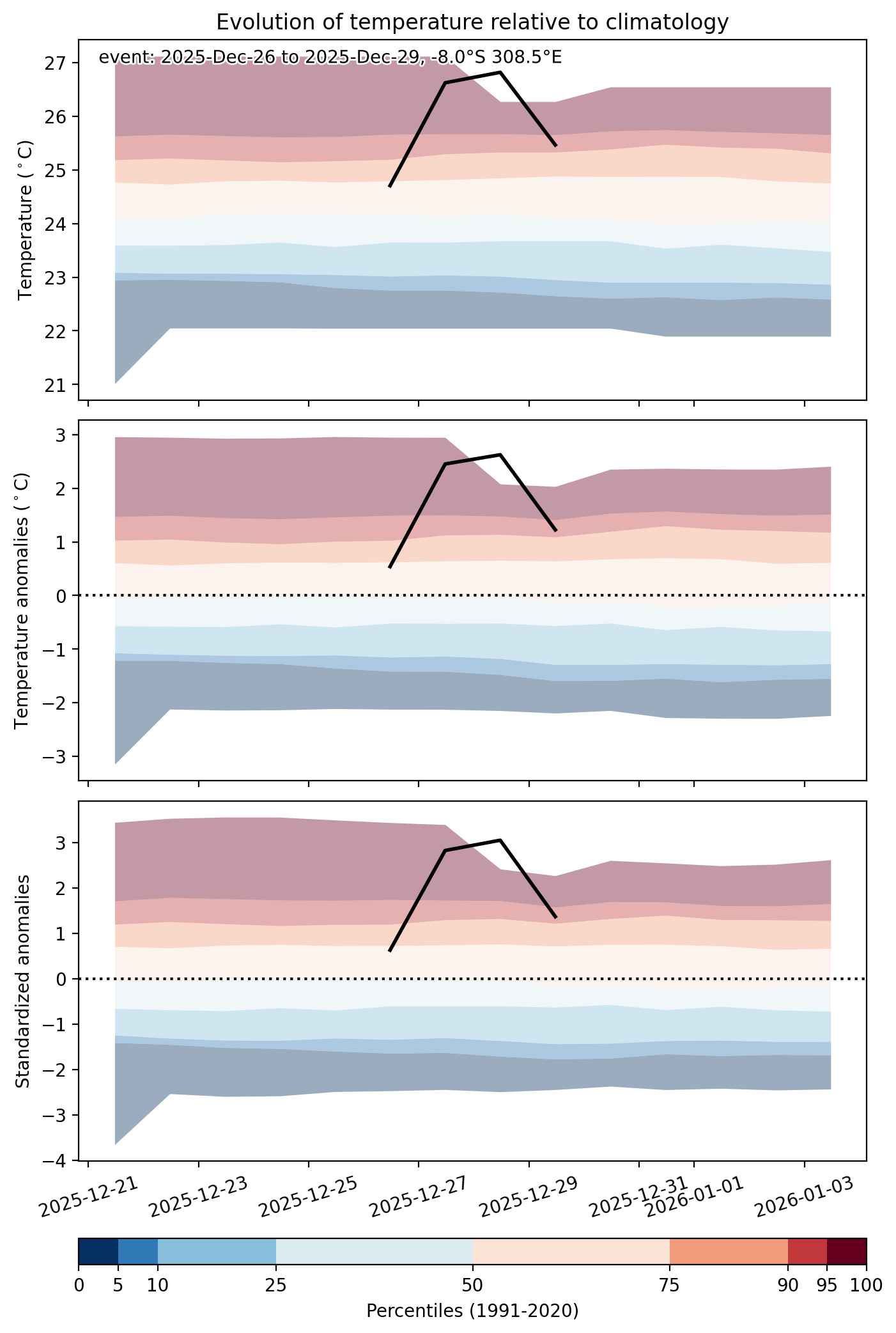
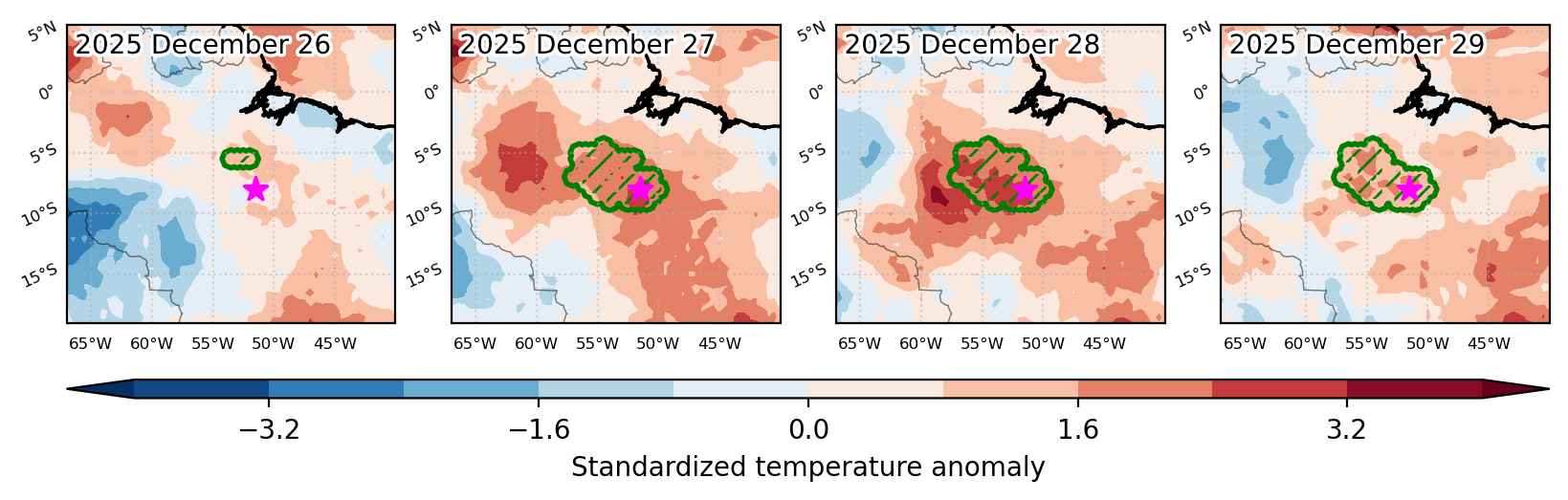
Heat wave occuring from December 26 2025 to December 29 2025 at -8.0°S 308.5°E

Download data: JSON

Event type: Heat wave

Countries affected (identified with ArcGIS Online; provided only for geographical reference):

  • Brazil

Duration: 4 days

Time span: December 26 2025 to December 29 2025

Statistics over entire affected area:

  • Mean temperature anomaly: 1.9 °C
  • Mean temperature: 26.8 °C
  • Maximum temperature anomaly: 2.9 °C
  • Maximum temperature: 28.5 °C

Event center: -8.0°S 308.5°E

Area affected: 230016 km$^2$


Fig. 1: Map of most extreme temperature anomalies (standardized) experienced during the event. The purple star indicates the center of the extreme event. Green hatching illustrates all areas under the effect of extremes at some time during the event.


Fig. 2: Evolution of temperature at the center of the event. The climatological percentile distribution is illustrated with color shadings.


Fig. 3: Maps illustrating the evolution of standardized temperature anomalies during the event.

Event ID: Heat_wave_2025-Dec-26_to_2025-Dec-29_308.5_-8.0