Heat wave occuring from April 10 2023 to April 14 2023 at 63.0°N 282.5°E

Download data: JSON

Event type: Heat wave

Countries affected (identified with ArcGIS Online; provided only for geographical reference):

  • Canada

Duration: 5 days

Time span: April 10 2023 to April 14 2023

Statistics over entire affected area:

  • Mean temperature anomaly: 7.5 °C
  • Mean temperature: -6.8 °C
  • Maximum temperature anomaly: 10.1 °C
  • Maximum temperature: -4.3 °C

Event center: 63.0°N 282.5°E

Area affected: 129793 km$^2$
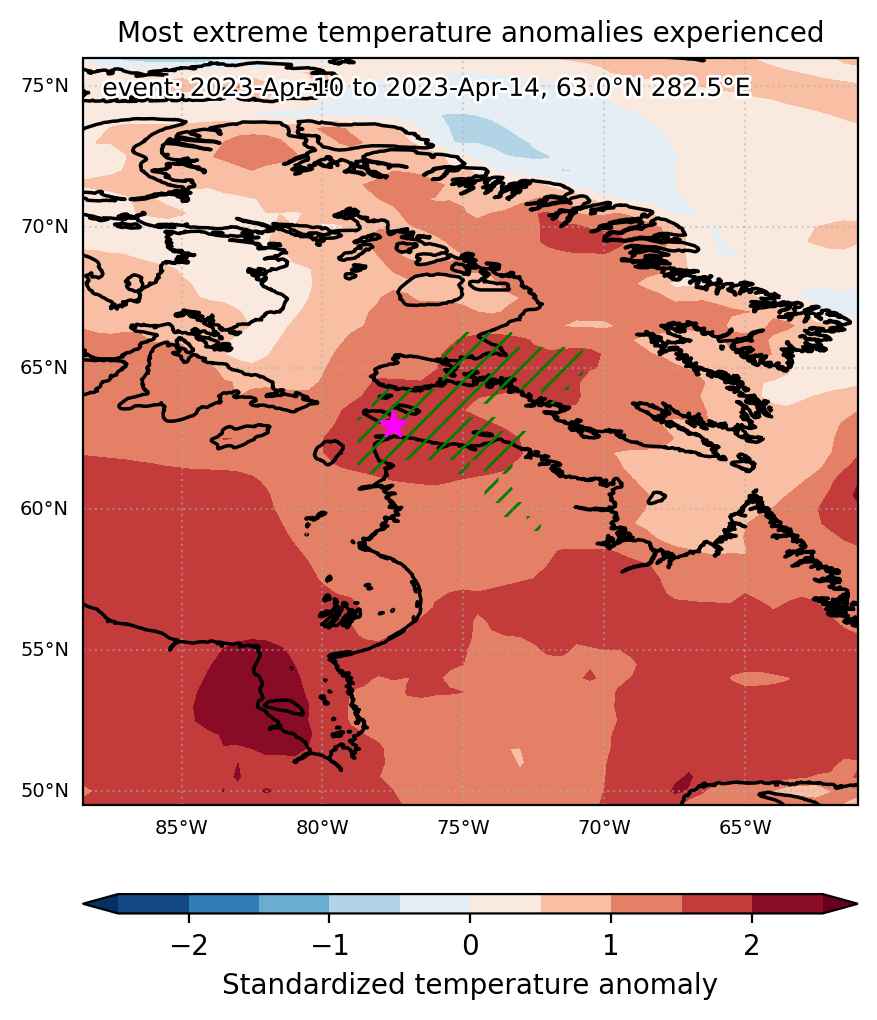

Fig. 1: Map of most extreme temperature anomalies (standardized) experienced during the event. The purple star indicates the center of the extreme event. Green hatching illustrates all areas under the effect of extremes at some time during the event.
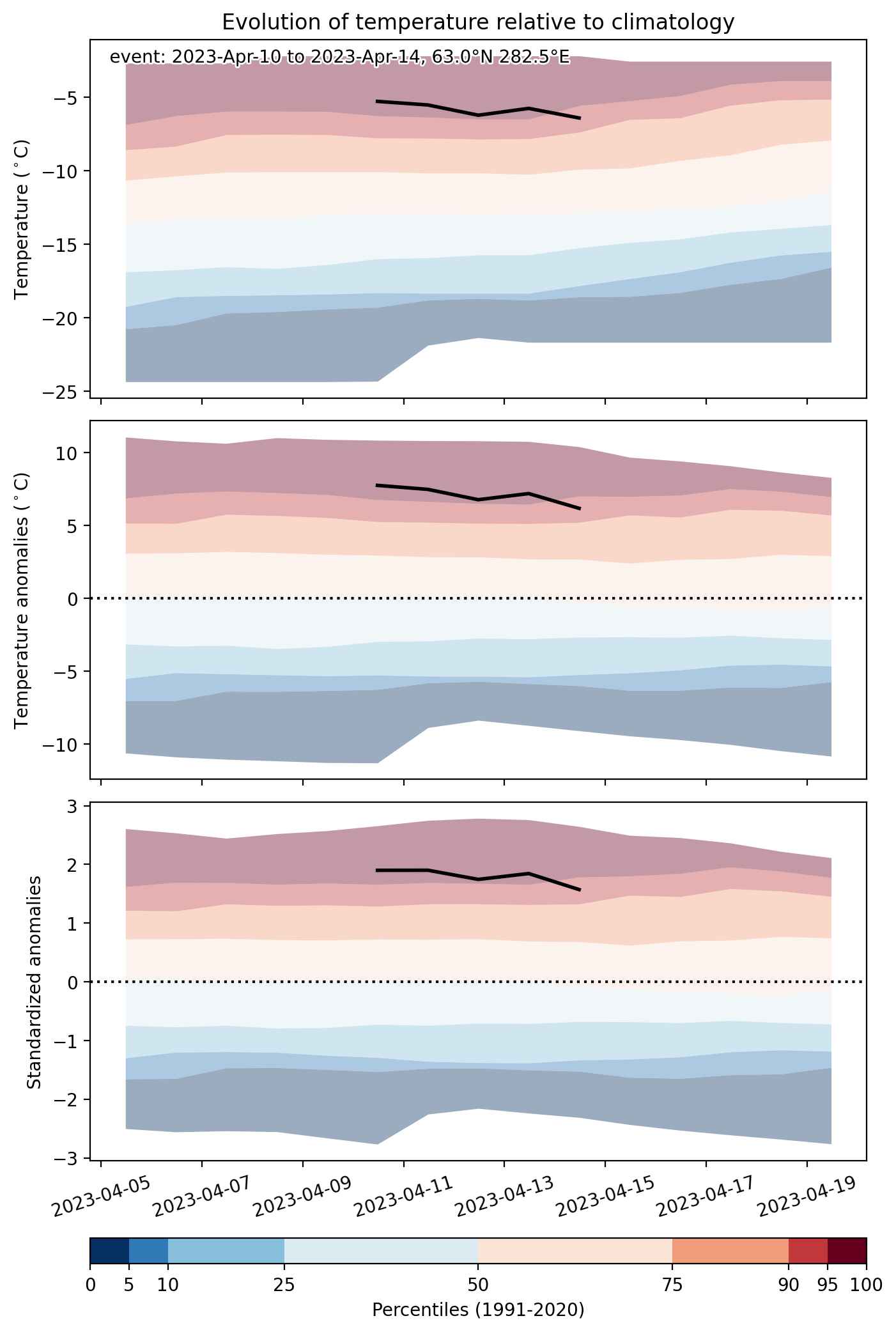


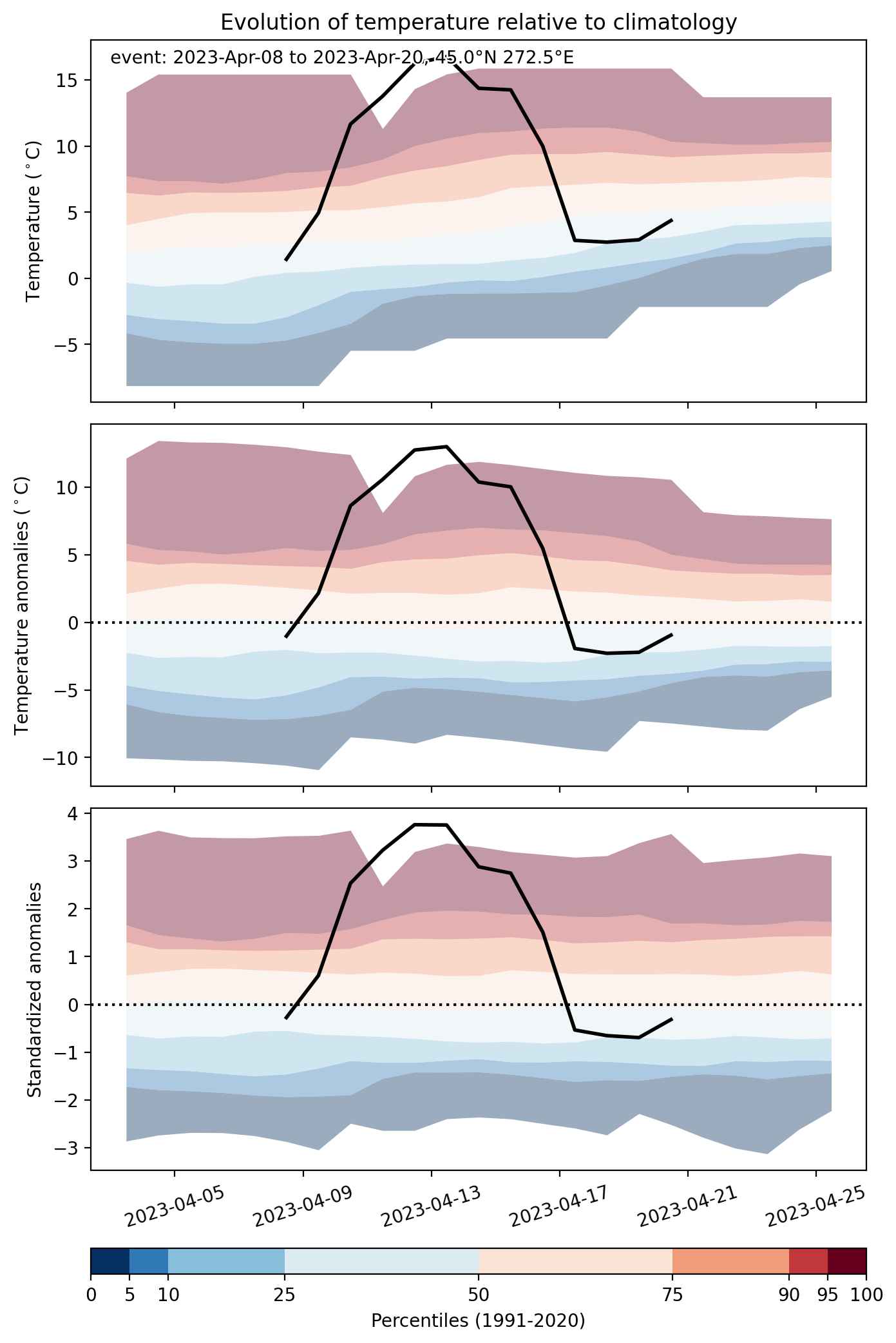
Fig. 2: Evolution of temperature at the center of the event. The climatological percentile distribution is illustrated with color shadings.
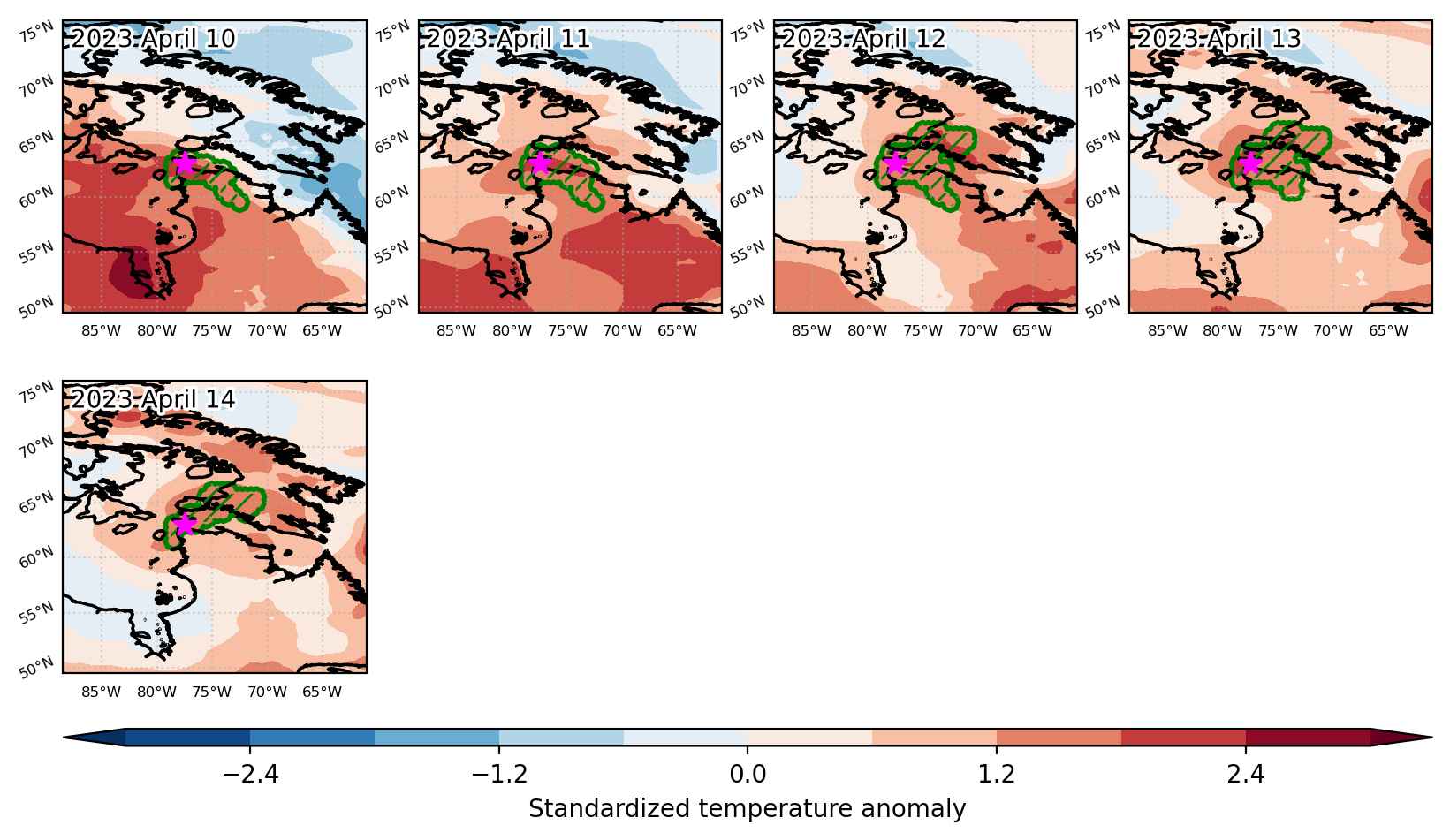


Fig. 3: Maps illustrating the evolution of standardized temperature anomalies during the event.

Event ID: Heat_wave_2023-Apr-10_to_2023-Apr-14_282.5_63.0
Heat wave occuring from April 08 2023 to April 20 2023 at 45.0°N 272.5°E

Download data: JSON

Event type: Heat wave

Countries affected (identified with ArcGIS Online; provided only for geographical reference):

  • Canada
  • Mexico
  • United States

Duration: 13 days

Time span: April 08 2023 to April 20 2023

Statistics over entire affected area:

  • Mean temperature anomaly: 8.5 °C
  • Mean temperature: 11.9 °C
  • Maximum temperature anomaly: 18.3 °C
  • Maximum temperature: 29.4 °C

Event center: 45.0°N 272.5°E

Area affected: 4905987 km$^2$


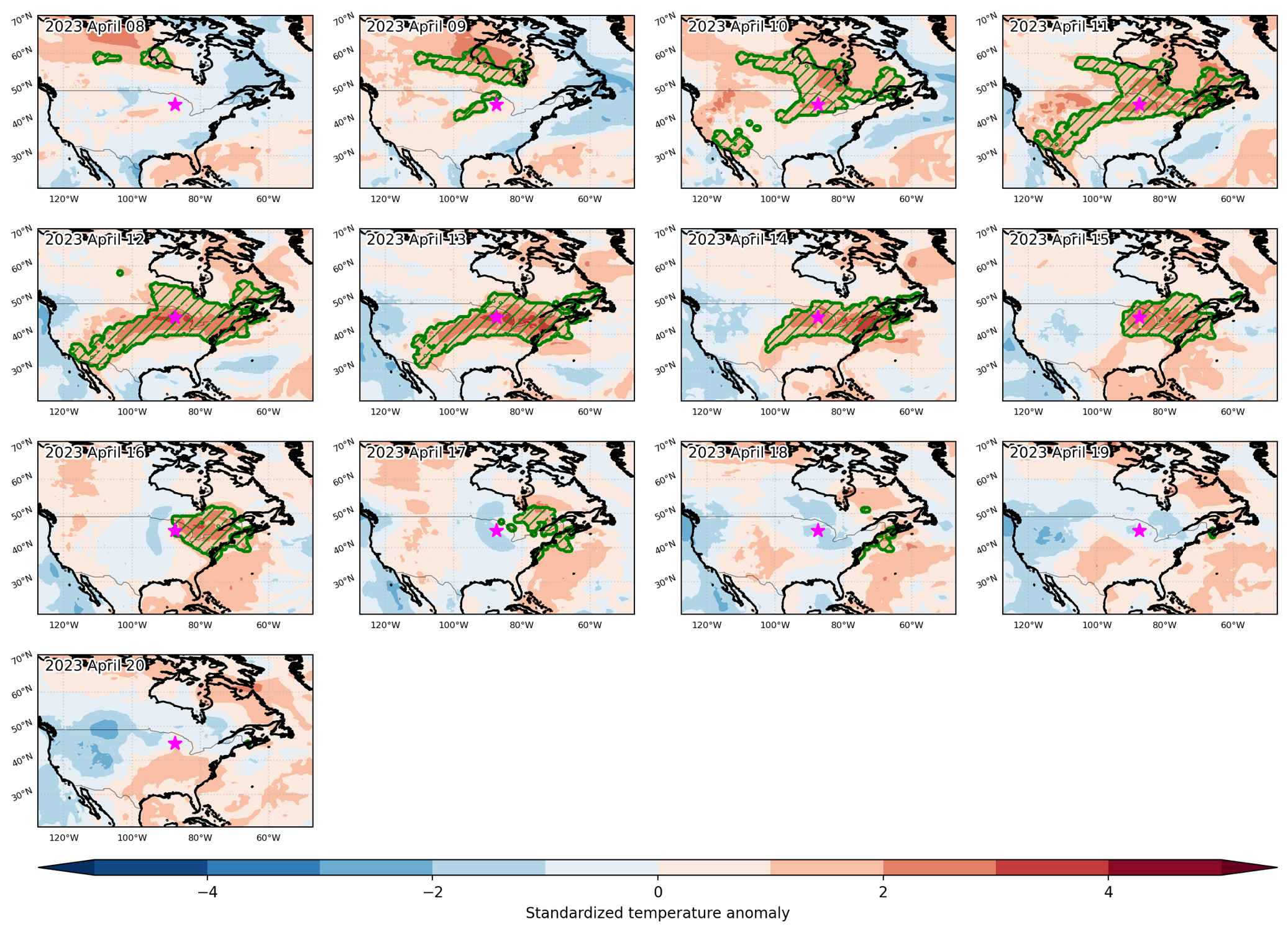
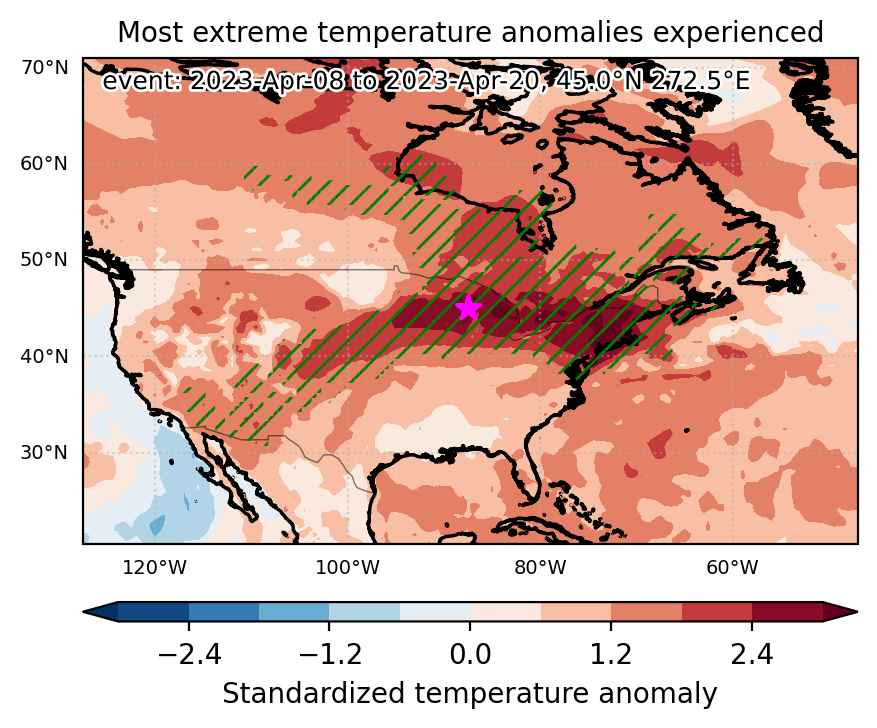
Fig. 1: Map of most extreme temperature anomalies (standardized) experienced during the event. The purple star indicates the center of the extreme event. Green hatching illustrates all areas under the effect of extremes at some time during the event.


Fig. 2: Evolution of temperature at the center of the event. The climatological percentile distribution is illustrated with color shadings.


Fig. 3: Maps illustrating the evolution of standardized temperature anomalies during the event.

Event ID: Heat_wave_2023-Apr-08_to_2023-Apr-20_272.5_45.0

Heat wave occuring from April 06 2023 to April 09 2023 at 67.0°N 259.0°E

Download data: JSON

Event type: Heat wave

Countries affected (identified with ArcGIS Online; provided only for geographical reference):

  • Canada

Duration: 4 days

Time span: April 06 2023 to April 09 2023

Statistics over entire affected area:

  • Mean temperature anomaly: 11.1 °C
  • Mean temperature: -5.3 °C
  • Maximum temperature anomaly: 15.7 °C
  • Maximum temperature: 4.1 °C

Event center: 67.0°N 259.0°E

Area affected: 113431 km$^2$


Fig. 1: Map of most extreme temperature anomalies (standardized) experienced during the event. The purple star indicates the center of the extreme event. Green hatching illustrates all areas under the effect of extremes at some time during the event.


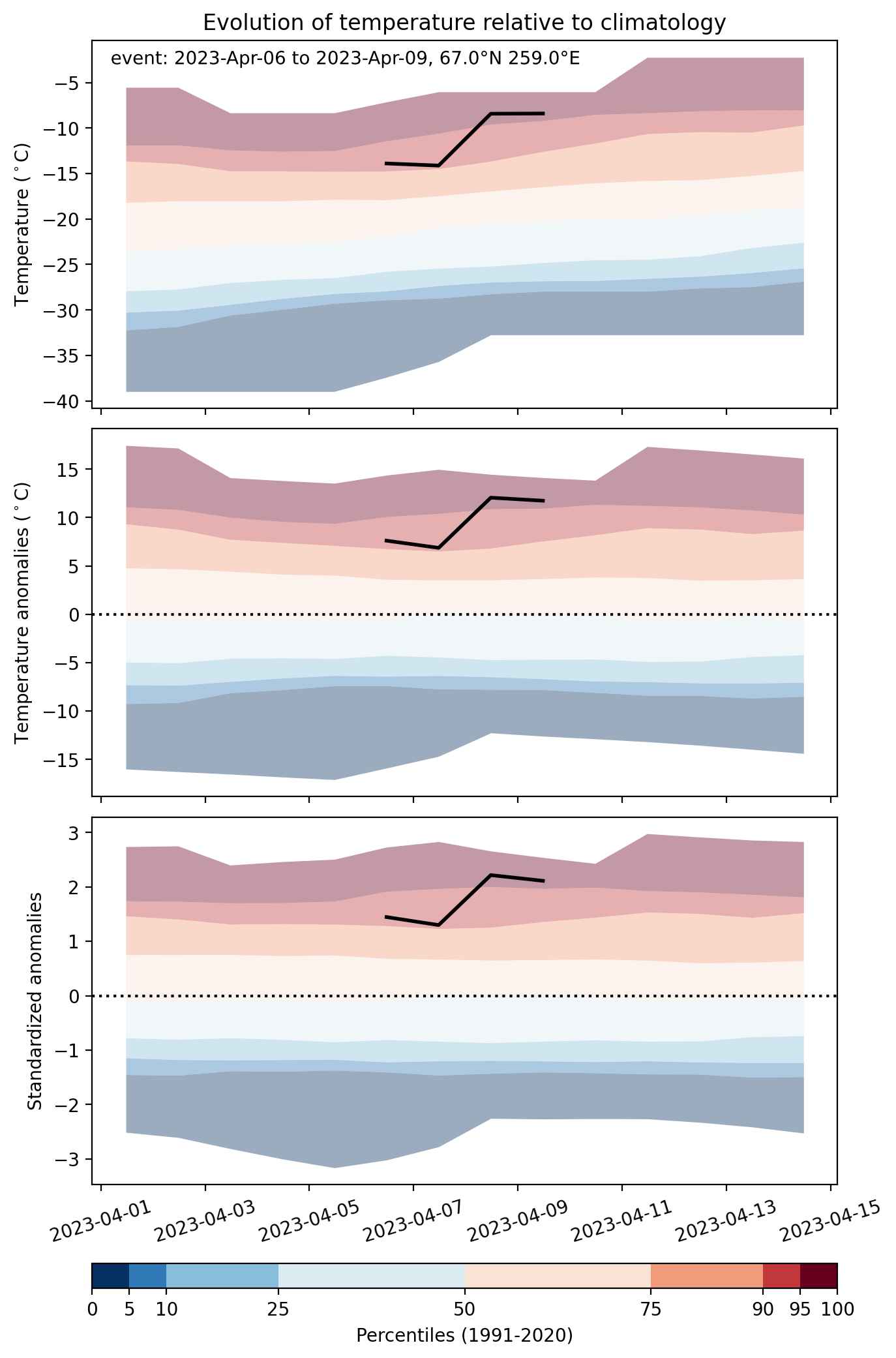
Fig. 2: Evolution of temperature at the center of the event. The climatological percentile distribution is illustrated with color shadings.


Fig. 3: Maps illustrating the evolution of standardized temperature anomalies during the event.

Event ID: Heat_wave_2023-Apr-06_to_2023-Apr-09_259.0_67.0

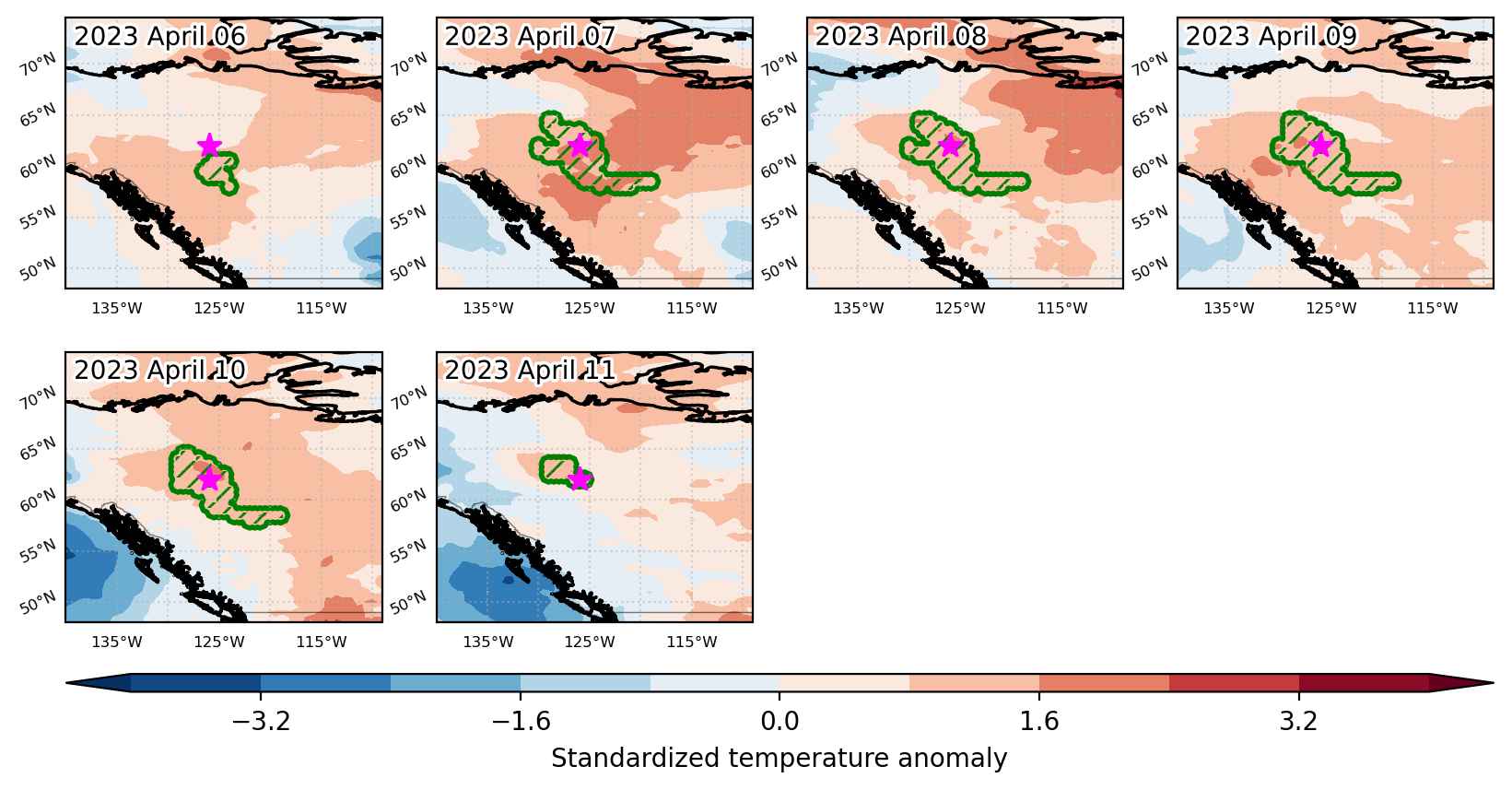
Heat wave occuring from April 06 2023 to April 11 2023 at 62.0°N 234.0°E

Download data: JSON

Event type: Heat wave

Countries affected (identified with ArcGIS Online; provided only for geographical reference):

  • Canada

Duration: 6 days

Time span: April 06 2023 to April 11 2023

Statistics over entire affected area:

  • Mean temperature anomaly: 6.3 °C
  • Mean temperature: 0.3 °C
  • Maximum temperature anomaly: 9.1 °C
  • Maximum temperature: 8.6 °C

Event center: 62.0°N 234.0°E

Area affected: 148118 km$^2$


Fig. 1: Map of most extreme temperature anomalies (standardized) experienced during the event. The purple star indicates the center of the extreme event. Green hatching illustrates all areas under the effect of extremes at some time during the event.


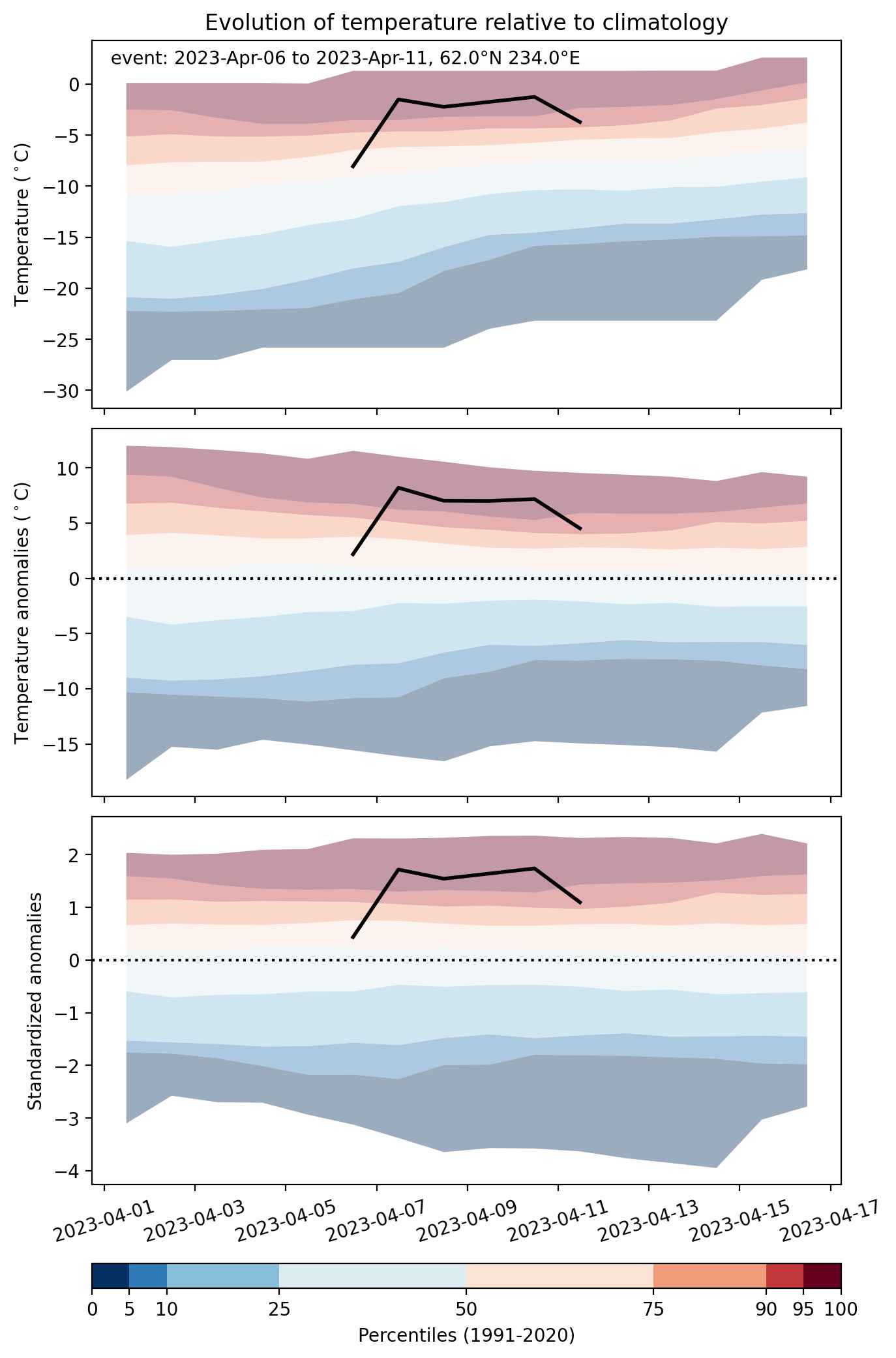
Fig. 2: Evolution of temperature at the center of the event. The climatological percentile distribution is illustrated with color shadings.


Fig. 3: Maps illustrating the evolution of standardized temperature anomalies during the event.

Event ID: Heat_wave_2023-Apr-06_to_2023-Apr-11_234.0_62.0

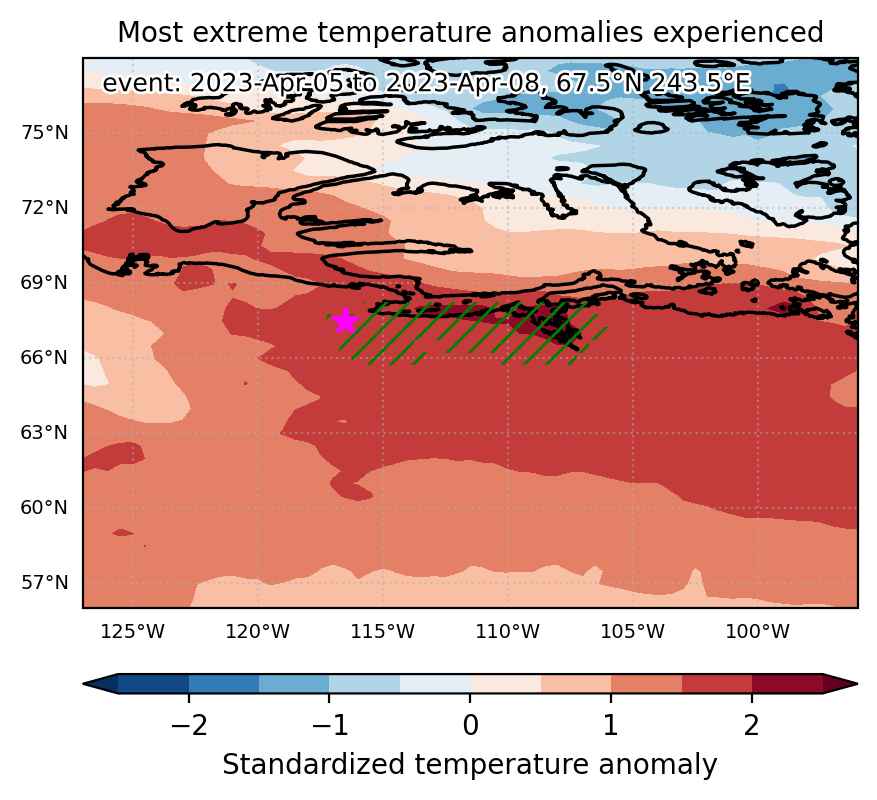
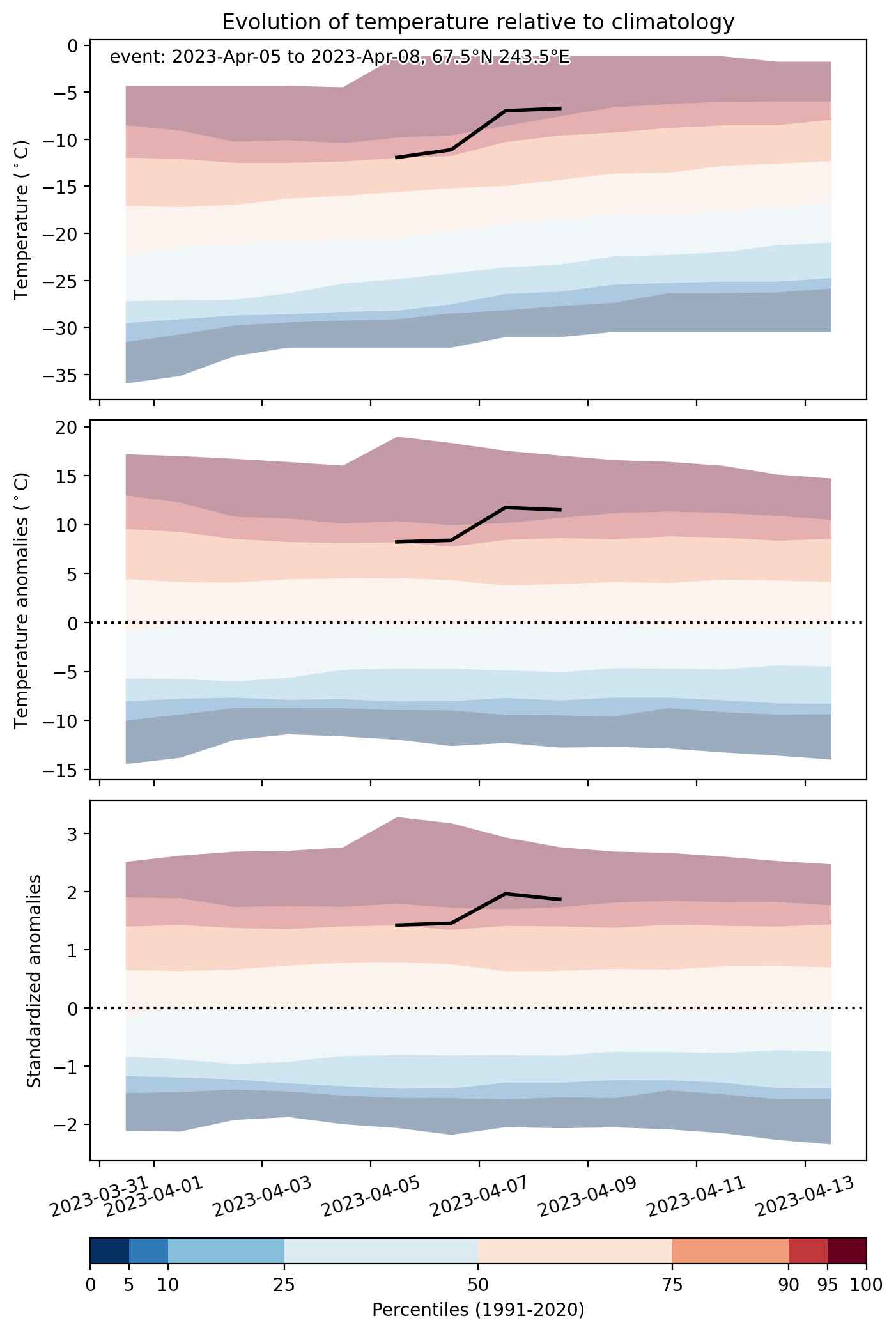
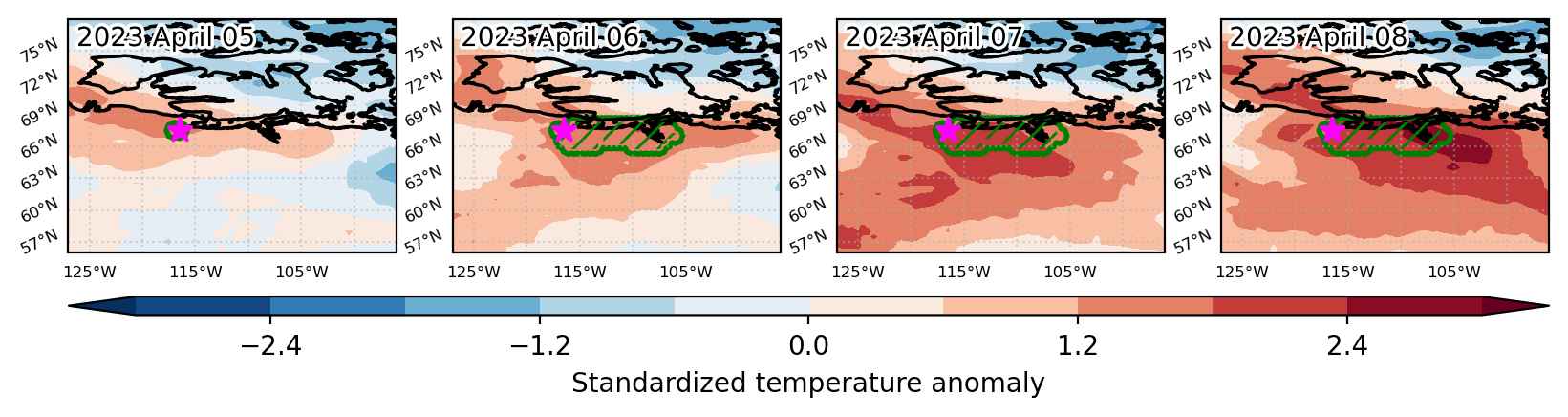
Heat wave occuring from April 05 2023 to April 08 2023 at 67.5°N 243.5°E

Download data: JSON

Event type: Heat wave

Countries affected (identified with ArcGIS Online; provided only for geographical reference):

  • Canada

Duration: 4 days

Time span: April 05 2023 to April 08 2023

Statistics over entire affected area:

  • Mean temperature anomaly: 10.9 °C
  • Mean temperature: -7.2 °C
  • Maximum temperature anomaly: 15.5 °C
  • Maximum temperature: -2.3 °C

Event center: 67.5°N 243.5°E

Area affected: 110711 km$^2$


Fig. 1: Map of most extreme temperature anomalies (standardized) experienced during the event. The purple star indicates the center of the extreme event. Green hatching illustrates all areas under the effect of extremes at some time during the event.


Fig. 2: Evolution of temperature at the center of the event. The climatological percentile distribution is illustrated with color shadings.


Fig. 3: Maps illustrating the evolution of standardized temperature anomalies during the event.

Event ID: Heat_wave_2023-Apr-05_to_2023-Apr-08_243.5_67.5

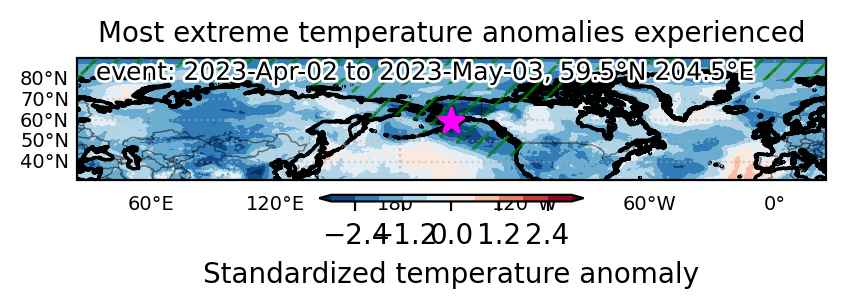
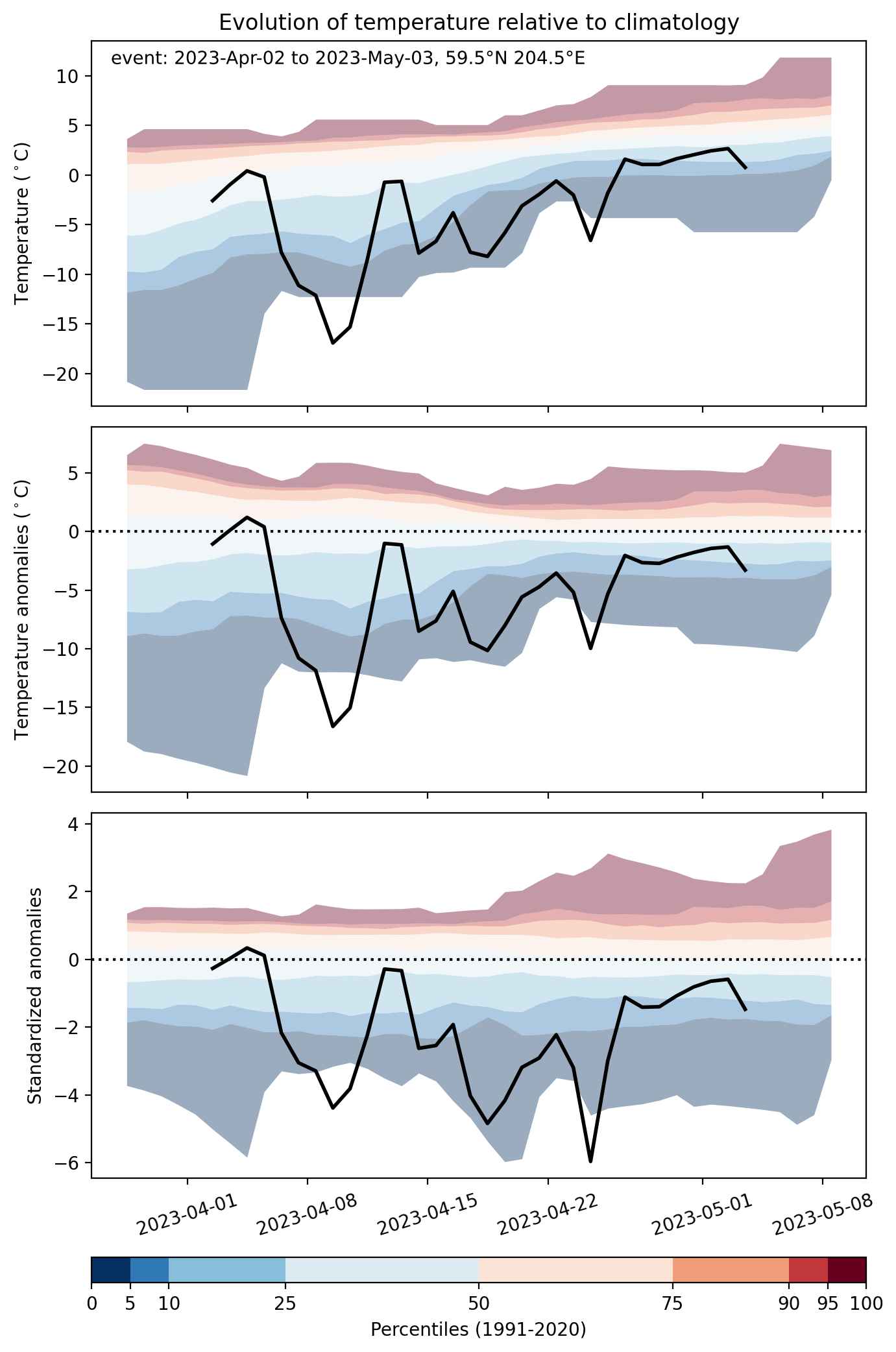
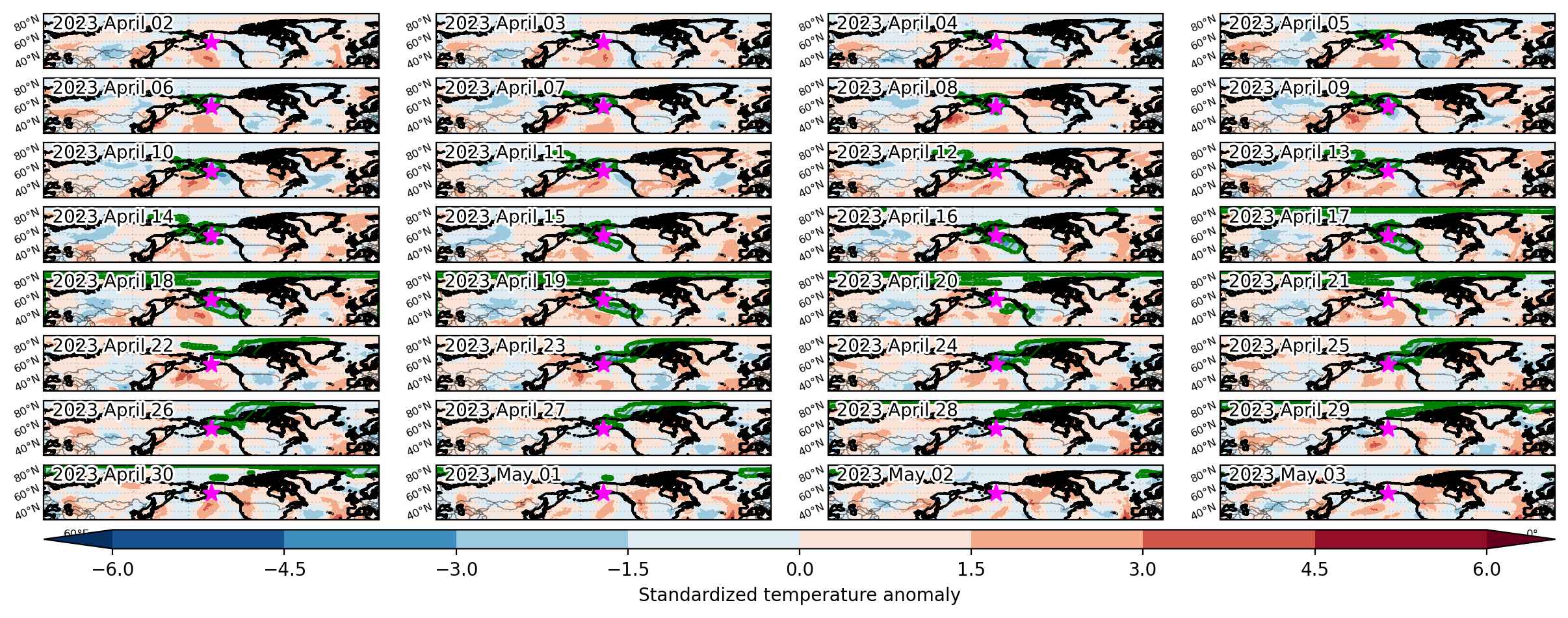
Cold spell occuring from April 02 2023 to May 03 2023 at 59.5°N 204.5°E

Download data: JSON

Event type: Cold spell

Countries affected (identified with ArcGIS Online; provided only for geographical reference):

  • Canada
  • Russian Federation
  • Svalbard and Jan Mayen
  • United States

Duration: 32 days

Time span: April 02 2023 to May 03 2023

Statistics over entire affected area:

  • Mean temperature anomaly: -6.8 °C
  • Mean temperature: -18.7 °C
  • Minimum temperature anomaly: -25.9 °C
  • Minimum temperature: -37.5 °C

Event center: 59.5°N 204.5°E

Area affected: 11288963 km$^2$


Fig. 1: Map of most extreme temperature anomalies (standardized) experienced during the event. The purple star indicates the center of the extreme event. Green hatching illustrates all areas under the effect of extremes at some time during the event.


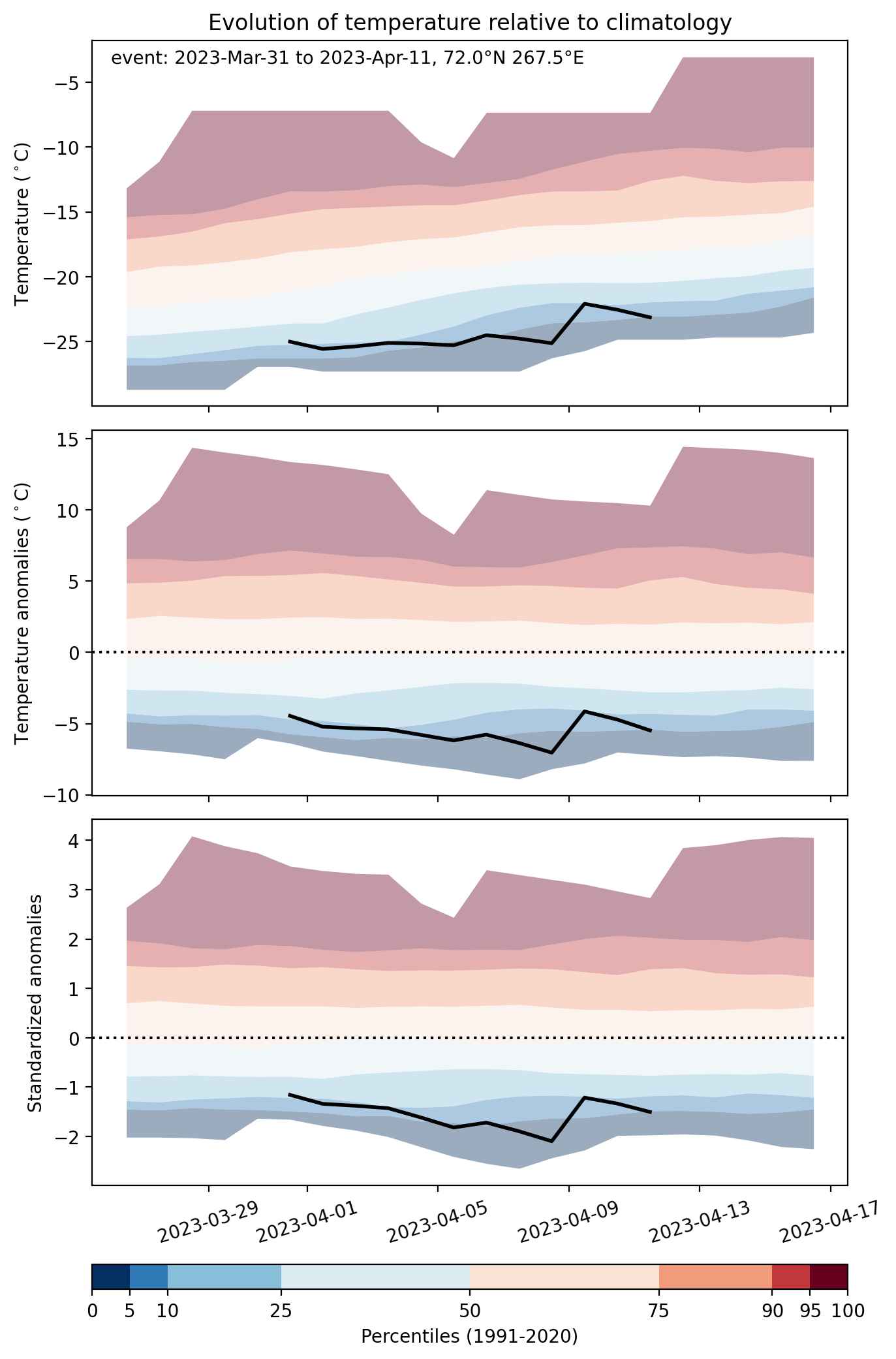
Fig. 2: Evolution of temperature at the center of the event. The climatological percentile distribution is illustrated with color shadings.


Fig. 3: Maps illustrating the evolution of standardized temperature anomalies during the event.

Event ID: Cold_spell_2023-Apr-02_to_2023-May-03_204.5_59.5

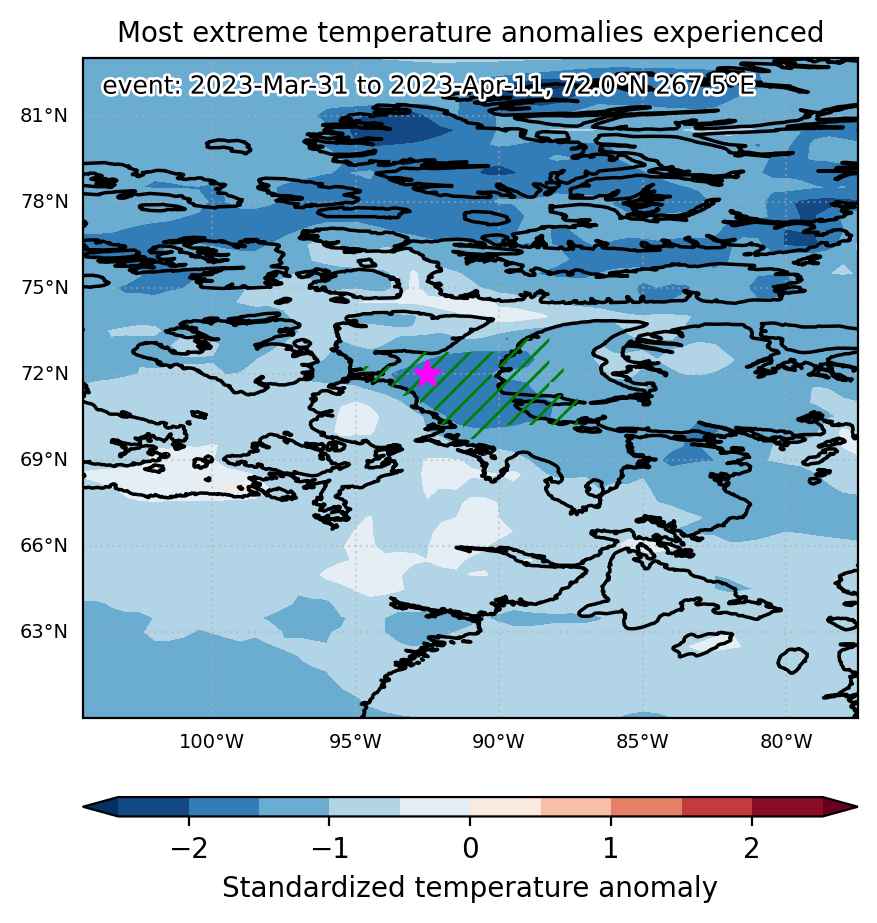
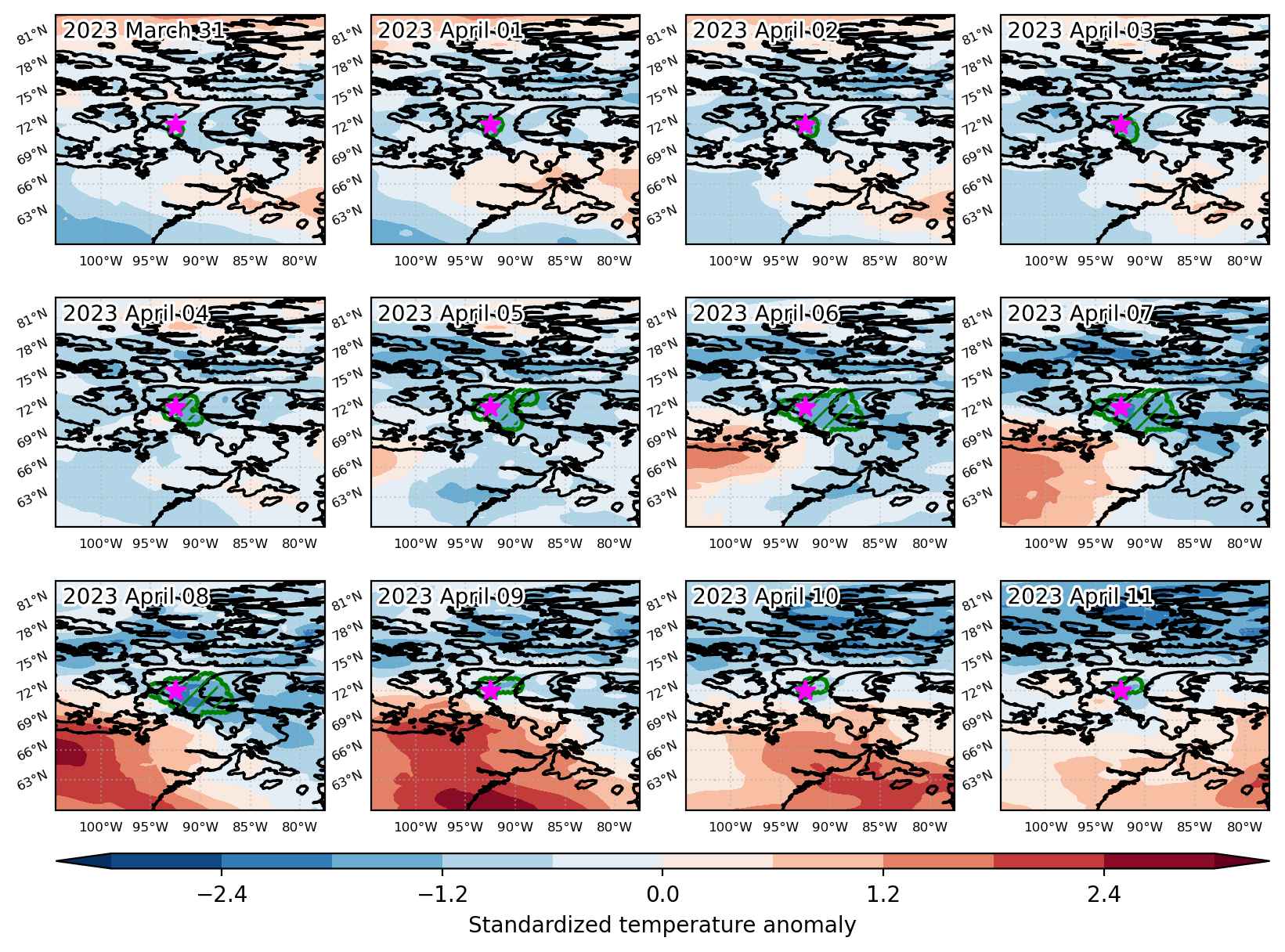
Cold spell occuring from March 31 2023 to April 11 2023 at 72.0°N 267.5°E

Download data: JSON

Event type: Cold spell

Countries affected (identified with ArcGIS Online; provided only for geographical reference):

  • Canada

Duration: 12 days

Time span: March 31 2023 to April 11 2023

Statistics over entire affected area:

  • Mean temperature anomaly: -5.9 °C
  • Mean temperature: -25.5 °C
  • Minimum temperature anomaly: -8.0 °C
  • Minimum temperature: -30.6 °C

Event center: 72.0°N 267.5°E

Area affected: 58715 km$^2$


Fig. 1: Map of most extreme temperature anomalies (standardized) experienced during the event. The purple star indicates the center of the extreme event. Green hatching illustrates all areas under the effect of extremes at some time during the event.


Fig. 2: Evolution of temperature at the center of the event. The climatological percentile distribution is illustrated with color shadings.


Fig. 3: Maps illustrating the evolution of standardized temperature anomalies during the event.

Event ID: Cold_spell_2023-Mar-31_to_2023-Apr-11_267.5_72.0

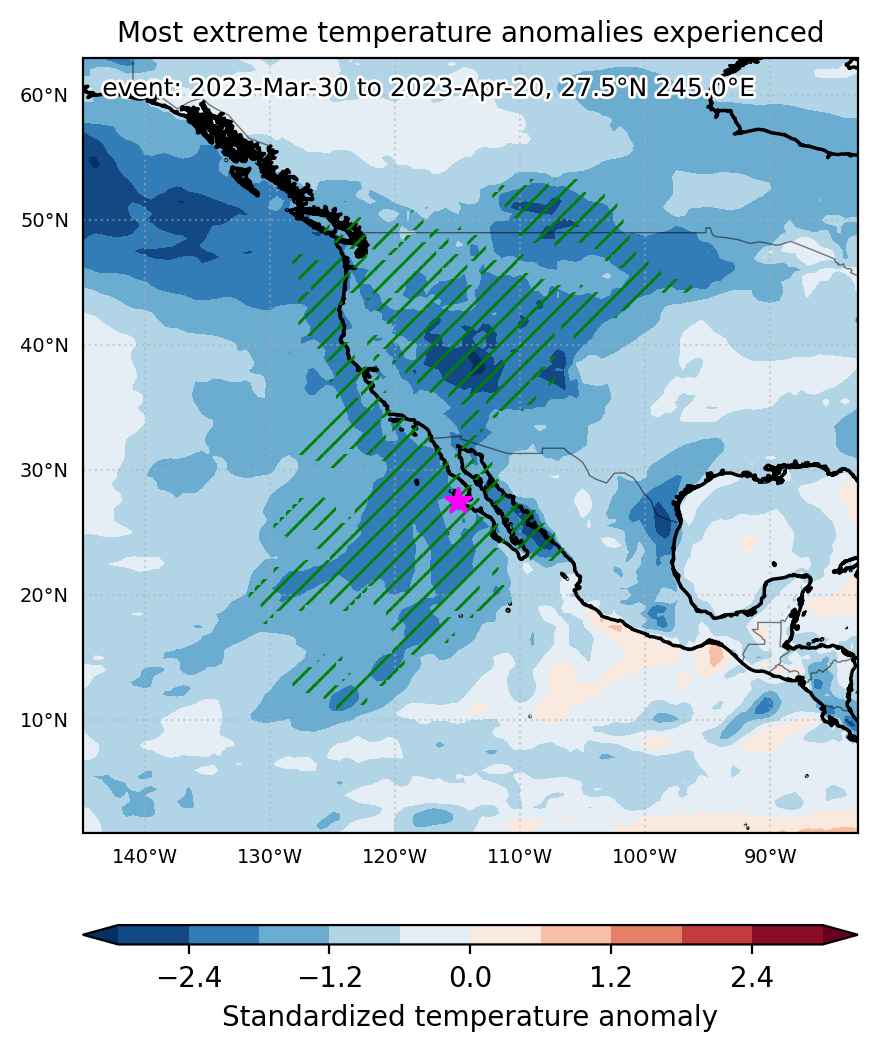
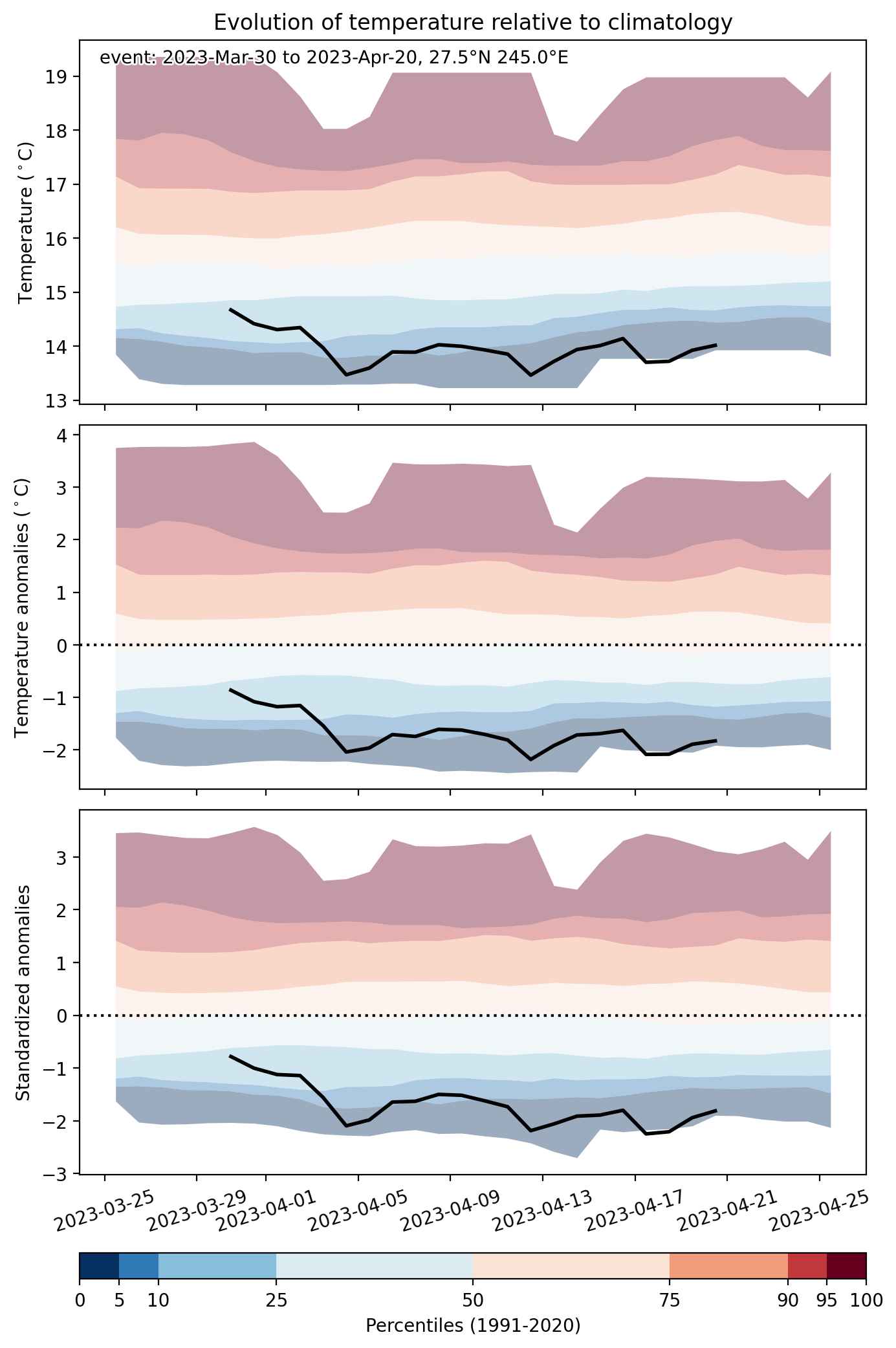
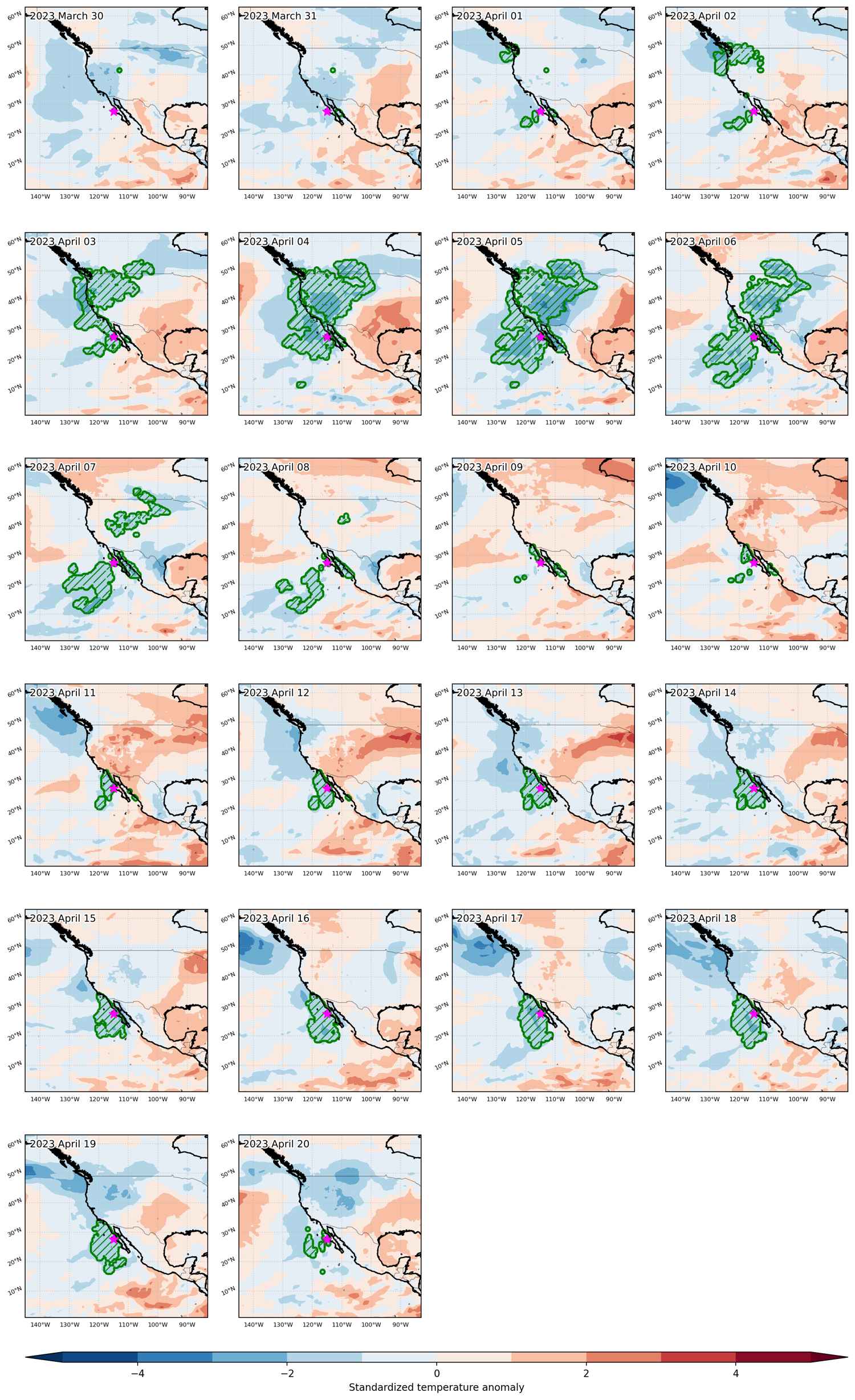
Cold spell occuring from March 30 2023 to April 20 2023 at 27.5°N 245.0°E

Download data: JSON

Event type: Cold spell

Countries affected (identified with ArcGIS Online; provided only for geographical reference):

  • Canada
  • Mexico
  • United States

Duration: 22 days

Time span: March 30 2023 to April 20 2023

Statistics over entire affected area:

  • Mean temperature anomaly: -4.2 °C
  • Mean temperature: 8.5 °C
  • Minimum temperature anomaly: -18.8 °C
  • Minimum temperature: -17.4 °C

Event center: 27.5°N 245.0°E

Area affected: 5445032 km$^2$


Fig. 1: Map of most extreme temperature anomalies (standardized) experienced during the event. The purple star indicates the center of the extreme event. Green hatching illustrates all areas under the effect of extremes at some time during the event.


Fig. 2: Evolution of temperature at the center of the event. The climatological percentile distribution is illustrated with color shadings.


Fig. 3: Maps illustrating the evolution of standardized temperature anomalies during the event.

Event ID: Cold_spell_2023-Mar-30_to_2023-Apr-20_245.0_27.5

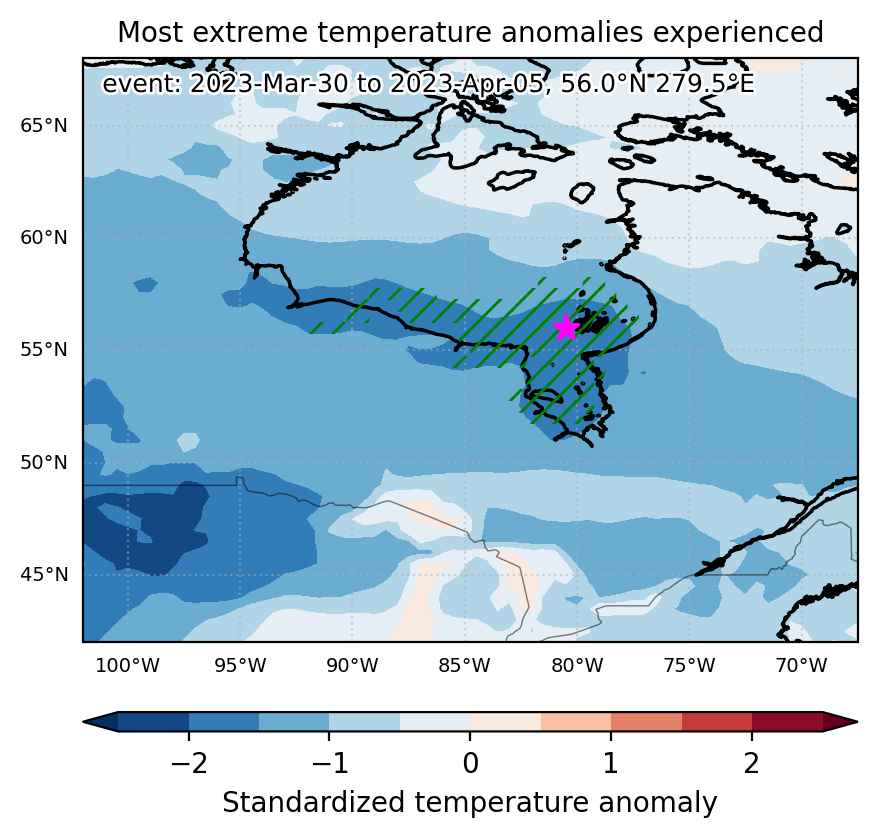
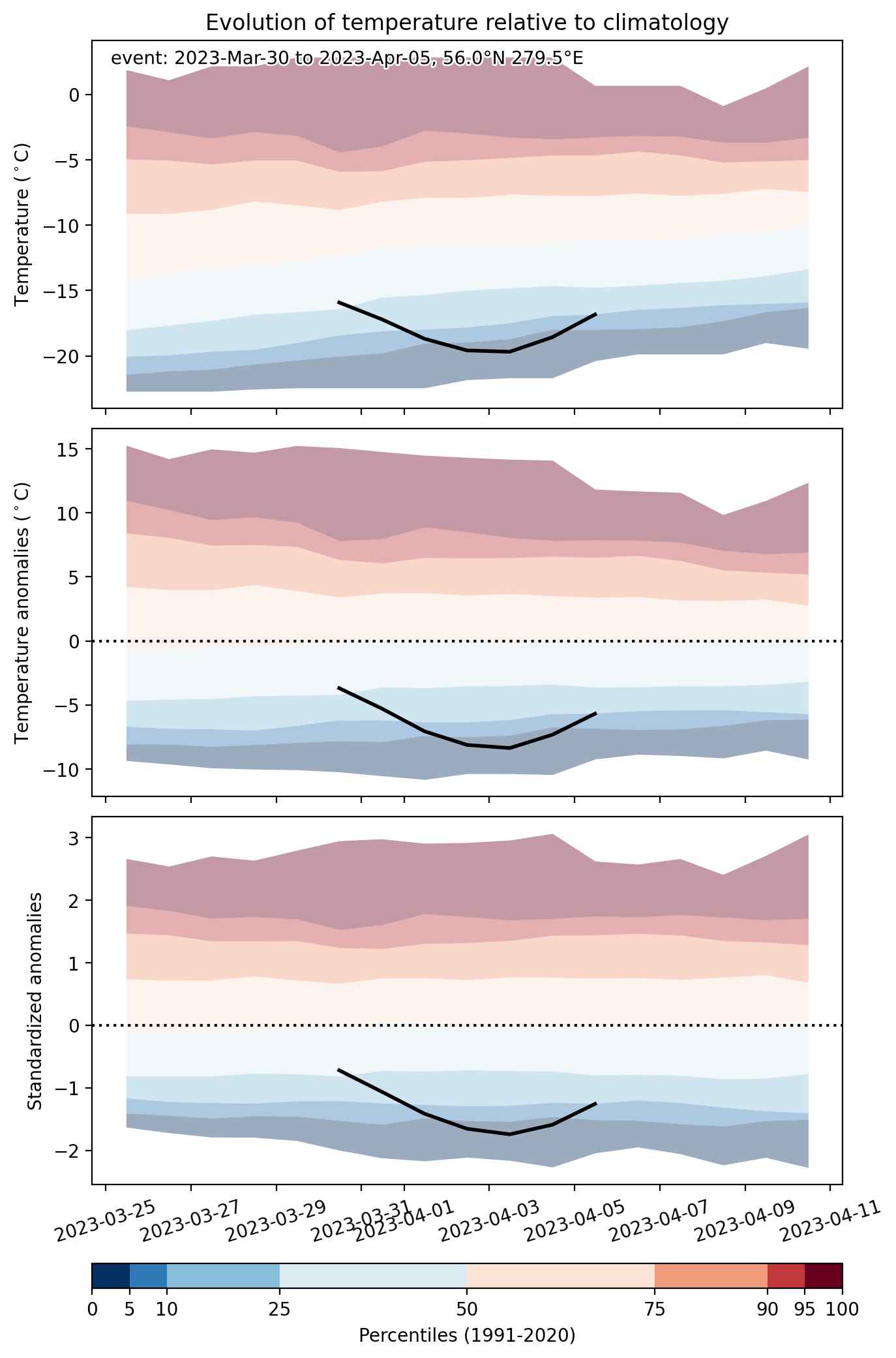
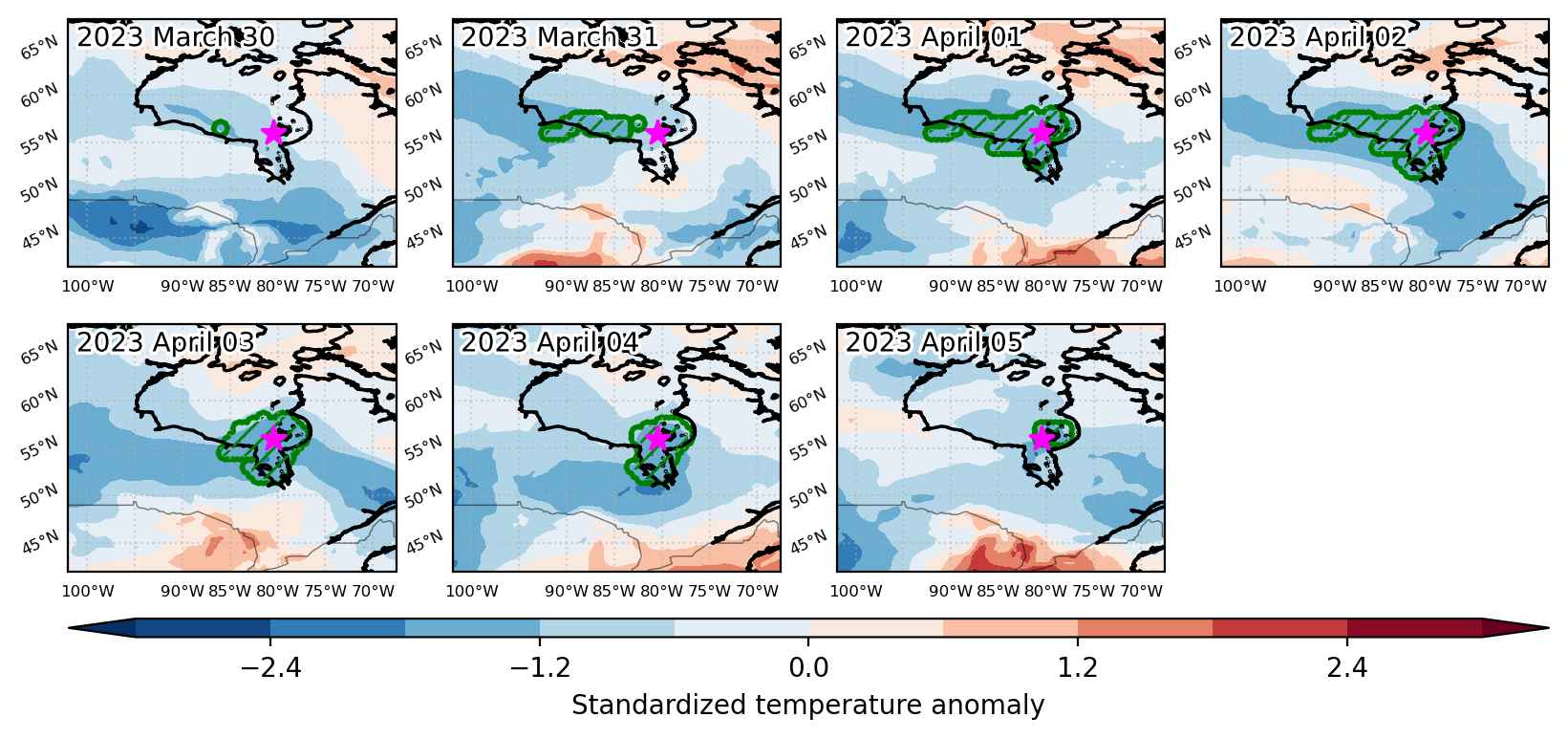
Cold spell occuring from March 30 2023 to April 05 2023 at 56.0°N 279.5°E

Download data: JSON

Event type: Cold spell

Countries affected (identified with ArcGIS Online; provided only for geographical reference):

  • Canada

Duration: 7 days

Time span: March 30 2023 to April 05 2023

Statistics over entire affected area:

  • Mean temperature anomaly: -8.1 °C
  • Mean temperature: -19.0 °C
  • Minimum temperature anomaly: -12.3 °C
  • Minimum temperature: -23.2 °C

Event center: 56.0°N 279.5°E

Area affected: 274527 km$^2$


Fig. 1: Map of most extreme temperature anomalies (standardized) experienced during the event. The purple star indicates the center of the extreme event. Green hatching illustrates all areas under the effect of extremes at some time during the event.


Fig. 2: Evolution of temperature at the center of the event. The climatological percentile distribution is illustrated with color shadings.


Fig. 3: Maps illustrating the evolution of standardized temperature anomalies during the event.

Event ID: Cold_spell_2023-Mar-30_to_2023-Apr-05_279.5_56.0

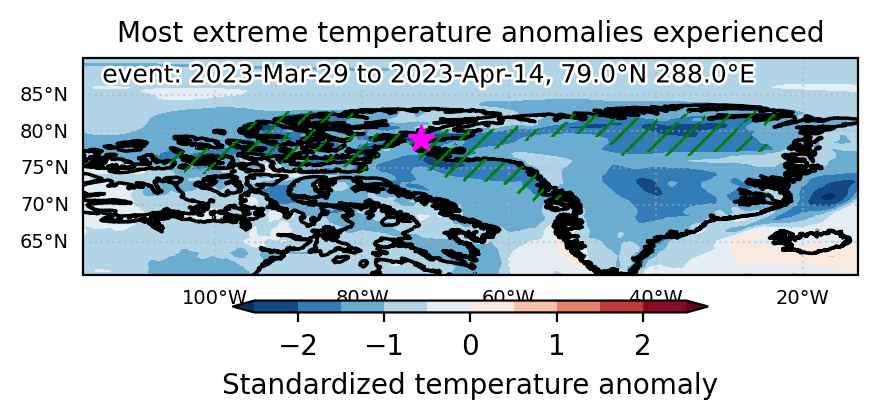
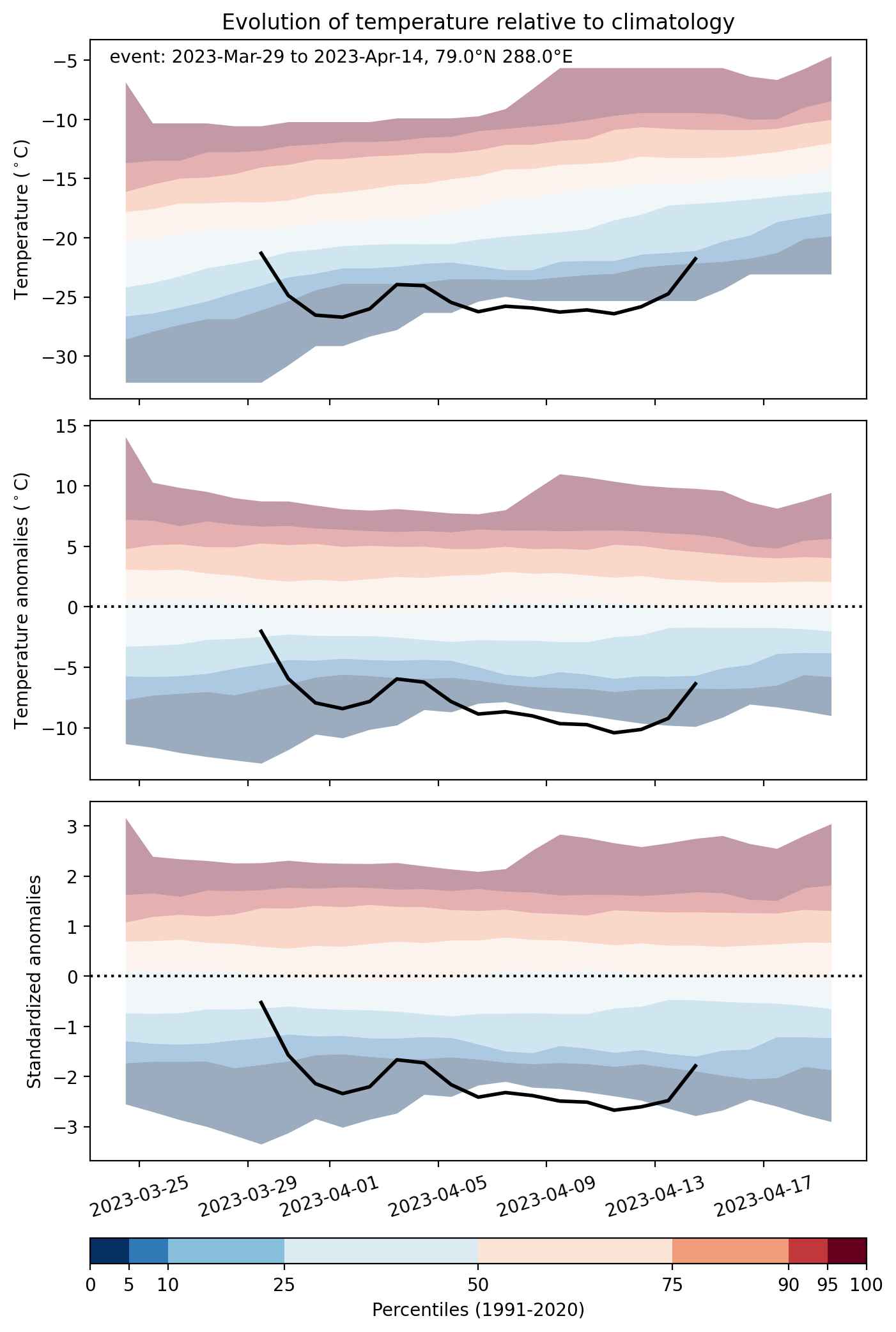
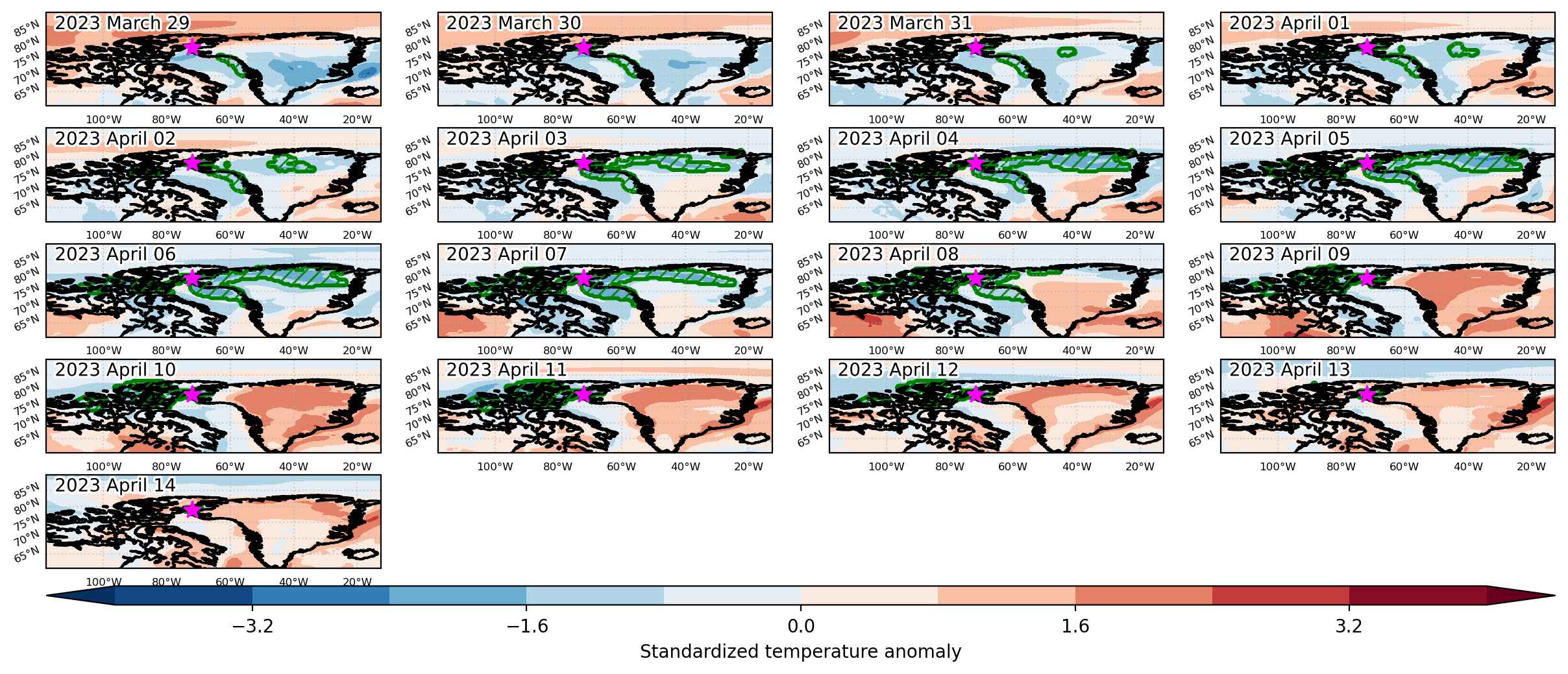
Cold spell occuring from March 29 2023 to April 14 2023 at 79.0°N 288.0°E

Download data: JSON

Event type: Cold spell

Countries affected (identified with ArcGIS Online; provided only for geographical reference):

  • Canada
  • Greenland

Duration: 17 days

Time span: March 29 2023 to April 14 2023

Statistics over entire affected area:

  • Mean temperature anomaly: -7.8 °C
  • Mean temperature: -32.2 °C
  • Minimum temperature anomaly: -13.6 °C
  • Minimum temperature: -47.0 °C

Event center: 79.0°N 288.0°E

Area affected: 810978 km$^2$


Fig. 1: Map of most extreme temperature anomalies (standardized) experienced during the event. The purple star indicates the center of the extreme event. Green hatching illustrates all areas under the effect of extremes at some time during the event.


Fig. 2: Evolution of temperature at the center of the event. The climatological percentile distribution is illustrated with color shadings.


Fig. 3: Maps illustrating the evolution of standardized temperature anomalies during the event.

Event ID: Cold_spell_2023-Mar-29_to_2023-Apr-14_288.0_79.0