Heat wave occuring from February 27 2022 to March 11 2022 at 80.5°N 283.5°E

Download data: JSON

Event type: Heat wave

Countries affected (identified with ArcGIS Online; provided only for geographical reference):

  • Canada
  • Greenland

Duration: 13 days

Time span: February 27 2022 to March 11 2022

Statistics over entire affected area:

  • Mean temperature anomaly: 8.9 °C
  • Mean temperature: -23.0 °C
  • Maximum temperature anomaly: 13.5 °C
  • Maximum temperature: -12.3 °C

Event center: 80.5°N 283.5°E

Area affected: 104156 km$^2$
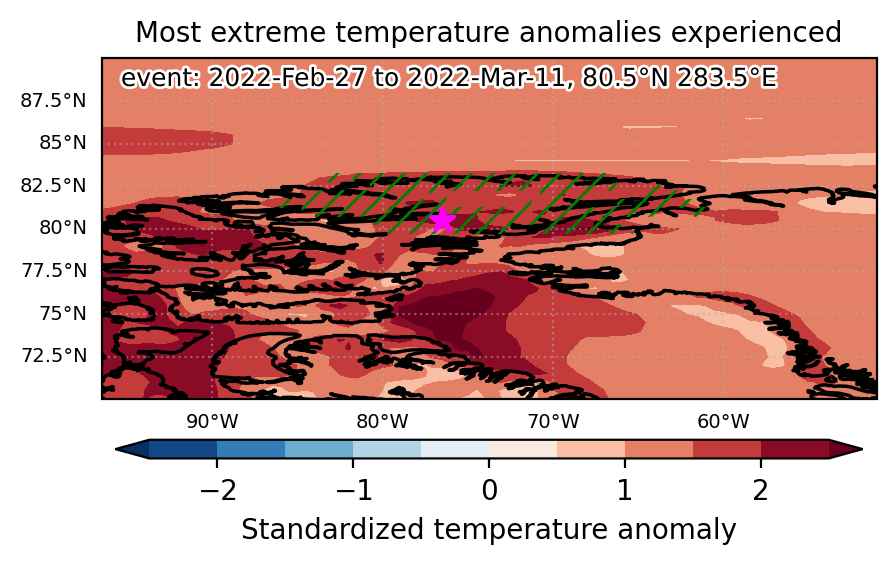

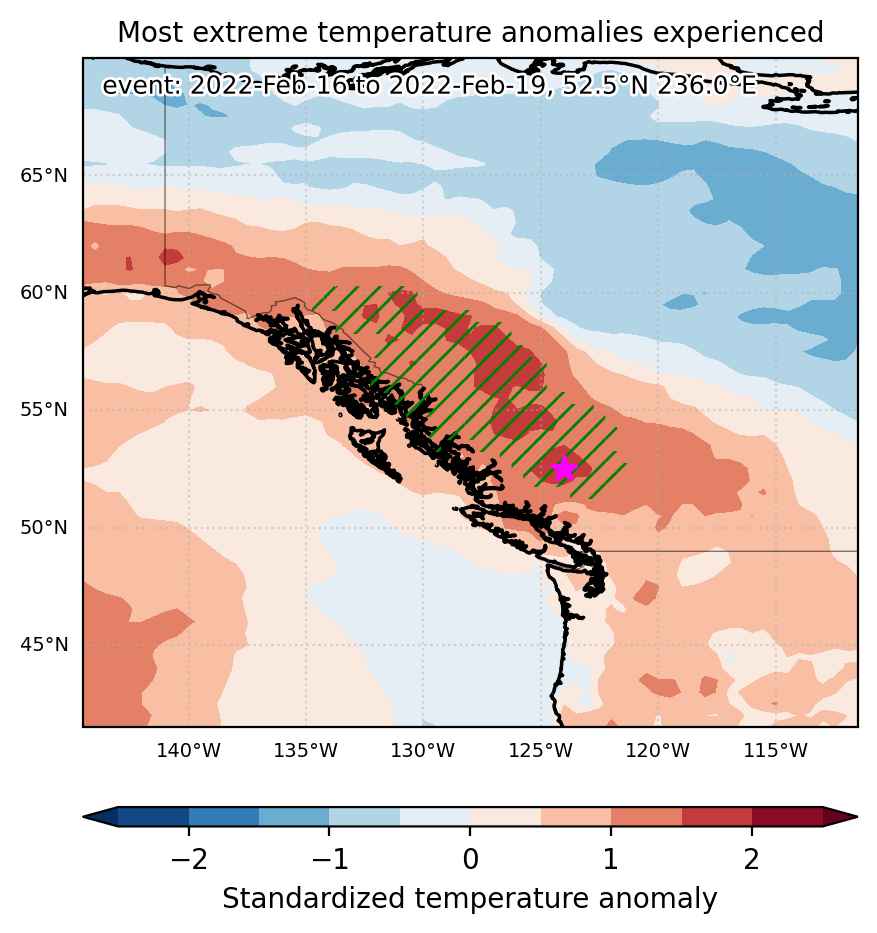
Fig. 1: Map of most extreme temperature anomalies (standardized) experienced during the event. The purple star indicates the center of the extreme event. Green hatching illustrates all areas under the effect of extremes at some time during the event.
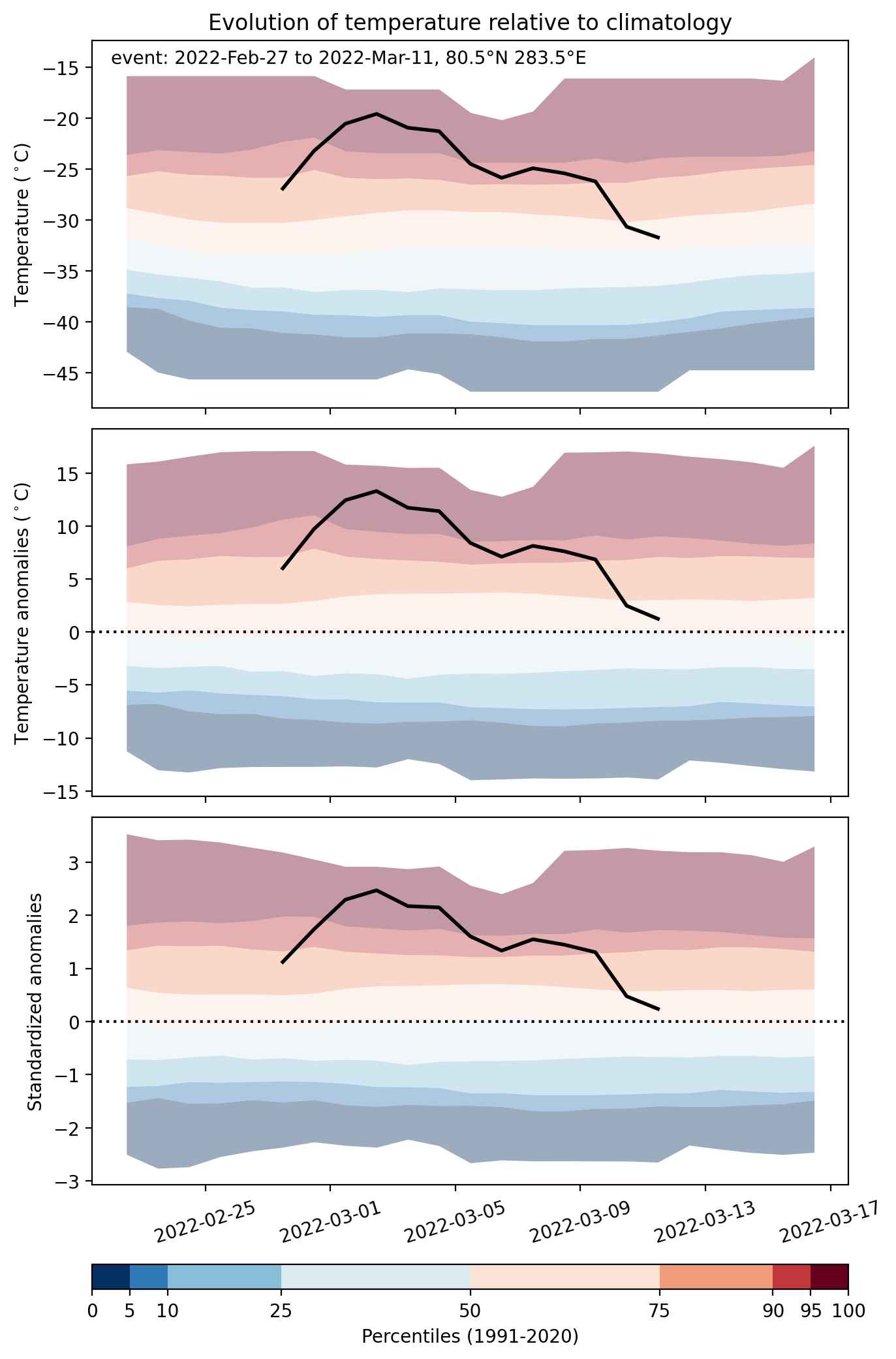


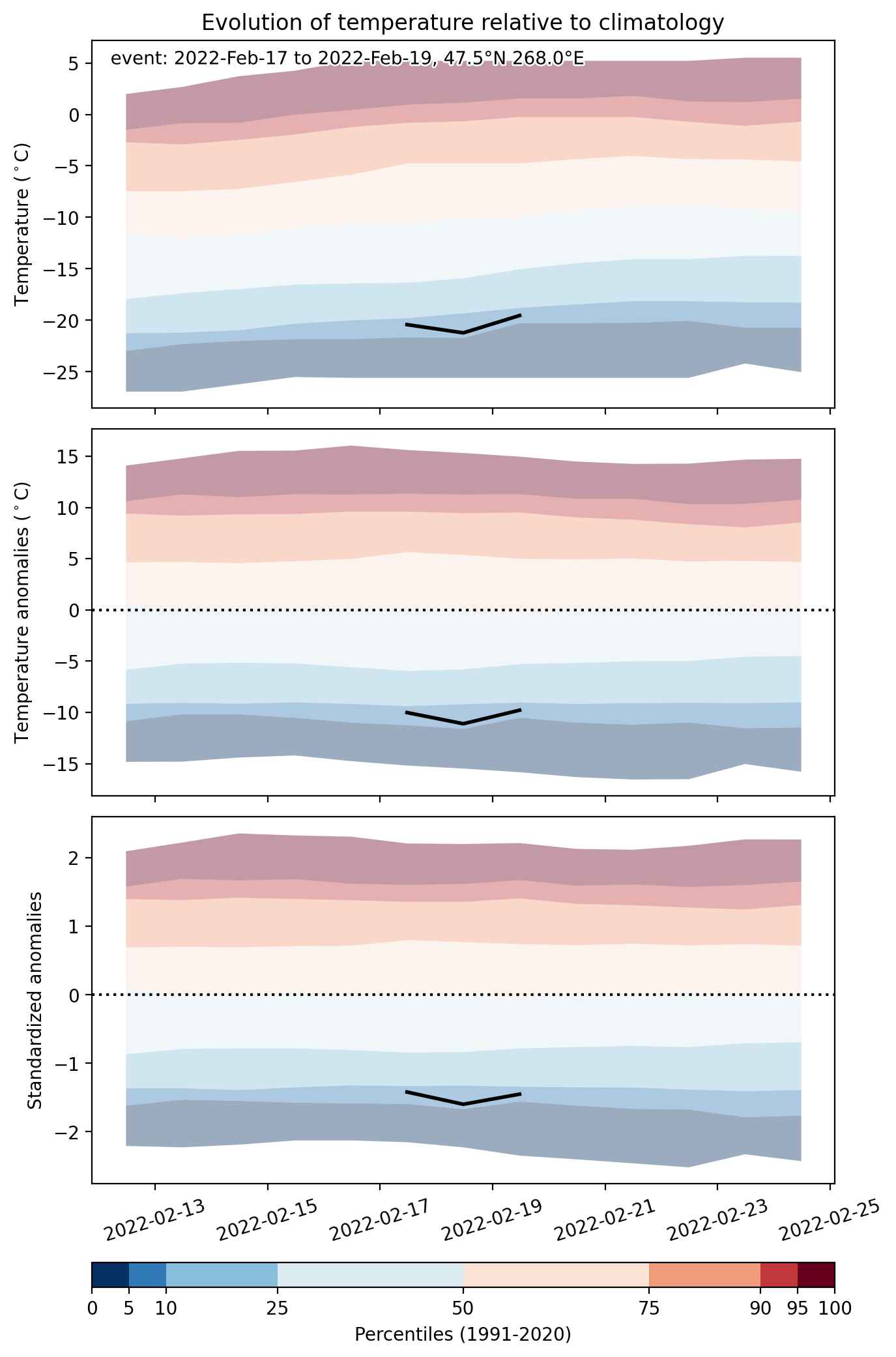
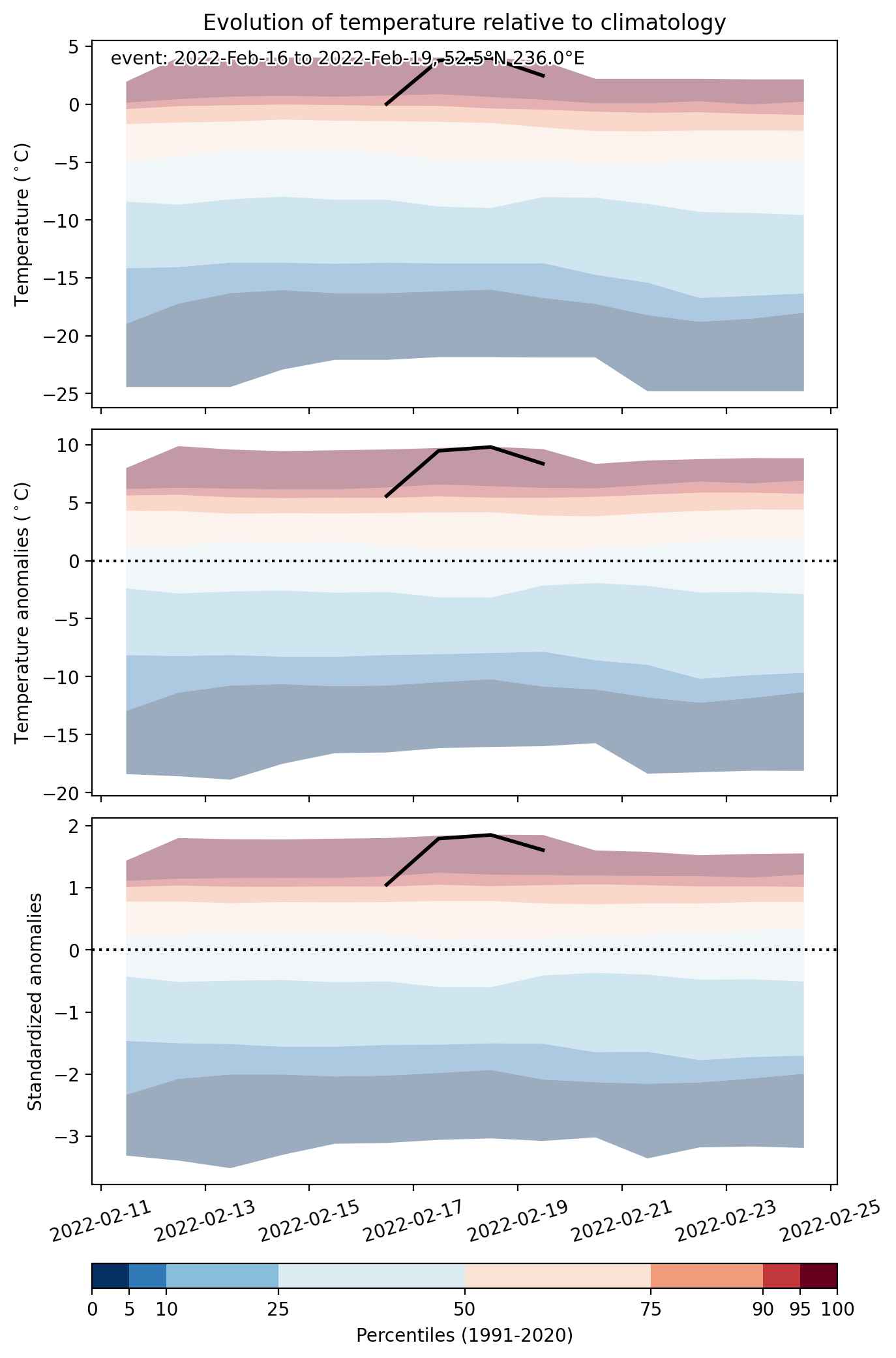
Fig. 2: Evolution of temperature at the center of the event. The climatological percentile distribution is illustrated with color shadings.
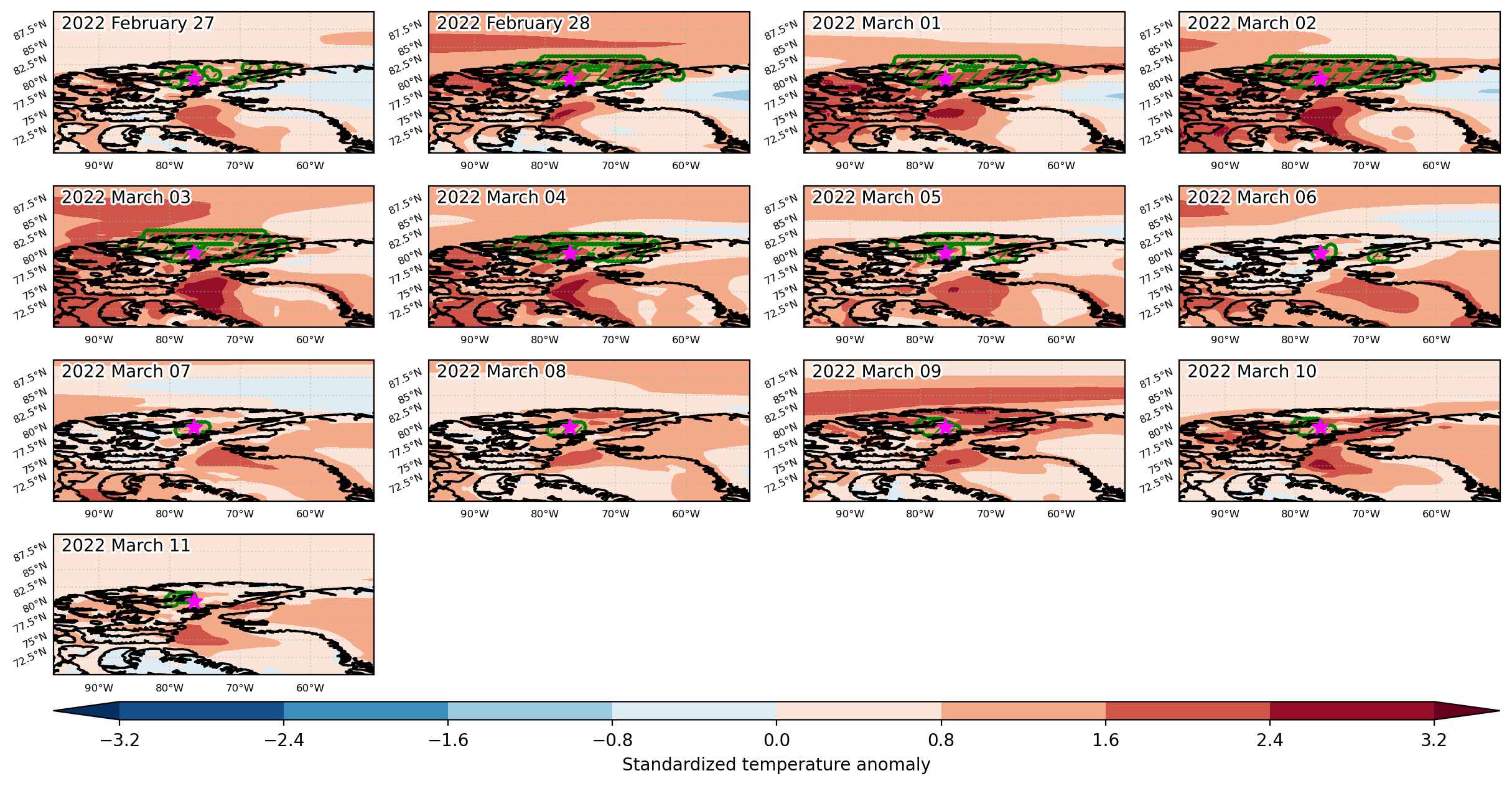


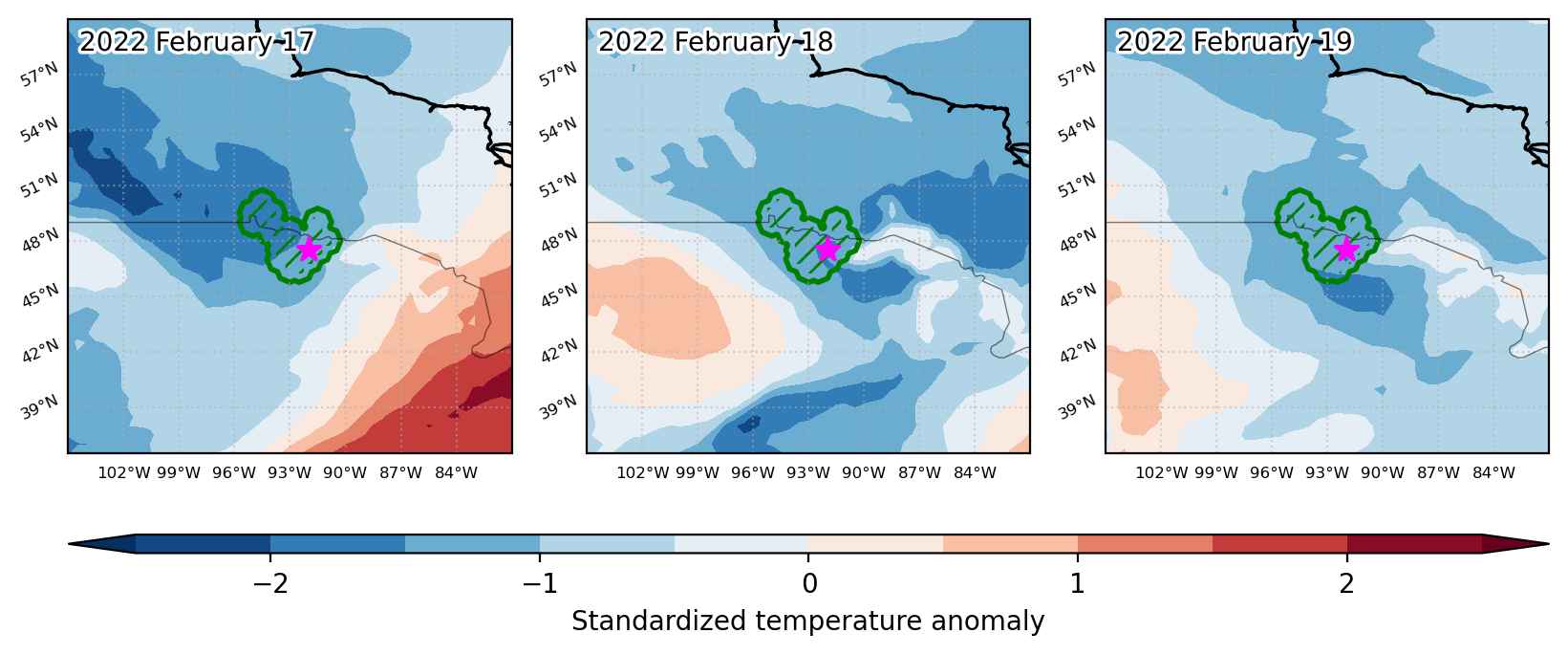
Fig. 3: Maps illustrating the evolution of standardized temperature anomalies during the event.

Event ID: Heat_wave_2022-Feb-27_to_2022-Mar-11_283.5_80.5
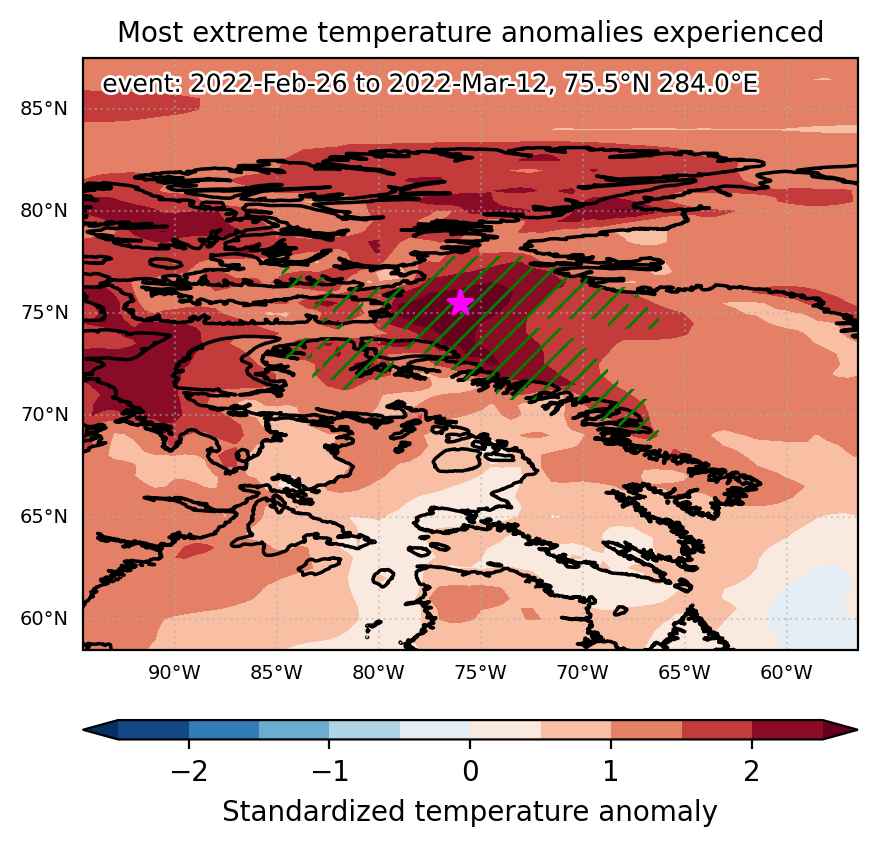
Heat wave occuring from February 26 2022 to March 12 2022 at 75.5°N 284.0°E

Download data: JSON

Event type: Heat wave

Countries affected (identified with ArcGIS Online; provided only for geographical reference):

  • Canada
  • Greenland

Duration: 15 days

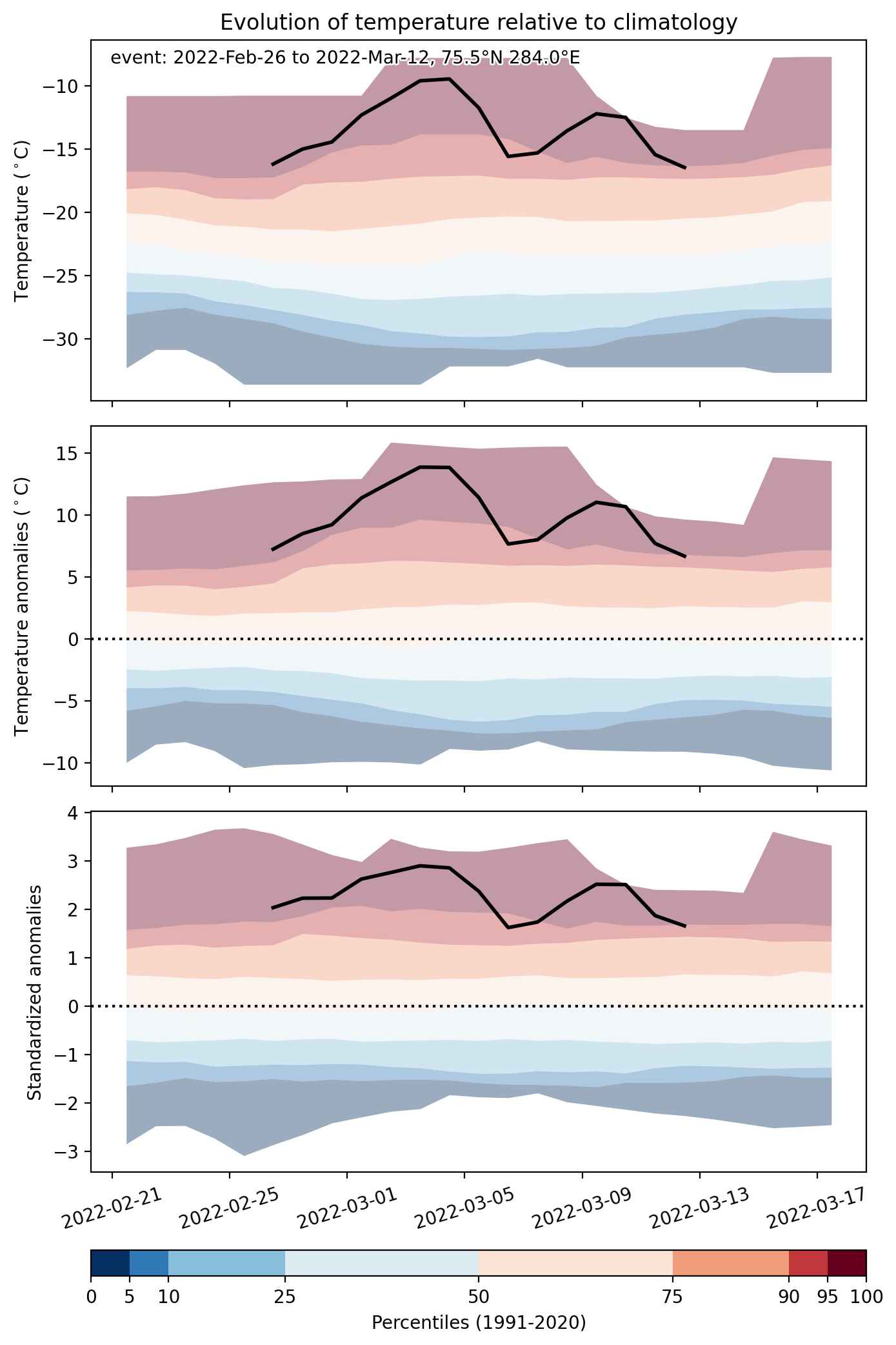
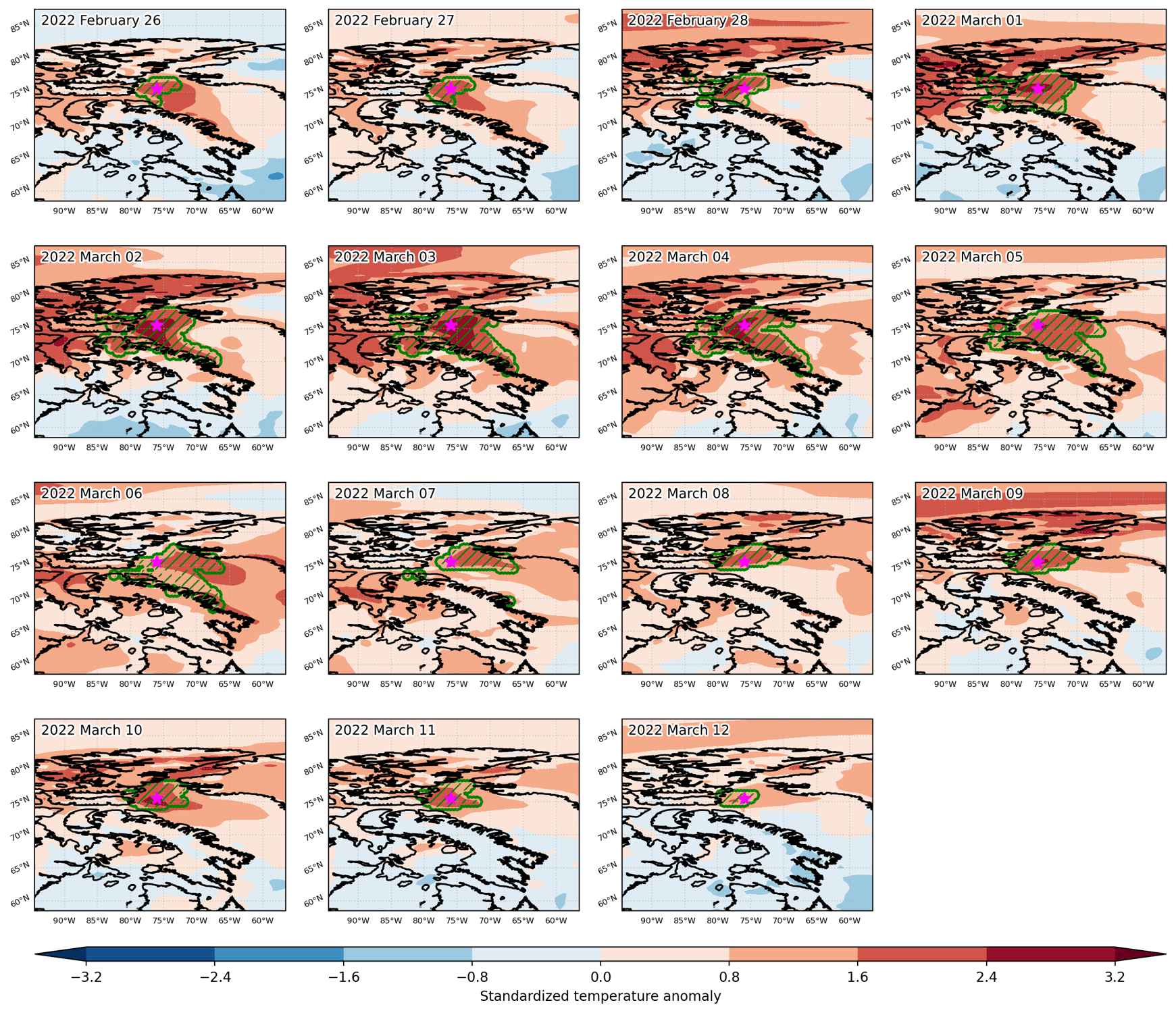
Time span: February 26 2022 to March 12 2022

Statistics over entire affected area:

  • Mean temperature anomaly: 9.2 °C
  • Mean temperature: -16.0 °C
  • Maximum temperature anomaly: 17.2 °C
  • Maximum temperature: -7.7 °C

Event center: 75.5°N 284.0°E

Area affected: 262125 km$^2$


Fig. 1: Map of most extreme temperature anomalies (standardized) experienced during the event. The purple star indicates the center of the extreme event. Green hatching illustrates all areas under the effect of extremes at some time during the event.


Fig. 2: Evolution of temperature at the center of the event. The climatological percentile distribution is illustrated with color shadings.


Fig. 3: Maps illustrating the evolution of standardized temperature anomalies during the event.

Event ID: Heat_wave_2022-Feb-26_to_2022-Mar-12_284.0_75.5

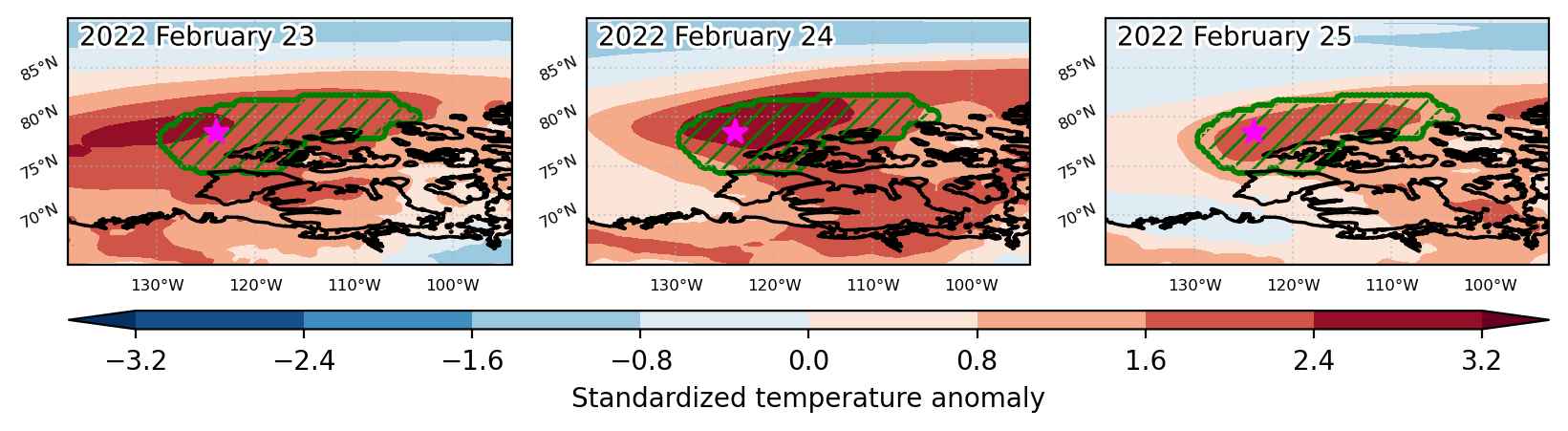
Heat wave occuring from February 23 2022 to February 25 2022 at 78.5°N 236.0°E

Download data: JSON

Event type: Heat wave

Countries affected (identified with ArcGIS Online; provided only for geographical reference):

  • Canada

Duration: 3 days

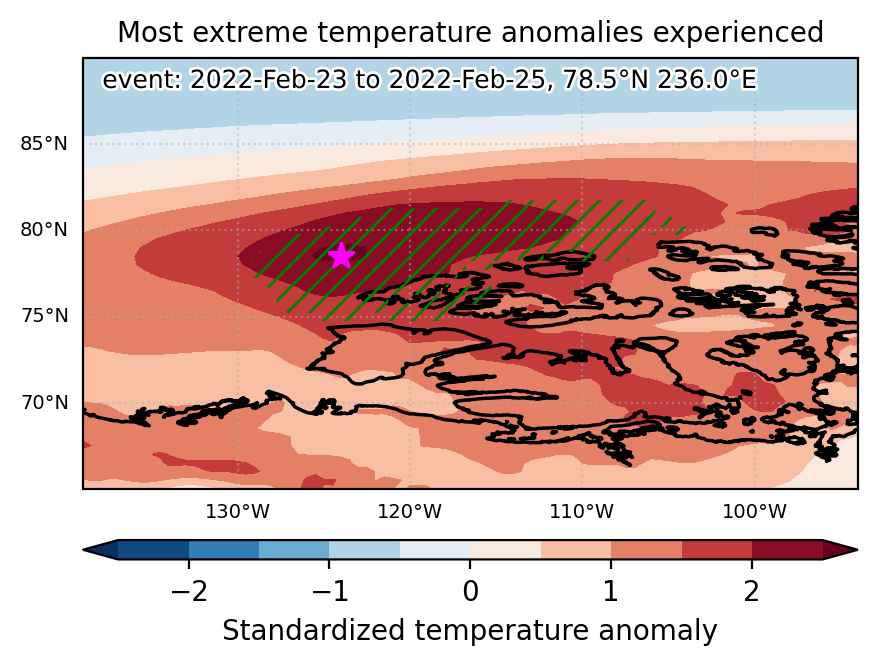
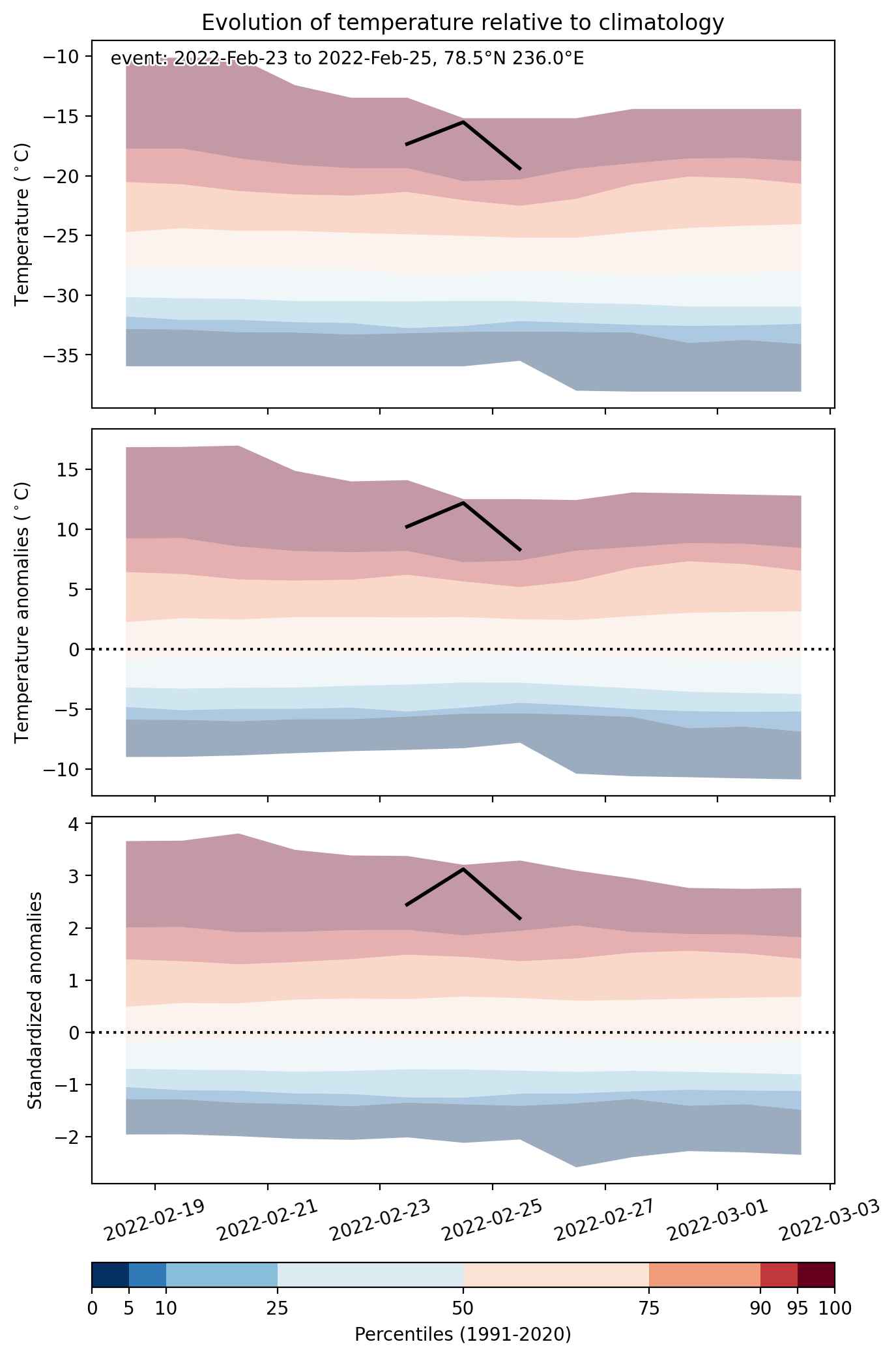
Time span: February 23 2022 to February 25 2022

Statistics over entire affected area:

  • Mean temperature anomaly: 8.5 °C
  • Mean temperature: -19.2 °C
  • Maximum temperature anomaly: 13.8 °C
  • Maximum temperature: -15.5 °C

Event center: 78.5°N 236.0°E

Area affected: 243720 km$^2$


Fig. 1: Map of most extreme temperature anomalies (standardized) experienced during the event. The purple star indicates the center of the extreme event. Green hatching illustrates all areas under the effect of extremes at some time during the event.


Fig. 2: Evolution of temperature at the center of the event. The climatological percentile distribution is illustrated with color shadings.


Fig. 3: Maps illustrating the evolution of standardized temperature anomalies during the event.

Event ID: Heat_wave_2022-Feb-23_to_2022-Feb-25_236.0_78.5

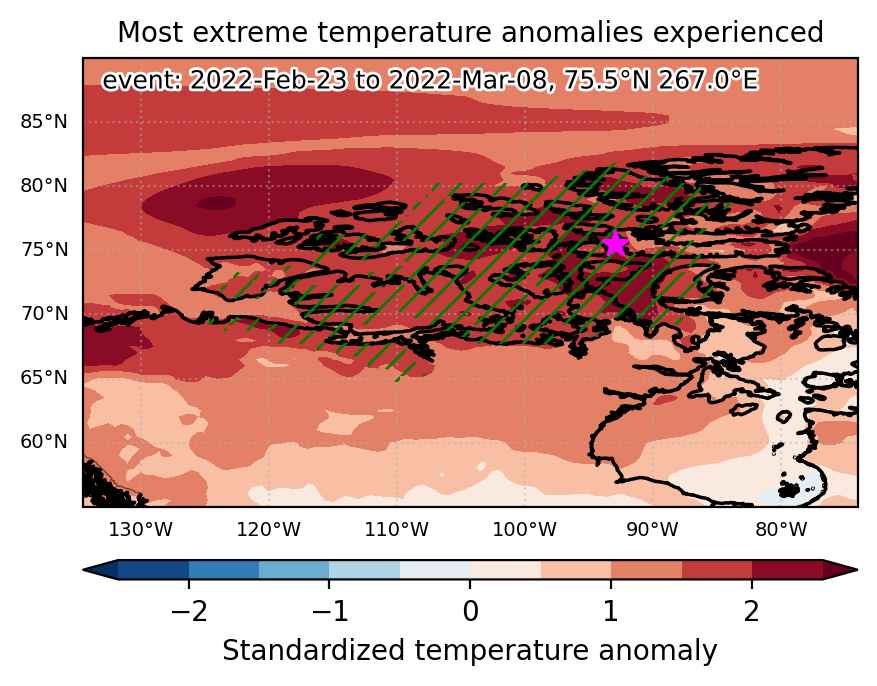
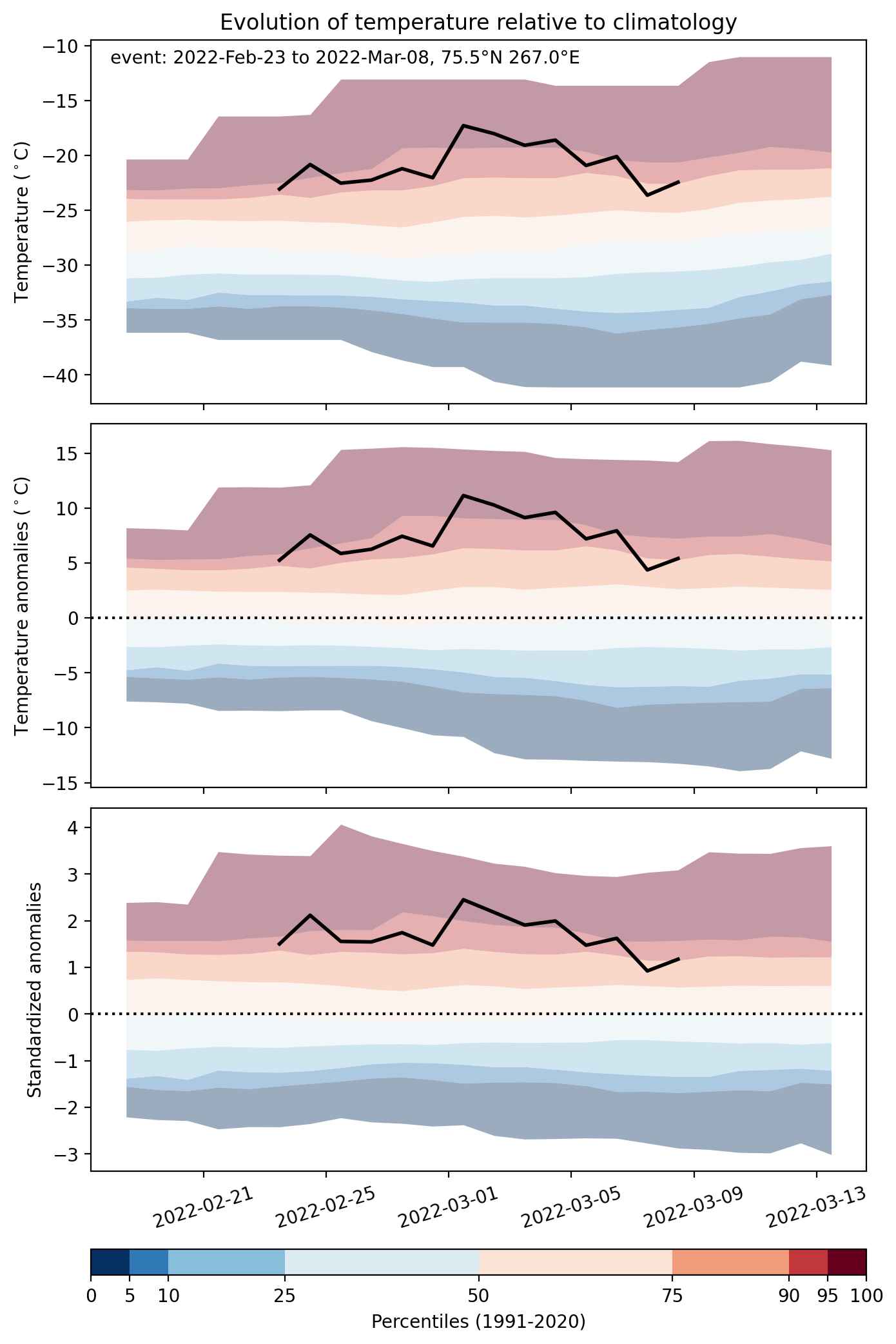
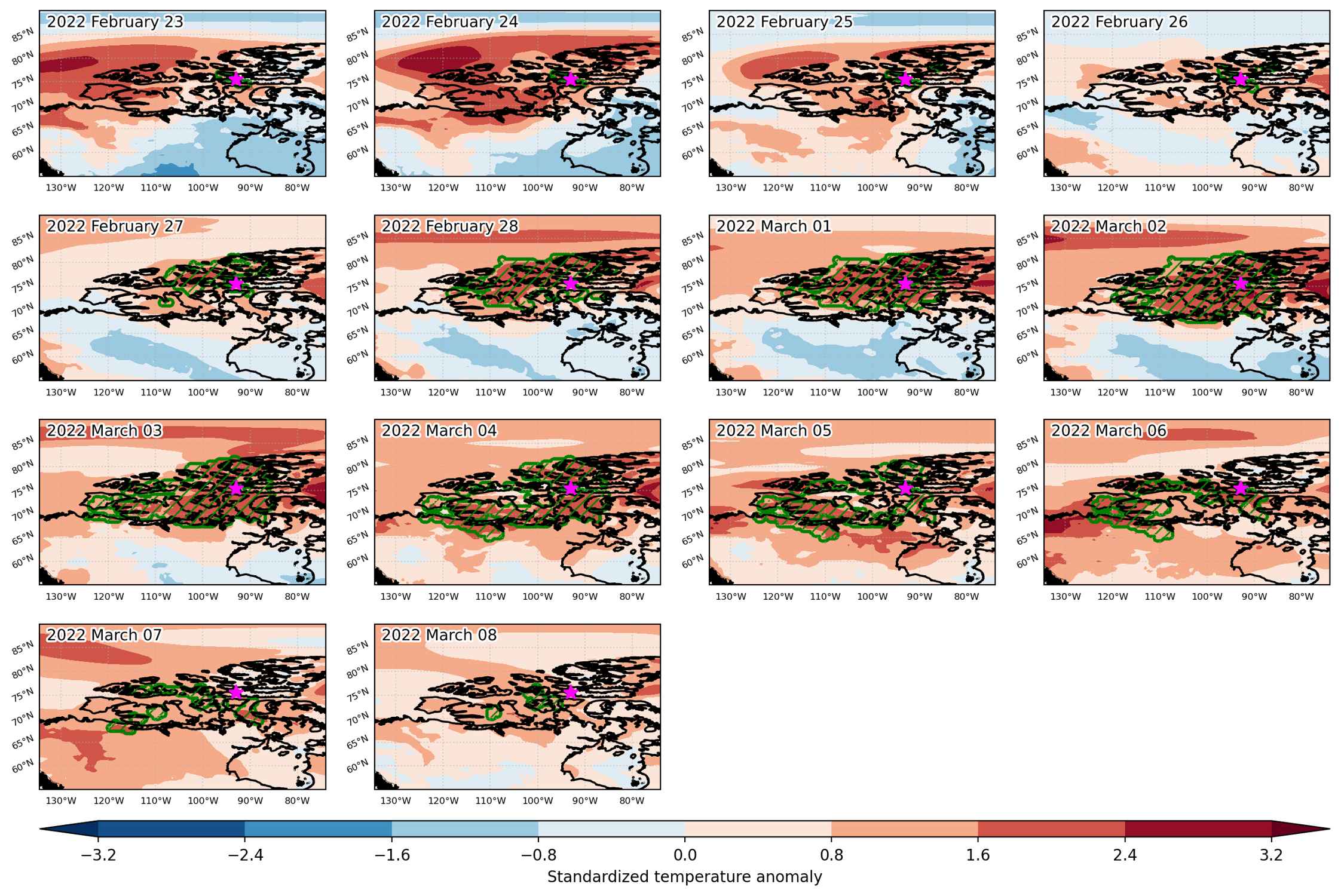
Heat wave occuring from February 23 2022 to March 08 2022 at 75.5°N 267.0°E

Download data: JSON

Event type: Heat wave

Countries affected (identified with ArcGIS Online; provided only for geographical reference):

  • Canada

Duration: 14 days

Time span: February 23 2022 to March 08 2022

Statistics over entire affected area:

  • Mean temperature anomaly: 9.0 °C
  • Mean temperature: -20.6 °C
  • Maximum temperature anomaly: 18.2 °C
  • Maximum temperature: -9.5 °C

Event center: 75.5°N 267.0°E

Area affected: 1079011 km$^2$


Fig. 1: Map of most extreme temperature anomalies (standardized) experienced during the event. The purple star indicates the center of the extreme event. Green hatching illustrates all areas under the effect of extremes at some time during the event.


Fig. 2: Evolution of temperature at the center of the event. The climatological percentile distribution is illustrated with color shadings.


Fig. 3: Maps illustrating the evolution of standardized temperature anomalies during the event.

Event ID: Heat_wave_2022-Feb-23_to_2022-Mar-08_267.0_75.5

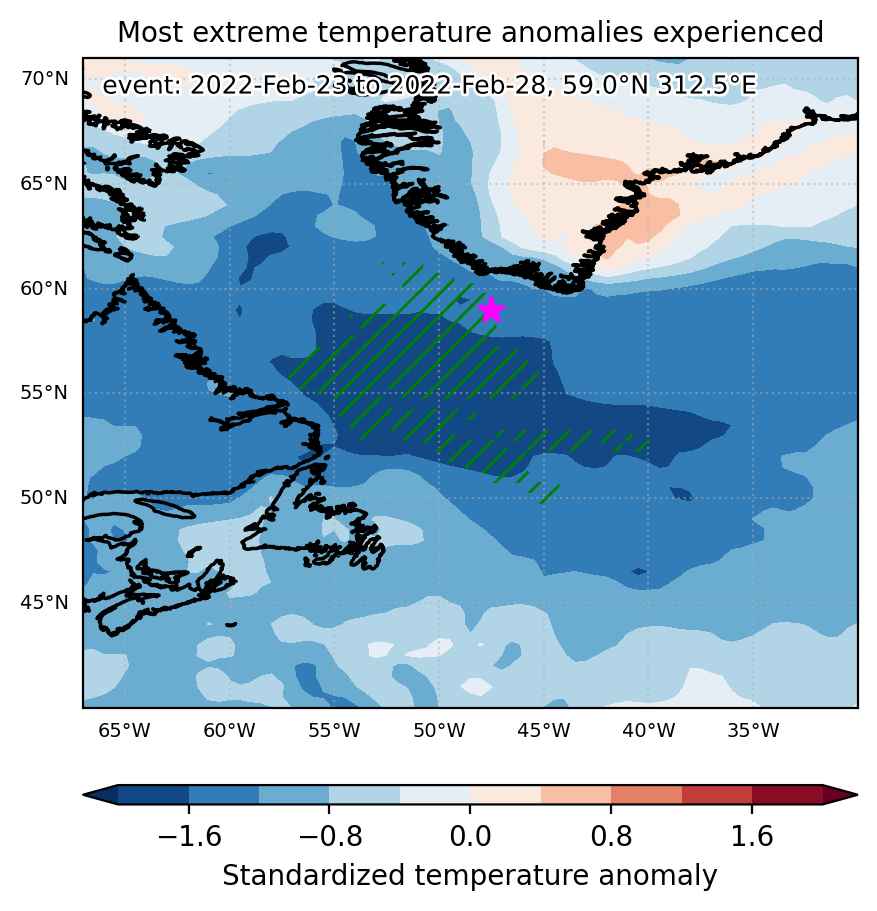
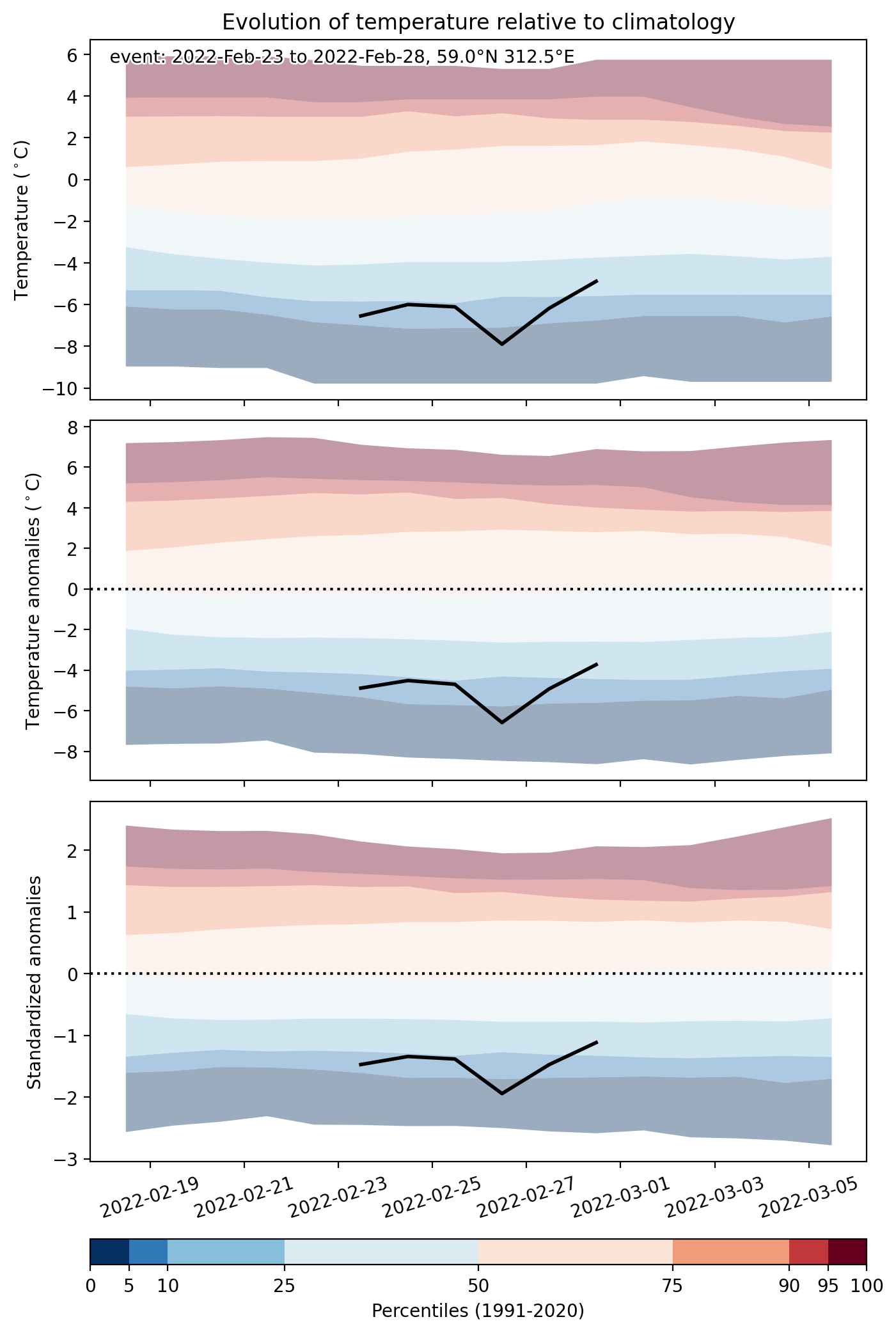
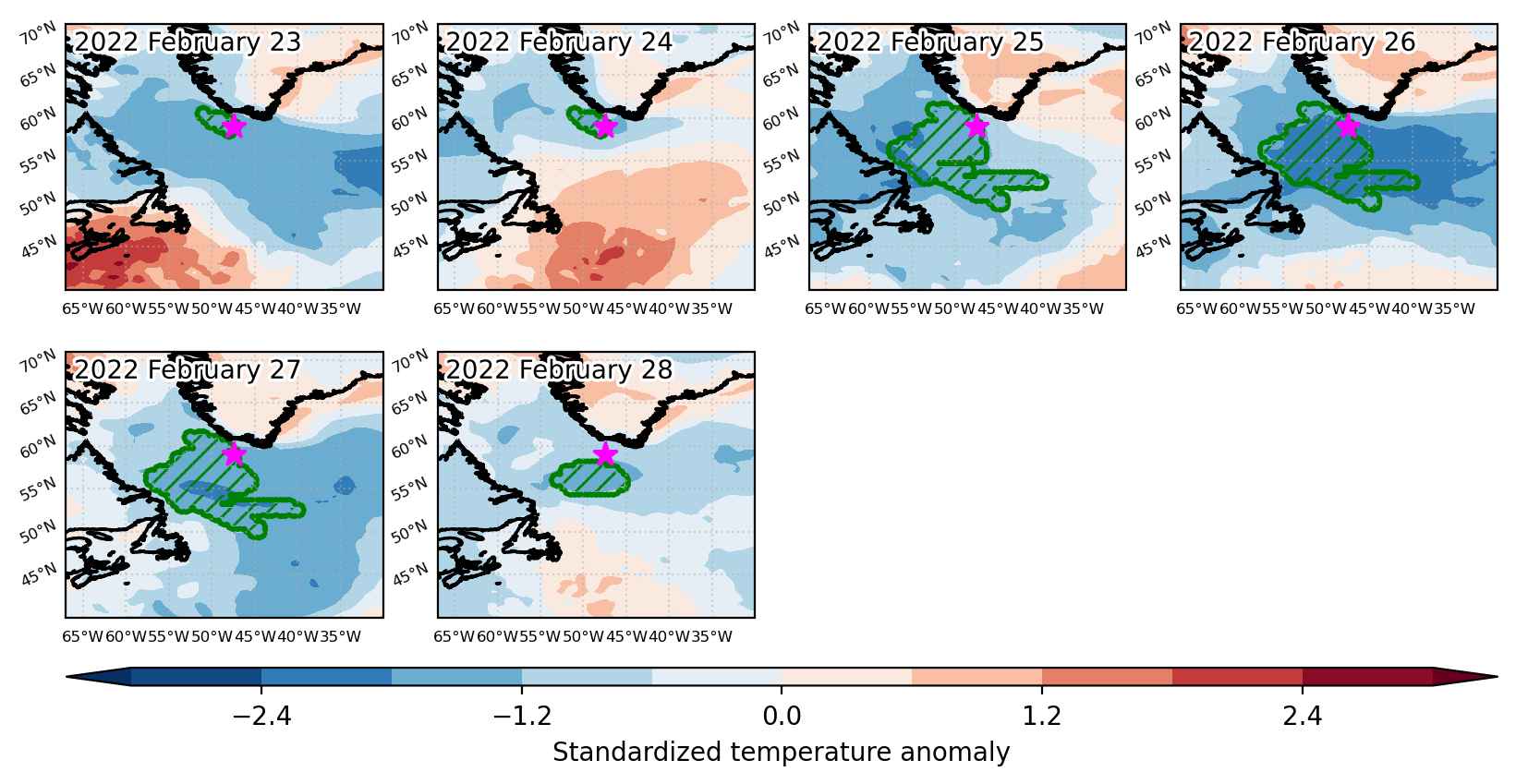
Cold spell occuring from February 23 2022 to February 28 2022 at 59.0°N 312.5°E

Download data: JSON

Event type: Cold spell

Countries affected (identified with ArcGIS Online; provided only for geographical reference):

  • Canada

Duration: 6 days

Time span: February 23 2022 to February 28 2022

Statistics over entire affected area:

  • Mean temperature anomaly: -6.1 °C
  • Mean temperature: -7.7 °C
  • Minimum temperature anomaly: -12.4 °C
  • Minimum temperature: -20.0 °C

Event center: 59.0°N 312.5°E

Area affected: 474607 km$^2$


Fig. 1: Map of most extreme temperature anomalies (standardized) experienced during the event. The purple star indicates the center of the extreme event. Green hatching illustrates all areas under the effect of extremes at some time during the event.


Fig. 2: Evolution of temperature at the center of the event. The climatological percentile distribution is illustrated with color shadings.


Fig. 3: Maps illustrating the evolution of standardized temperature anomalies during the event.

Event ID: Cold_spell_2022-Feb-23_to_2022-Feb-28_312.5_59.0

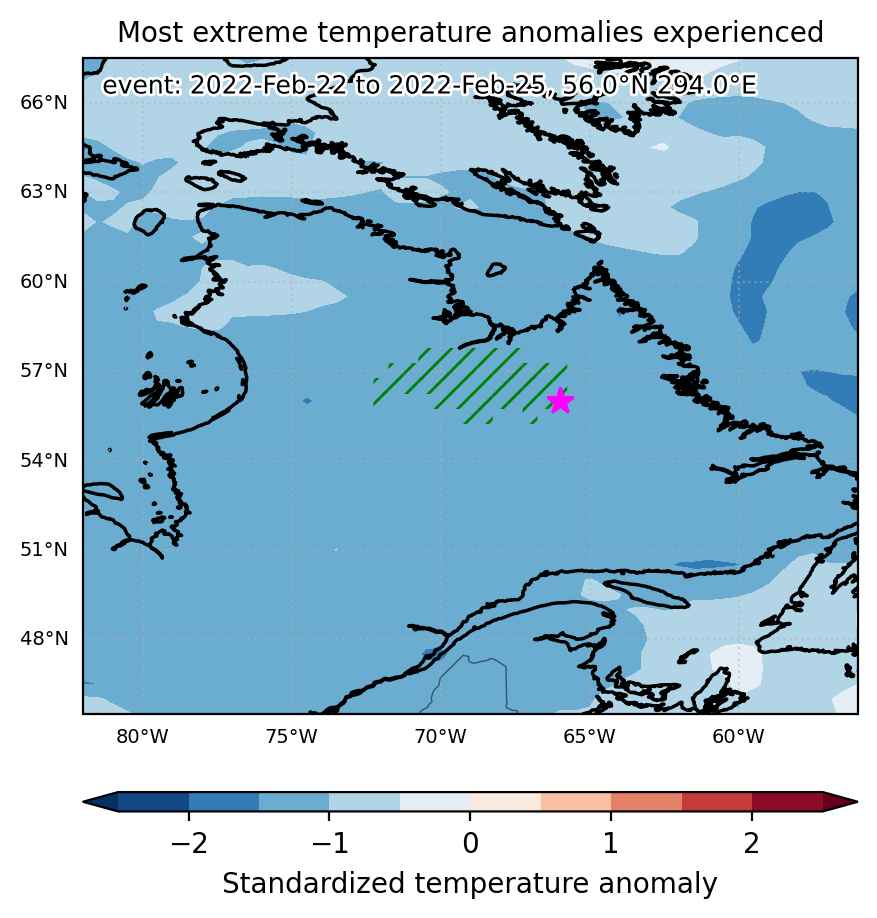
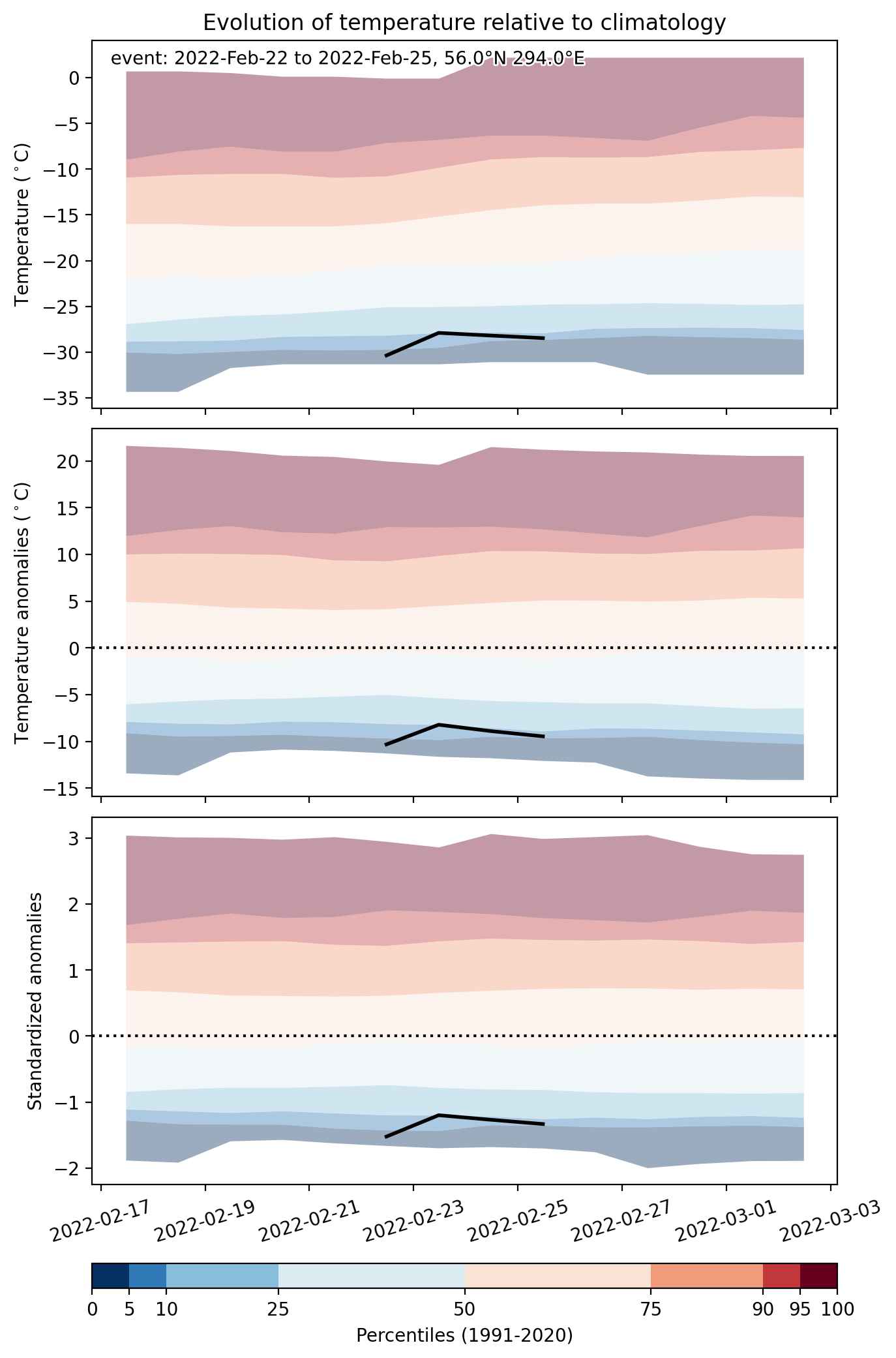
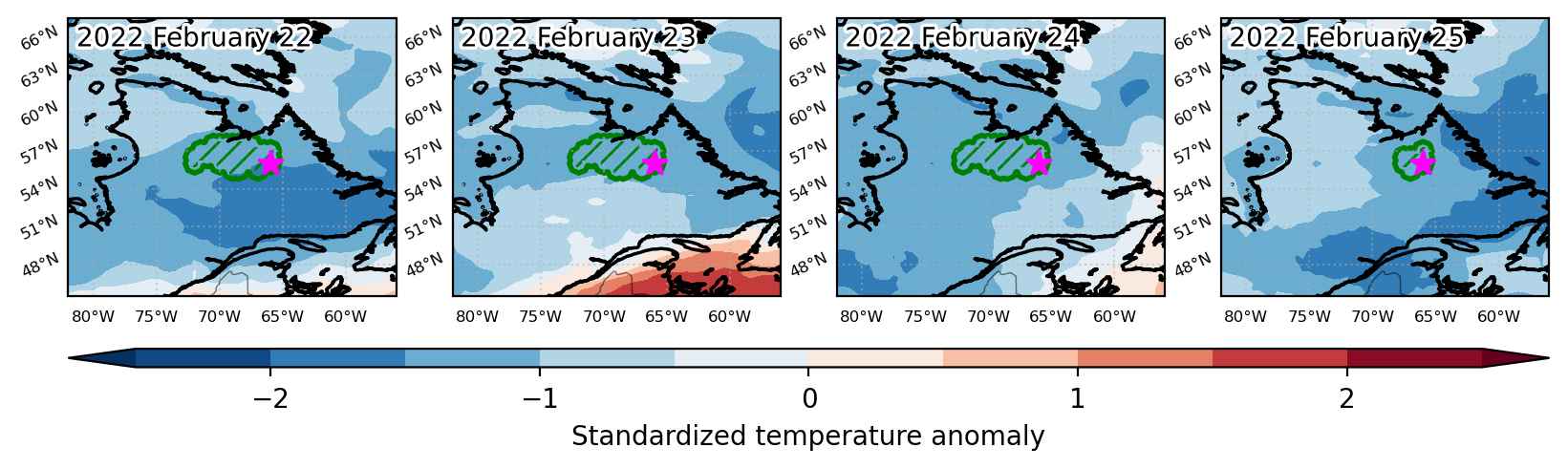
Cold spell occuring from February 22 2022 to February 25 2022 at 56.0°N 294.0°E

Download data: JSON

Event type: Cold spell

Countries affected (identified with ArcGIS Online; provided only for geographical reference):

  • Canada

Duration: 4 days

Time span: February 22 2022 to February 25 2022

Statistics over entire affected area:

  • Mean temperature anomaly: -9.1 °C
  • Mean temperature: -30.2 °C
  • Minimum temperature anomaly: -10.9 °C
  • Minimum temperature: -32.6 °C

Event center: 56.0°N 294.0°E

Area affected: 76544 km$^2$


Fig. 1: Map of most extreme temperature anomalies (standardized) experienced during the event. The purple star indicates the center of the extreme event. Green hatching illustrates all areas under the effect of extremes at some time during the event.


Fig. 2: Evolution of temperature at the center of the event. The climatological percentile distribution is illustrated with color shadings.


Fig. 3: Maps illustrating the evolution of standardized temperature anomalies during the event.

Event ID: Cold_spell_2022-Feb-22_to_2022-Feb-25_294.0_56.0

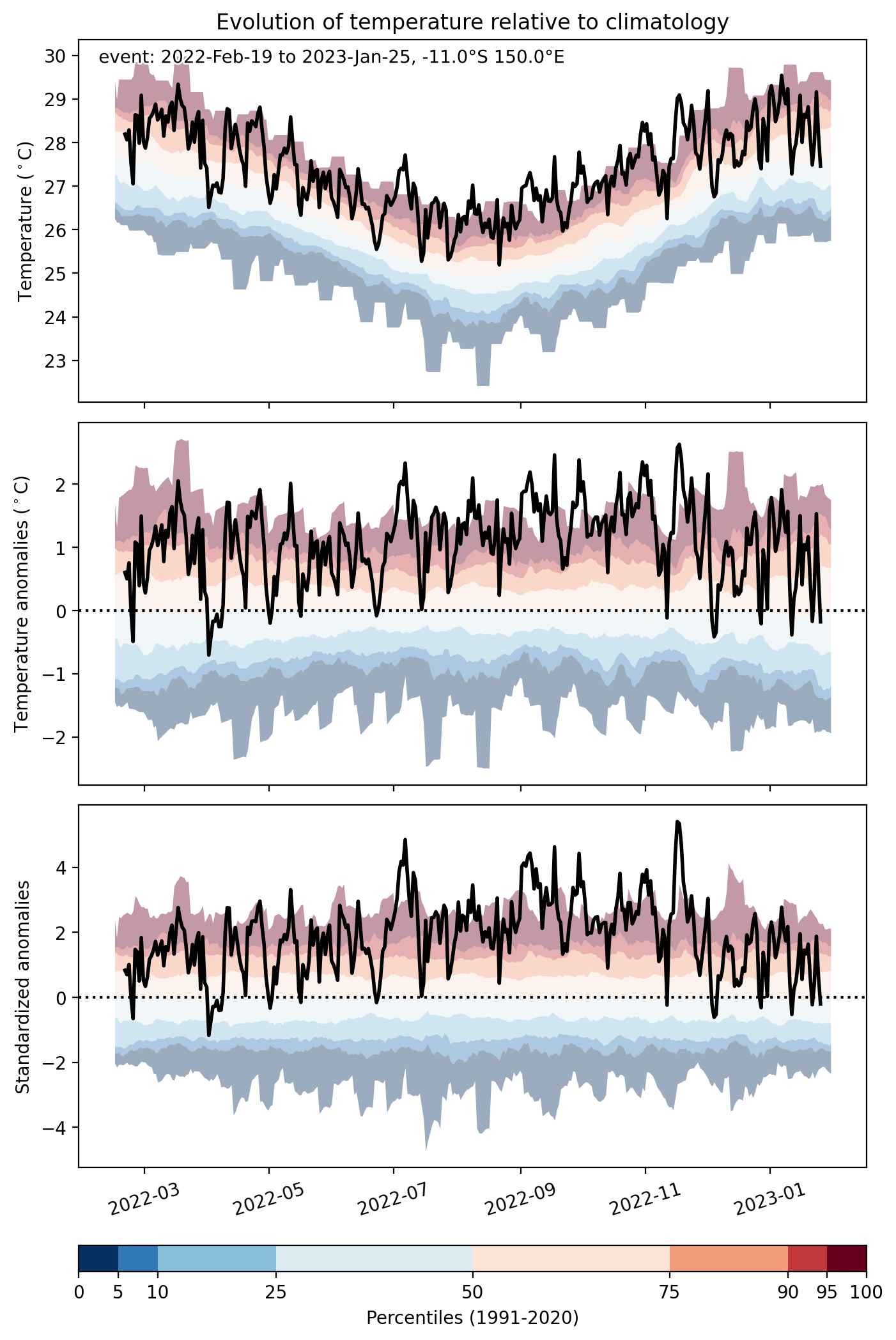
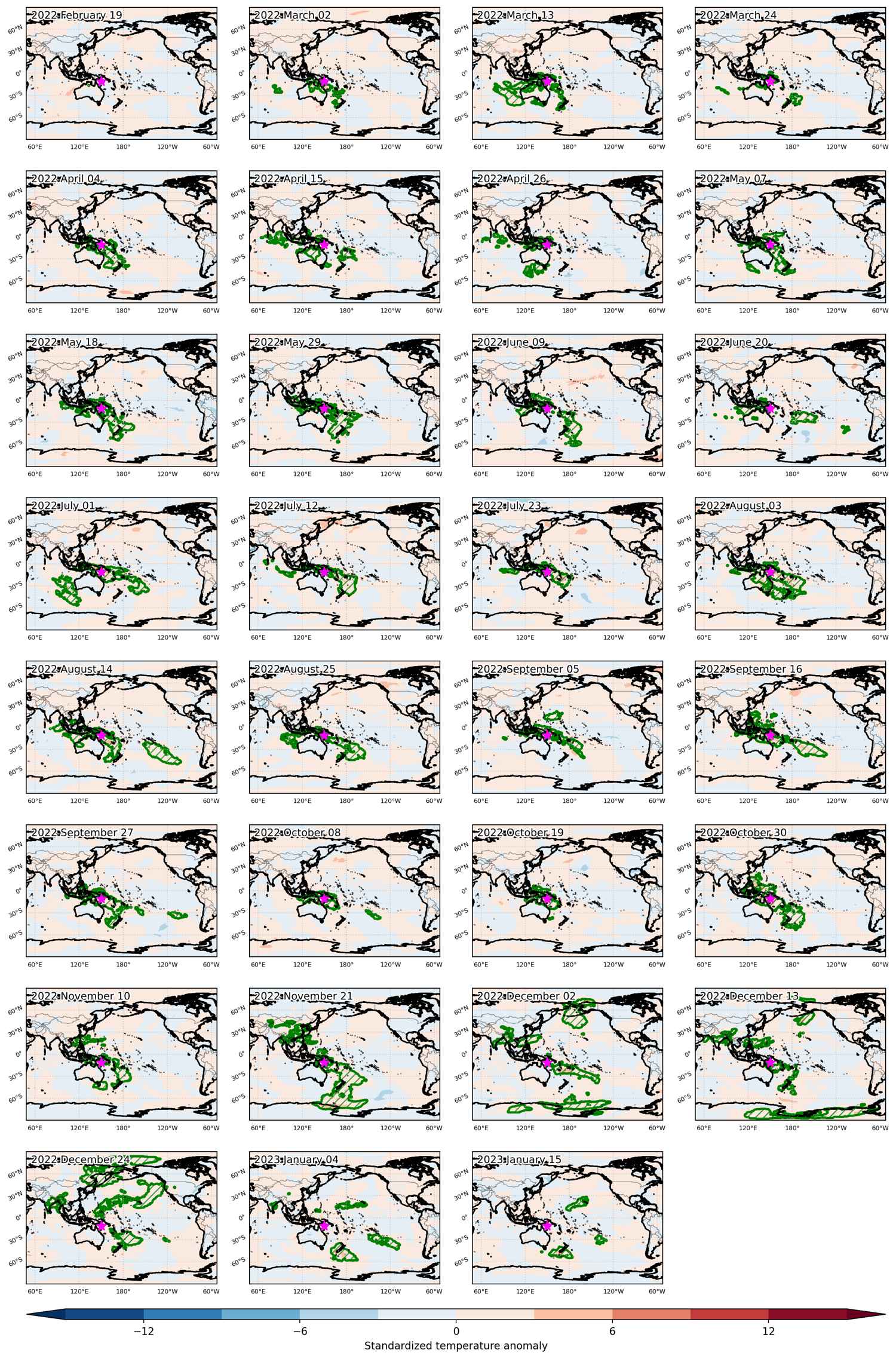
Heat wave occuring from February 19 2022 to January 25 2023 at -11.0°S 150.0°E

Download data: JSON

Event type: Heat wave

Countries affected (identified with ArcGIS Online; provided only for geographical reference):

  • Antarctica
  • Australia
  • Bangladesh
  • Bhutan
  • Cambodia
  • Canada
  • China
  • Christmas Island
  • Cook Islands
  • Fiji
  • French Polynesia
  • Hong Kong
  • India
  • Indonesia
  • Japan
  • Kazakhstan
  • Korea, Democratic People’s Republic of
  • Korea, Republic of
  • Kyrgyzstan
  • Lao People’s Democratic Republic
  • Malaysia
  • Maldives
  • Mongolia
  • Myanmar
  • Nepal
  • New Caledonia
  • New Zealand
  • Norfolk Island
  • Northern Mariana Islands
  • Oman
  • Pakistan
  • Papua New Guinea
  • Philippines
  • Russian Federation
  • Solomon Islands
  • Sri Lanka
  • Taiwan, Province of China
  • Thailand
  • Timor-Leste
  • Tonga
  • United States
  • Vanuatu
  • Viet Nam

Duration: 341 days

Time span: February 19 2022 to January 25 2023

Statistics over entire affected area:

  • Mean temperature anomaly: 2.6 °C
  • Mean temperature: 19.0 °C
  • Maximum temperature anomaly: 33.4 °C
  • Maximum temperature: 37.4 °C

Event center: -11.0°S 150.0°E

Area affected: 154052228 km$^2$


Fig. 1: Map of most extreme temperature anomalies (standardized) experienced during the event. The purple star indicates the center of the extreme event. Green hatching illustrates all areas under the effect of extremes at some time during the event.


Fig. 2: Evolution of temperature at the center of the event. The climatological percentile distribution is illustrated with color shadings.


Fig. 3: Maps illustrating the evolution of standardized temperature anomalies during the event.

Event ID: Heat_wave_2022-Feb-19_to_2023-Jan-25_150.0_-11.0

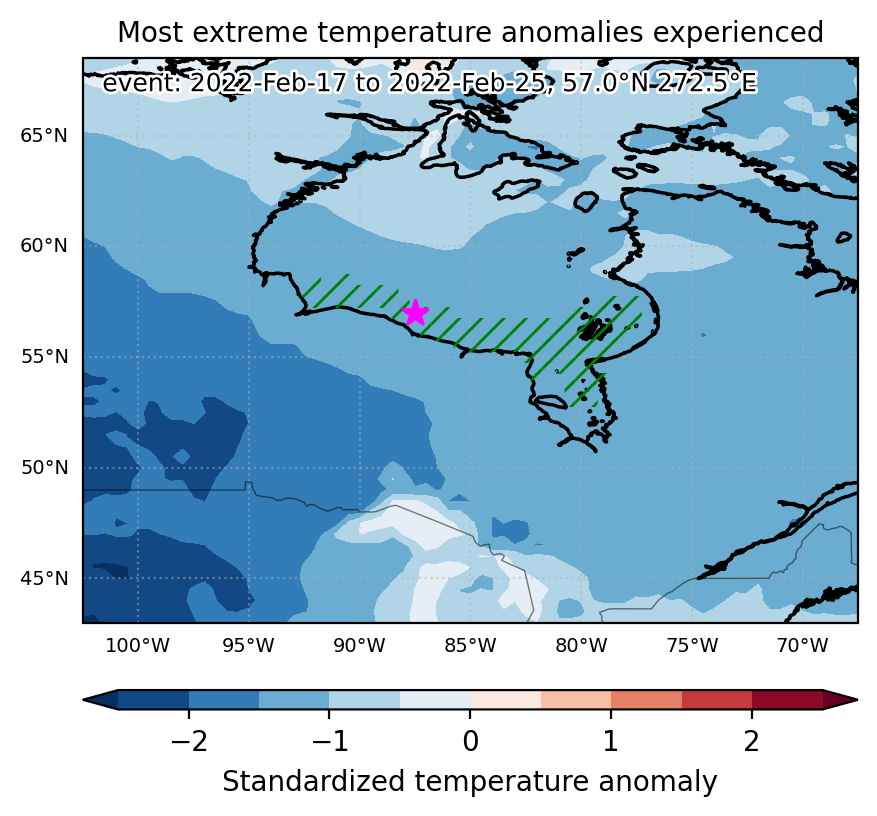
Cold spell occuring from February 17 2022 to February 25 2022 at 57.0°N 272.5°E

Download data: JSON

Event type: Cold spell

Countries affected (identified with ArcGIS Online; provided only for geographical reference):

  • Canada

Duration: 9 days

Time span: February 17 2022 to February 25 2022

Statistics over entire affected area:

  • Mean temperature anomaly: -6.9 °C
  • Mean temperature: -28.1 °C
  • Minimum temperature anomaly: -10.4 °C
  • Minimum temperature: -32.3 °C

Event center: 57.0°N 272.5°E

Area affected: 201424 km$^2$


Fig. 1: Map of most extreme temperature anomalies (standardized) experienced during the event. The purple star indicates the center of the extreme event. Green hatching illustrates all areas under the effect of extremes at some time during the event.


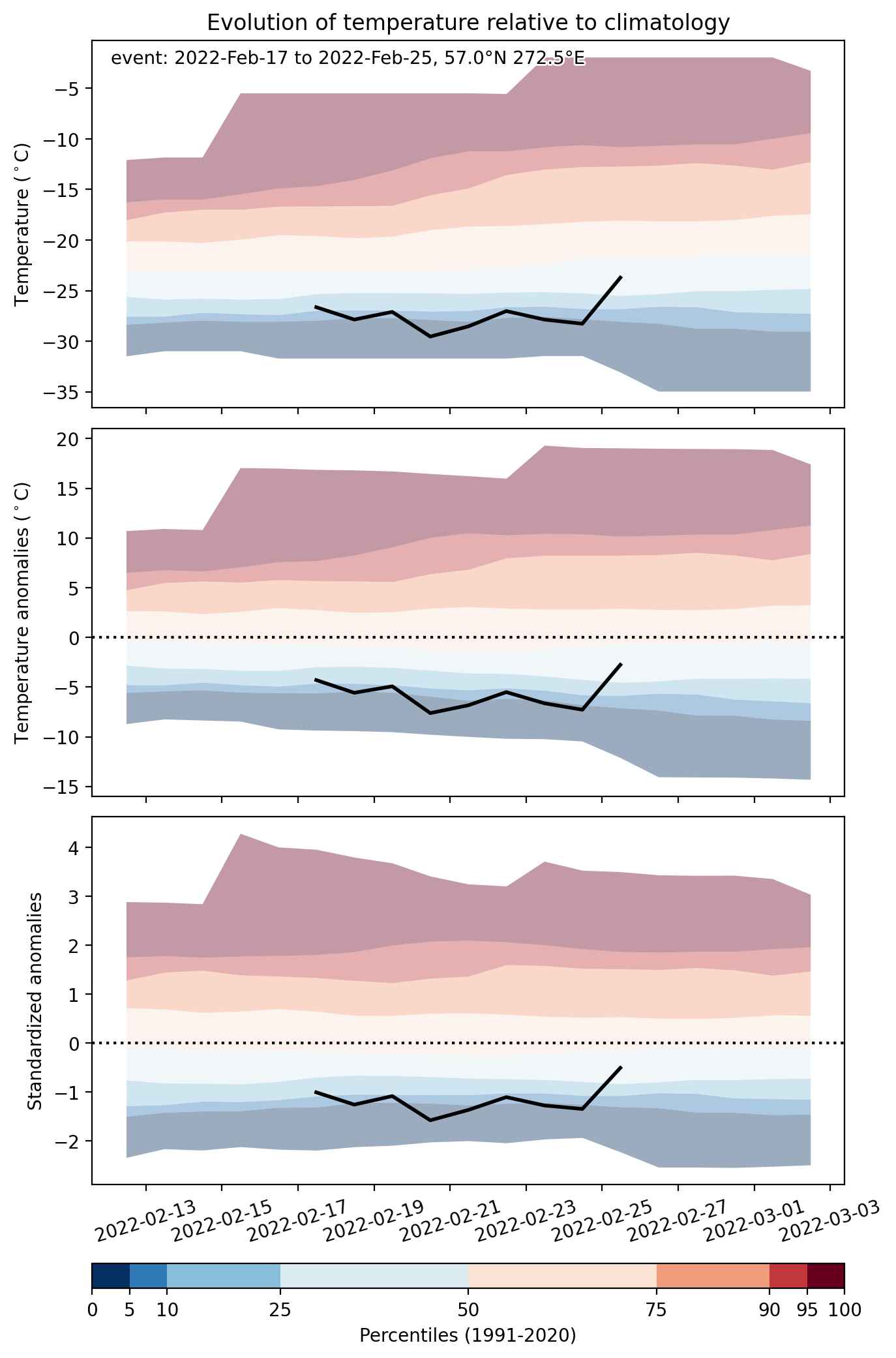
Fig. 2: Evolution of temperature at the center of the event. The climatological percentile distribution is illustrated with color shadings.


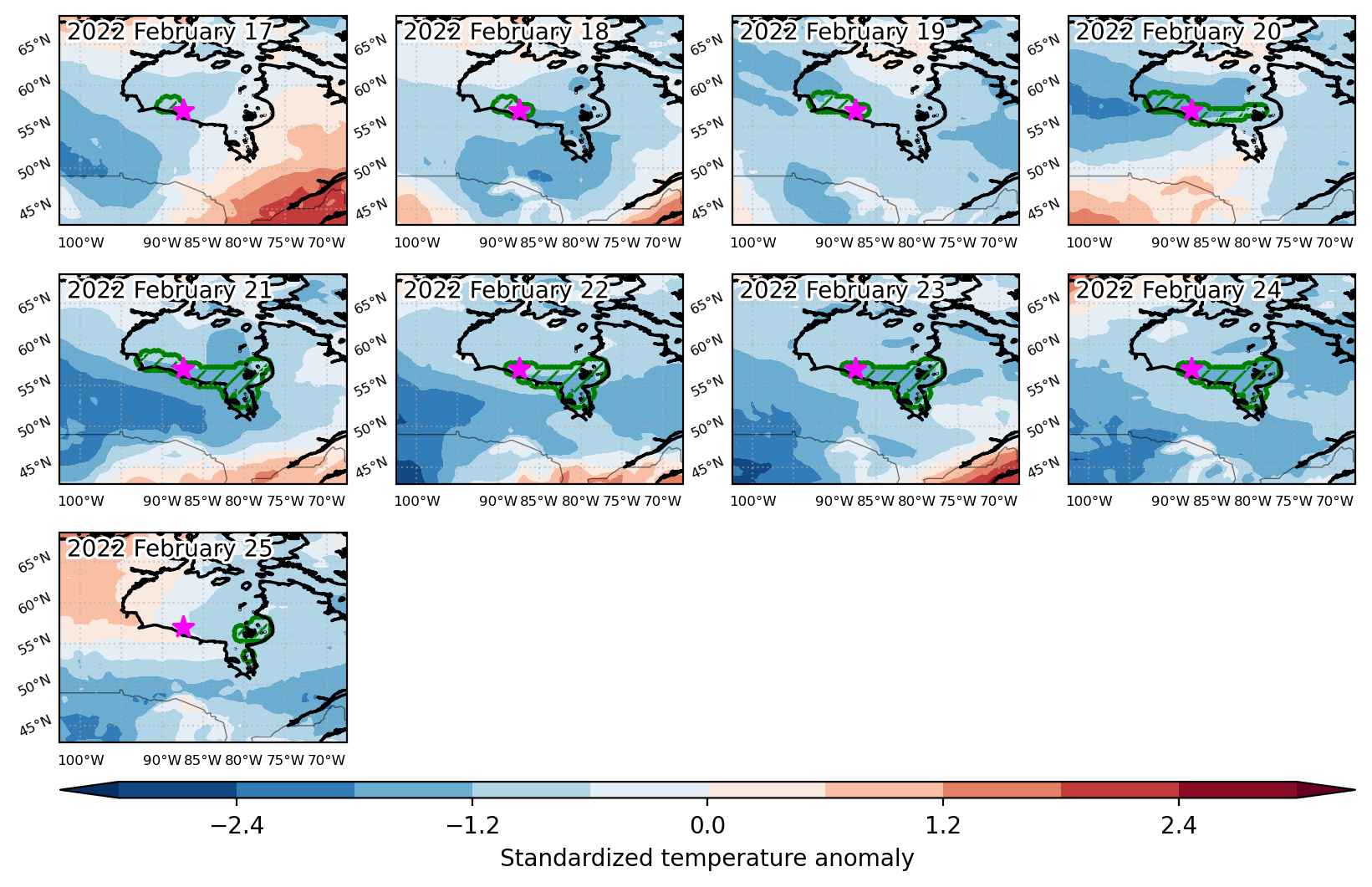
Fig. 3: Maps illustrating the evolution of standardized temperature anomalies during the event.

Event ID: Cold_spell_2022-Feb-17_to_2022-Feb-25_272.5_57.0

Cold spell occuring from February 17 2022 to February 19 2022 at 47.5°N 268.0°E

Download data: JSON

Event type: Cold spell

Countries affected (identified with ArcGIS Online; provided only for geographical reference):

  • Canada
  • United States

Duration: 3 days

Time span: February 17 2022 to February 19 2022

Statistics over entire affected area:

  • Mean temperature anomaly: -10.0 °C
  • Mean temperature: -20.3 °C
  • Minimum temperature anomaly: -12.8 °C
  • Minimum temperature: -25.5 °C

Event center: 47.5°N 268.0°E

Area affected: 57825 km$^2$


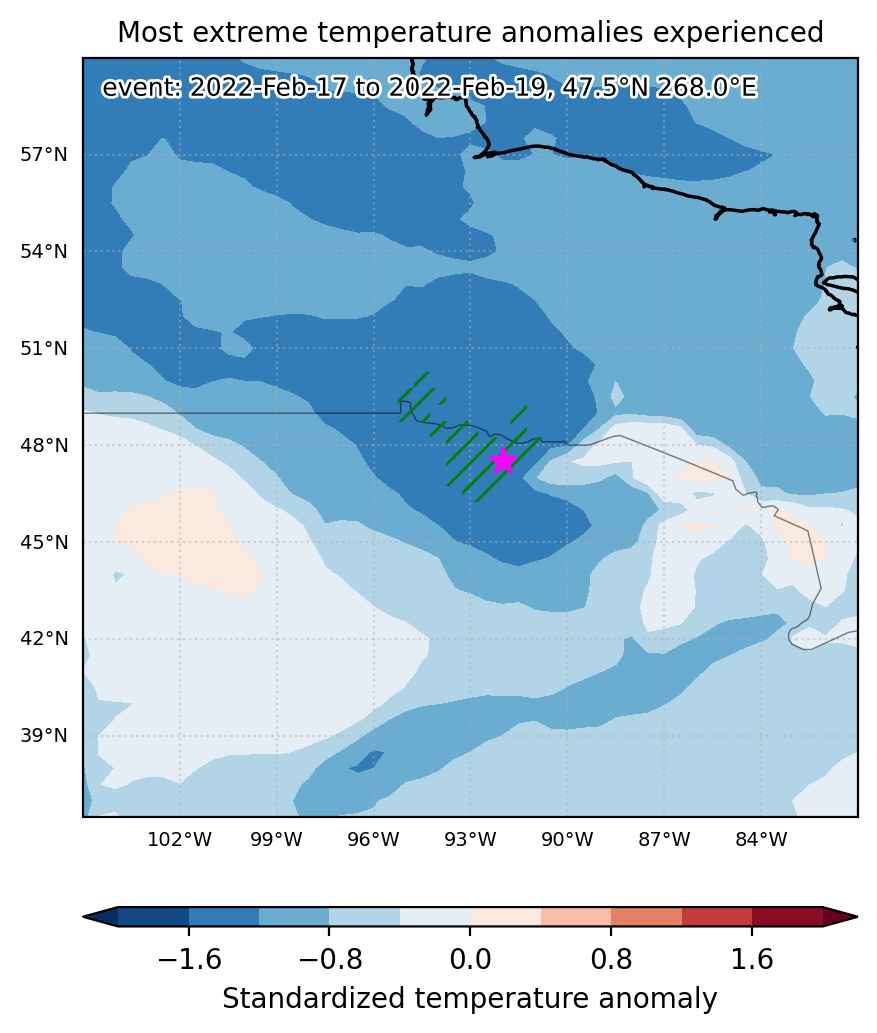
Fig. 1: Map of most extreme temperature anomalies (standardized) experienced during the event. The purple star indicates the center of the extreme event. Green hatching illustrates all areas under the effect of extremes at some time during the event.


Fig. 2: Evolution of temperature at the center of the event. The climatological percentile distribution is illustrated with color shadings.


Fig. 3: Maps illustrating the evolution of standardized temperature anomalies during the event.

Event ID: Cold_spell_2022-Feb-17_to_2022-Feb-19_268.0_47.5

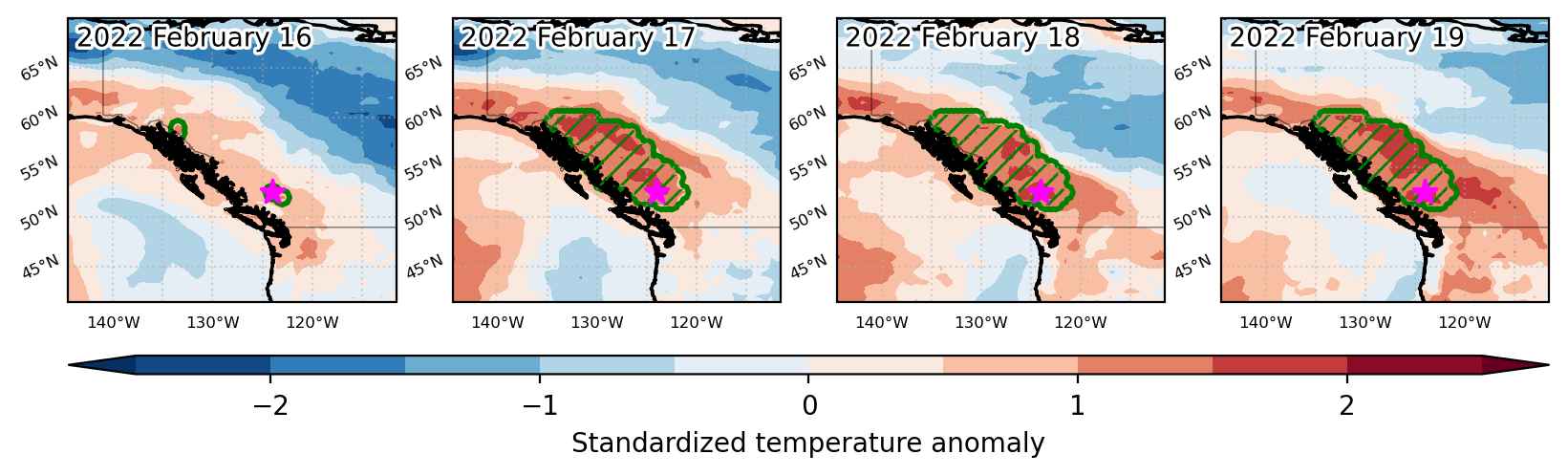
Heat wave occuring from February 16 2022 to February 19 2022 at 52.5°N 236.0°E

Download data: JSON

Event type: Heat wave

Countries affected (identified with ArcGIS Online; provided only for geographical reference):

  • Canada
  • United States

Duration: 4 days

Time span: February 16 2022 to February 19 2022

Statistics over entire affected area:

  • Mean temperature anomaly: 8.1 °C
  • Mean temperature: 0.0 °C
  • Maximum temperature anomaly: 12.3 °C
  • Maximum temperature: 5.9 °C

Event center: 52.5°N 236.0°E

Area affected: 375617 km$^2$


Fig. 1: Map of most extreme temperature anomalies (standardized) experienced during the event. The purple star indicates the center of the extreme event. Green hatching illustrates all areas under the effect of extremes at some time during the event.


Fig. 2: Evolution of temperature at the center of the event. The climatological percentile distribution is illustrated with color shadings.


Fig. 3: Maps illustrating the evolution of standardized temperature anomalies during the event.

Event ID: Heat_wave_2022-Feb-16_to_2022-Feb-19_236.0_52.5