Heat wave occuring from May 11 2010 to May 16 2010 at 55.0°N 276.0°E

Download data: JSON

Event type: Heat wave

Countries affected (identified with ArcGIS Online; provided only for geographical reference):

  • Canada

Duration: 6 days

Time span: May 11 2010 to May 16 2010

Statistics over entire affected area:

  • Mean temperature anomaly: 8.0 °C
  • Mean temperature: 7.8 °C
  • Maximum temperature anomaly: 13.0 °C
  • Maximum temperature: 14.5 °C

Event center: 55.0°N 276.0°E

Area affected: 76510 km$^2$
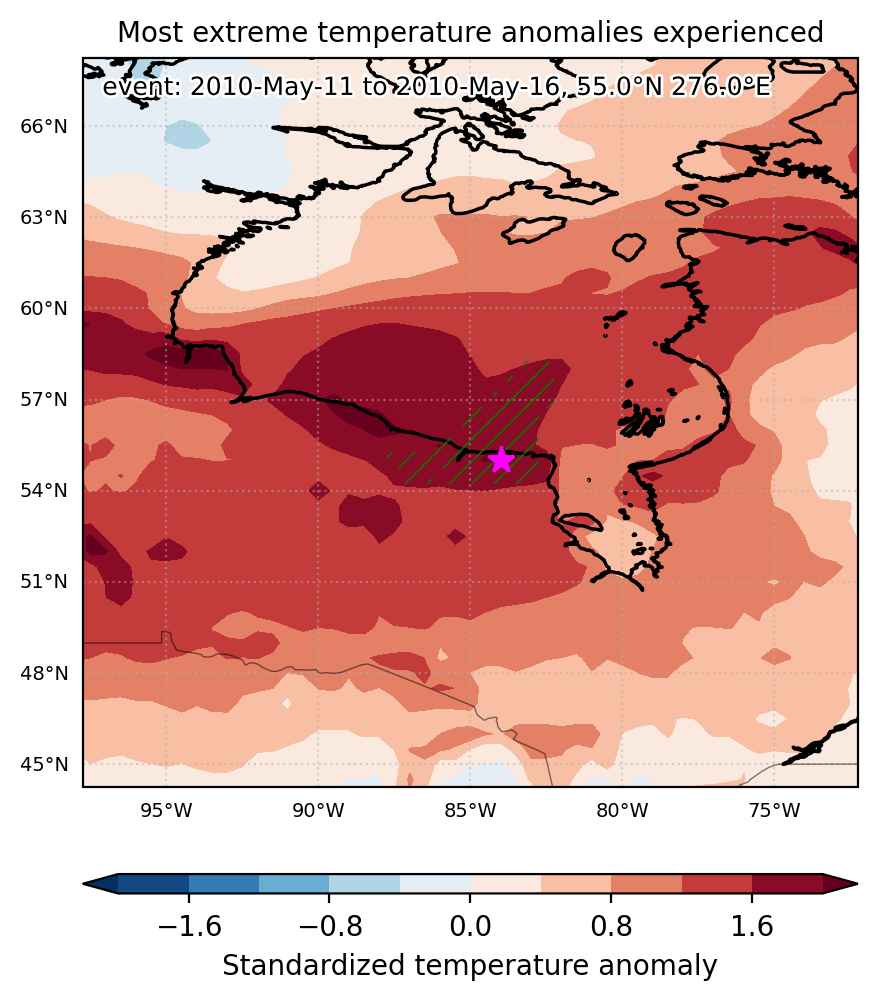

Fig. 1: Map of most extreme temperature anomalies (standardized) experienced during the event. The purple star indicates the center of the extreme event. Green hatching illustrates all areas under the effect of extremes at some time during the event.
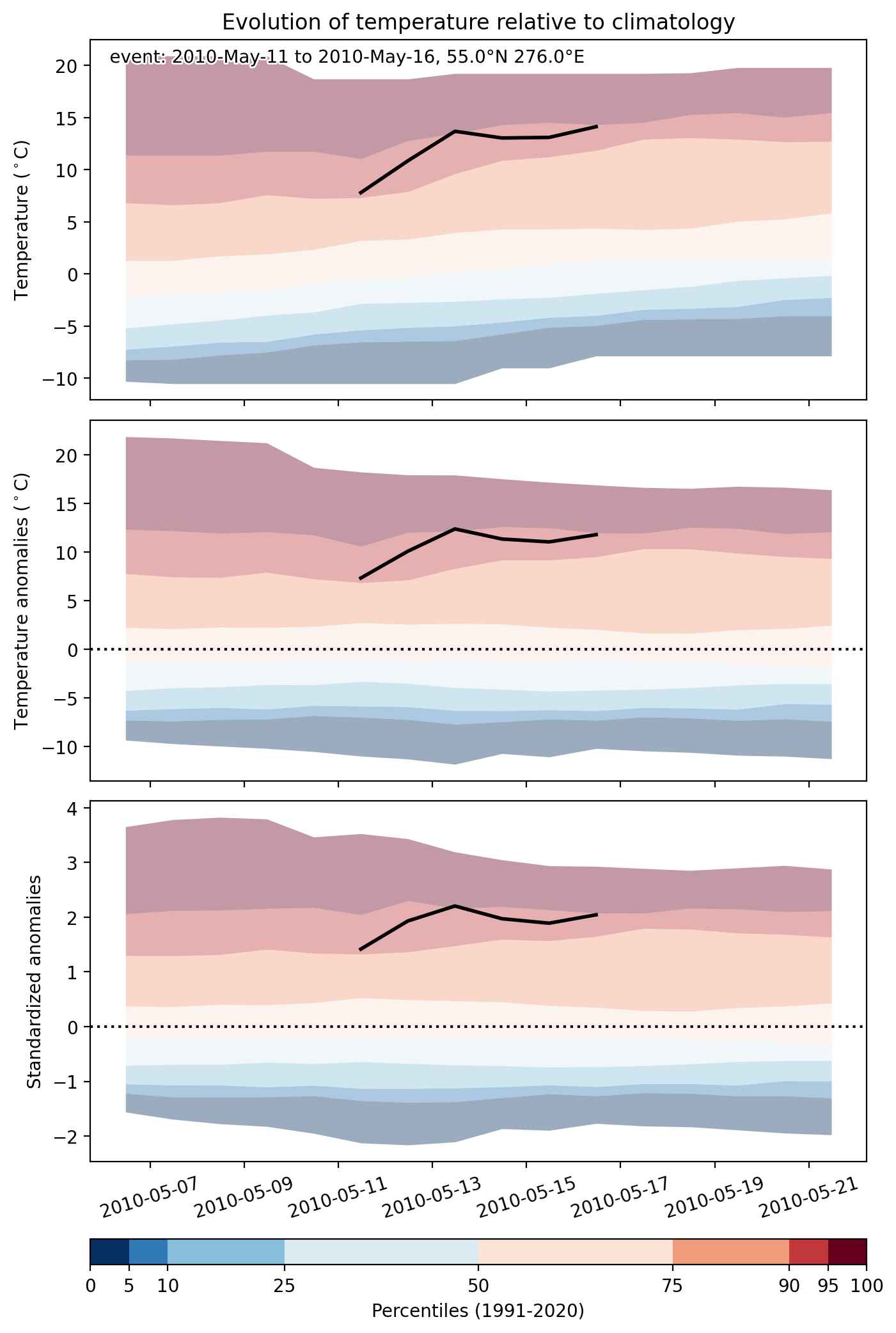


Fig. 2: Evolution of temperature at the center of the event. The climatological percentile distribution is illustrated with color shadings.
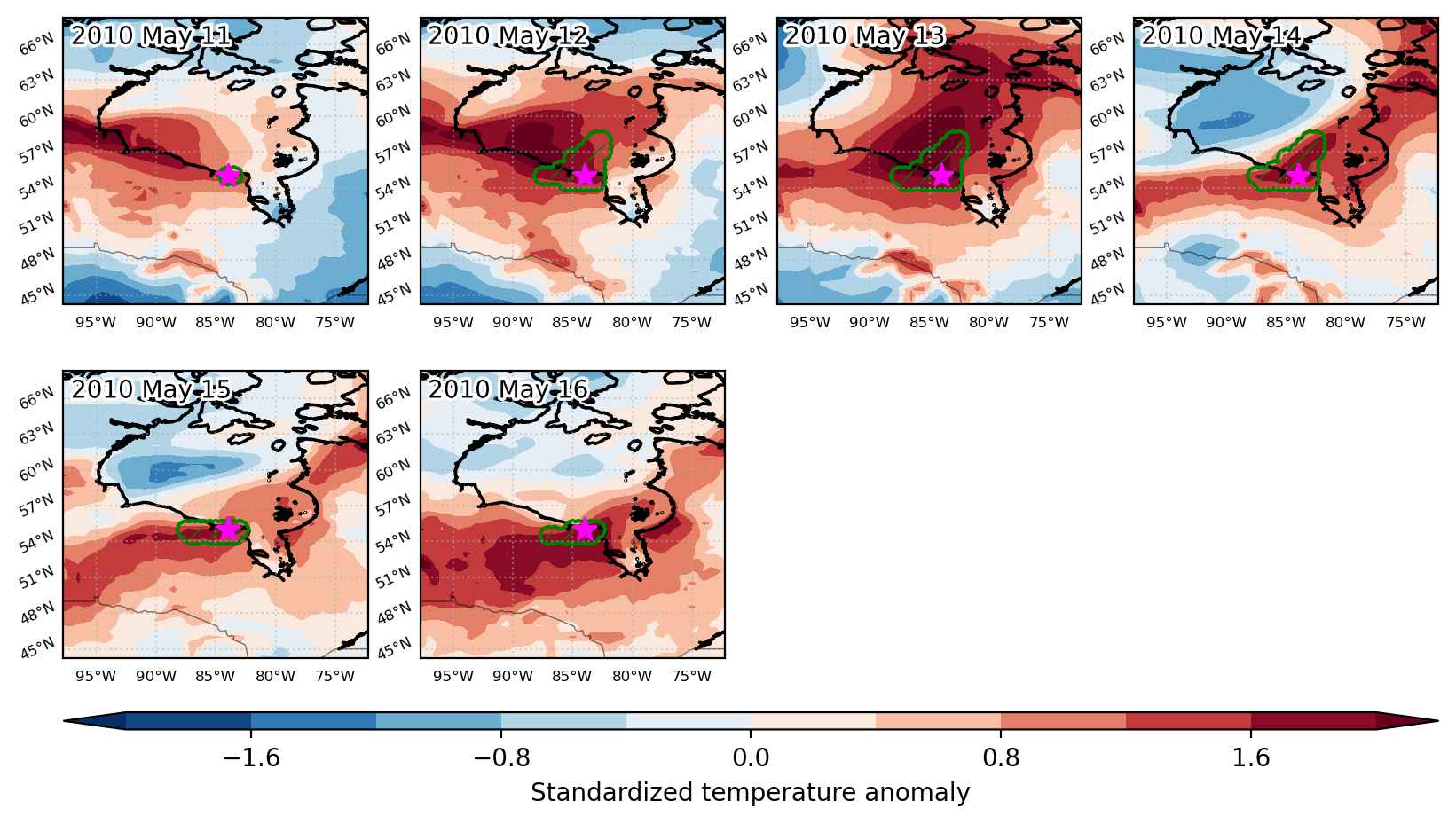


Fig. 3: Maps illustrating the evolution of standardized temperature anomalies during the event.

Event ID: Heat_wave_2010-May-11_to_2010-May-16_276.0_55.0
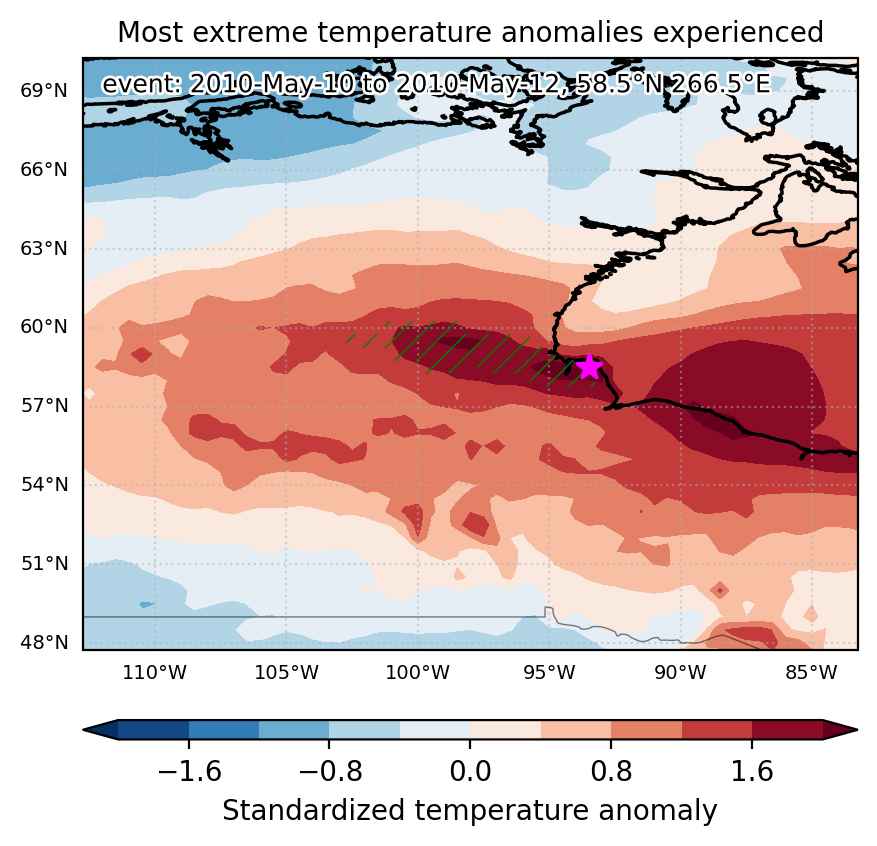
Heat wave occuring from May 10 2010 to May 12 2010 at 58.5°N 266.5°E

Download data: JSON

Event type: Heat wave

Countries affected (identified with ArcGIS Online; provided only for geographical reference):

  • Canada

Duration: 3 days

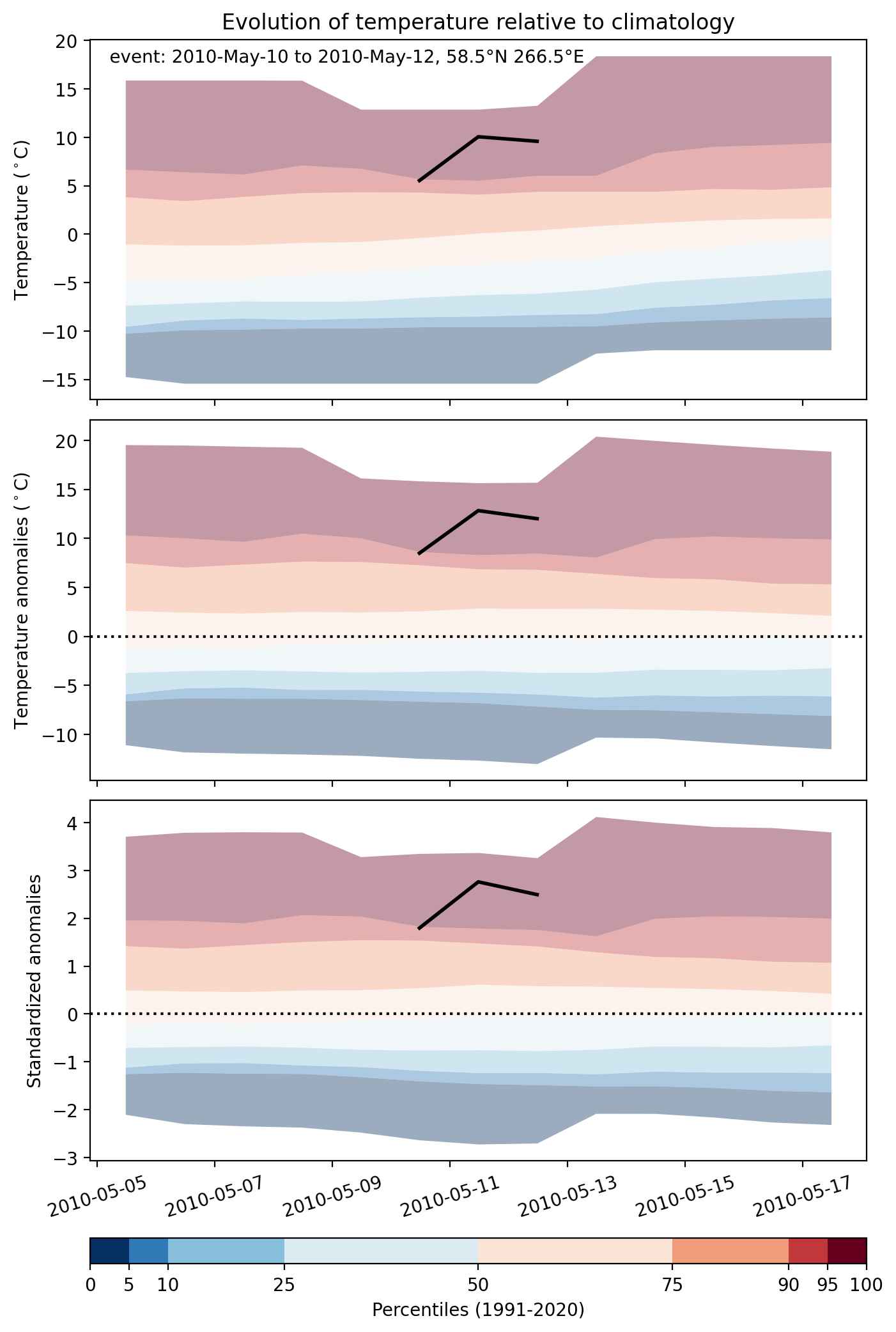
Time span: May 10 2010 to May 12 2010

Statistics over entire affected area:

  • Mean temperature anomaly: 9.7 °C
  • Mean temperature: 7.7 °C
  • Maximum temperature anomaly: 12.8 °C
  • Maximum temperature: 11.1 °C

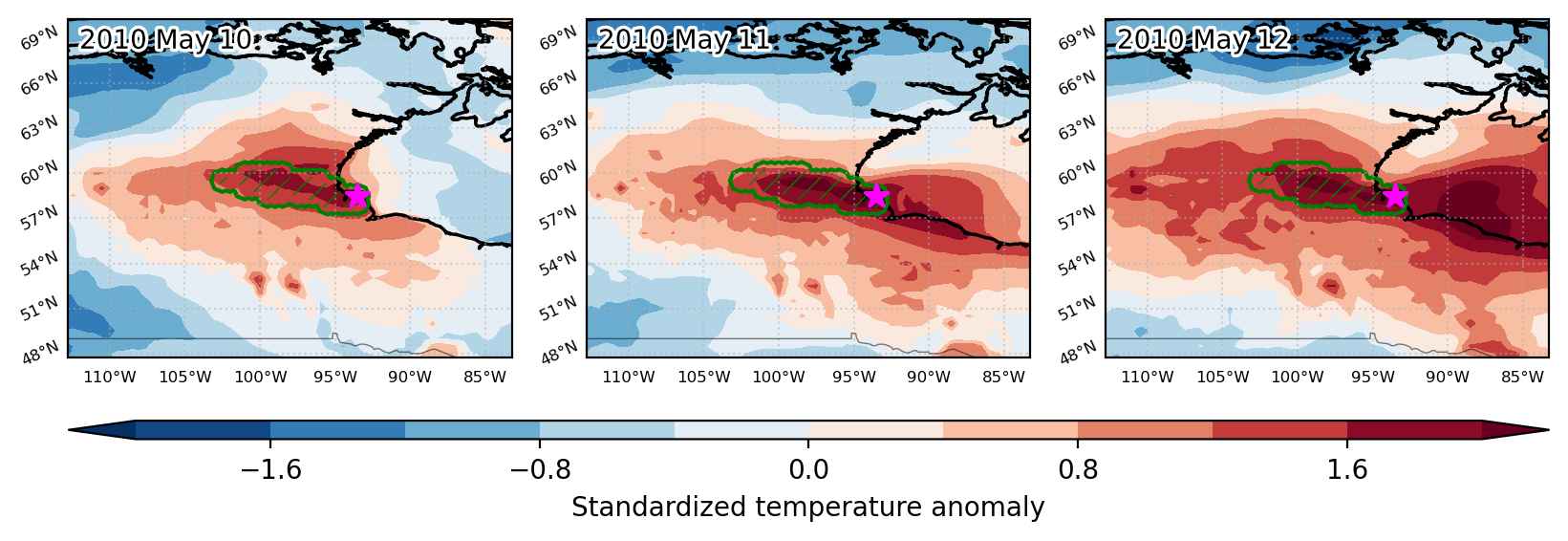
Event center: 58.5°N 266.5°E

Area affected: 79504 km$^2$


Fig. 1: Map of most extreme temperature anomalies (standardized) experienced during the event. The purple star indicates the center of the extreme event. Green hatching illustrates all areas under the effect of extremes at some time during the event.


Fig. 2: Evolution of temperature at the center of the event. The climatological percentile distribution is illustrated with color shadings.


Fig. 3: Maps illustrating the evolution of standardized temperature anomalies during the event.

Event ID: Heat_wave_2010-May-10_to_2010-May-12_266.5_58.5

Heat wave occuring from May 08 2010 to May 11 2010 at 66.0°N 297.5°E

Download data: JSON

Event type: Heat wave

Countries affected (identified with ArcGIS Online; provided only for geographical reference):

  • Canada

Duration: 4 days

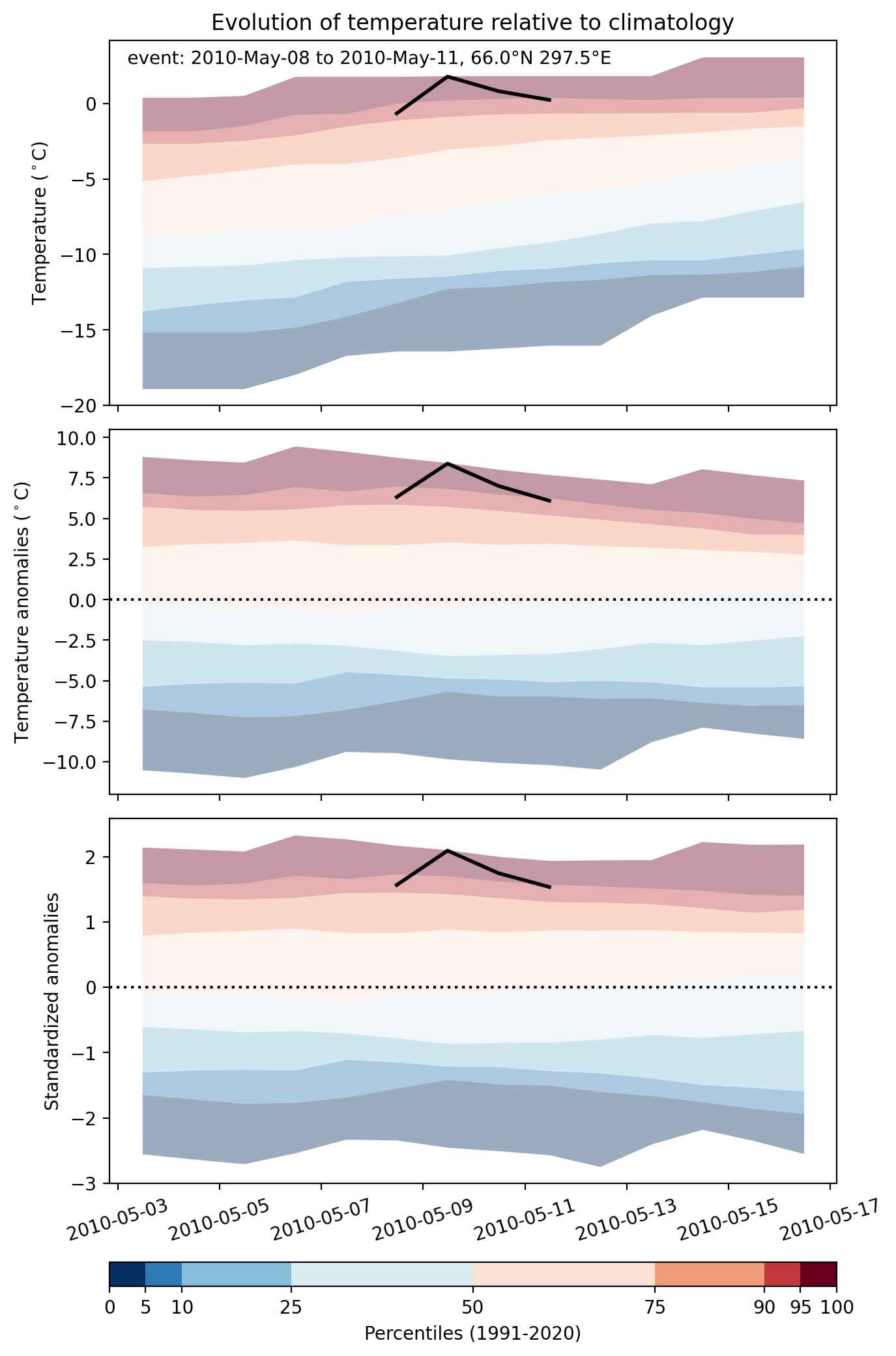
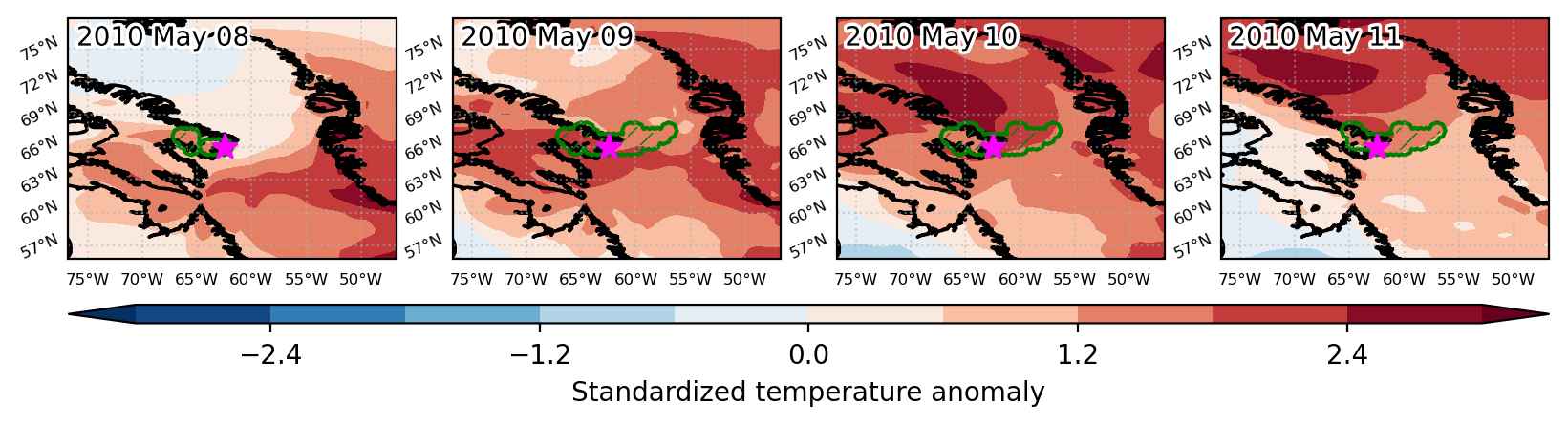
Time span: May 08 2010 to May 11 2010

Statistics over entire affected area:

  • Mean temperature anomaly: 7.2 °C
  • Mean temperature: -0.2 °C
  • Maximum temperature anomaly: 12.4 °C
  • Maximum temperature: 4.8 °C

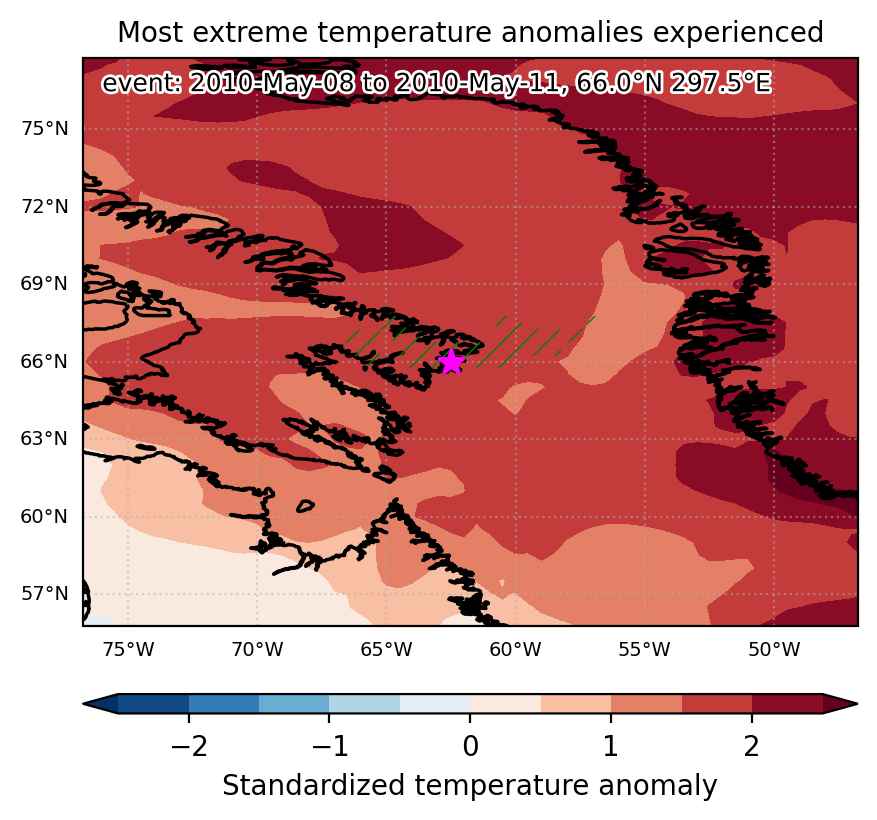
Event center: 66.0°N 297.5°E

Area affected: 51468 km$^2$


Fig. 1: Map of most extreme temperature anomalies (standardized) experienced during the event. The purple star indicates the center of the extreme event. Green hatching illustrates all areas under the effect of extremes at some time during the event.


Fig. 2: Evolution of temperature at the center of the event. The climatological percentile distribution is illustrated with color shadings.


Fig. 3: Maps illustrating the evolution of standardized temperature anomalies during the event.

Event ID: Heat_wave_2010-May-08_to_2010-May-11_297.5_66.0

Cold spell occuring from May 07 2010 to May 30 2010 at 54.0°N 183.0°E

Download data: JSON

Event type: Cold spell

Countries affected (identified with ArcGIS Online; provided only for geographical reference):

  • Canada
  • Mexico
  • Russian Federation
  • United States

Duration: 24 days

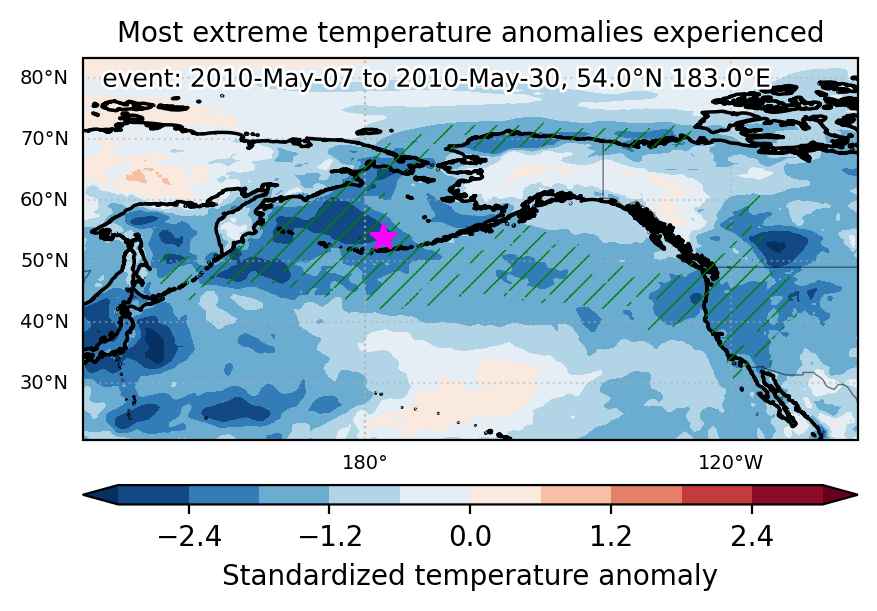
Time span: May 07 2010 to May 30 2010

Statistics over entire affected area:

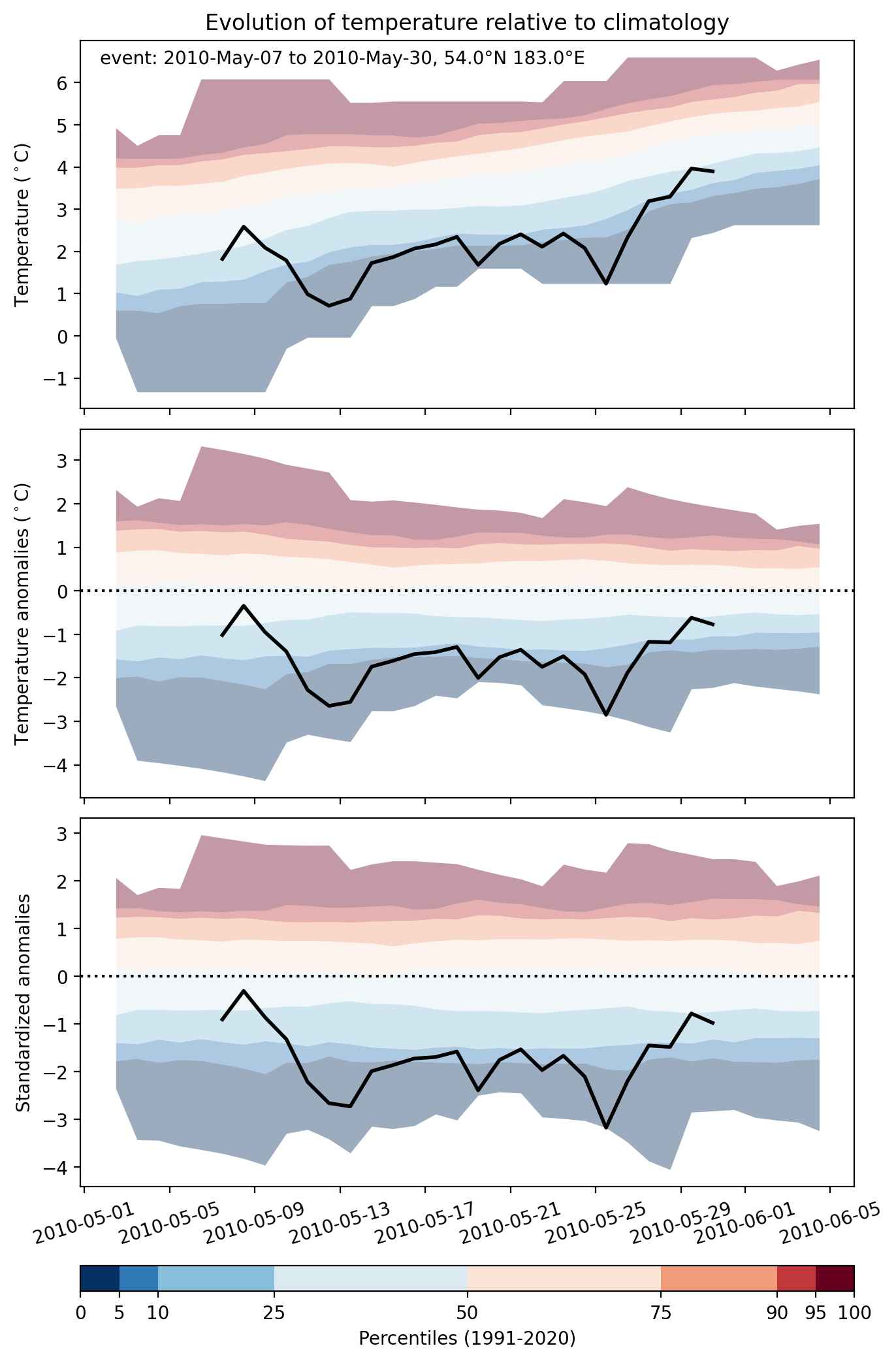
  • Mean temperature anomaly: -3.1 °C
  • Mean temperature: 2.2 °C
  • Minimum temperature anomaly: -12.4 °C
  • Minimum temperature: -14.8 °C

Event center: 54.0°N 183.0°E

Area affected: 9483848 km$^2$


Fig. 1: Map of most extreme temperature anomalies (standardized) experienced during the event. The purple star indicates the center of the extreme event. Green hatching illustrates all areas under the effect of extremes at some time during the event.


Fig. 2: Evolution of temperature at the center of the event. The climatological percentile distribution is illustrated with color shadings.


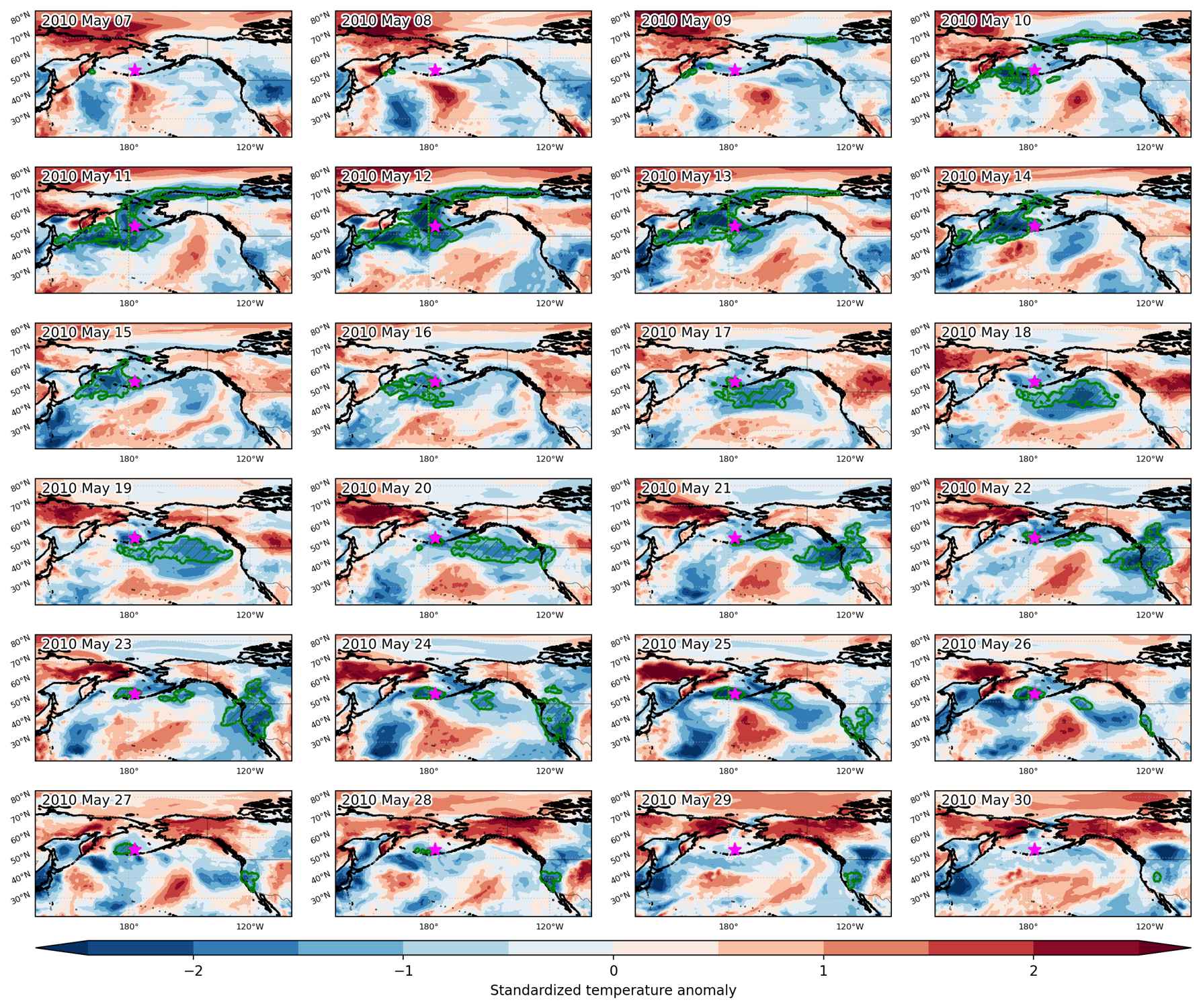
Fig. 3: Maps illustrating the evolution of standardized temperature anomalies during the event.

Event ID: Cold_spell_2010-May-07_to_2010-May-30_183.0_54.0

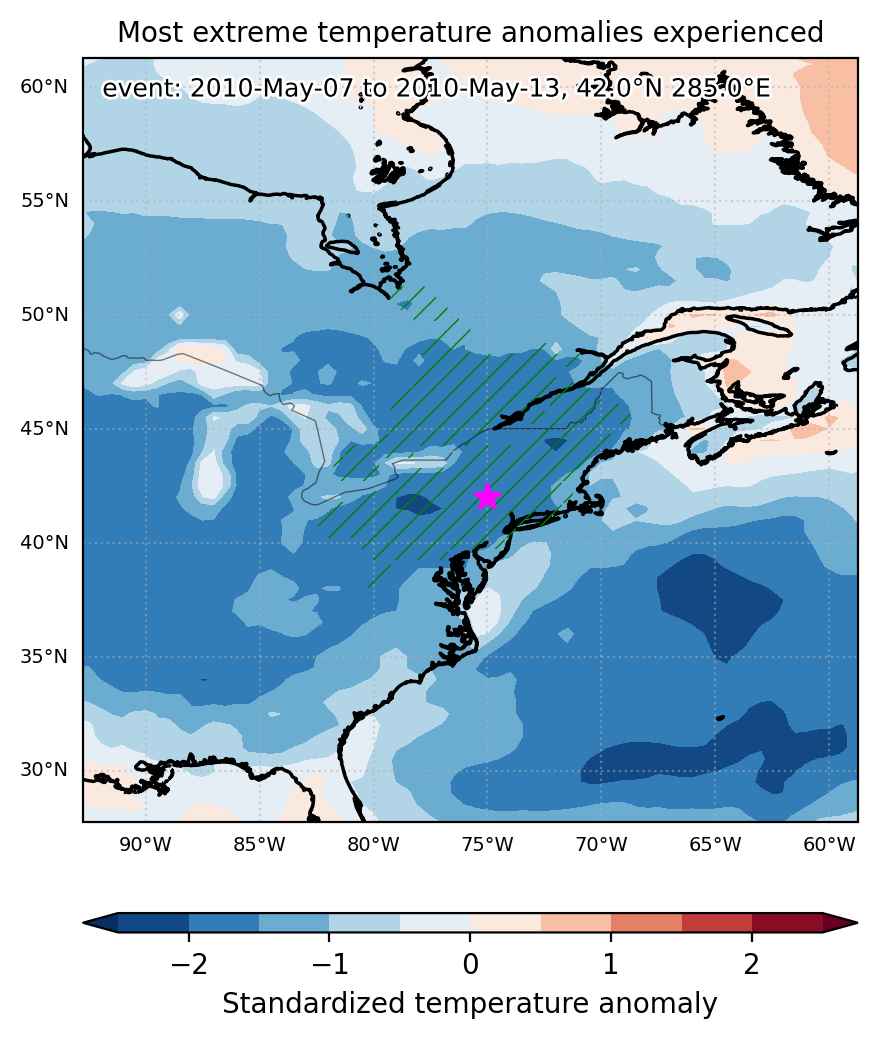
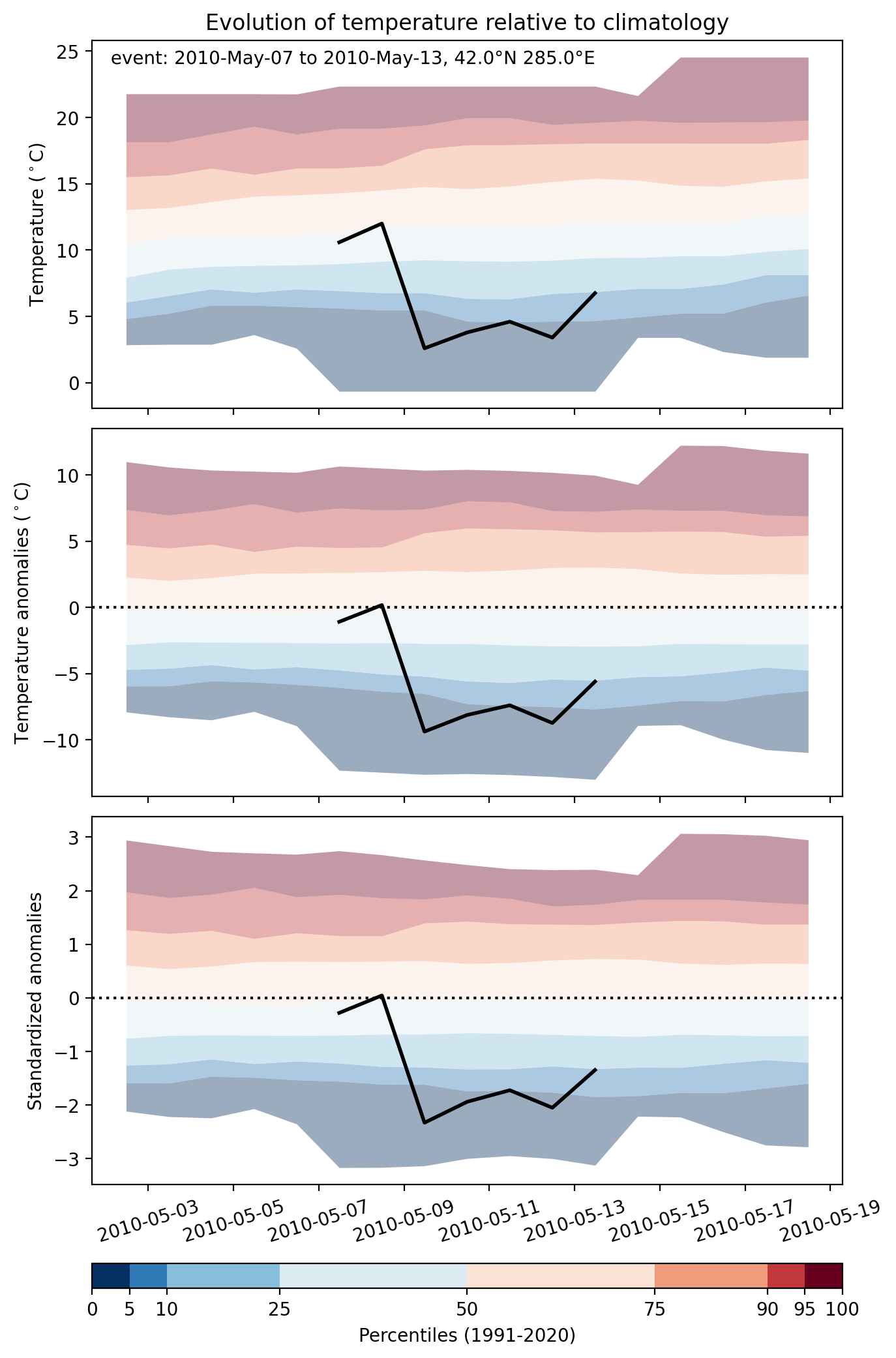
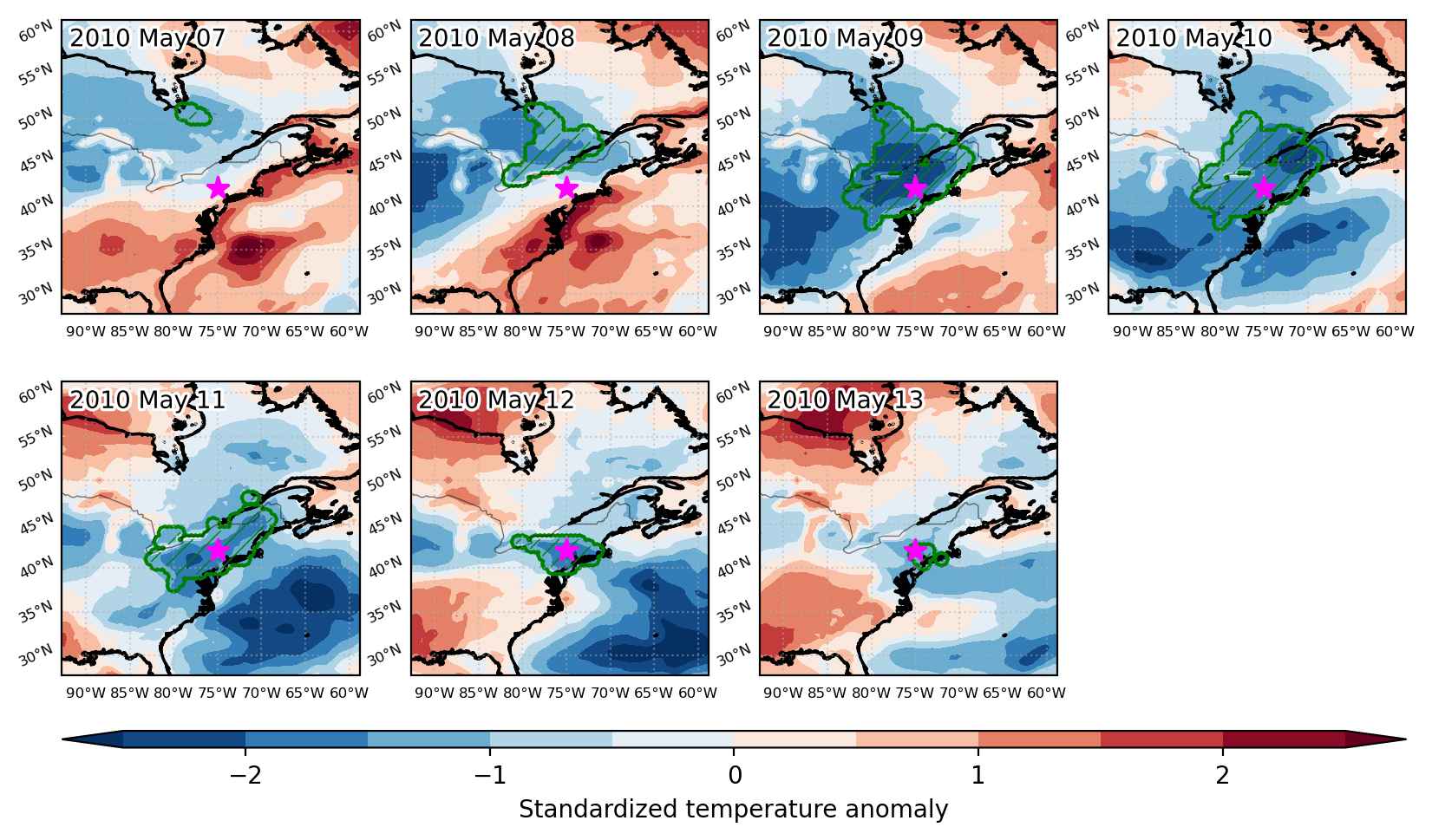
Cold spell occuring from May 07 2010 to May 13 2010 at 42.0°N 285.0°E

Download data: JSON

Event type: Cold spell

Countries affected (identified with ArcGIS Online; provided only for geographical reference):

  • Canada
  • United States

Duration: 7 days

Time span: May 07 2010 to May 13 2010

Statistics over entire affected area:

  • Mean temperature anomaly: -7.3 °C
  • Mean temperature: 4.2 °C
  • Minimum temperature anomaly: -11.7 °C
  • Minimum temperature: -5.4 °C

Event center: 42.0°N 285.0°E

Area affected: 717786 km$^2$


Fig. 1: Map of most extreme temperature anomalies (standardized) experienced during the event. The purple star indicates the center of the extreme event. Green hatching illustrates all areas under the effect of extremes at some time during the event.


Fig. 2: Evolution of temperature at the center of the event. The climatological percentile distribution is illustrated with color shadings.


Fig. 3: Maps illustrating the evolution of standardized temperature anomalies during the event.

Event ID: Cold_spell_2010-May-07_to_2010-May-13_285.0_42.0

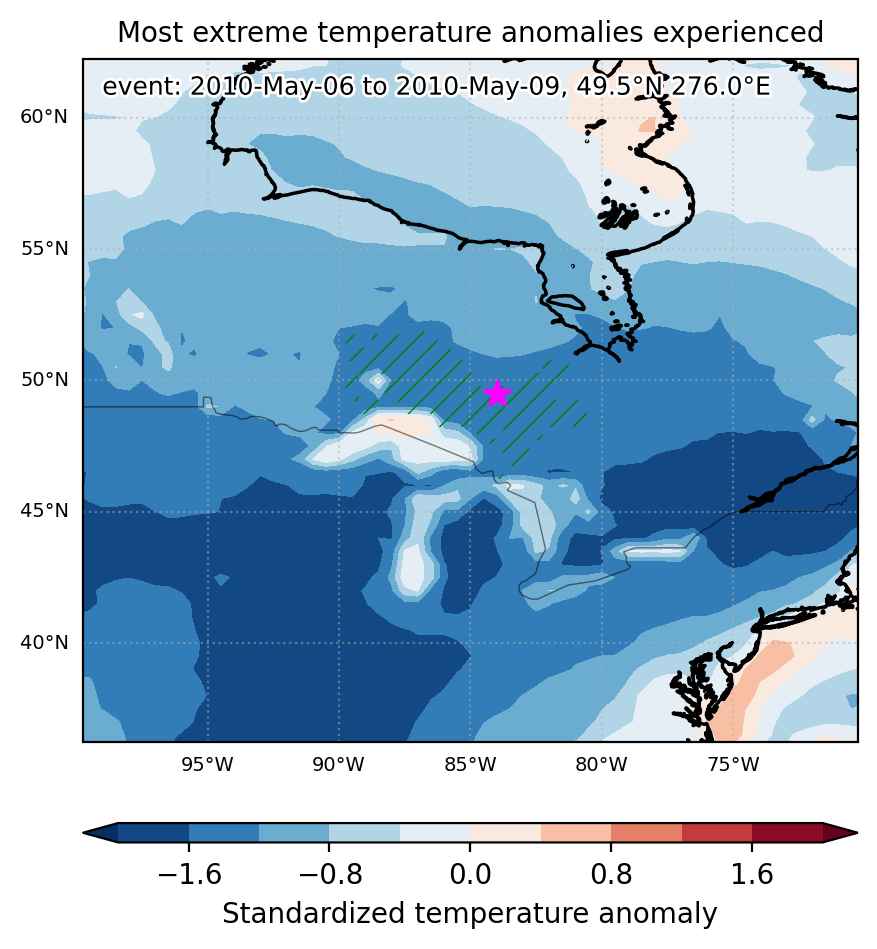
Cold spell occuring from May 06 2010 to May 09 2010 at 49.5°N 276.0°E

Download data: JSON

Event type: Cold spell

Countries affected (identified with ArcGIS Online; provided only for geographical reference):

  • Canada

Duration: 4 days

Time span: May 06 2010 to May 09 2010

Statistics over entire affected area:

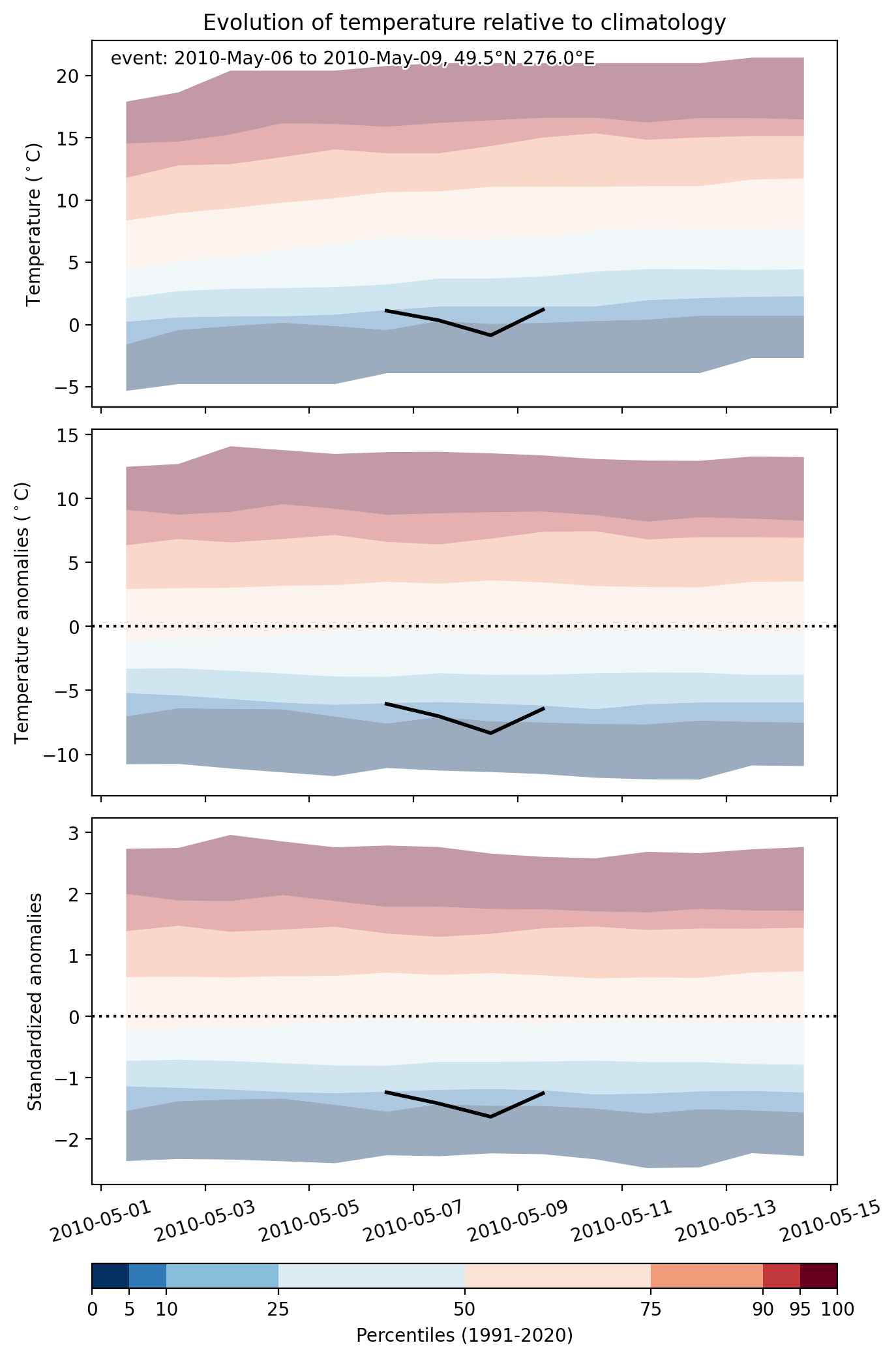
  • Mean temperature anomaly: -6.6 °C
  • Mean temperature: 0.6 °C
  • Minimum temperature anomaly: -9.9 °C
  • Minimum temperature: -2.9 °C

Event center: 49.5°N 276.0°E

Area affected: 178527 km$^2$


Fig. 1: Map of most extreme temperature anomalies (standardized) experienced during the event. The purple star indicates the center of the extreme event. Green hatching illustrates all areas under the effect of extremes at some time during the event.


Fig. 2: Evolution of temperature at the center of the event. The climatological percentile distribution is illustrated with color shadings.


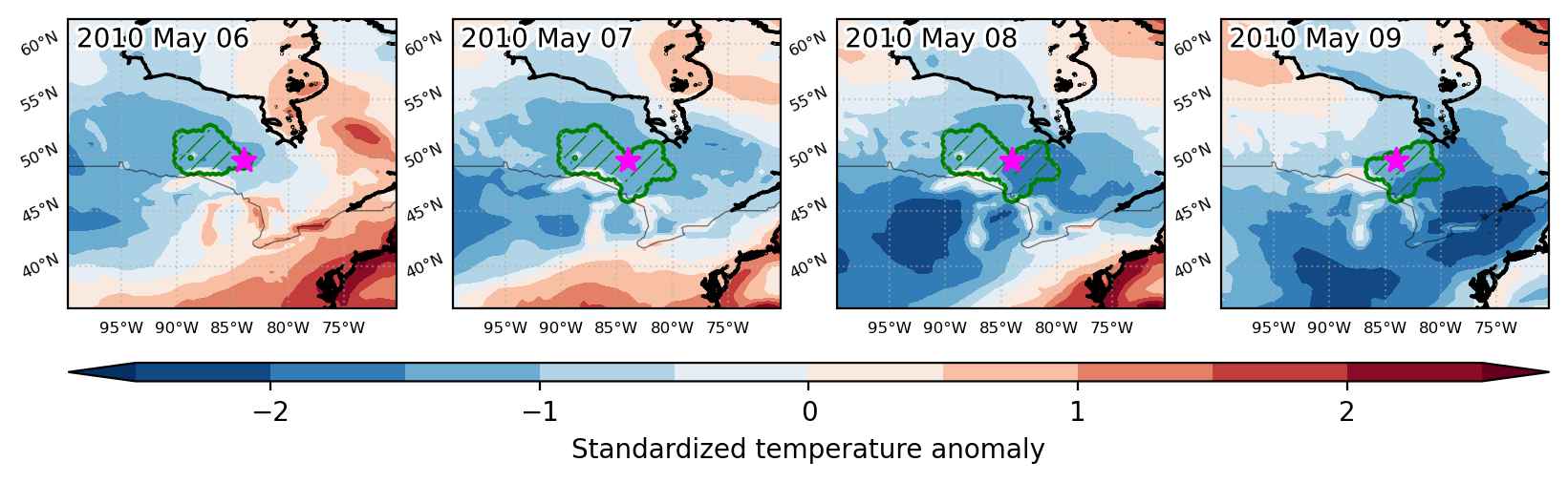
Fig. 3: Maps illustrating the evolution of standardized temperature anomalies during the event.

Event ID: Cold_spell_2010-May-06_to_2010-May-09_276.0_49.5

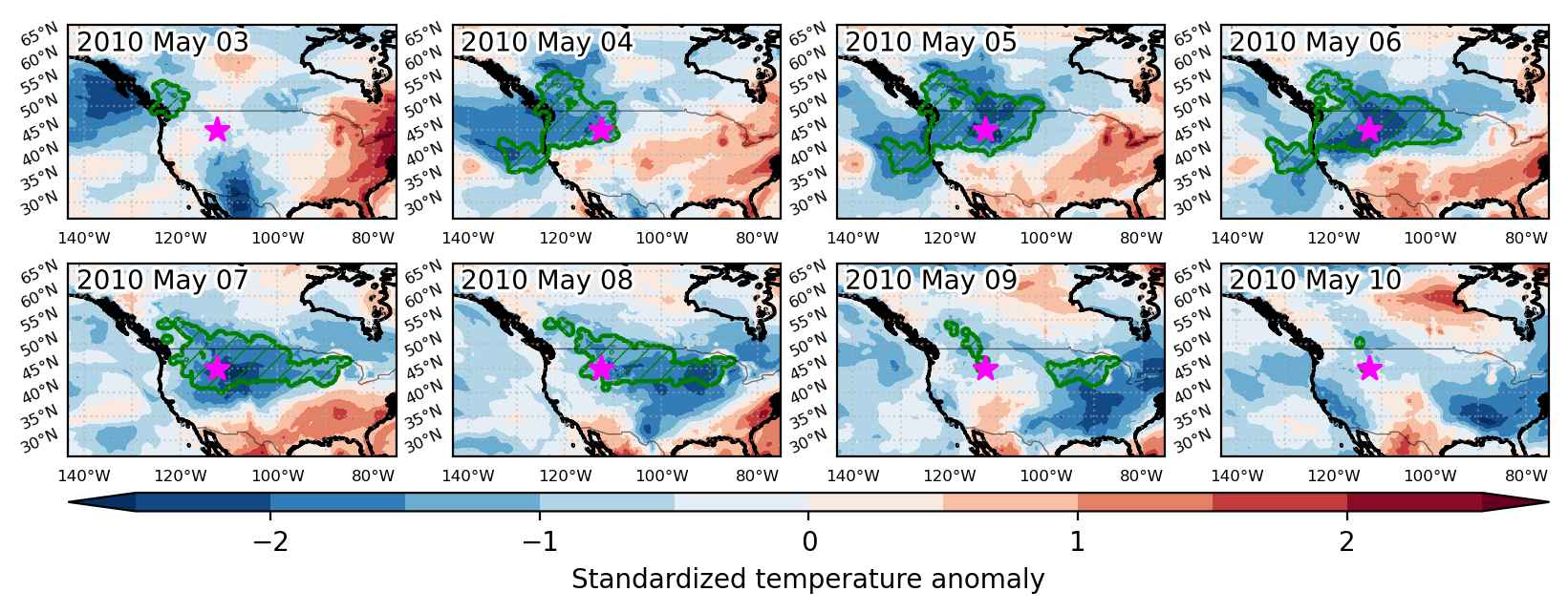
Cold spell occuring from May 03 2010 to May 10 2010 at 45.0°N 247.5°E

Download data: JSON

Event type: Cold spell

Countries affected (identified with ArcGIS Online; provided only for geographical reference):

  • Canada
  • United States

Duration: 8 days

Time span: May 03 2010 to May 10 2010

Statistics over entire affected area:

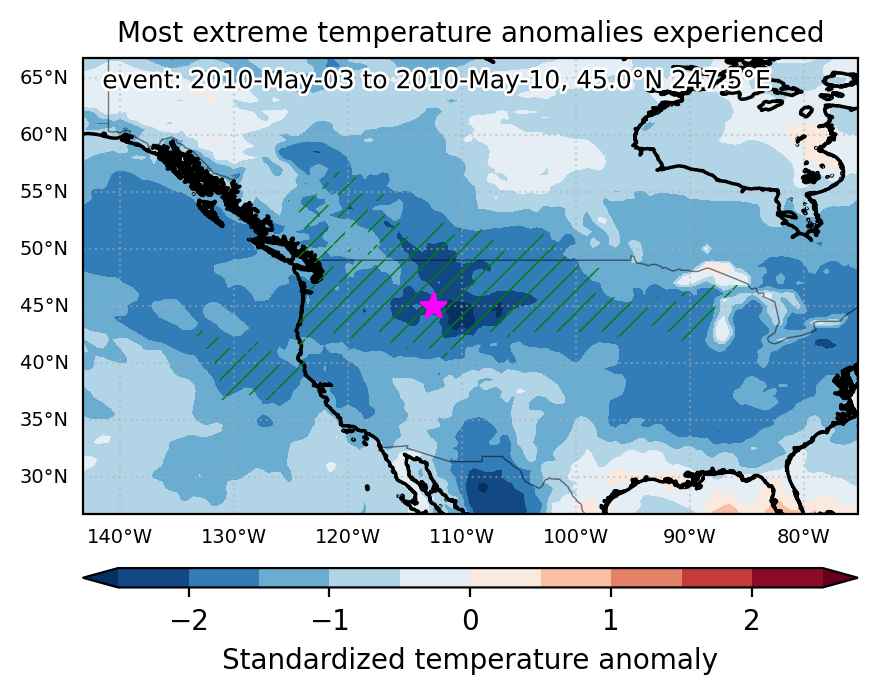
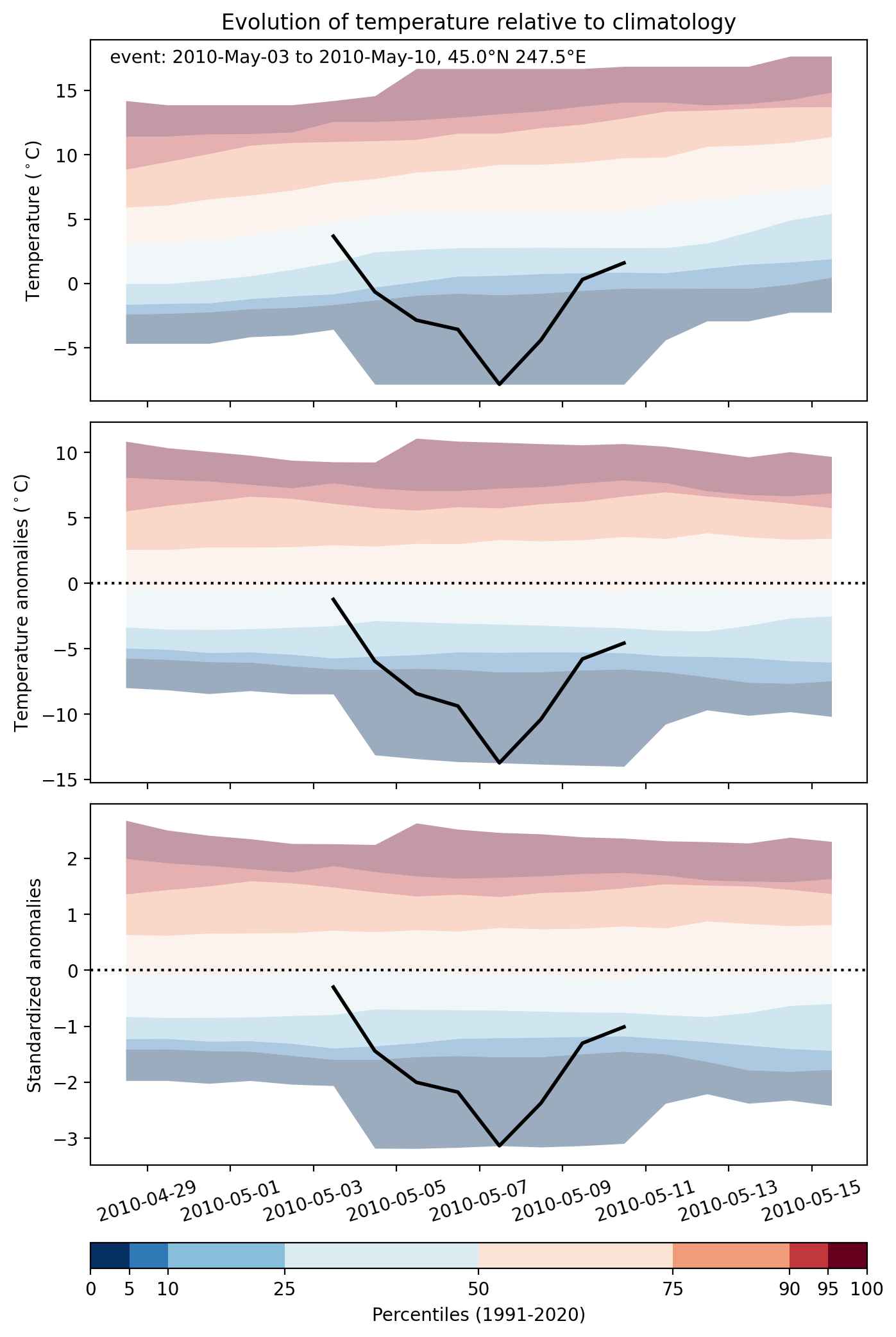
  • Mean temperature anomaly: -6.7 °C
  • Mean temperature: 2.4 °C
  • Minimum temperature anomaly: -14.5 °C
  • Minimum temperature: -10.7 °C

Event center: 45.0°N 247.5°E

Area affected: 2591672 km$^2$


Fig. 1: Map of most extreme temperature anomalies (standardized) experienced during the event. The purple star indicates the center of the extreme event. Green hatching illustrates all areas under the effect of extremes at some time during the event.


Fig. 2: Evolution of temperature at the center of the event. The climatological percentile distribution is illustrated with color shadings.


Fig. 3: Maps illustrating the evolution of standardized temperature anomalies during the event.

Event ID: Cold_spell_2010-May-03_to_2010-May-10_247.5_45.0

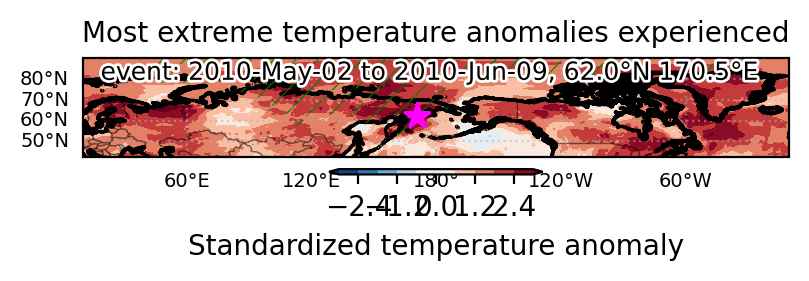
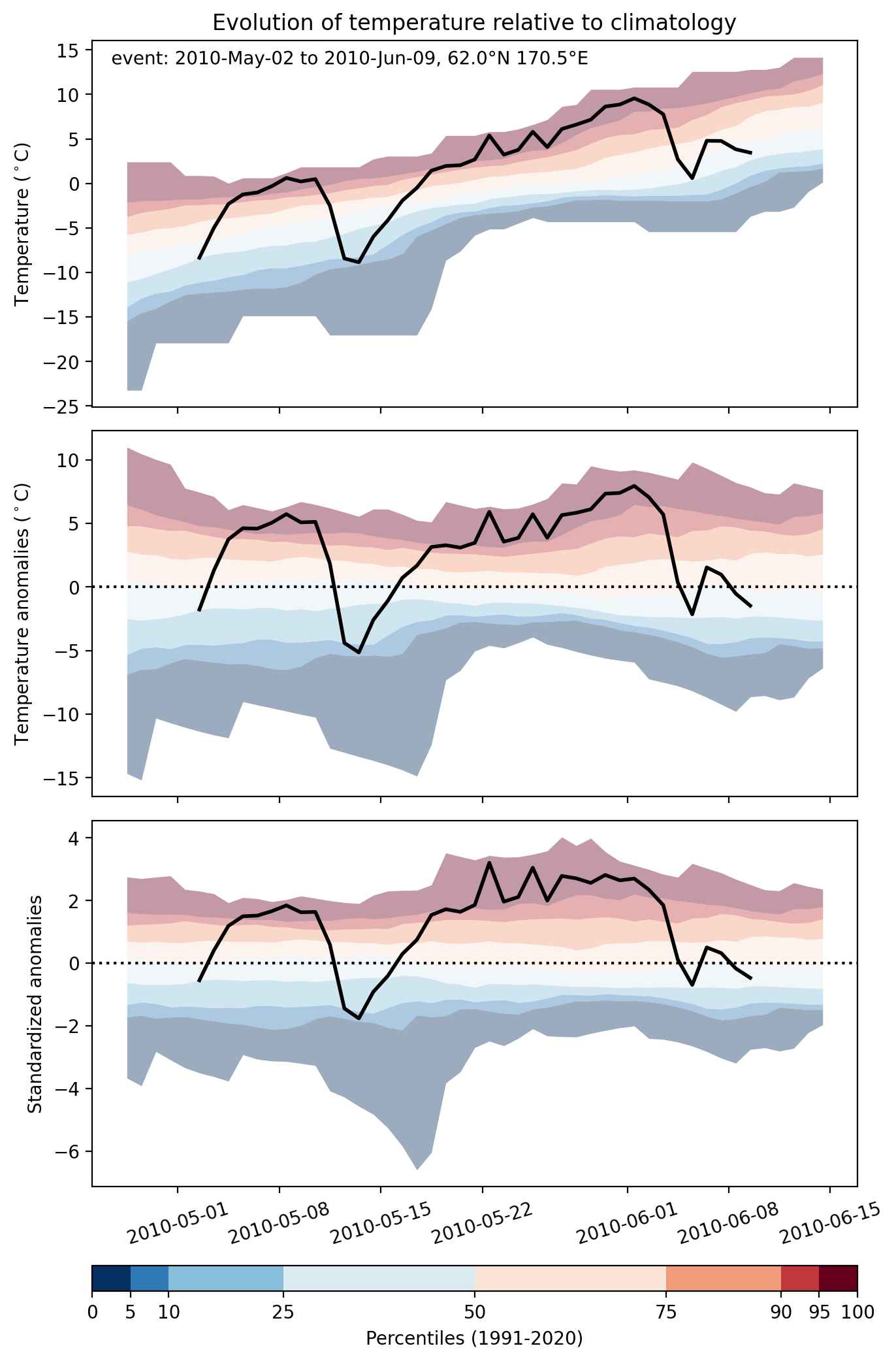
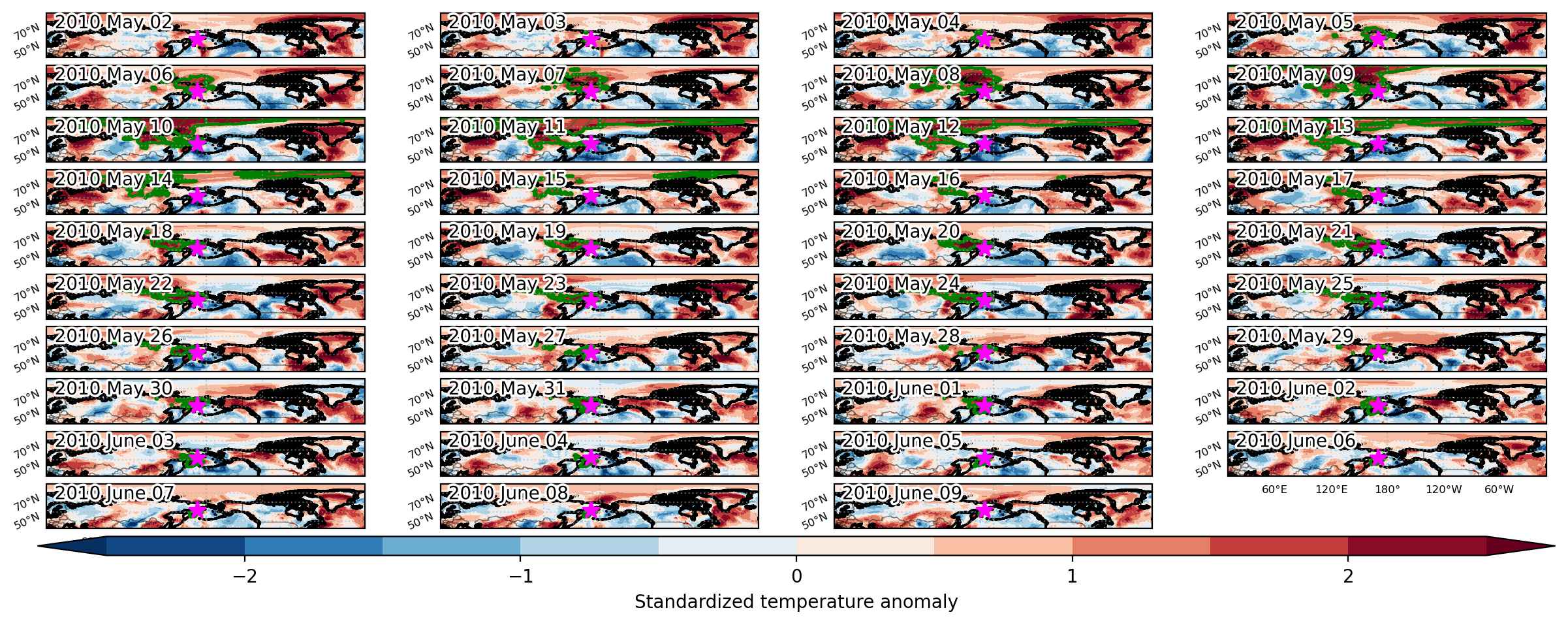
Heat wave occuring from May 02 2010 to June 09 2010 at 62.0°N 170.5°E

Download data: JSON

Event type: Heat wave

Countries affected (identified with ArcGIS Online; provided only for geographical reference):

  • Canada
  • Russian Federation

Duration: 39 days

Time span: May 02 2010 to June 09 2010

Statistics over entire affected area:

  • Mean temperature anomaly: 5.5 °C
  • Mean temperature: -0.2 °C
  • Maximum temperature anomaly: 14.8 °C
  • Maximum temperature: 21.5 °C

Event center: 62.0°N 170.5°E

Area affected: 8883668 km$^2$


Fig. 1: Map of most extreme temperature anomalies (standardized) experienced during the event. The purple star indicates the center of the extreme event. Green hatching illustrates all areas under the effect of extremes at some time during the event.


Fig. 2: Evolution of temperature at the center of the event. The climatological percentile distribution is illustrated with color shadings.


Fig. 3: Maps illustrating the evolution of standardized temperature anomalies during the event.

Event ID: Heat_wave_2010-May-02_to_2010-Jun-09_170.5_62.0

Heat wave occuring from April 29 2010 to May 08 2010 at 41.5°N 290.5°E

Download data: JSON

Event type: Heat wave

Countries affected (identified with ArcGIS Online; provided only for geographical reference):

  • Canada
  • United States

Duration: 10 days

Time span: April 29 2010 to May 08 2010

Statistics over entire affected area:

  • Mean temperature anomaly: 5.2 °C
  • Mean temperature: 17.7 °C
  • Maximum temperature anomaly: 12.7 °C
  • Maximum temperature: 27.9 °C

Event center: 41.5°N 290.5°E

Area affected: 1961897 km$^2$


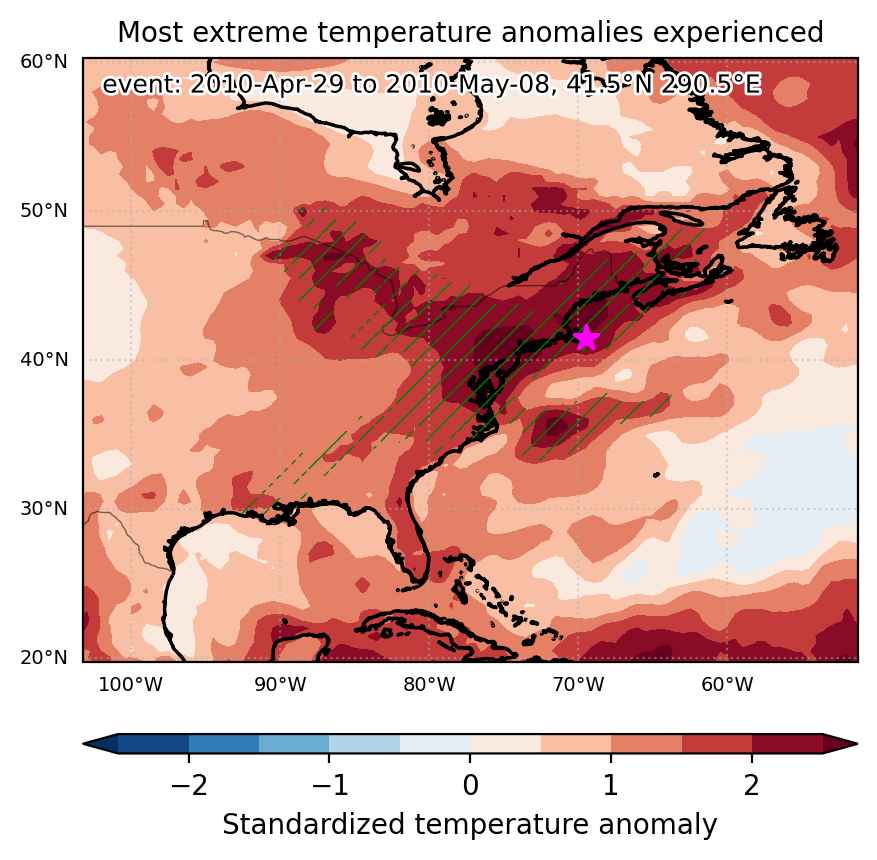
Fig. 1: Map of most extreme temperature anomalies (standardized) experienced during the event. The purple star indicates the center of the extreme event. Green hatching illustrates all areas under the effect of extremes at some time during the event.


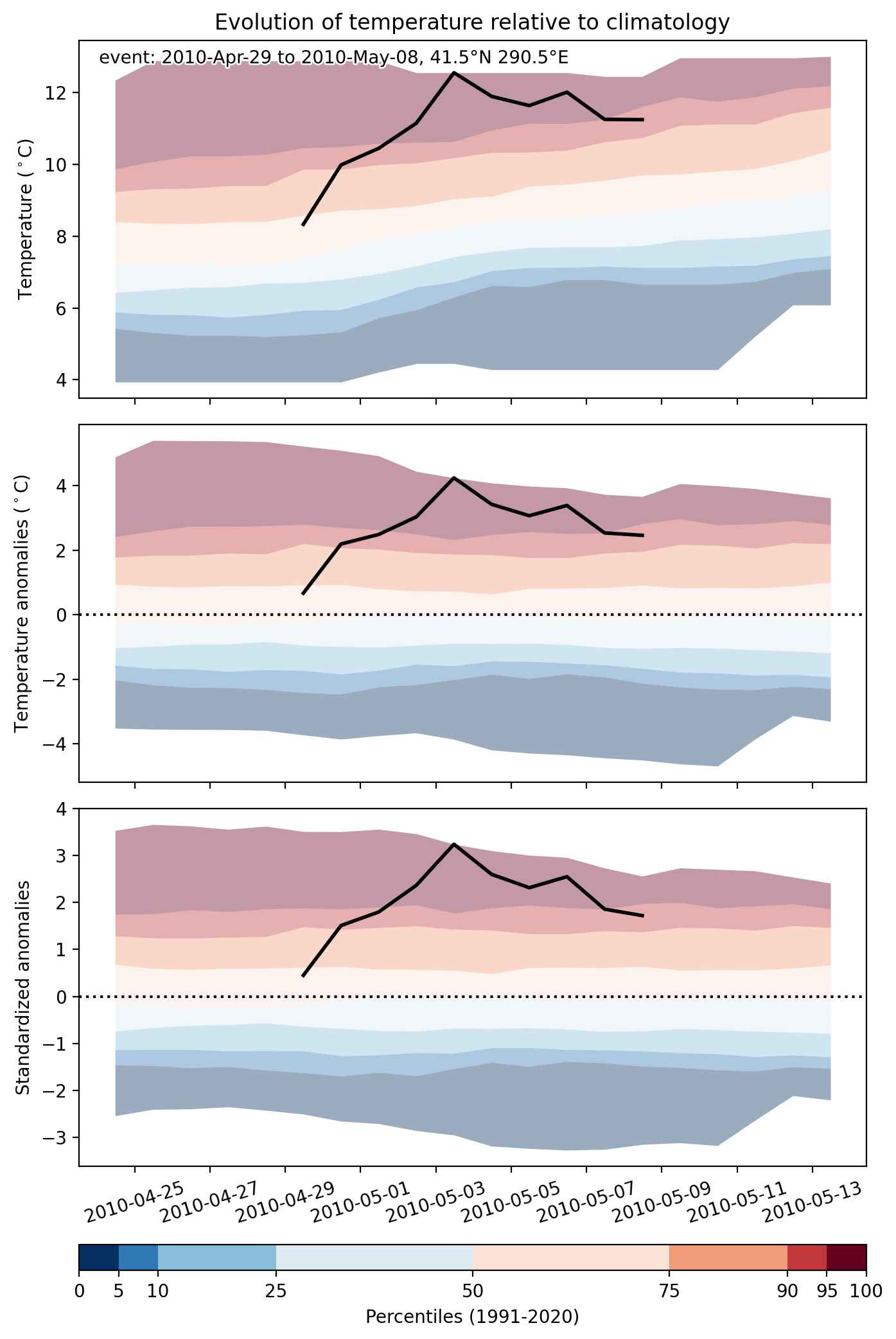
Fig. 2: Evolution of temperature at the center of the event. The climatological percentile distribution is illustrated with color shadings.


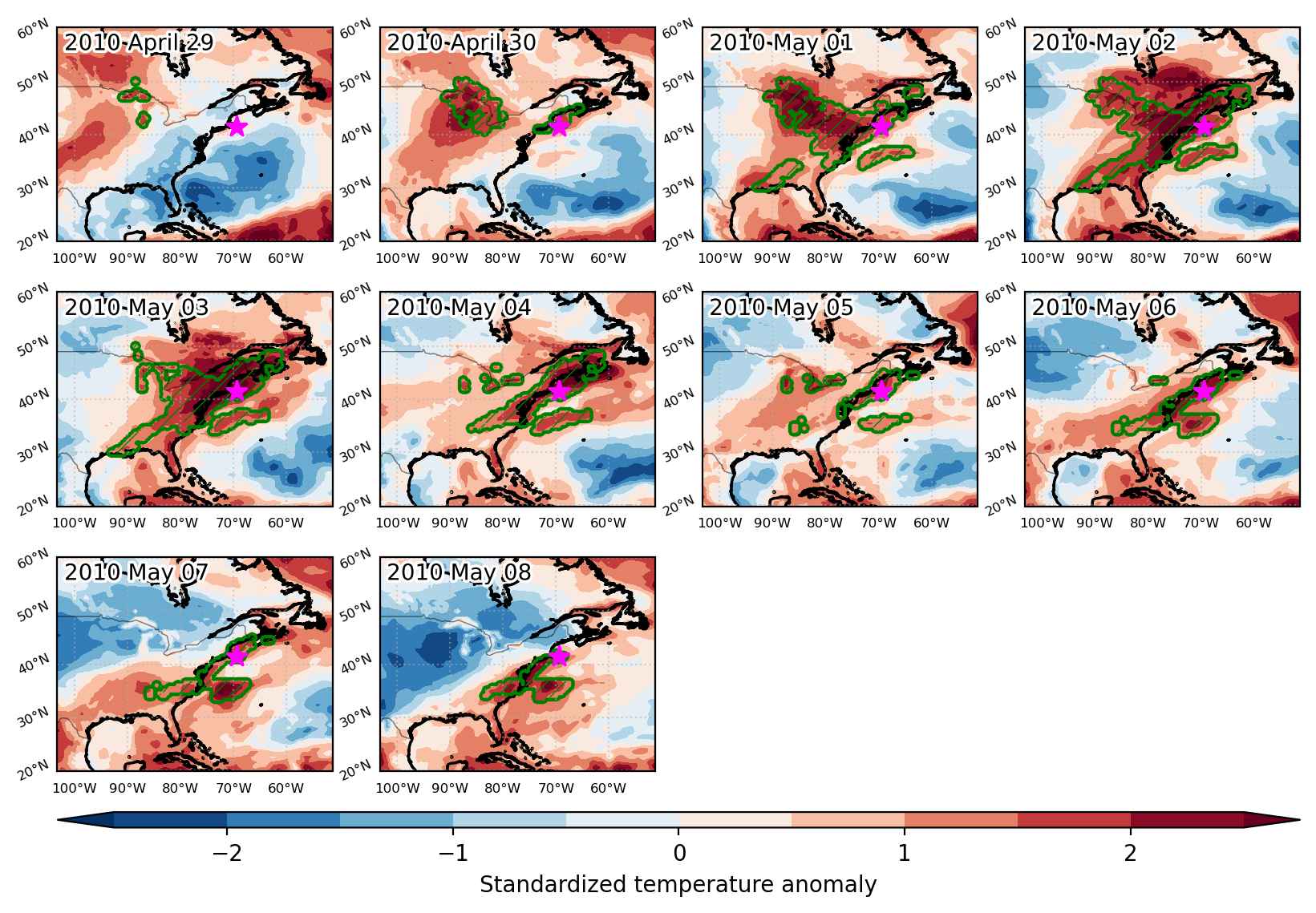
Fig. 3: Maps illustrating the evolution of standardized temperature anomalies during the event.

Event ID: Heat_wave_2010-Apr-29_to_2010-May-08_290.5_41.5

Heat wave occuring from April 28 2010 to May 08 2010 at 49.5°N 293.0°E

Download data: JSON

Event type: Heat wave

Countries affected (identified with ArcGIS Online; provided only for geographical reference):

  • Canada

Duration: 11 days

Time span: April 28 2010 to May 08 2010

Statistics over entire affected area:

  • Mean temperature anomaly: 4.8 °C
  • Mean temperature: 8.1 °C
  • Maximum temperature anomaly: 10.4 °C
  • Maximum temperature: 14.6 °C

Event center: 49.5°N 293.0°E

Area affected: 106076 km$^2$


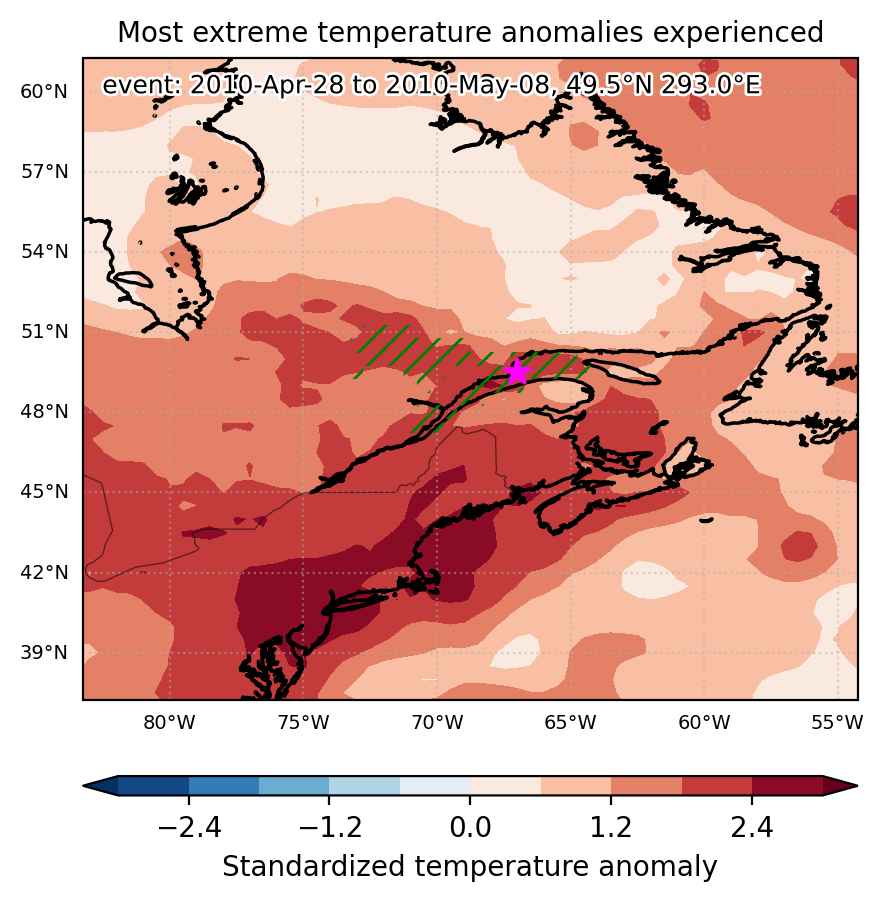
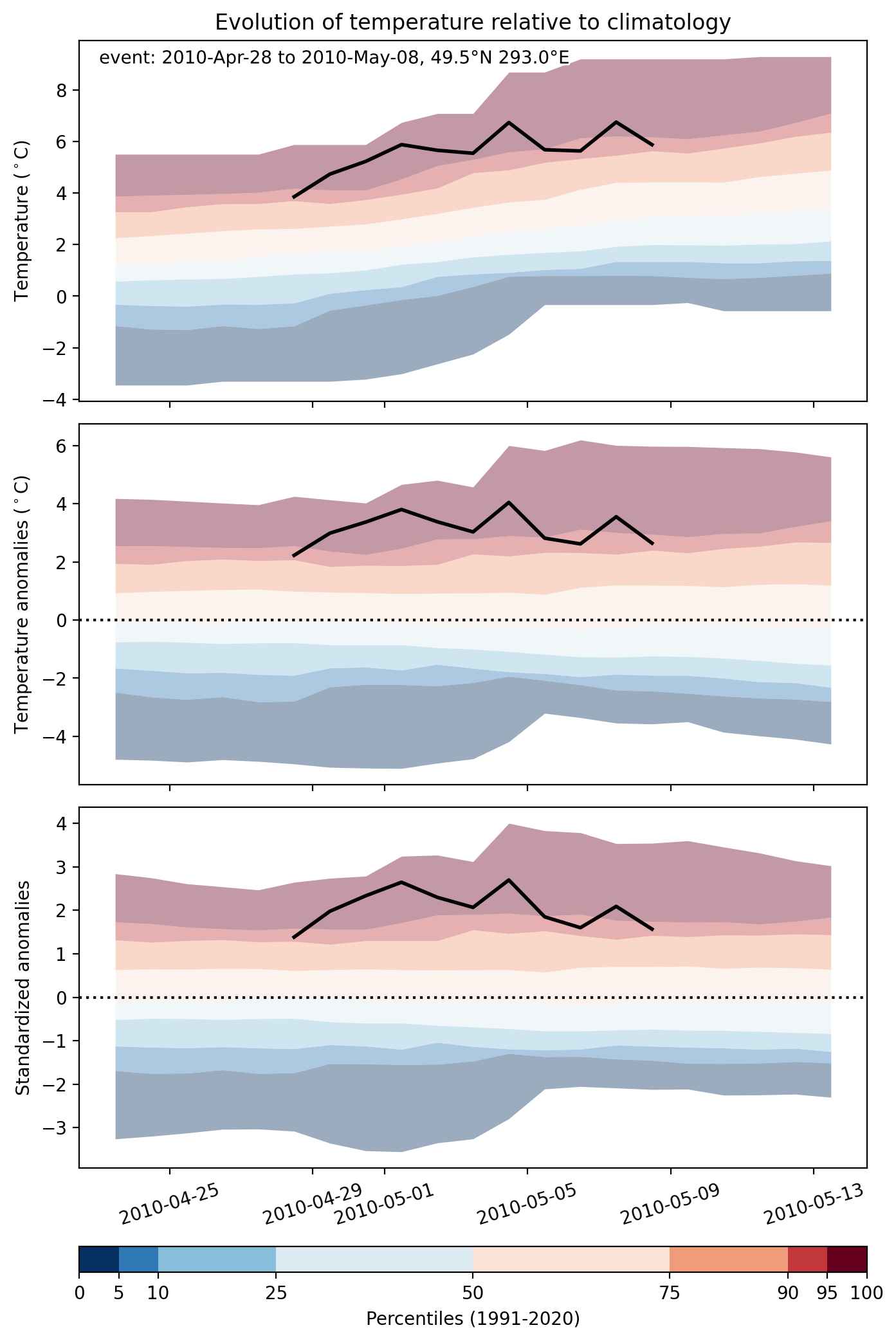
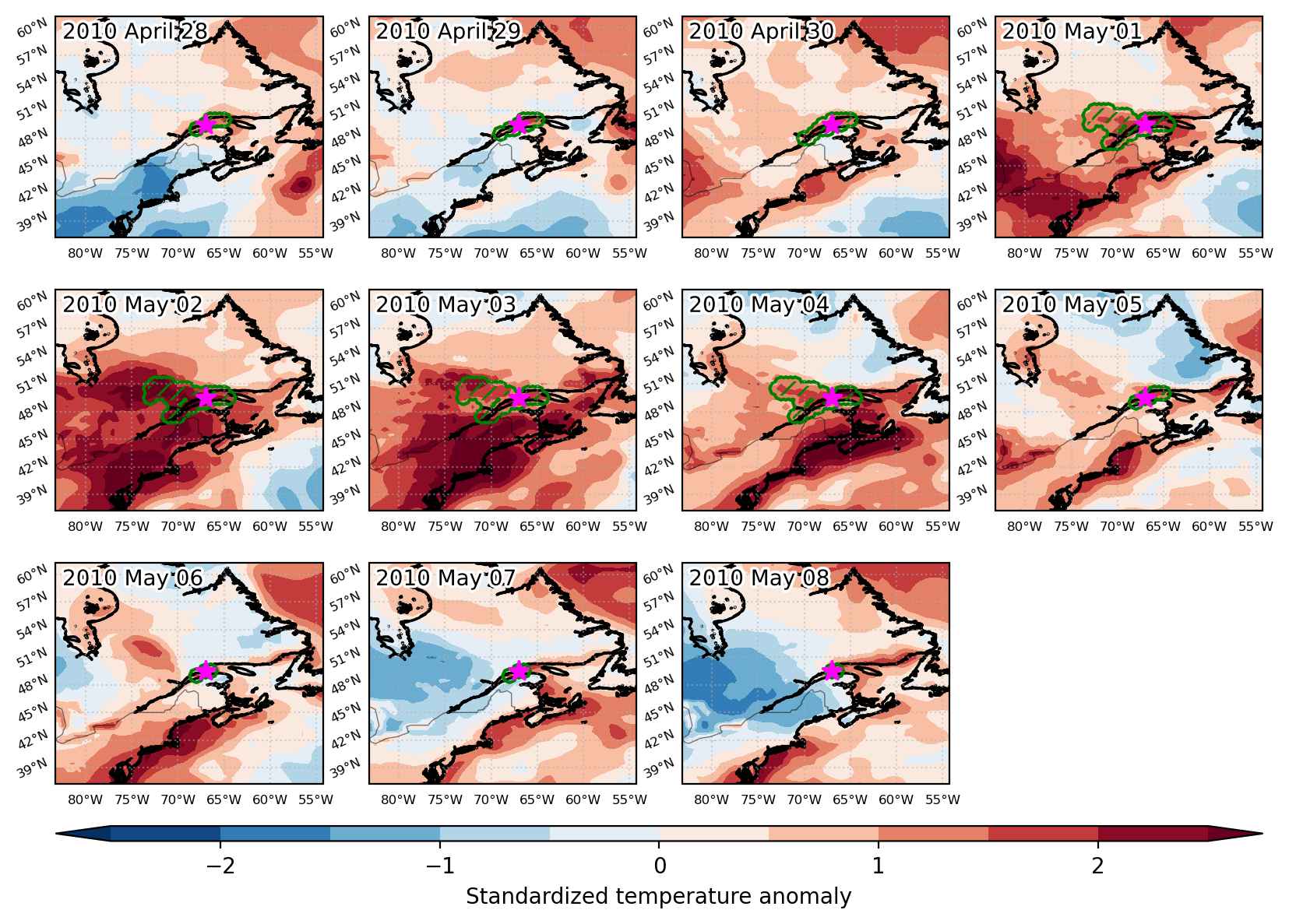
Fig. 1: Map of most extreme temperature anomalies (standardized) experienced during the event. The purple star indicates the center of the extreme event. Green hatching illustrates all areas under the effect of extremes at some time during the event.


Fig. 2: Evolution of temperature at the center of the event. The climatological percentile distribution is illustrated with color shadings.


Fig. 3: Maps illustrating the evolution of standardized temperature anomalies during the event.

Event ID: Heat_wave_2010-Apr-28_to_2010-May-08_293.0_49.5