Cold spell occuring from January 11 2020 to January 14 2020 at 23.5°N 6.0°E

Download data: JSON

Event type: Cold spell

Countries affected (identified with ArcGIS Online; provided only for geographical reference):

  • Algeria

Duration: 4 days

Time span: January 11 2020 to January 14 2020

Statistics over entire affected area:

  • Mean temperature anomaly: -3.9 °C
  • Mean temperature: 8.7 °C
  • Minimum temperature anomaly: -7.2 °C
  • Minimum temperature: 1.8 °C

Event center: 23.5°N 6.0°E

Area affected: 146196 km$^2$


Fig. 1: Map of most extreme temperature anomalies (standardized) experienced during the event. The purple star indicates the center of the extreme event. Green hatching illustrates all areas under the effect of extremes at some time during the event.


Fig. 2: Evolution of temperature at the center of the event. The climatological percentile distribution is illustrated with color shadings.


Fig. 3: Maps illustrating the evolution of standardized temperature anomalies during the event.

Event ID: Cold_spell_2020-Jan-11_to_2020-Jan-14_6.0_23.5
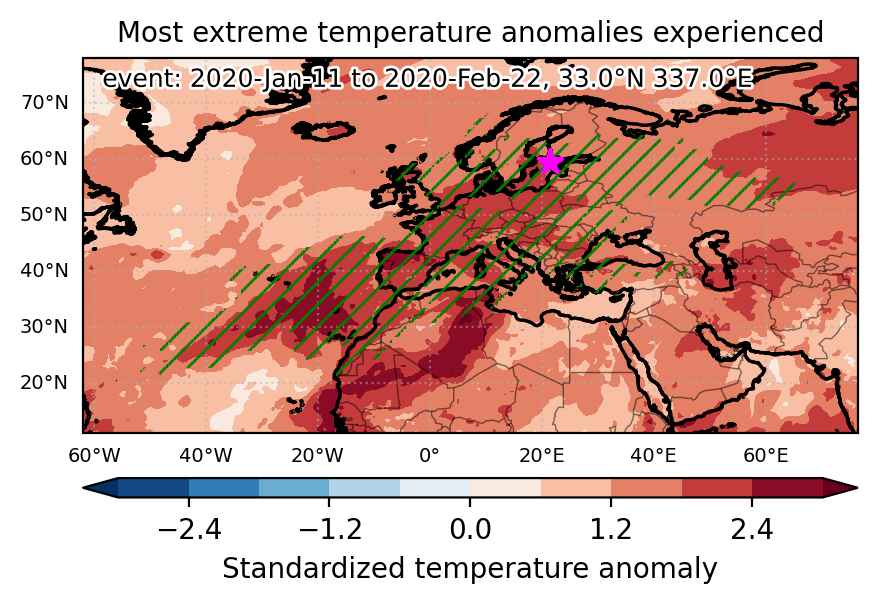
Heat wave occuring from January 11 2020 to February 22 2020 at 33.0°N 337.0°E

Download data: JSON

Event type: Heat wave

Countries affected (identified with ArcGIS Online; provided only for geographical reference):

  • Albania
  • Algeria
  • Andorra
  • Armenia
  • Austria
  • Azerbaijan
  • Belarus
  • Belgium
  • Bosnia and Herzegovina
  • Bulgaria
  • Croatia
  • Czechia
  • Denmark
  • Estonia
  • Finland
  • France
  • Georgia
  • Germany
  • Greece
  • Hungary
  • Iran, Islamic Republic of
  • Italy
  • Kazakhstan
  • Latvia
  • Lithuania
  • Luxembourg
  • Mauritania
  • Moldova, Republic of
  • Montenegro
  • Morocco
  • Netherlands
  • North Macedonia
  • Norway
  • Poland
  • Portugal
  • Romania
  • Russian Federation
  • Serbia
  • Slovakia
  • Slovenia
  • Spain
  • Sweden
  • Switzerland
  • Tunisia
  • Türkiye
  • Ukraine
  • United Kingdom

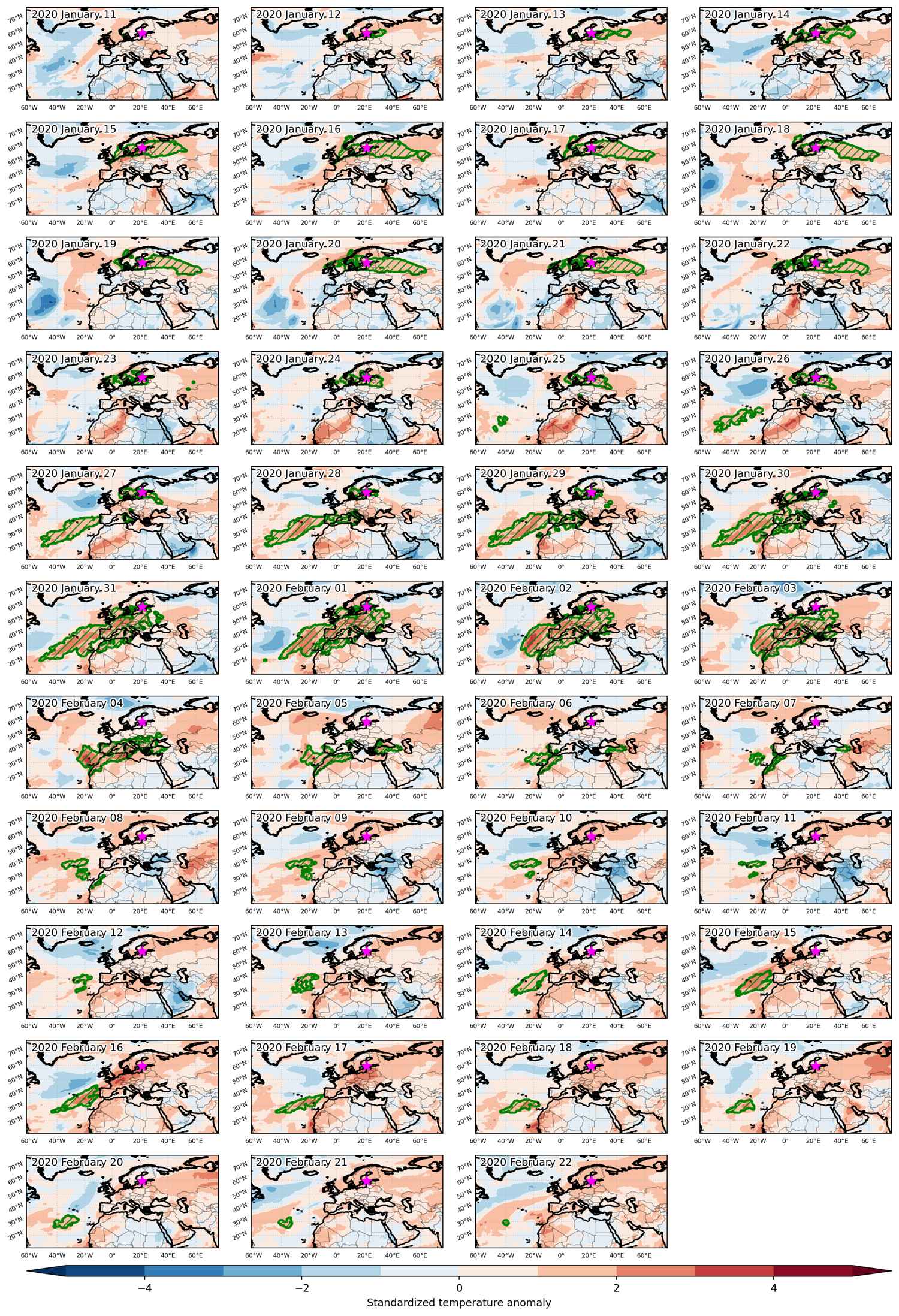
Duration: 43 days

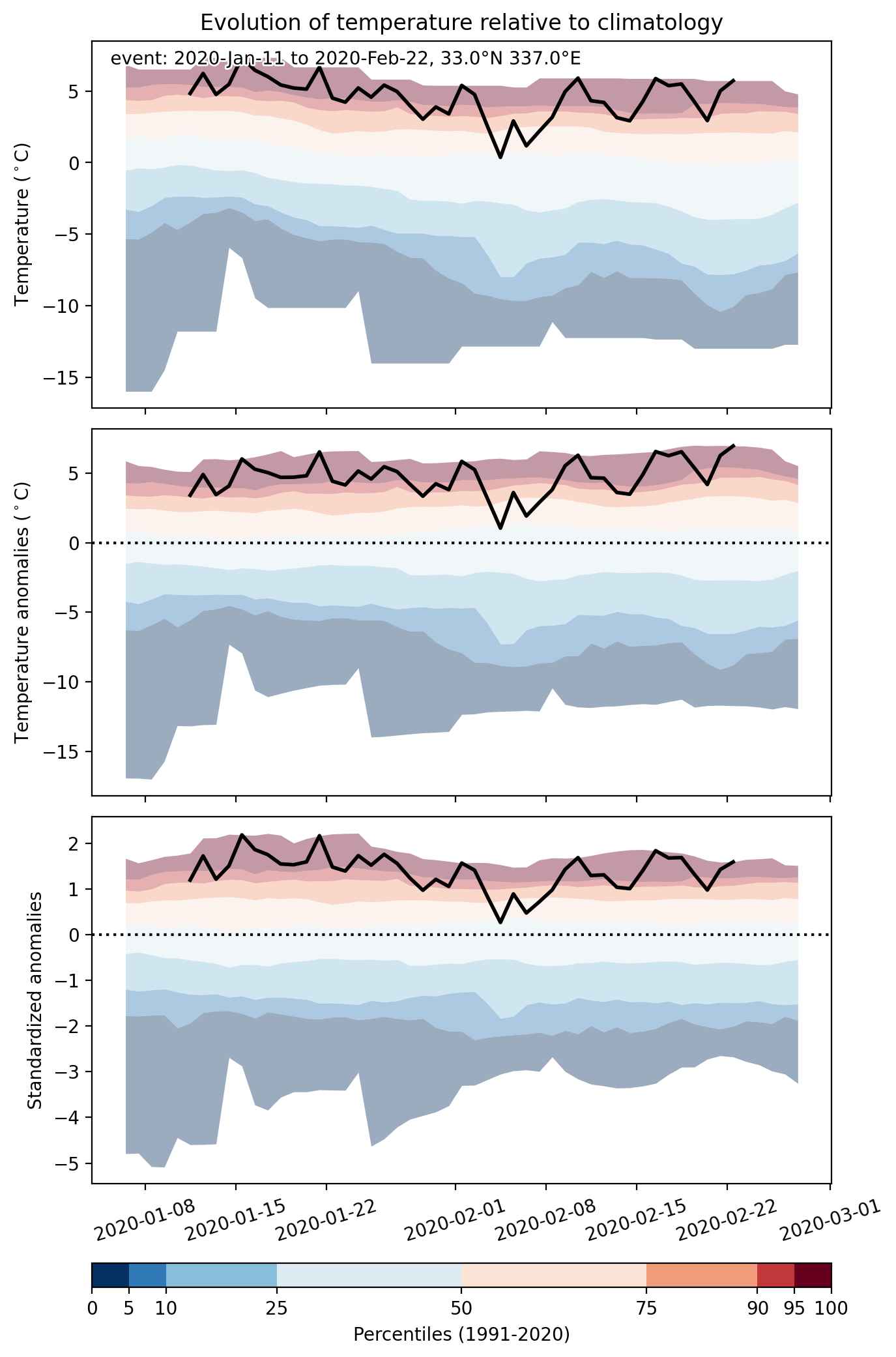
Time span: January 11 2020 to February 22 2020

Statistics over entire affected area:

  • Mean temperature anomaly: 6.9 °C
  • Mean temperature: 5.8 °C
  • Maximum temperature anomaly: 13.9 °C
  • Maximum temperature: 20.9 °C

Event center: 59.5°N 21.5°E

Area affected: 15888708 km$^2$


Fig. 1: Map of most extreme temperature anomalies (standardized) experienced during the event. The purple star indicates the center of the extreme event. Green hatching illustrates all areas under the effect of extremes at some time during the event.


Fig. 2: Evolution of temperature at the center of the event. The climatological percentile distribution is illustrated with color shadings.


Fig. 3: Maps illustrating the evolution of standardized temperature anomalies during the event.

Event ID: Heat_wave_2020-Jan-11_to_2020-Feb-22_337.0_33.0

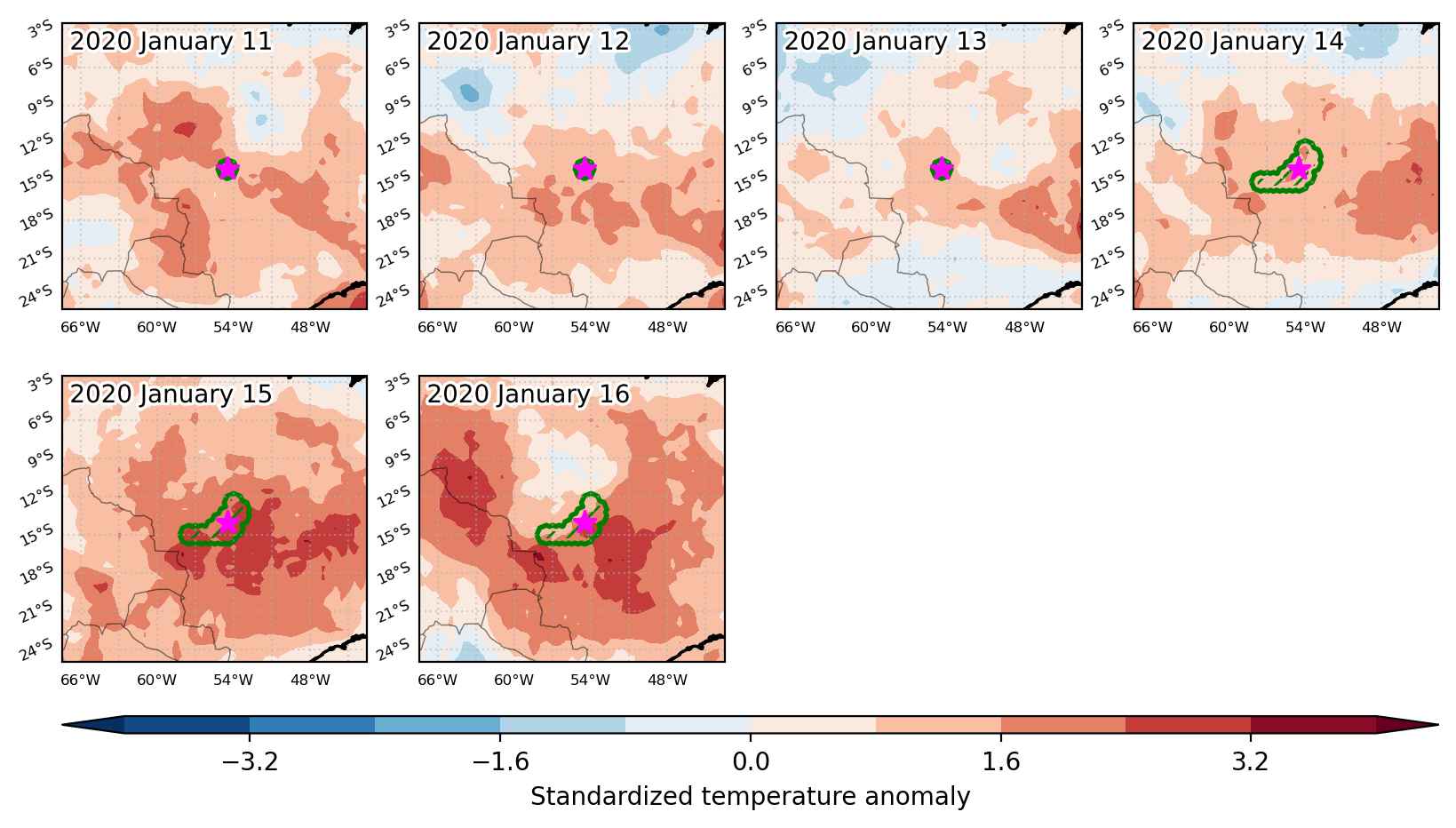
Heat wave occuring from January 11 2020 to January 16 2020 at -14.0°S 305.5°E

Download data: JSON

Event type: Heat wave

Countries affected (identified with ArcGIS Online; provided only for geographical reference):

  • Brazil

Duration: 6 days

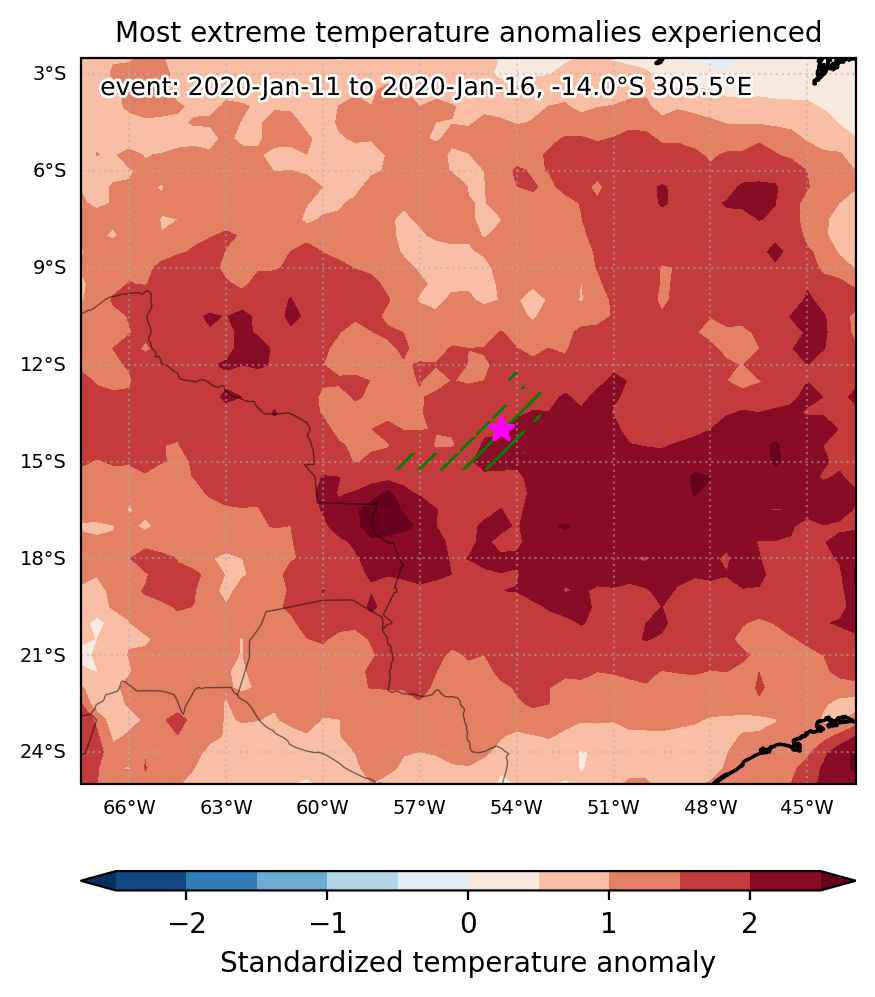
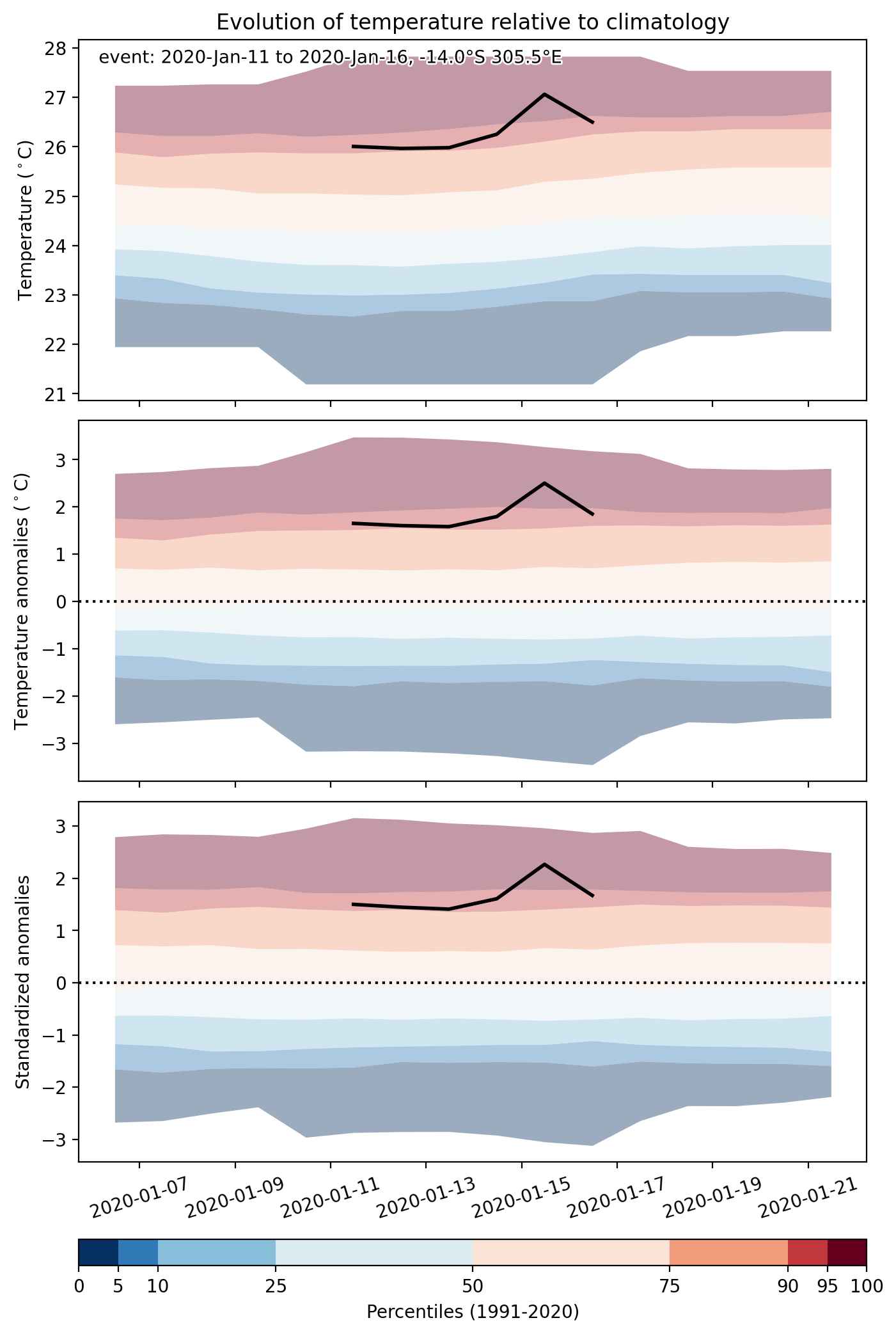
Time span: January 11 2020 to January 16 2020

Statistics over entire affected area:

  • Mean temperature anomaly: 2.3 °C
  • Mean temperature: 27.3 °C
  • Maximum temperature anomaly: 3.2 °C
  • Maximum temperature: 29.8 °C

Event center: -14.0°S 305.5°E

Area affected: 56915 km$^2$


Fig. 1: Map of most extreme temperature anomalies (standardized) experienced during the event. The purple star indicates the center of the extreme event. Green hatching illustrates all areas under the effect of extremes at some time during the event.


Fig. 2: Evolution of temperature at the center of the event. The climatological percentile distribution is illustrated with color shadings.


Fig. 3: Maps illustrating the evolution of standardized temperature anomalies during the event.

Event ID: Heat_wave_2020-Jan-11_to_2020-Jan-16_305.5_-14.0

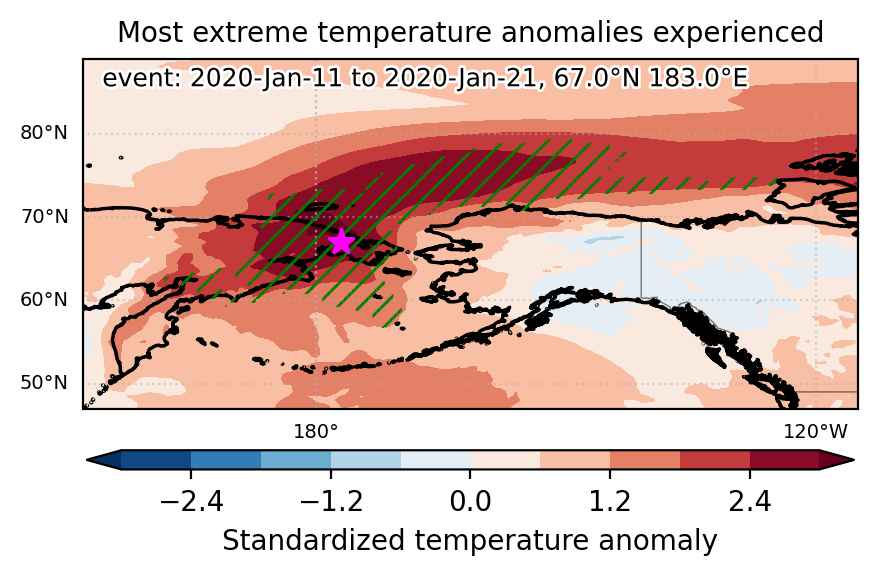
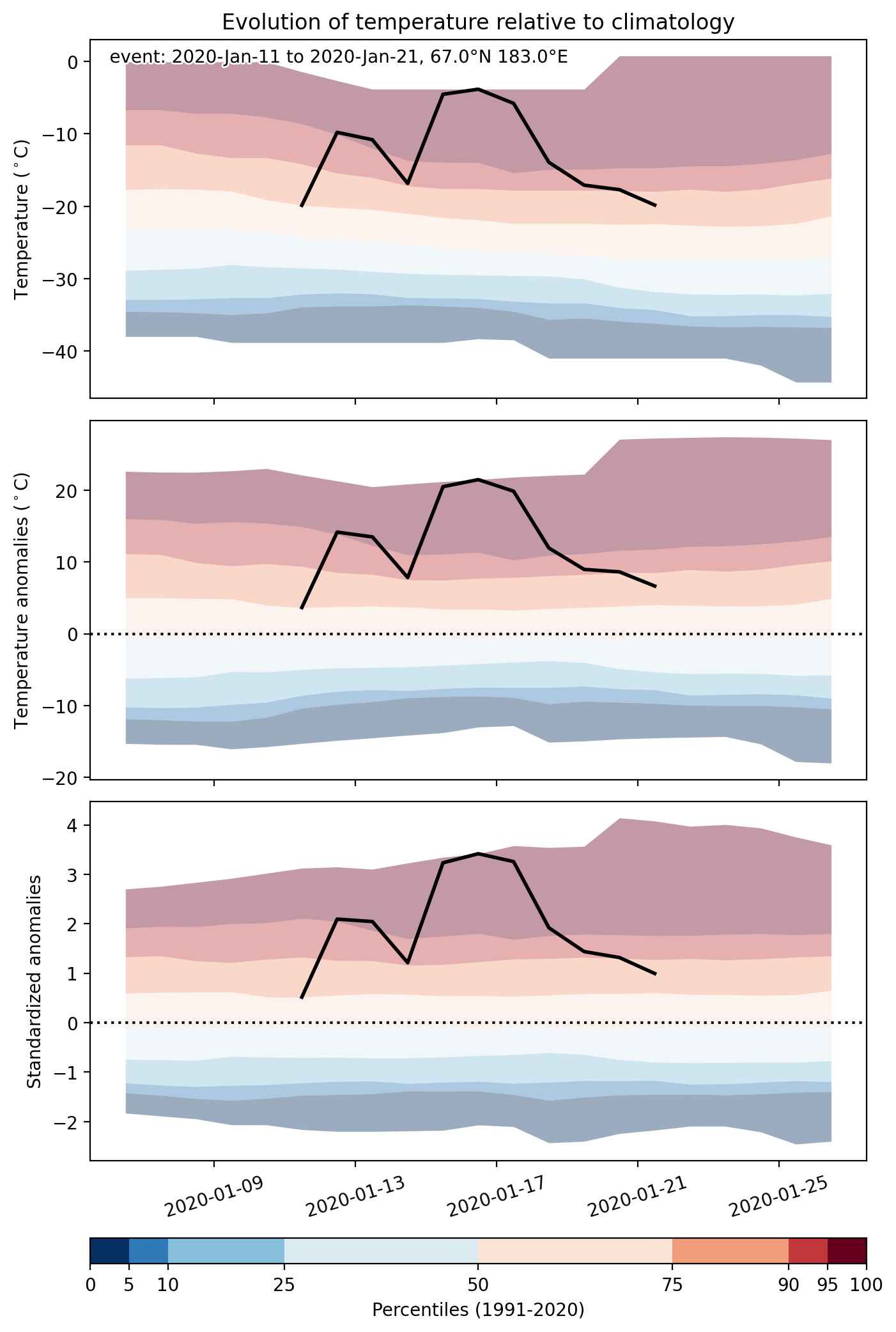
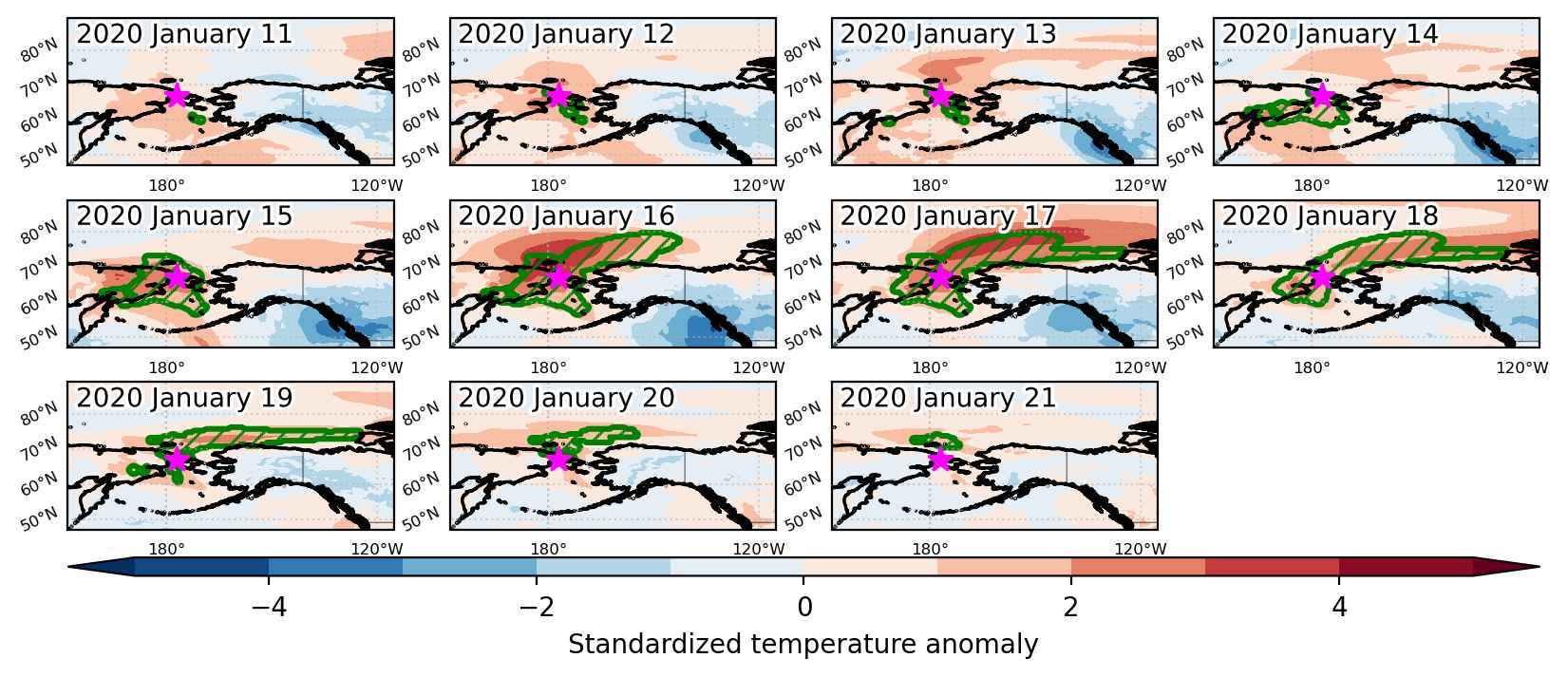
Heat wave occuring from January 11 2020 to January 21 2020 at 67.0°N 183.0°E

Download data: JSON

Event type: Heat wave

Countries affected (identified with ArcGIS Online; provided only for geographical reference):

  • Canada
  • Russian Federation
  • United States

Duration: 11 days

Time span: January 11 2020 to January 21 2020

Statistics over entire affected area:

  • Mean temperature anomaly: 12.4 °C
  • Mean temperature: -9.5 °C
  • Maximum temperature anomaly: 28.2 °C
  • Maximum temperature: 3.6 °C

Event center: 67.0°N 183.0°E

Area affected: 1933578 km$^2$


Fig. 1: Map of most extreme temperature anomalies (standardized) experienced during the event. The purple star indicates the center of the extreme event. Green hatching illustrates all areas under the effect of extremes at some time during the event.


Fig. 2: Evolution of temperature at the center of the event. The climatological percentile distribution is illustrated with color shadings.


Fig. 3: Maps illustrating the evolution of standardized temperature anomalies during the event.

Event ID: Heat_wave_2020-Jan-11_to_2020-Jan-21_183.0_67.0

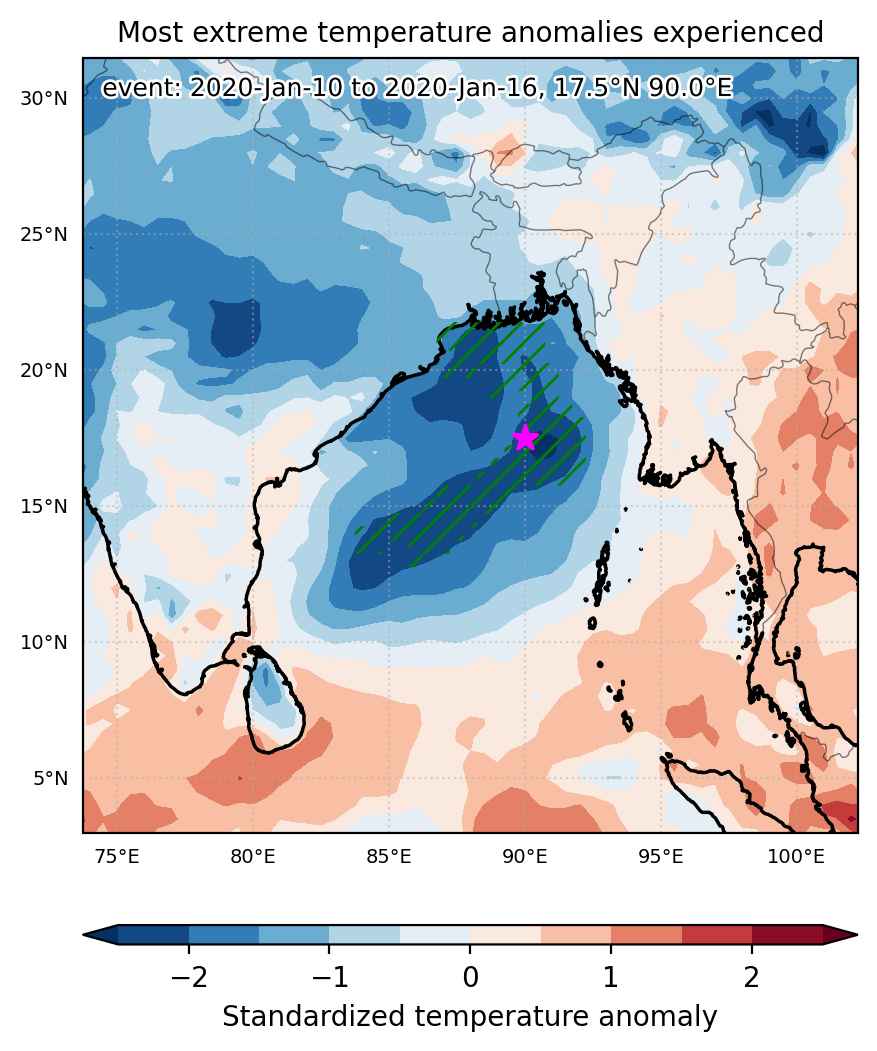
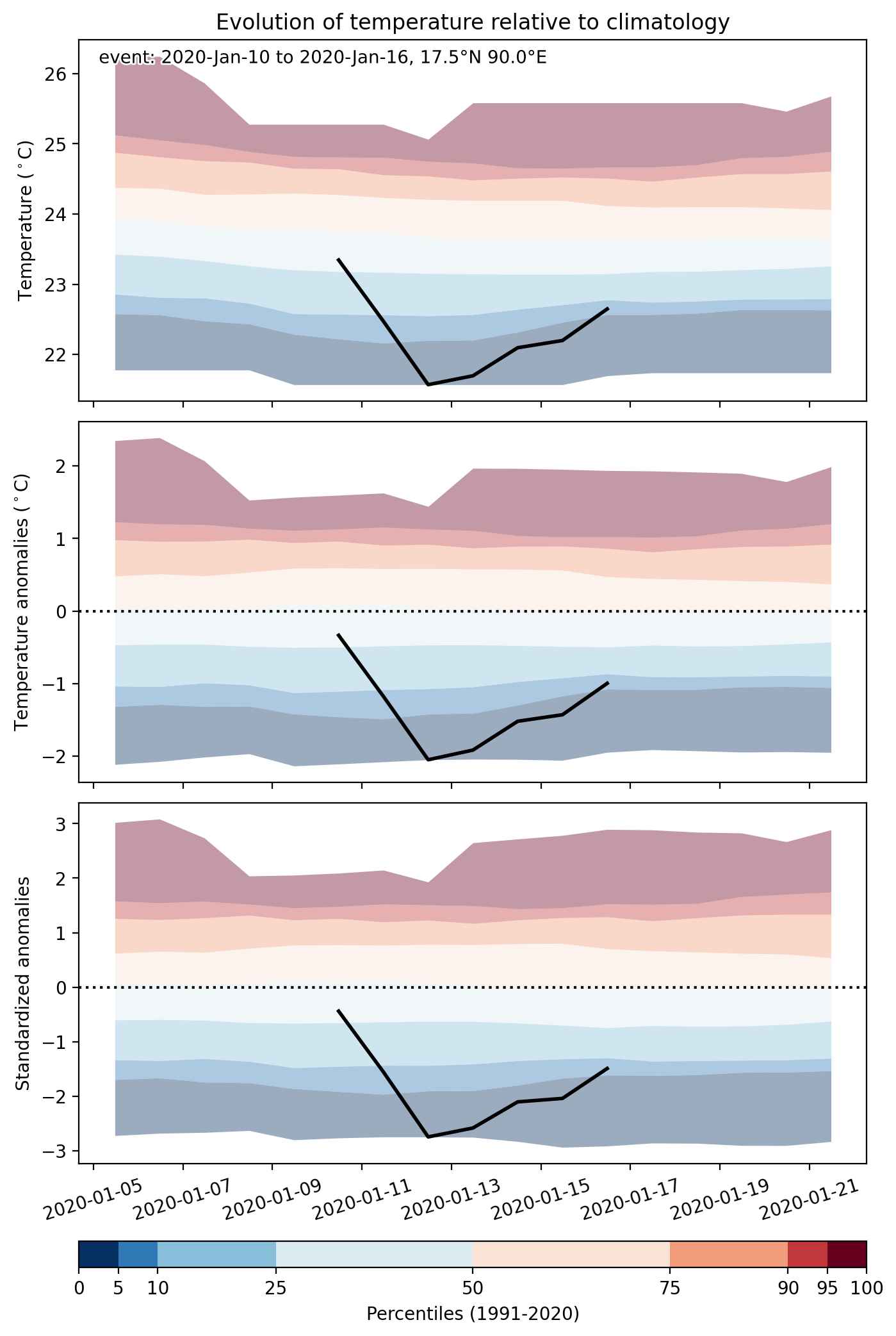
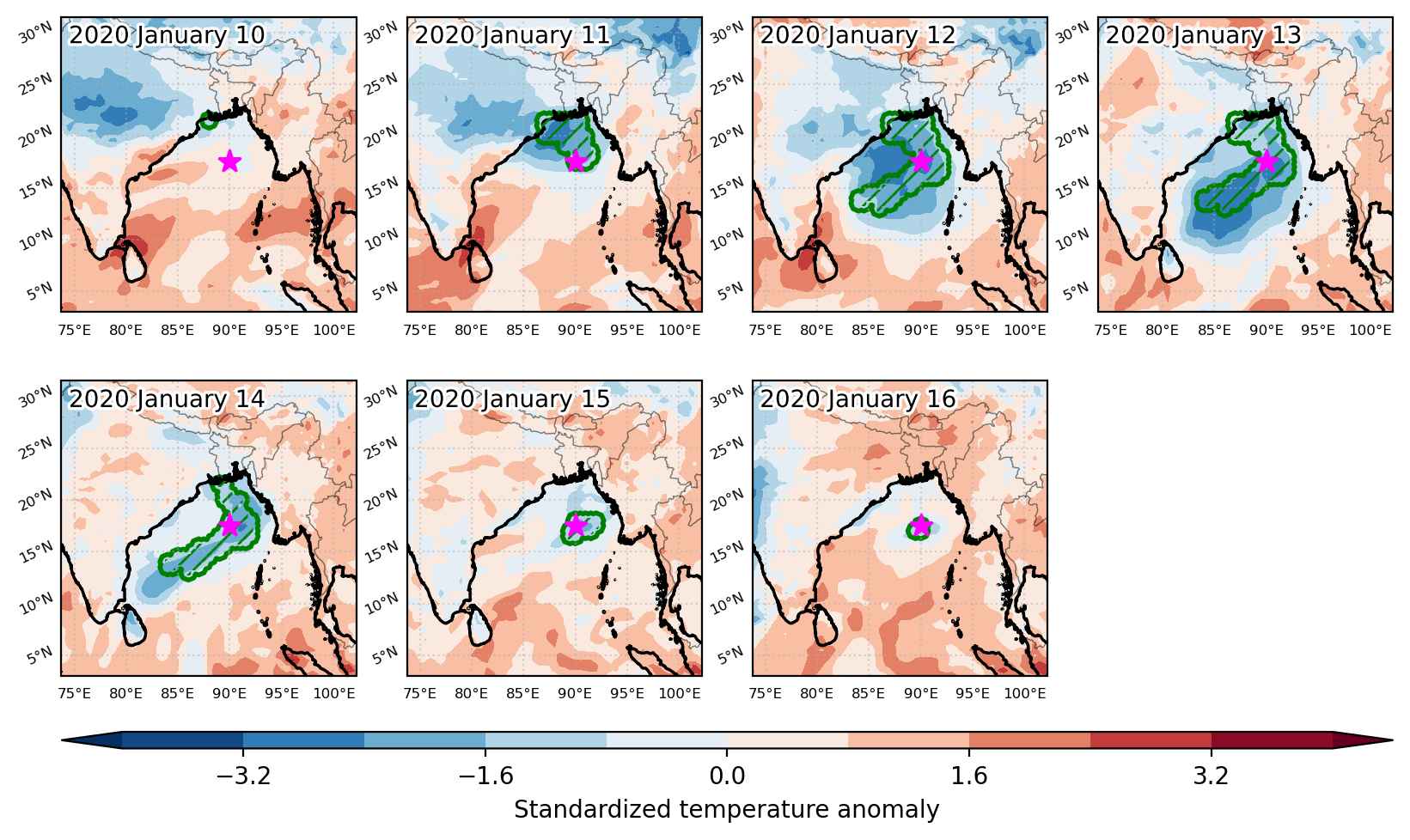
Cold spell occuring from January 10 2020 to January 16 2020 at 17.5°N 90.0°E

Download data: JSON

Event type: Cold spell

Countries affected (identified with ArcGIS Online; provided only for geographical reference):

  • India

Duration: 7 days

Time span: January 10 2020 to January 16 2020

Statistics over entire affected area:

  • Mean temperature anomaly: -1.6 °C
  • Mean temperature: 21.9 °C
  • Minimum temperature anomaly: -2.8 °C
  • Minimum temperature: 17.5 °C

Event center: 17.5°N 90.0°E

Area affected: 309246 km$^2$


Fig. 1: Map of most extreme temperature anomalies (standardized) experienced during the event. The purple star indicates the center of the extreme event. Green hatching illustrates all areas under the effect of extremes at some time during the event.


Fig. 2: Evolution of temperature at the center of the event. The climatological percentile distribution is illustrated with color shadings.


Fig. 3: Maps illustrating the evolution of standardized temperature anomalies during the event.

Event ID: Cold_spell_2020-Jan-10_to_2020-Jan-16_90.0_17.5

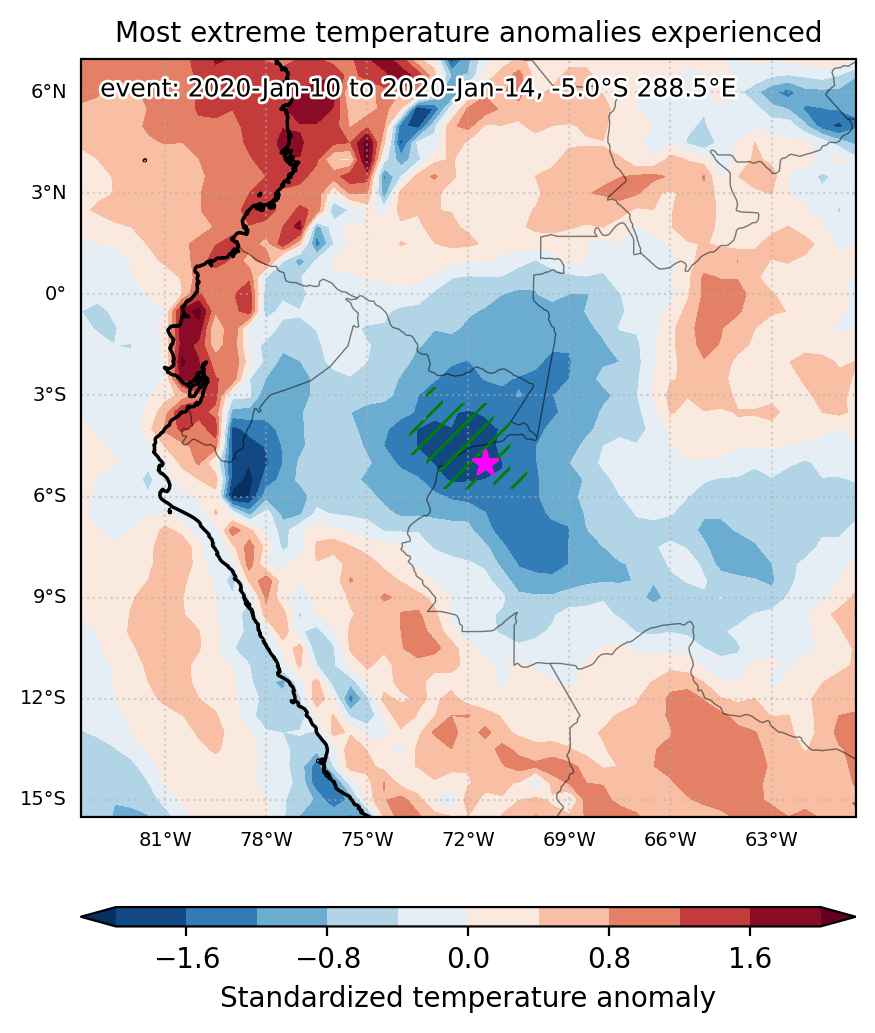
Cold spell occuring from January 10 2020 to January 14 2020 at -5.0°S 288.5°E

Download data: JSON

Event type: Cold spell

Countries affected (identified with ArcGIS Online; provided only for geographical reference):

  • Brazil
  • Peru

Duration: 5 days

Time span: January 10 2020 to January 14 2020

Statistics over entire affected area:

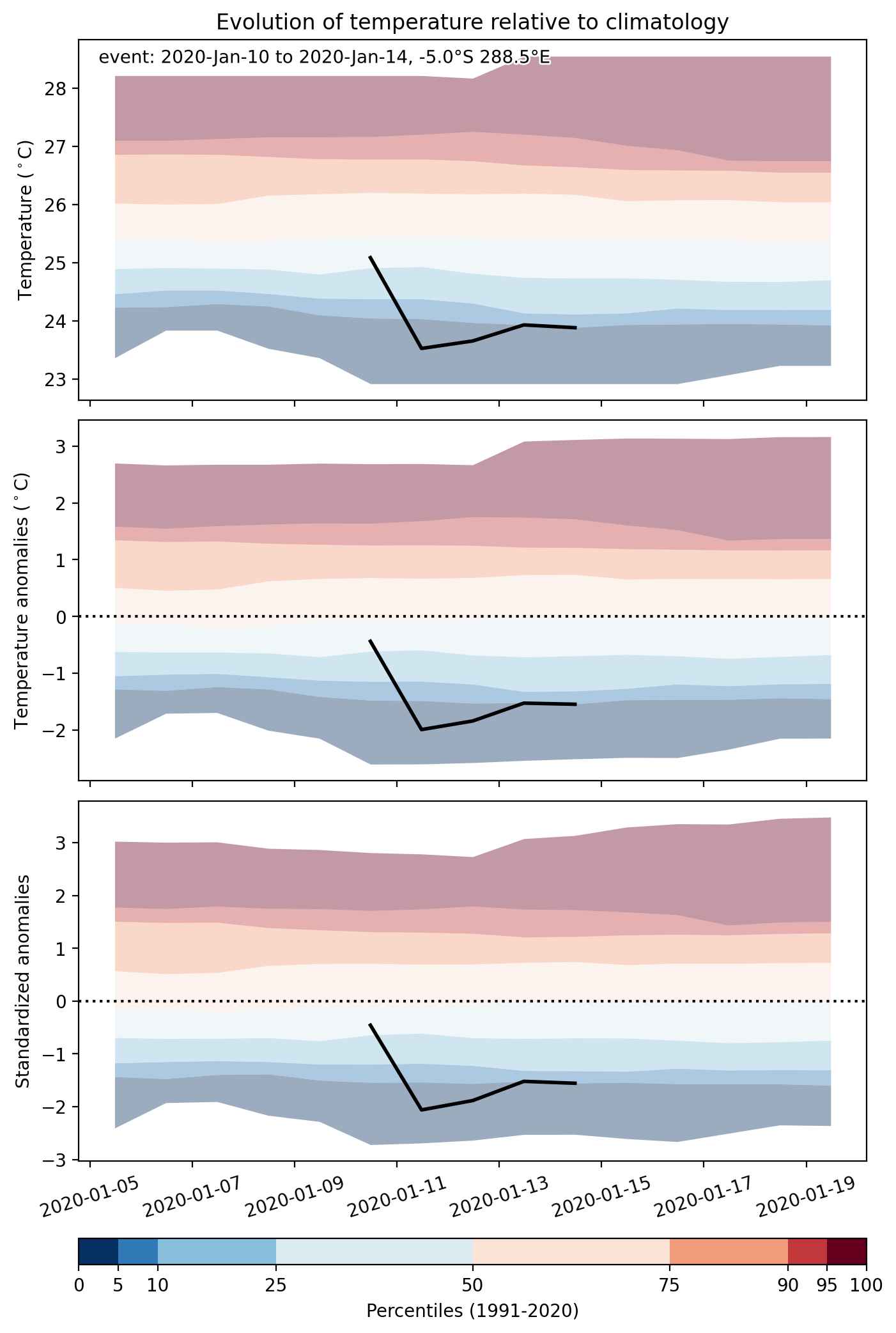
  • Mean temperature anomaly: -1.6 °C
  • Mean temperature: 24.0 °C
  • Minimum temperature anomaly: -2.2 °C
  • Minimum temperature: 23.4 °C

Event center: -5.0°S 288.5°E

Area affected: 80122 km$^2$


Fig. 1: Map of most extreme temperature anomalies (standardized) experienced during the event. The purple star indicates the center of the extreme event. Green hatching illustrates all areas under the effect of extremes at some time during the event.


Fig. 2: Evolution of temperature at the center of the event. The climatological percentile distribution is illustrated with color shadings.


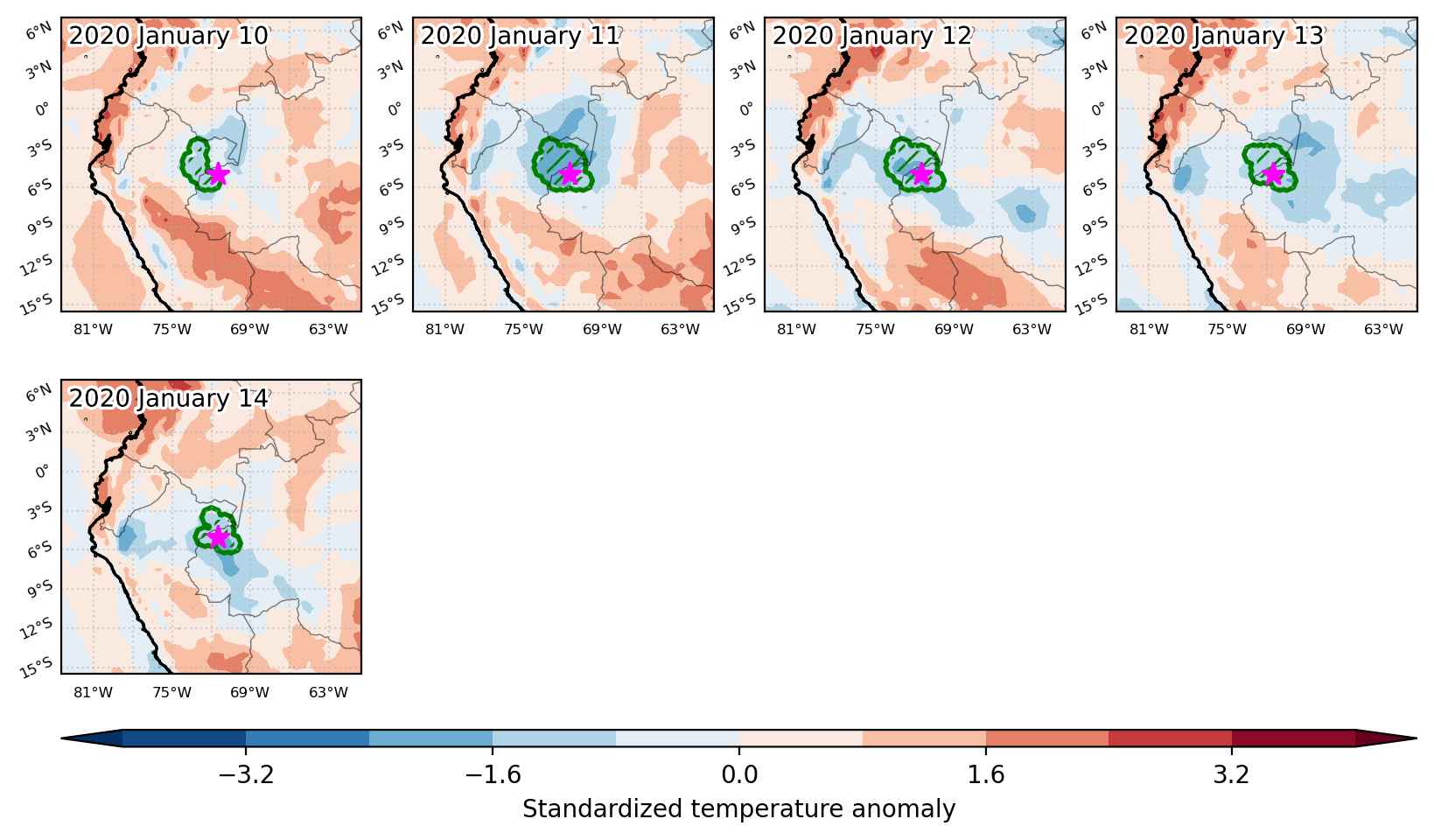
Fig. 3: Maps illustrating the evolution of standardized temperature anomalies during the event.

Event ID: Cold_spell_2020-Jan-10_to_2020-Jan-14_288.5_-5.0

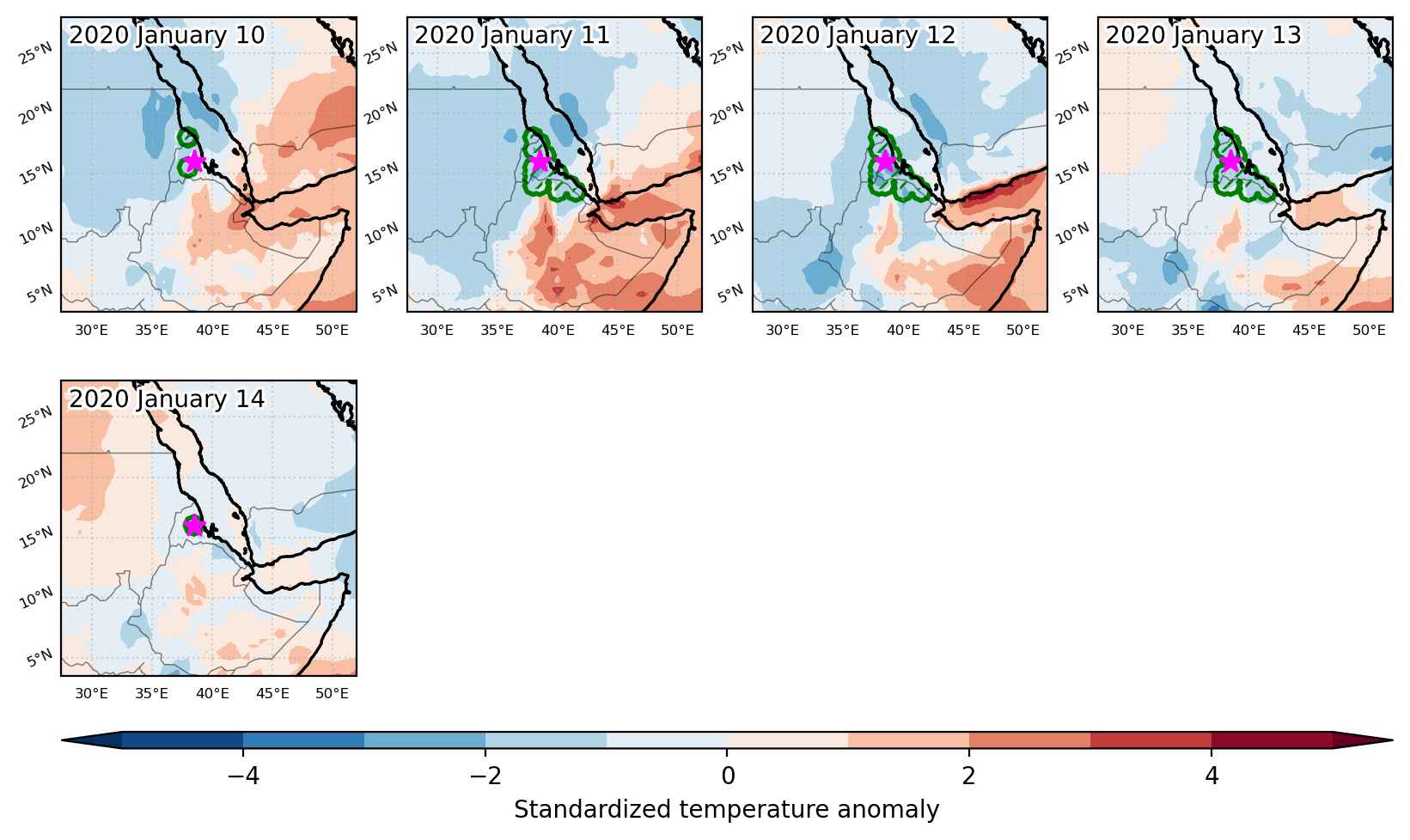
Cold spell occuring from January 10 2020 to January 14 2020 at 16.0°N 38.5°E

Download data: JSON

Event type: Cold spell

Countries affected (identified with ArcGIS Online; provided only for geographical reference):

  • Eritrea
  • Ethiopia
  • Sudan

Duration: 5 days

Time span: January 10 2020 to January 14 2020

Statistics over entire affected area:

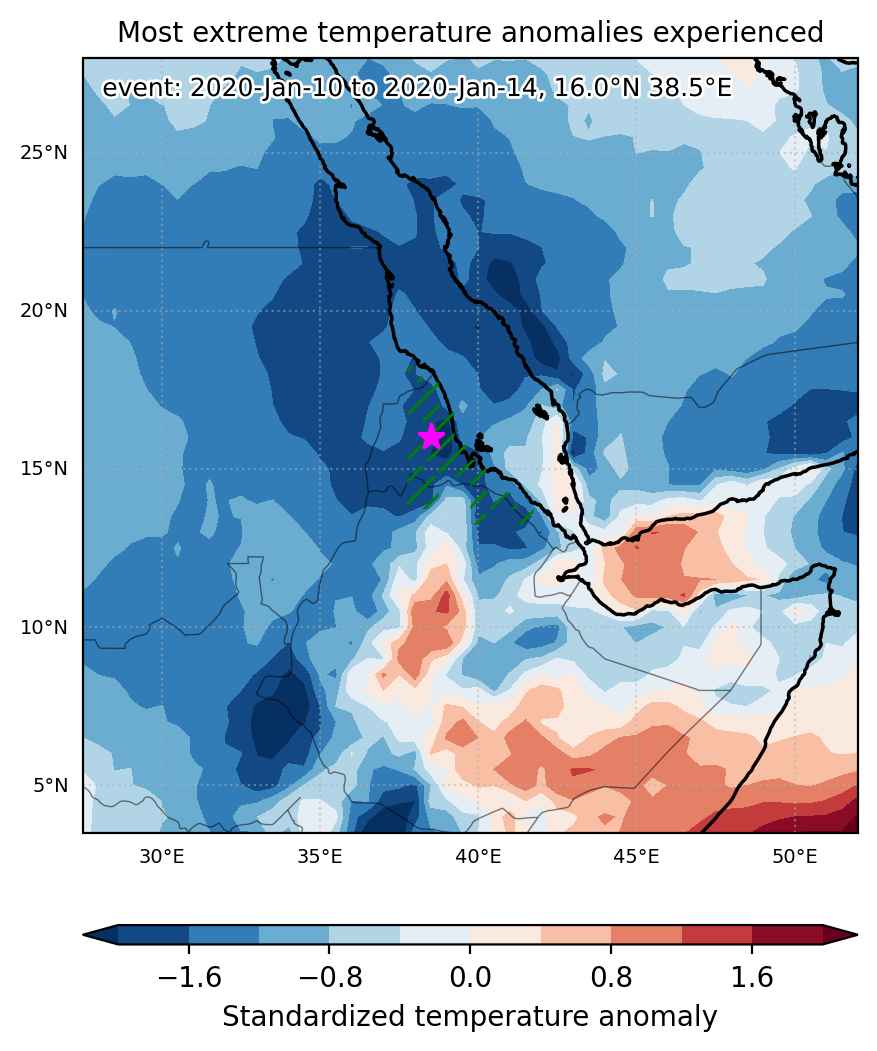
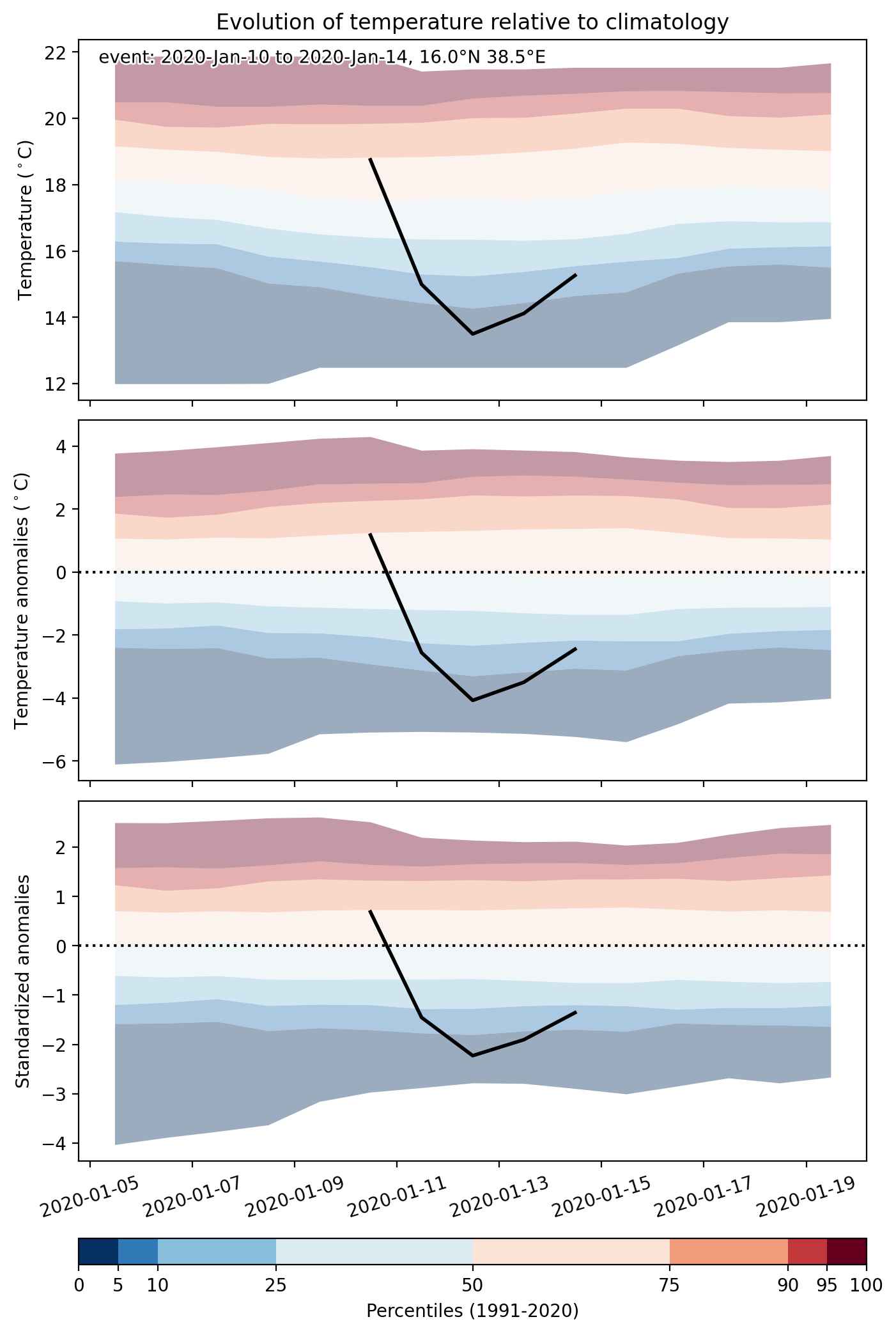
  • Mean temperature anomaly: -3.2 °C
  • Mean temperature: 18.3 °C
  • Minimum temperature anomaly: -4.6 °C
  • Minimum temperature: 13.0 °C

Event center: 16.0°N 38.5°E

Area affected: 77513 km$^2$


Fig. 1: Map of most extreme temperature anomalies (standardized) experienced during the event. The purple star indicates the center of the extreme event. Green hatching illustrates all areas under the effect of extremes at some time during the event.


Fig. 2: Evolution of temperature at the center of the event. The climatological percentile distribution is illustrated with color shadings.


Fig. 3: Maps illustrating the evolution of standardized temperature anomalies during the event.

Event ID: Cold_spell_2020-Jan-10_to_2020-Jan-14_38.5_16.0

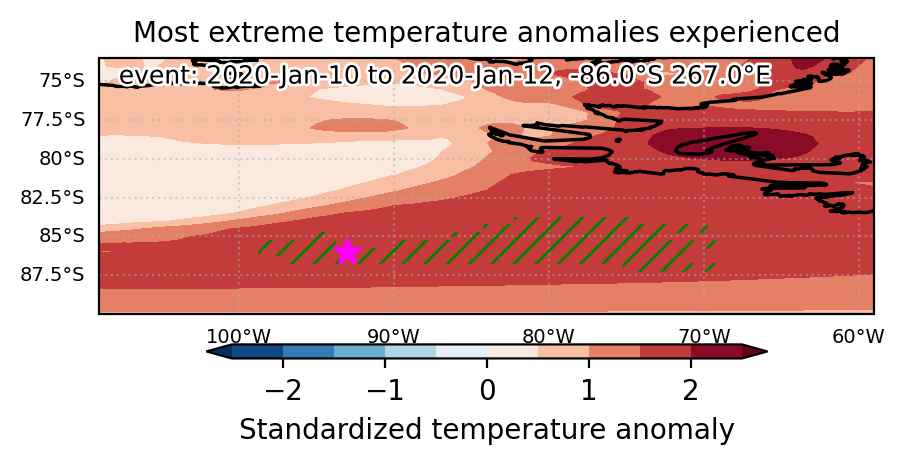
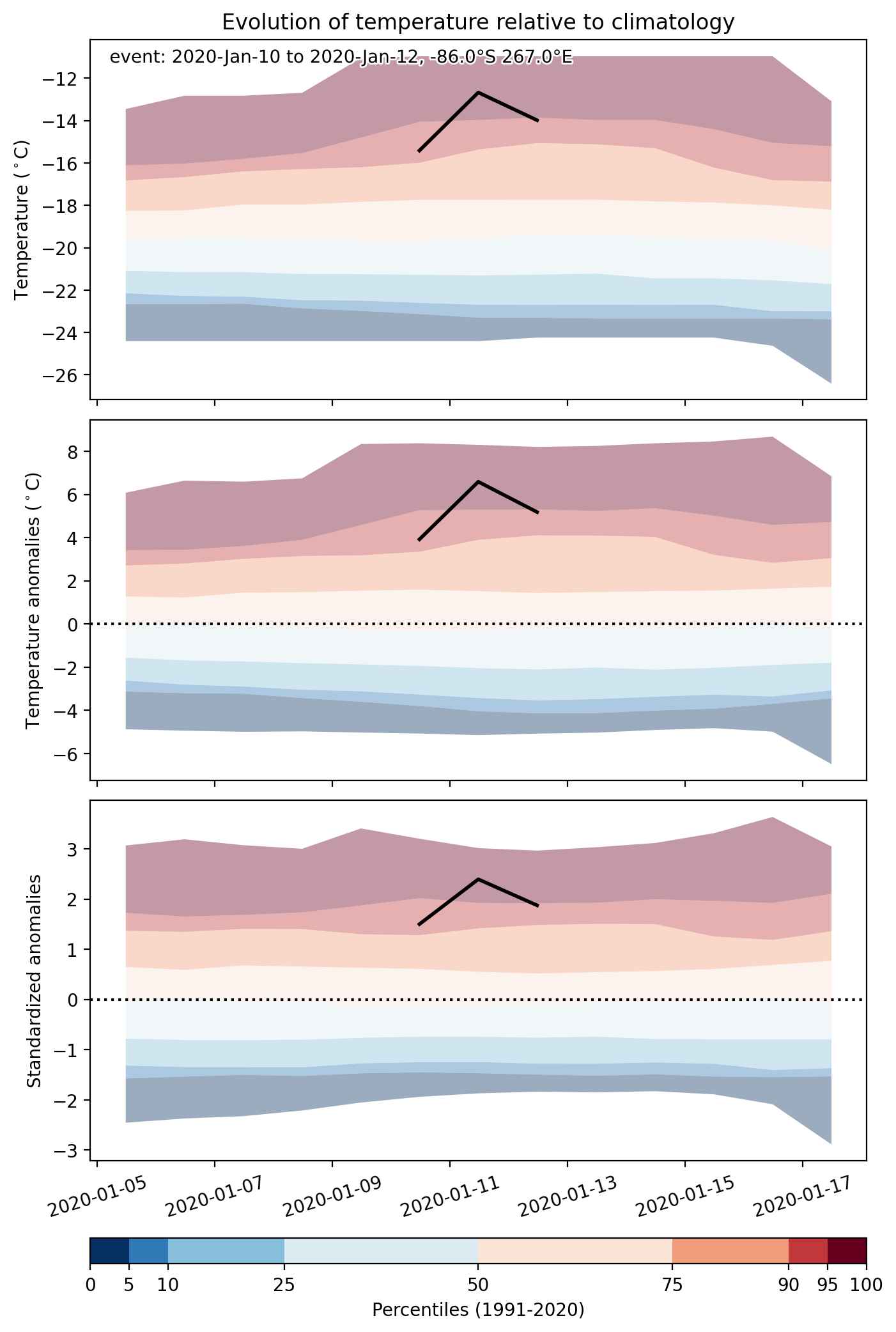
Heat wave occuring from January 10 2020 to January 12 2020 at -86.0°S 267.0°E

Download data: JSON

Event type: Heat wave

Countries affected (identified with ArcGIS Online; provided only for geographical reference):

  • Antarctica

Duration: 3 days

Time span: January 10 2020 to January 12 2020

Statistics over entire affected area:

  • Mean temperature anomaly: 4.8 °C
  • Mean temperature: -12.5 °C
  • Maximum temperature anomaly: 6.8 °C
  • Maximum temperature: -6.0 °C

Event center: -86.0°S 267.0°E

Area affected: 59037 km$^2$


Fig. 1: Map of most extreme temperature anomalies (standardized) experienced during the event. The purple star indicates the center of the extreme event. Green hatching illustrates all areas under the effect of extremes at some time during the event.


Fig. 2: Evolution of temperature at the center of the event. The climatological percentile distribution is illustrated with color shadings.


Fig. 3: Maps illustrating the evolution of standardized temperature anomalies during the event.

Event ID: Heat_wave_2020-Jan-10_to_2020-Jan-12_267.0_-86.0

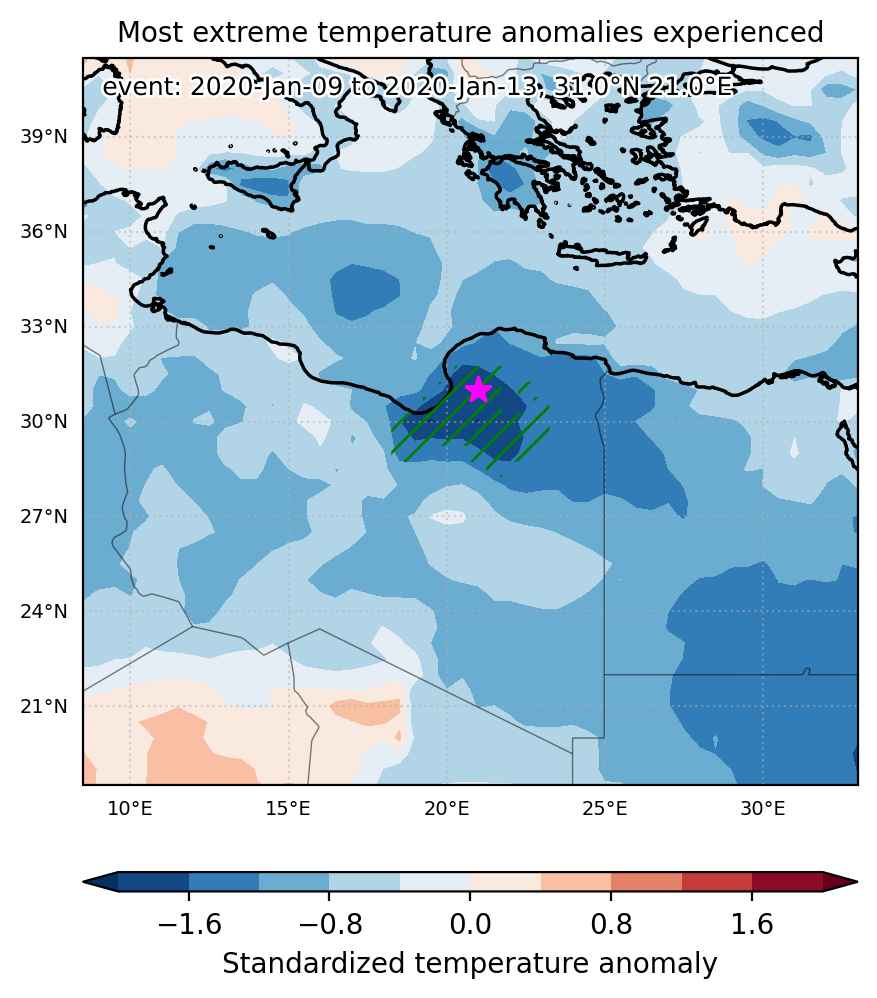
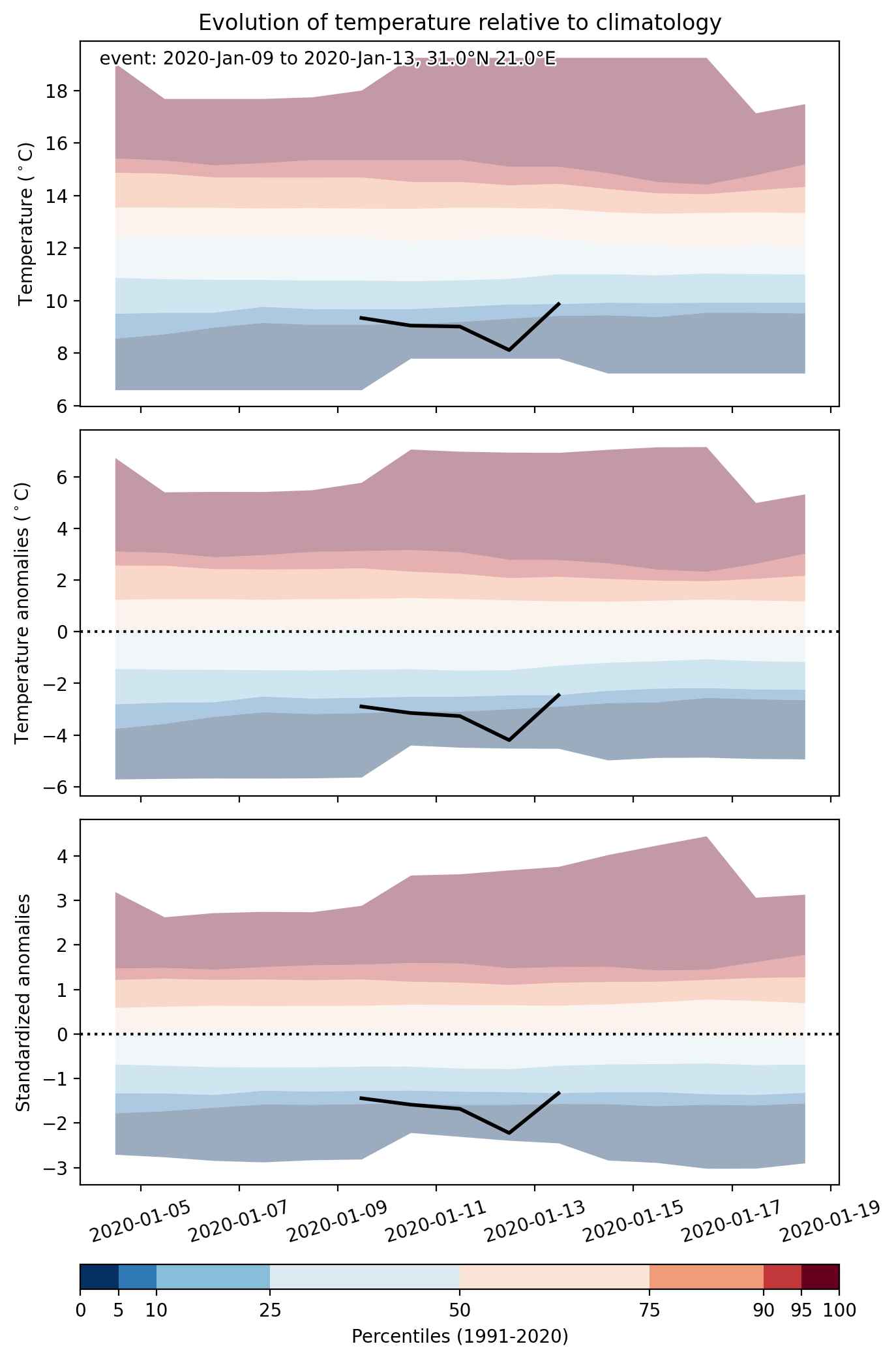
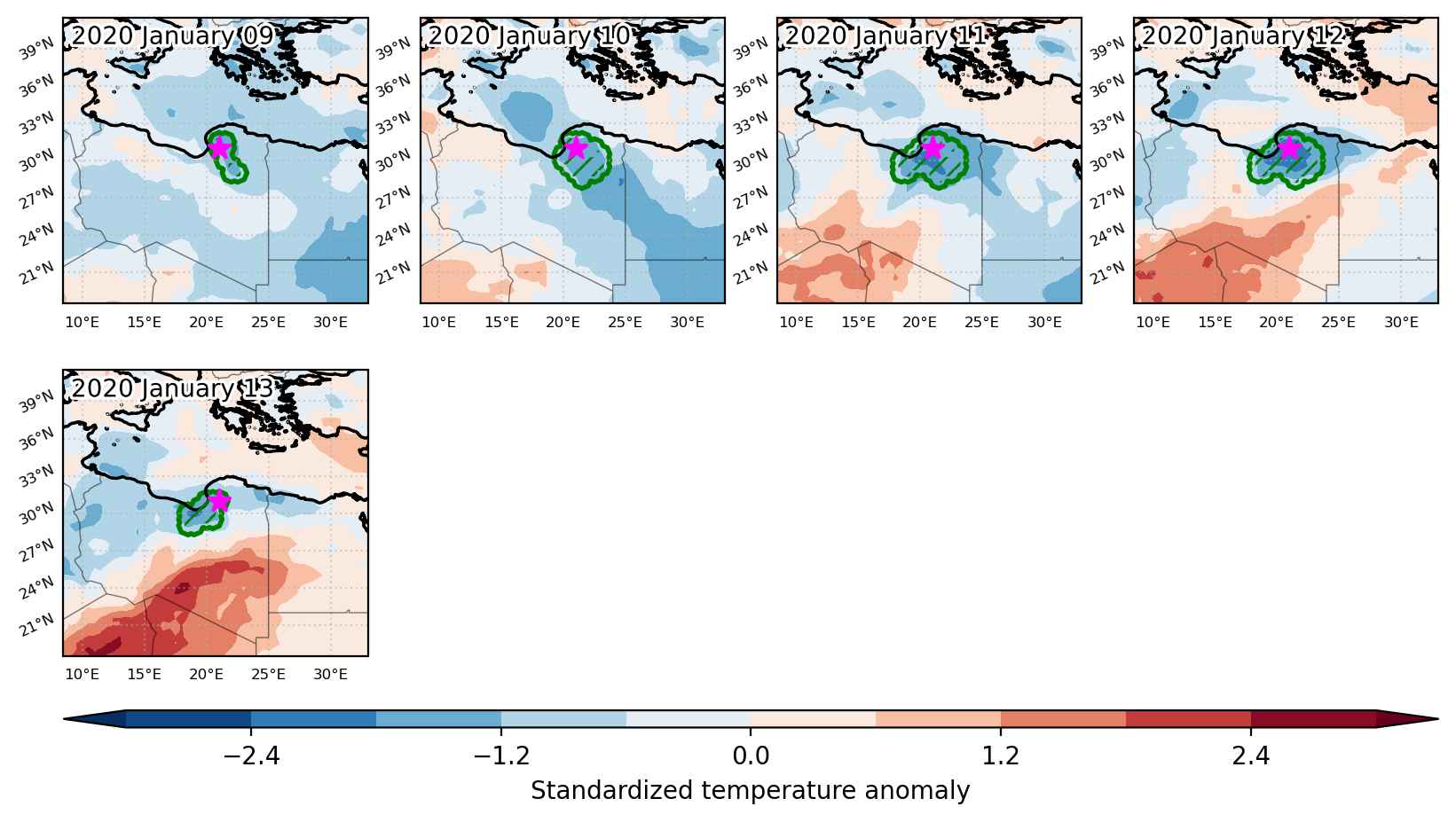
Cold spell occuring from January 09 2020 to January 13 2020 at 31.0°N 21.0°E

Download data: JSON

Event type: Cold spell

Countries affected (identified with ArcGIS Online; provided only for geographical reference):

  • Libya

Duration: 5 days

Time span: January 09 2020 to January 13 2020

Statistics over entire affected area:

  • Mean temperature anomaly: -3.2 °C
  • Mean temperature: 9.4 °C
  • Minimum temperature anomaly: -4.5 °C
  • Minimum temperature: 7.9 °C

Event center: 31.0°N 21.0°E

Area affected: 109745 km$^2$


Fig. 1: Map of most extreme temperature anomalies (standardized) experienced during the event. The purple star indicates the center of the extreme event. Green hatching illustrates all areas under the effect of extremes at some time during the event.


Fig. 2: Evolution of temperature at the center of the event. The climatological percentile distribution is illustrated with color shadings.


Fig. 3: Maps illustrating the evolution of standardized temperature anomalies during the event.

Event ID: Cold_spell_2020-Jan-09_to_2020-Jan-13_21.0_31.0

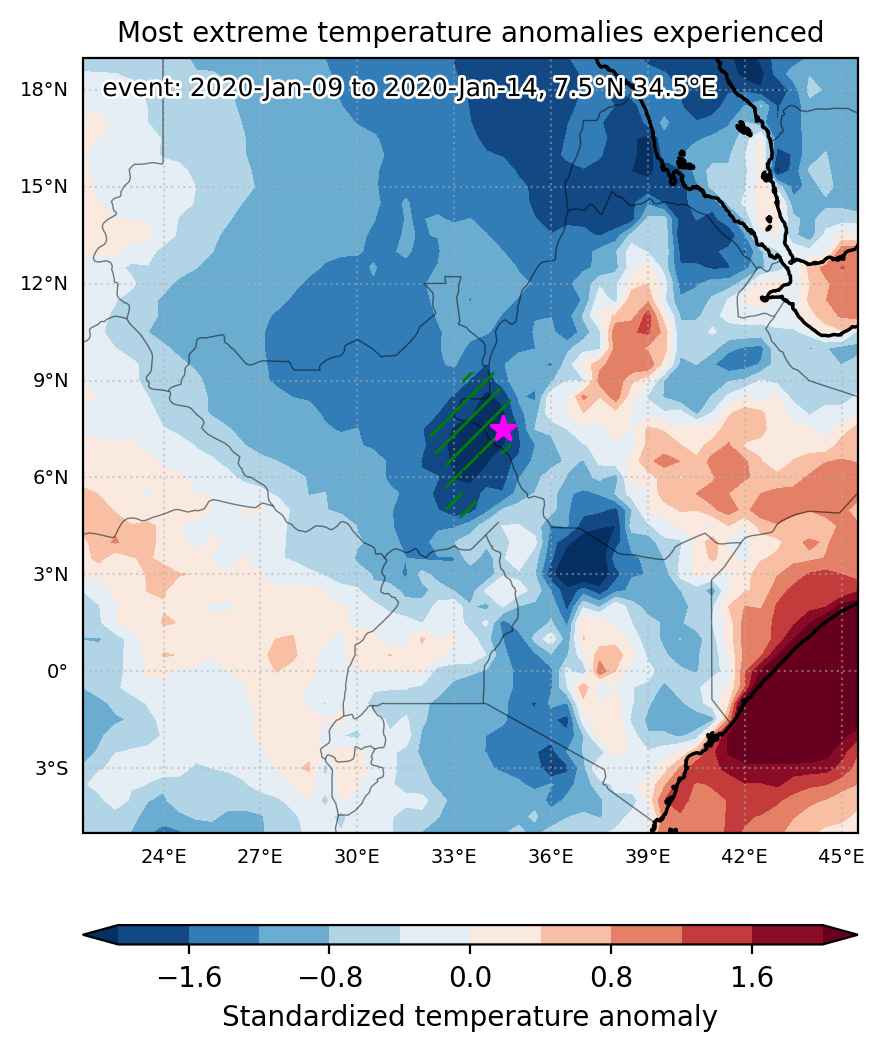
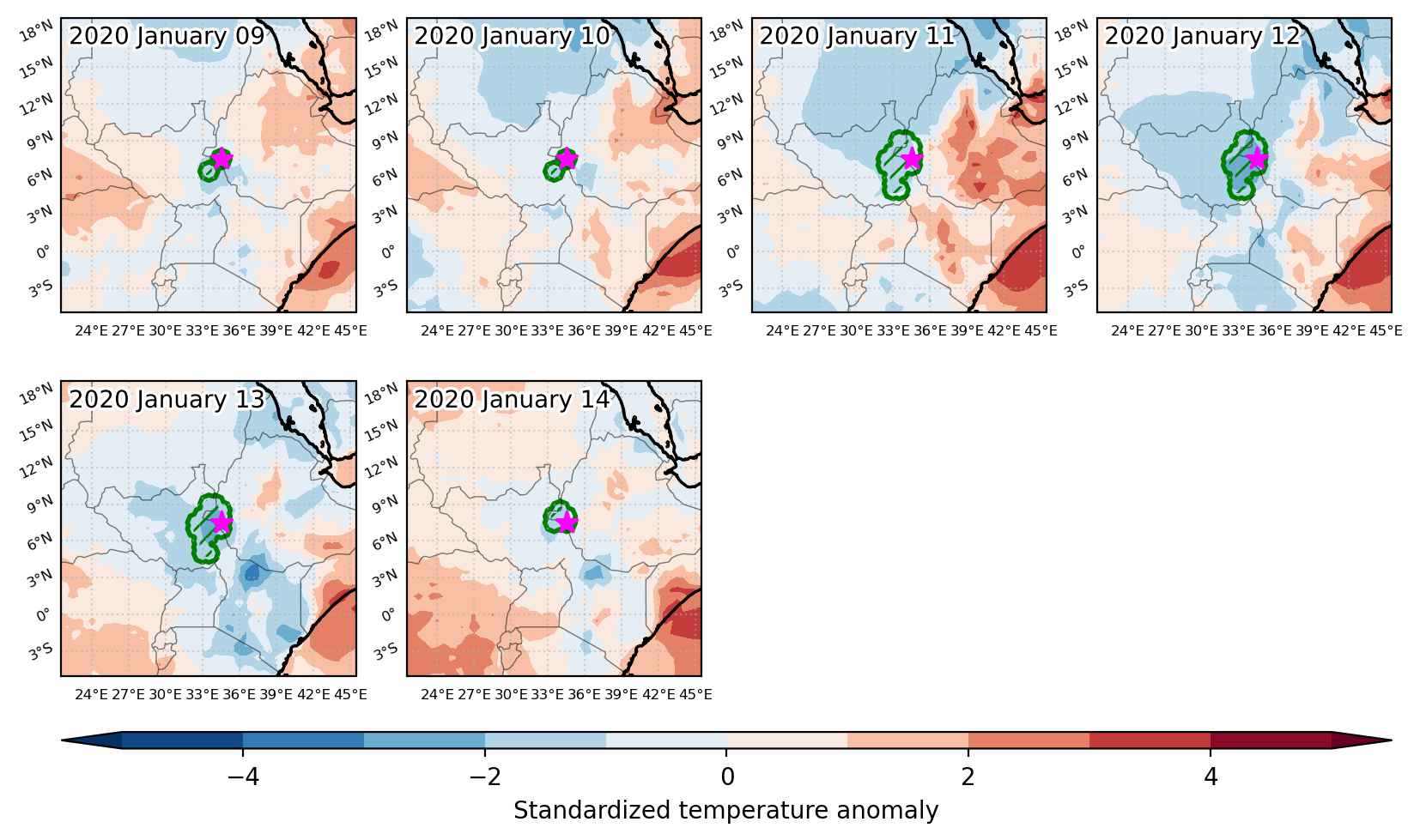
Cold spell occuring from January 09 2020 to January 14 2020 at 7.5°N 34.5°E

Download data: JSON

Event type: Cold spell

Countries affected (identified with ArcGIS Online; provided only for geographical reference):

  • Ethiopia
  • South Sudan

Duration: 6 days

Time span: January 09 2020 to January 14 2020

Statistics over entire affected area:

  • Mean temperature anomaly: -3.3 °C
  • Mean temperature: 26.5 °C
  • Minimum temperature anomaly: -4.7 °C
  • Minimum temperature: 22.5 °C

Event center: 7.5°N 34.5°E

Area affected: 76636 km$^2$


Fig. 1: Map of most extreme temperature anomalies (standardized) experienced during the event. The purple star indicates the center of the extreme event. Green hatching illustrates all areas under the effect of extremes at some time during the event.


Fig. 2: Evolution of temperature at the center of the event. The climatological percentile distribution is illustrated with color shadings.


Fig. 3: Maps illustrating the evolution of standardized temperature anomalies during the event.

Event ID: Cold_spell_2020-Jan-09_to_2020-Jan-14_34.5_7.5