Heat wave occuring from February 15 2026 to February 17 2026 at 44.0°N 342.5°E

Download data: JSON

Event type: Heat wave

Countries affected (identified with ArcGIS Online; provided only for geographical reference):

  • Spain

Duration: 3 days

Time span: February 15 2026 to February 17 2026

Statistics over entire affected area:

  • Mean temperature anomaly: 1.9 °C
  • Mean temperature: 13.6 °C
  • Maximum temperature anomaly: 4.8 °C
  • Maximum temperature: 14.8 °C

Event center: 44.0°N 342.5°E

Area affected: 268073 km$^2$
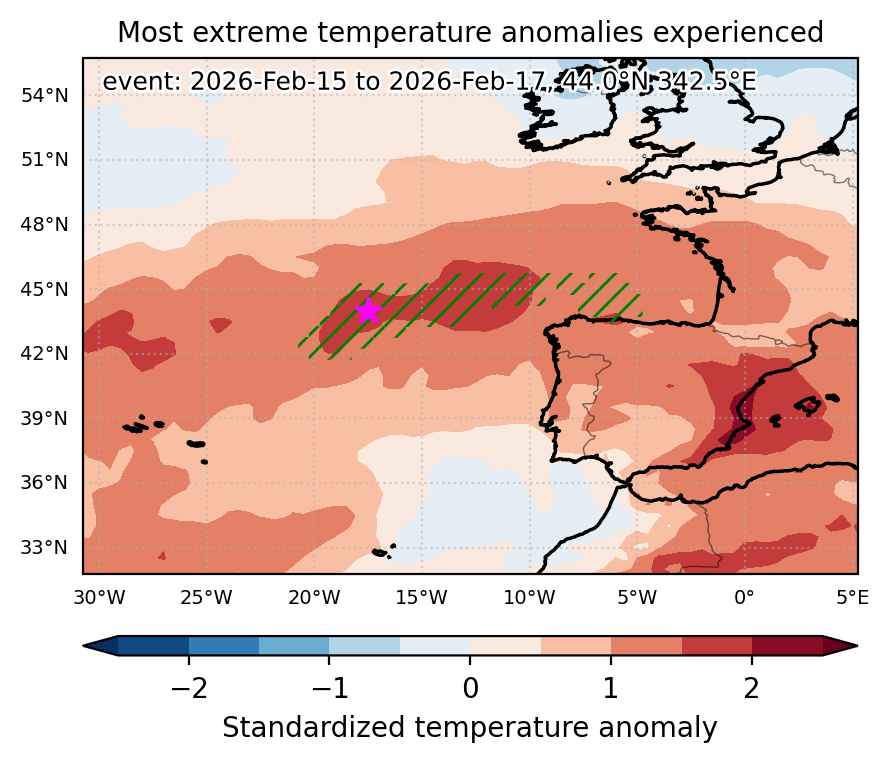

Fig. 1: Map of most extreme temperature anomalies (standardized) experienced during the event. The purple star indicates the center of the extreme event. Green hatching illustrates all areas under the effect of extremes at some time during the event.


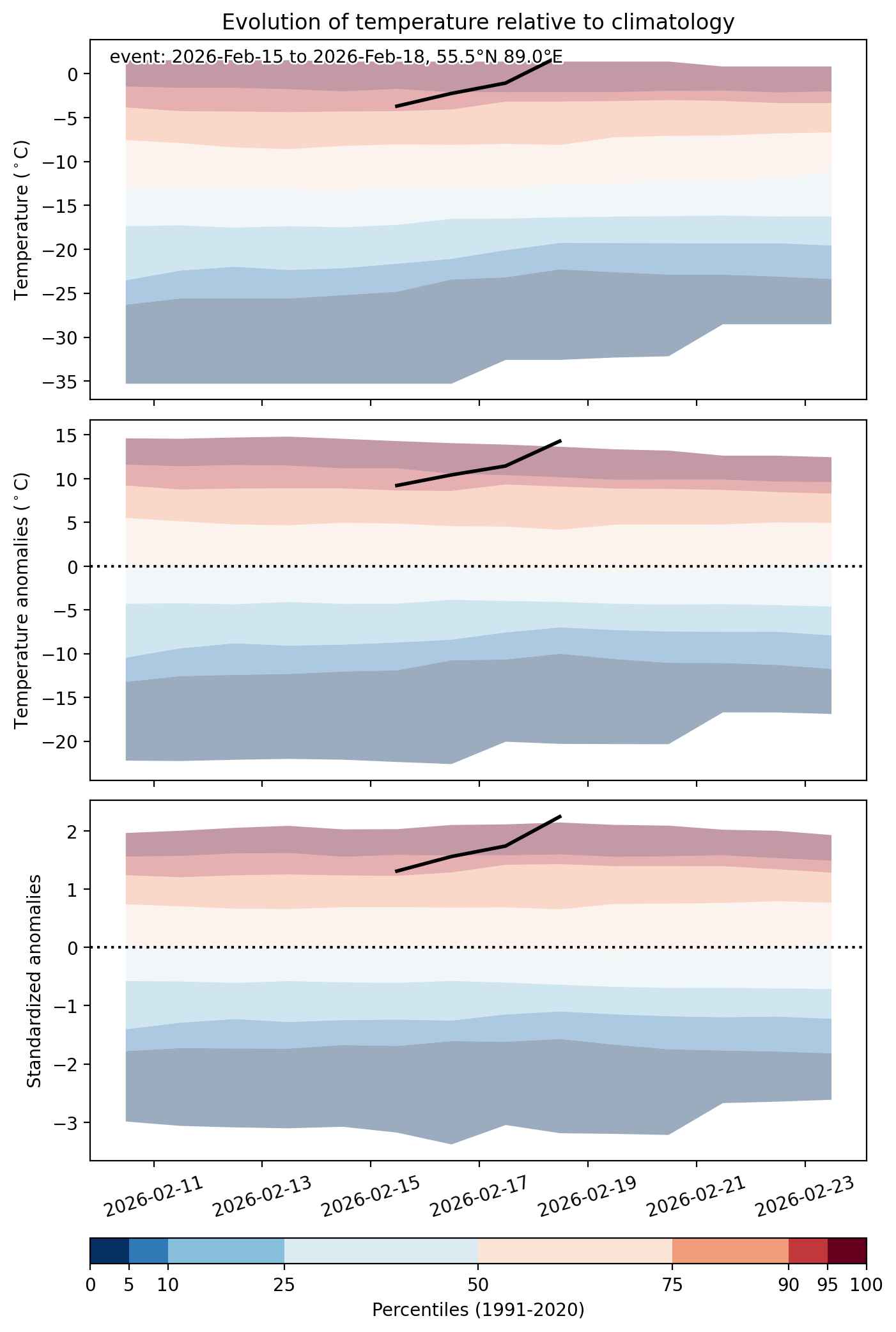
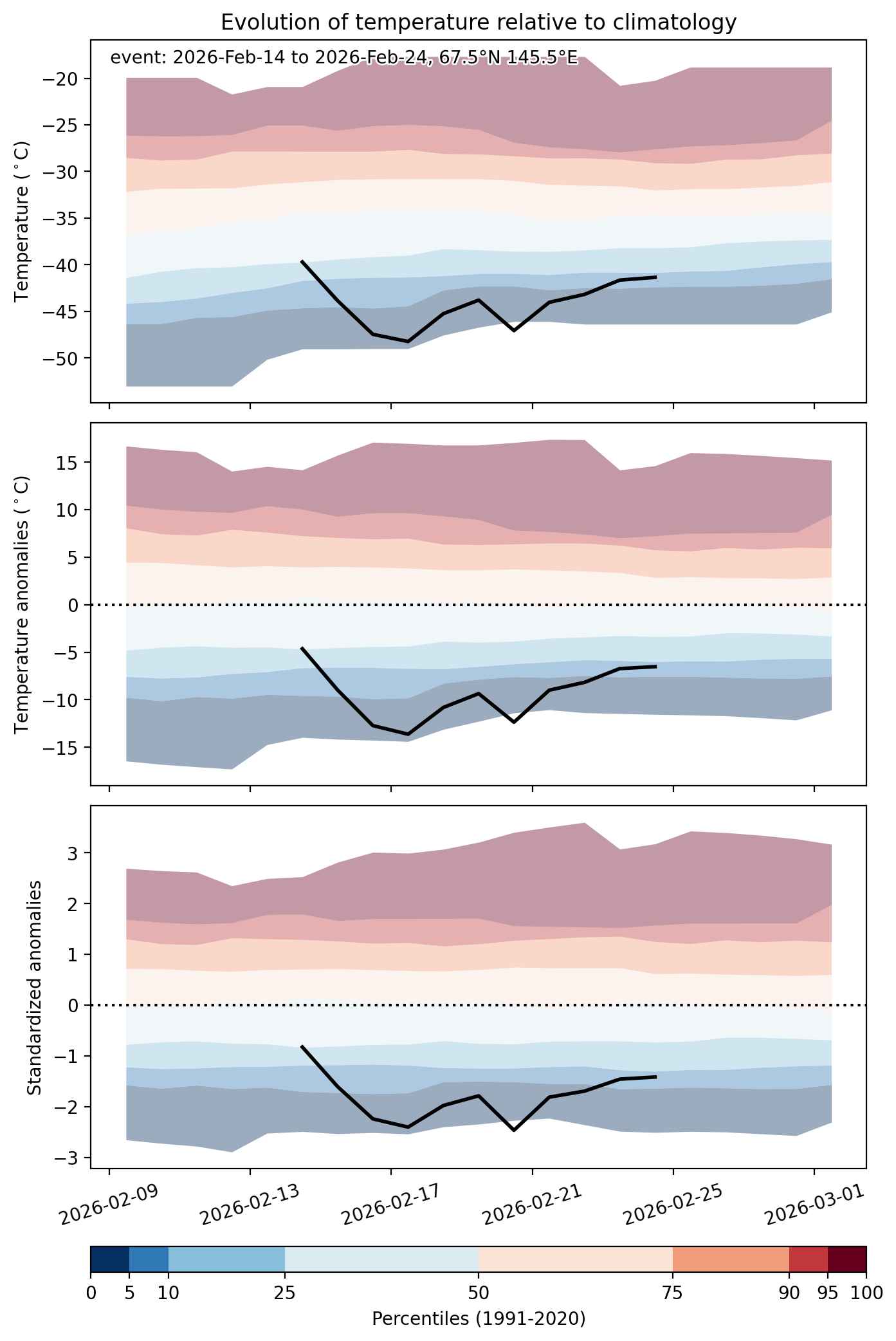
Fig. 2: Evolution of temperature at the center of the event. The climatological percentile distribution is illustrated with color shadings.
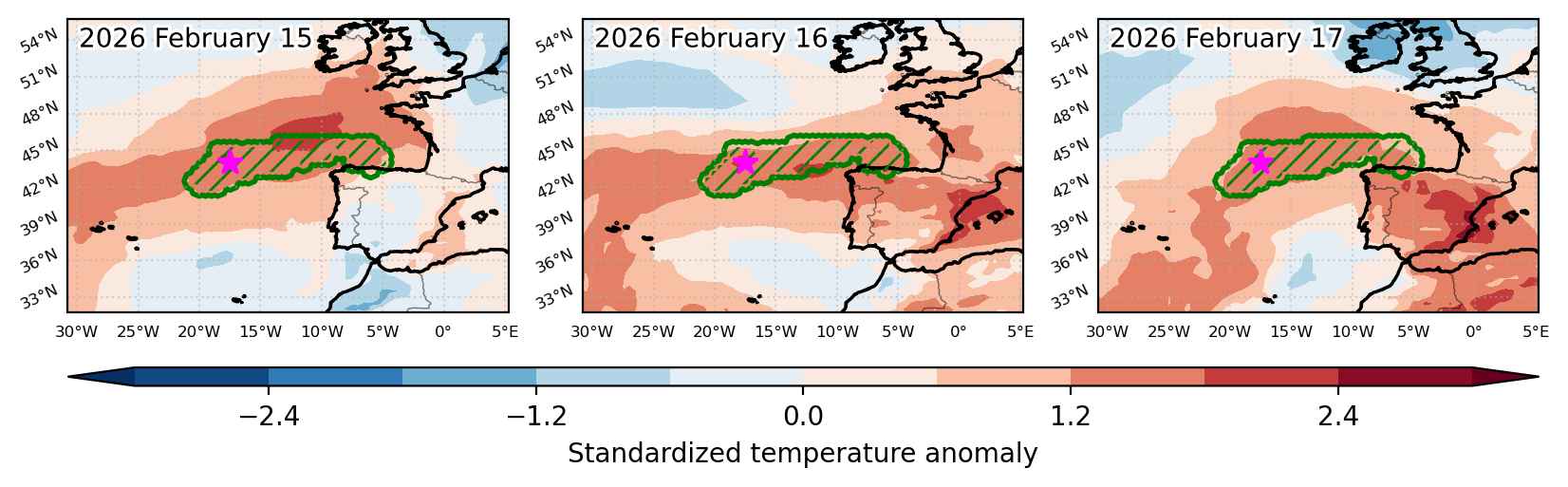


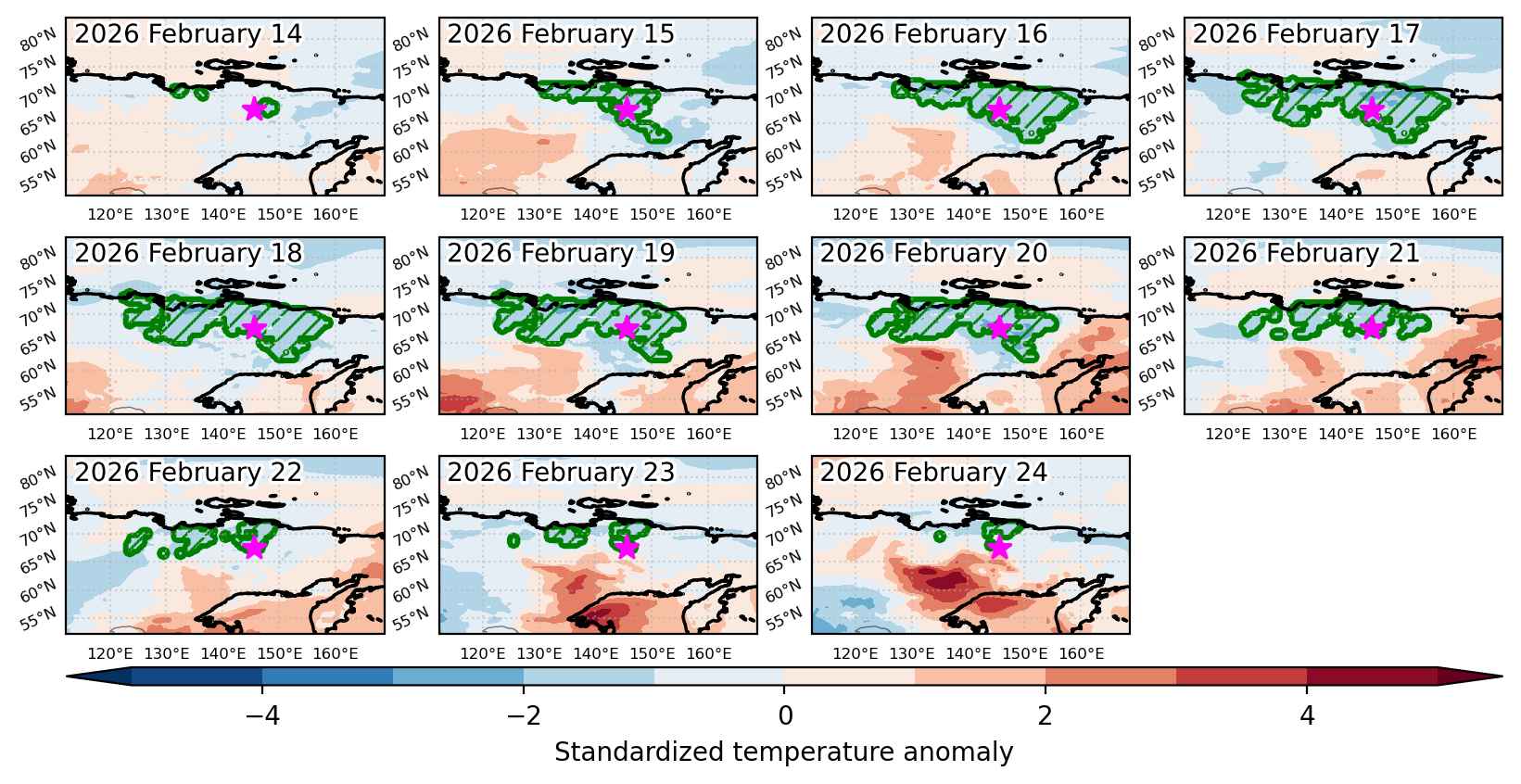
Fig. 3: Maps illustrating the evolution of standardized temperature anomalies during the event.

Event ID: Heat_wave_2026-Feb-15_to_2026-Feb-17_342.5_44.0
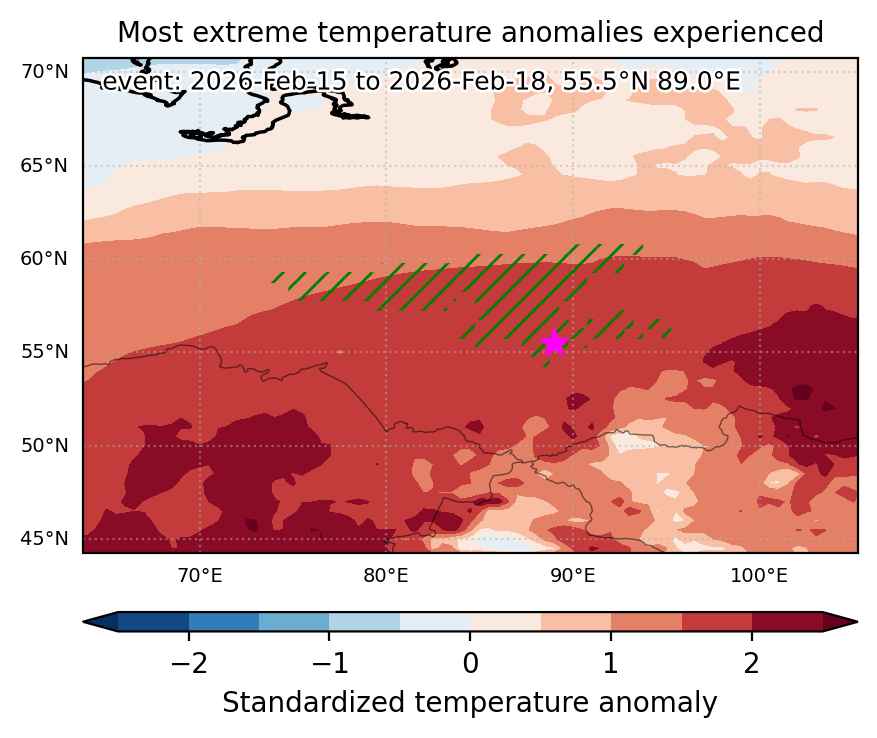
Heat wave occuring from February 15 2026 to February 18 2026 at 55.5°N 89.0°E

Download data: JSON

Event type: Heat wave

Countries affected (identified with ArcGIS Online; provided only for geographical reference):

  • Russian Federation

Duration: 4 days

Time span: February 15 2026 to February 18 2026

Statistics over entire affected area:

  • Mean temperature anomaly: 11.2 °C
  • Mean temperature: -4.3 °C
  • Maximum temperature anomaly: 17.8 °C
  • Maximum temperature: 3.4 °C

Event center: 55.5°N 89.0°E

Area affected: 367004 km$^2$


Fig. 1: Map of most extreme temperature anomalies (standardized) experienced during the event. The purple star indicates the center of the extreme event. Green hatching illustrates all areas under the effect of extremes at some time during the event.


Fig. 2: Evolution of temperature at the center of the event. The climatological percentile distribution is illustrated with color shadings.


Fig. 3: Maps illustrating the evolution of standardized temperature anomalies during the event.

Event ID: Heat_wave_2026-Feb-15_to_2026-Feb-18_89.0_55.5

Heat wave occuring from February 15 2026 to February 20 2026 at -8.0°S 132.5°E

Download data: JSON

Event type: Heat wave

Countries affected (identified with ArcGIS Online; provided only for geographical reference):

  • Indonesia

Duration: 6 days

Time span: February 15 2026 to February 20 2026

Statistics over entire affected area:

  • Mean temperature anomaly: 0.9 °C
  • Mean temperature: 28.2 °C
  • Maximum temperature anomaly: 1.4 °C
  • Maximum temperature: 28.9 °C

Event center: -8.0°S 132.5°E

Area affected: 235905 km$^2$


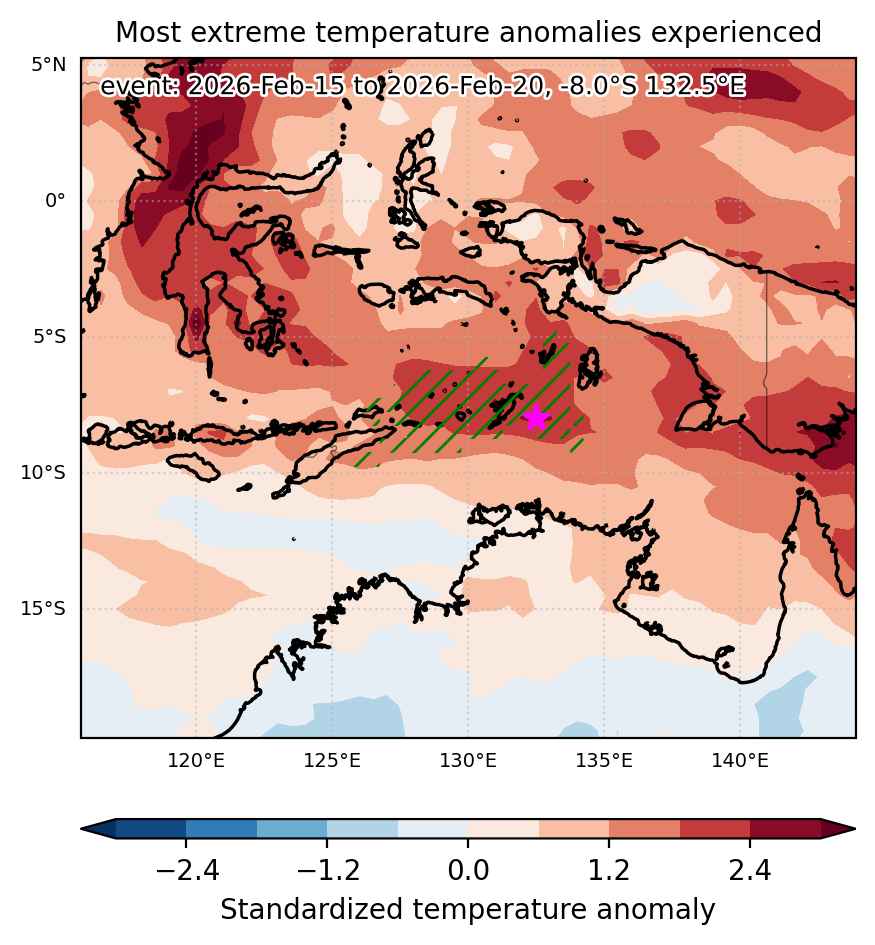
Fig. 1: Map of most extreme temperature anomalies (standardized) experienced during the event. The purple star indicates the center of the extreme event. Green hatching illustrates all areas under the effect of extremes at some time during the event.


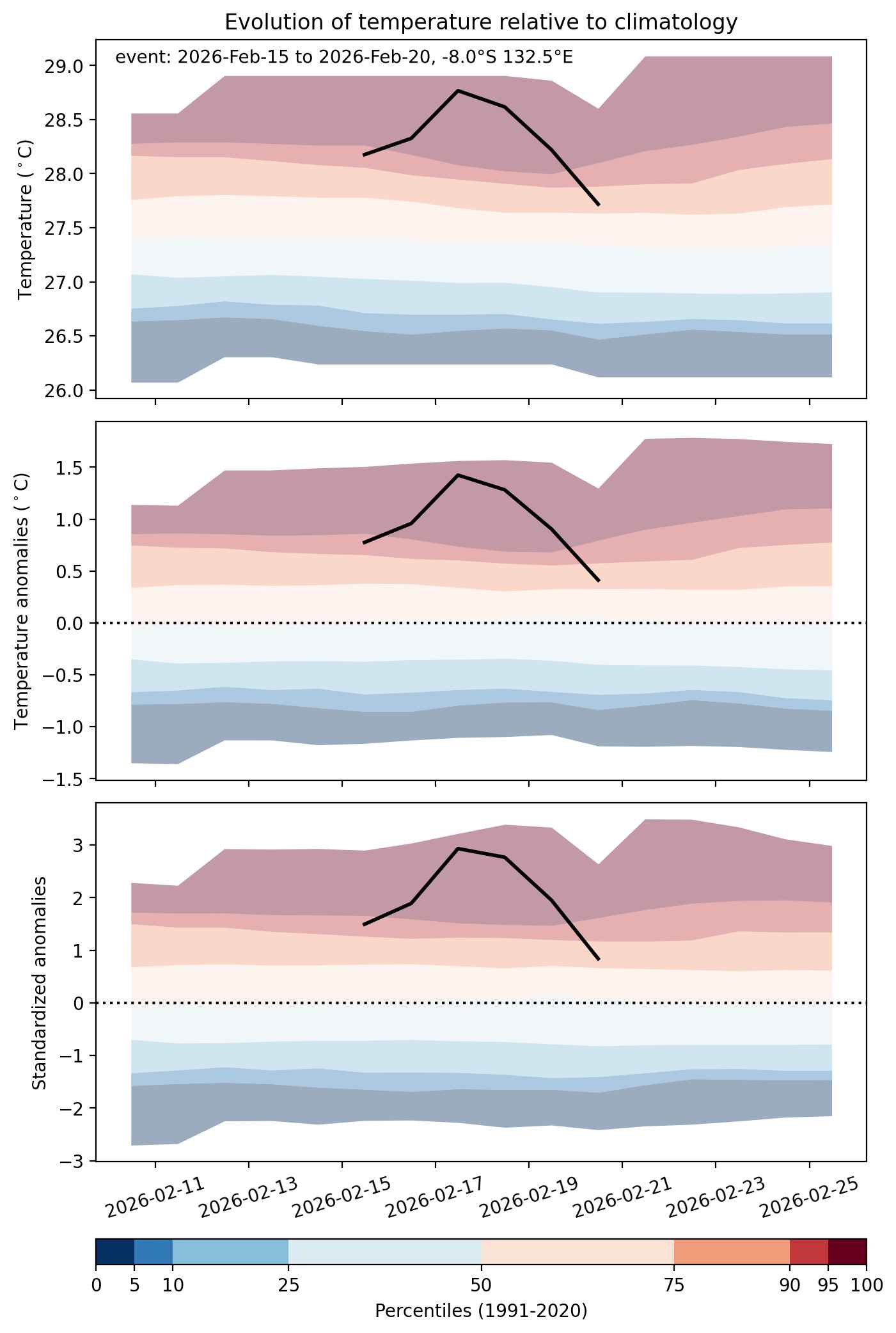
Fig. 2: Evolution of temperature at the center of the event. The climatological percentile distribution is illustrated with color shadings.


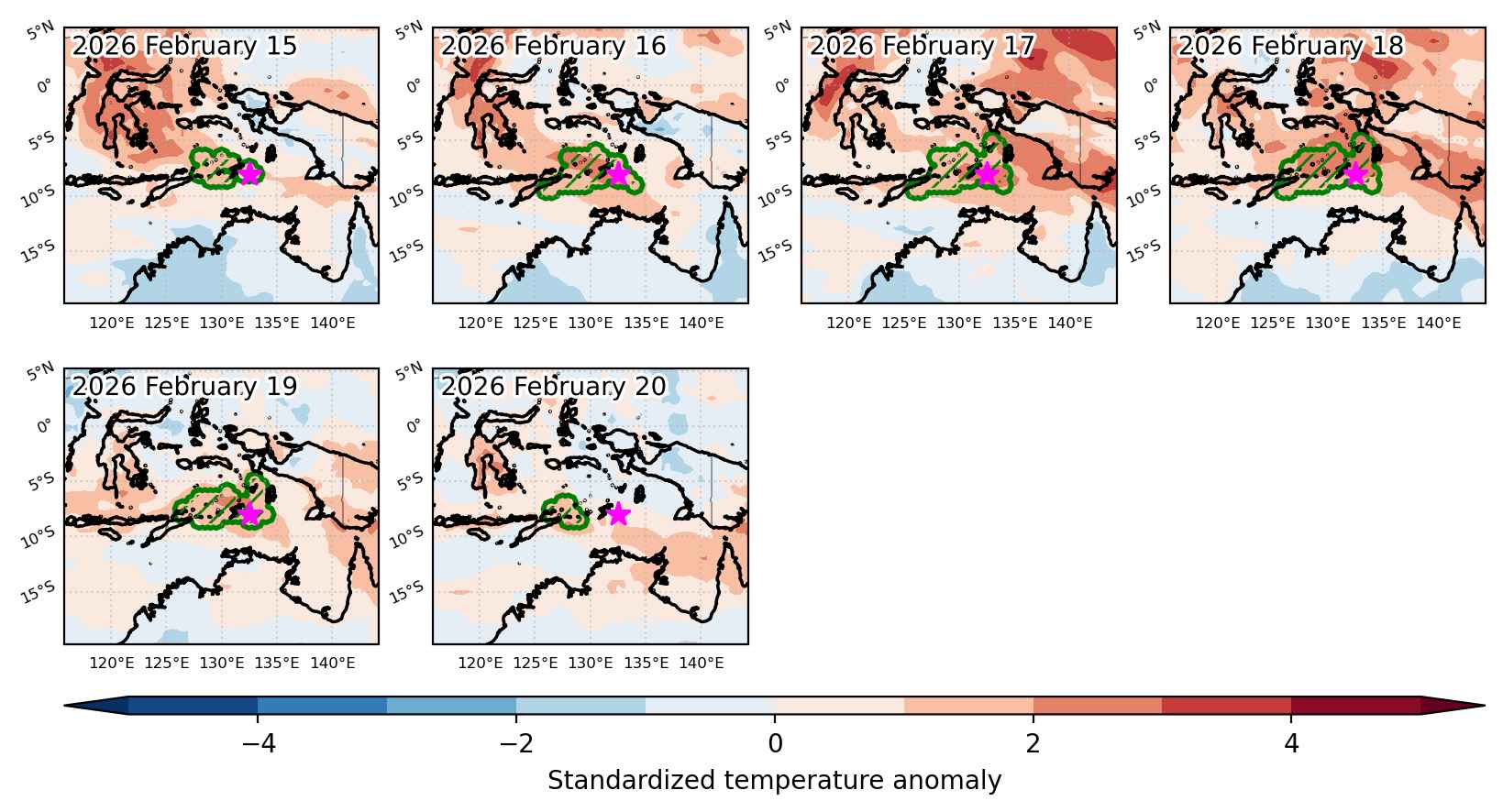
Fig. 3: Maps illustrating the evolution of standardized temperature anomalies during the event.

Event ID: Heat_wave_2026-Feb-15_to_2026-Feb-20_132.5_-8.0

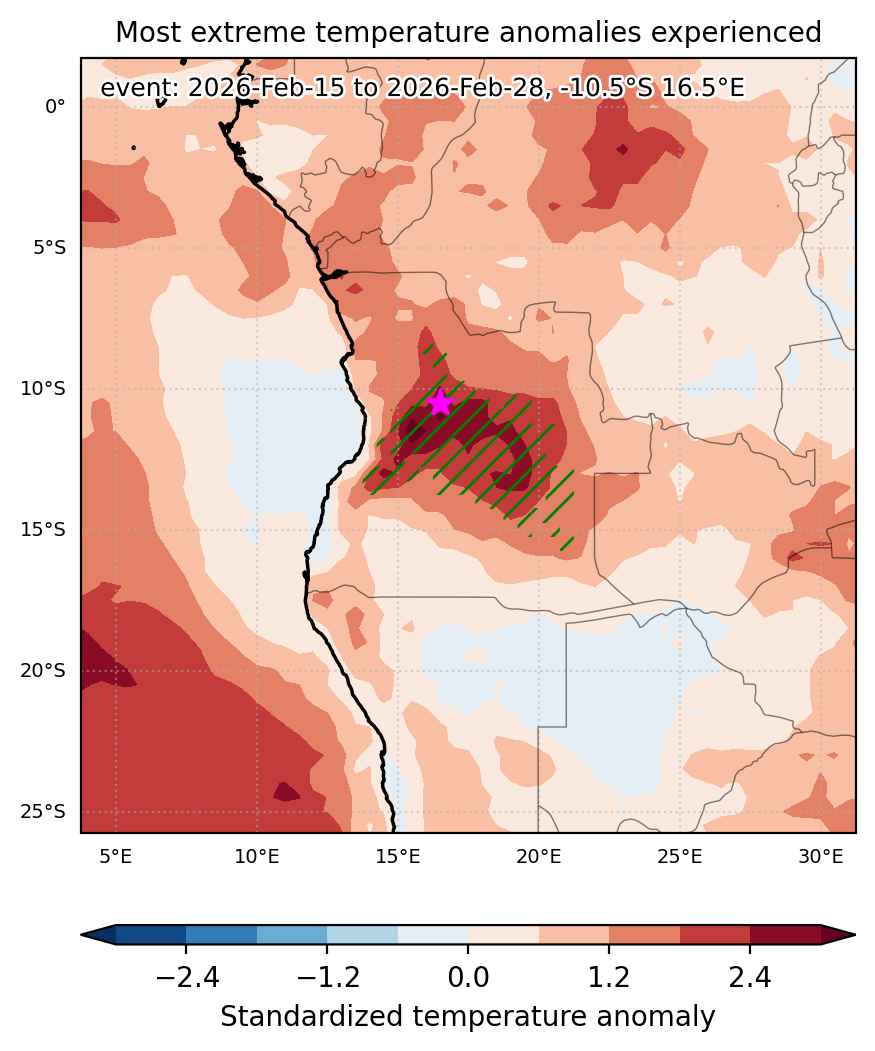
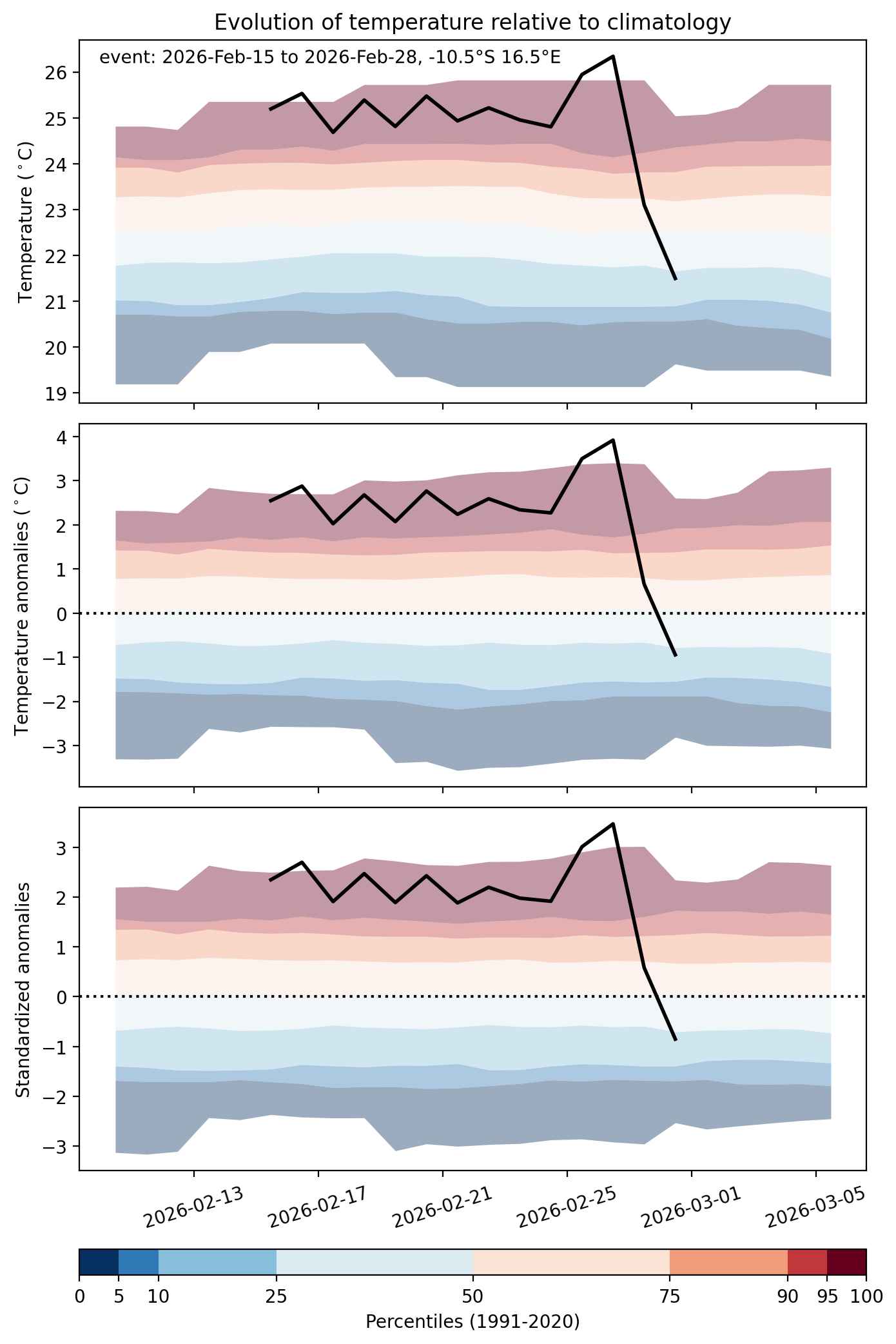
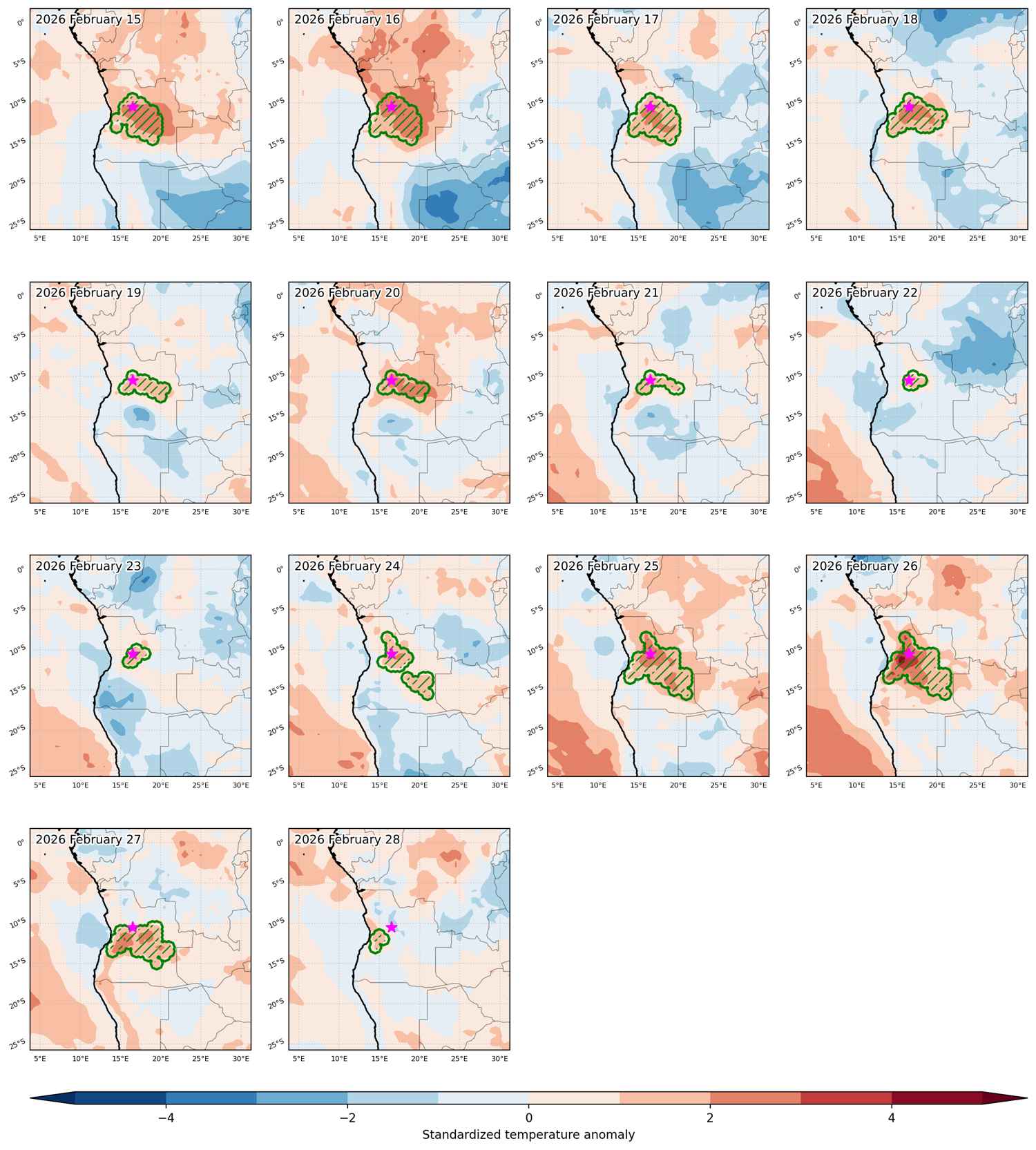
Heat wave occuring from February 15 2026 to February 28 2026 at -10.5°S 16.5°E

Download data: JSON

Event type: Heat wave

Countries affected (identified with ArcGIS Online; provided only for geographical reference):

  • Angola

Duration: 14 days

Time span: February 15 2026 to February 28 2026

Statistics over entire affected area:

  • Mean temperature anomaly: 2.1 °C
  • Mean temperature: 22.9 °C
  • Maximum temperature anomaly: 4.5 °C
  • Maximum temperature: 26.5 °C

Event center: -10.5°S 16.5°E

Area affected: 295951 km$^2$


Fig. 1: Map of most extreme temperature anomalies (standardized) experienced during the event. The purple star indicates the center of the extreme event. Green hatching illustrates all areas under the effect of extremes at some time during the event.


Fig. 2: Evolution of temperature at the center of the event. The climatological percentile distribution is illustrated with color shadings.


Fig. 3: Maps illustrating the evolution of standardized temperature anomalies during the event.

Event ID: Heat_wave_2026-Feb-15_to_2026-Feb-28_16.5_-10.5

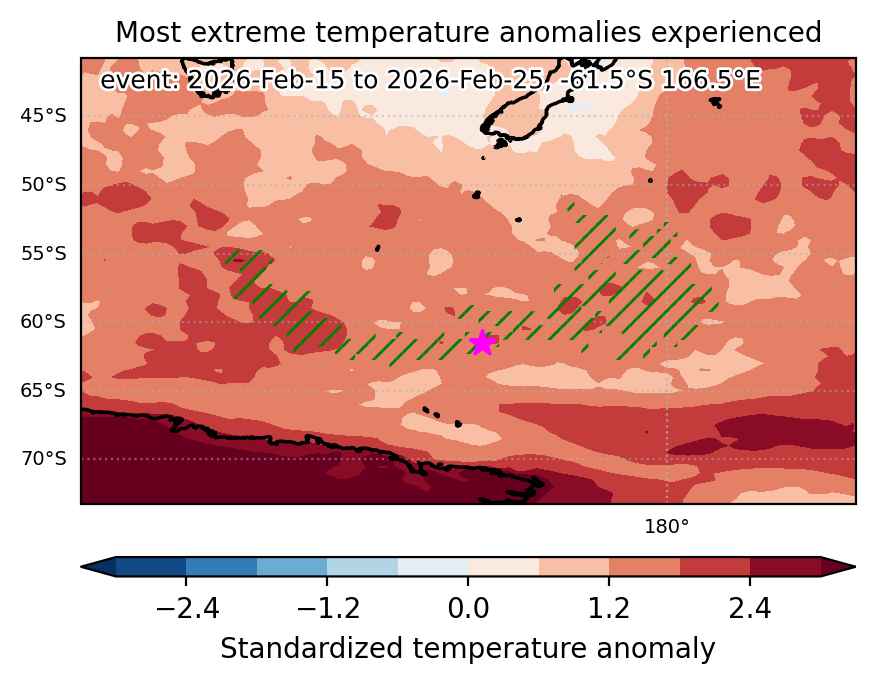
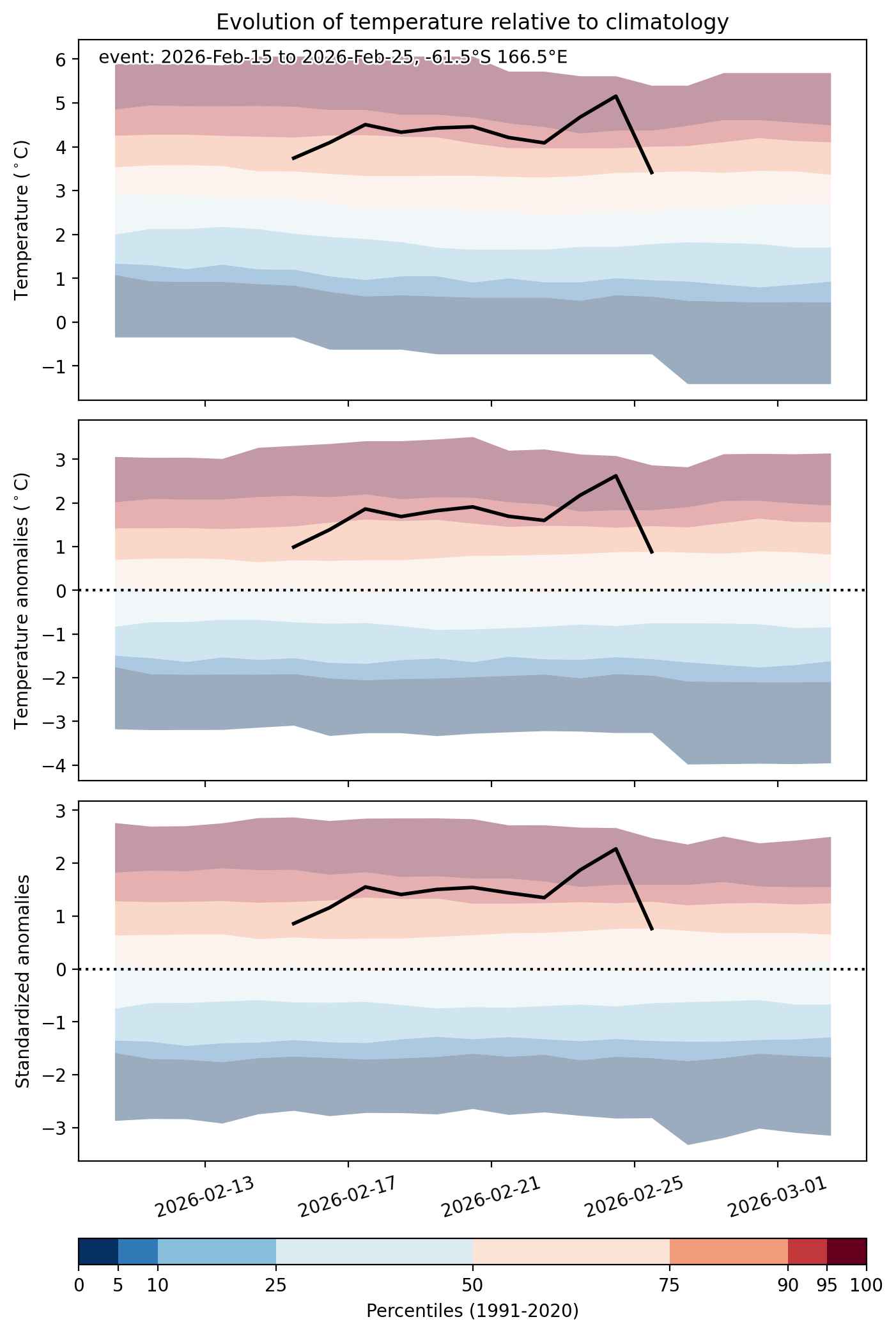
Heat wave occuring from February 15 2026 to February 25 2026 at -61.5°S 166.5°E

Download data: JSON

Event type: Heat wave

Countries affected (identified with ArcGIS Online; provided only for geographical reference):

  • Antarctica

Duration: 11 days

Time span: February 15 2026 to February 25 2026

Statistics over entire affected area:

  • Mean temperature anomaly: 1.9 °C
  • Mean temperature: 6.6 °C
  • Maximum temperature anomaly: 3.5 °C
  • Maximum temperature: 11.5 °C

Event center: -61.5°S 166.5°E

Area affected: 803545 km$^2$


Fig. 1: Map of most extreme temperature anomalies (standardized) experienced during the event. The purple star indicates the center of the extreme event. Green hatching illustrates all areas under the effect of extremes at some time during the event.


Fig. 2: Evolution of temperature at the center of the event. The climatological percentile distribution is illustrated with color shadings.


Fig. 3: Maps illustrating the evolution of standardized temperature anomalies during the event.

Event ID: Heat_wave_2026-Feb-15_to_2026-Feb-25_166.5_-61.5

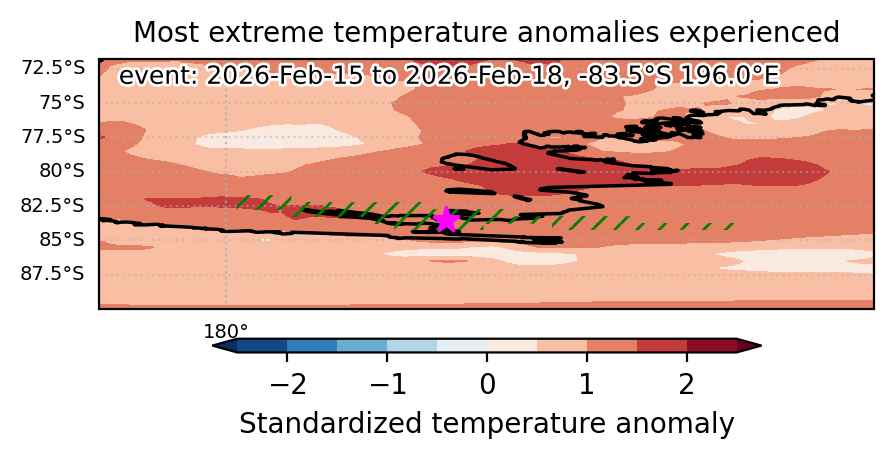
Heat wave occuring from February 15 2026 to February 18 2026 at -83.5°S 196.0°E

Download data: JSON

Event type: Heat wave

Countries affected (identified with ArcGIS Online; provided only for geographical reference):

  • Antarctica

Duration: 4 days

Time span: February 15 2026 to February 18 2026

Statistics over entire affected area:

  • Mean temperature anomaly: 6.8 °C
  • Mean temperature: -10.7 °C
  • Maximum temperature anomaly: 8.4 °C
  • Maximum temperature: -7.8 °C

Event center: -83.5°S 196.0°E

Area affected: 52610 km$^2$


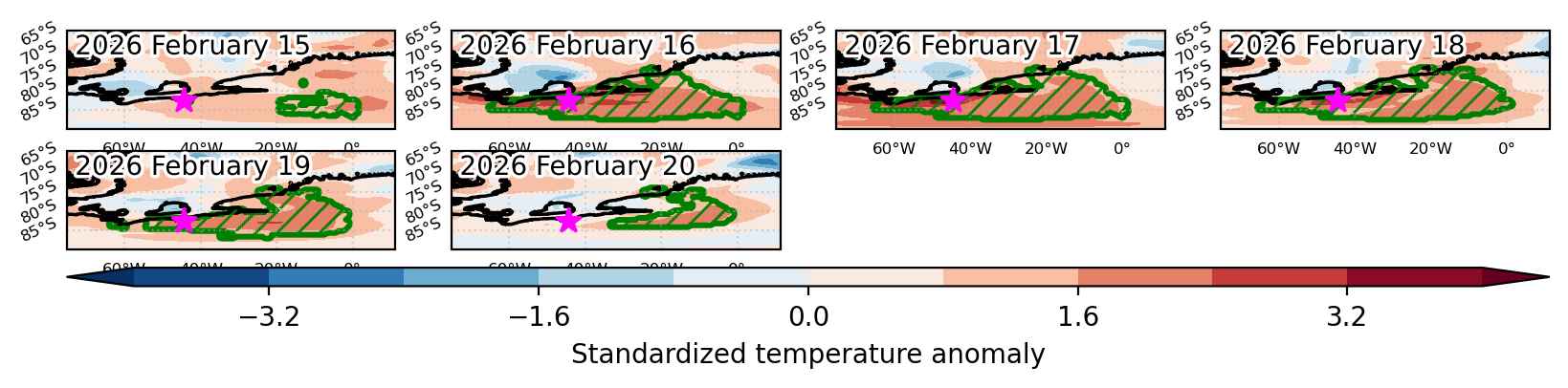
Fig. 1: Map of most extreme temperature anomalies (standardized) experienced during the event. The purple star indicates the center of the extreme event. Green hatching illustrates all areas under the effect of extremes at some time during the event.


Fig. 2: Evolution of temperature at the center of the event. The climatological percentile distribution is illustrated with color shadings.


Fig. 3: Maps illustrating the evolution of standardized temperature anomalies during the event.

Event ID: Heat_wave_2026-Feb-15_to_2026-Feb-18_196.0_-83.5

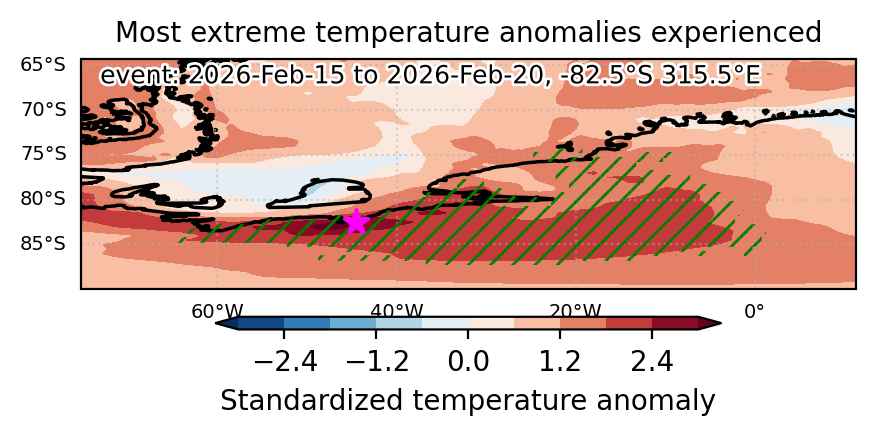
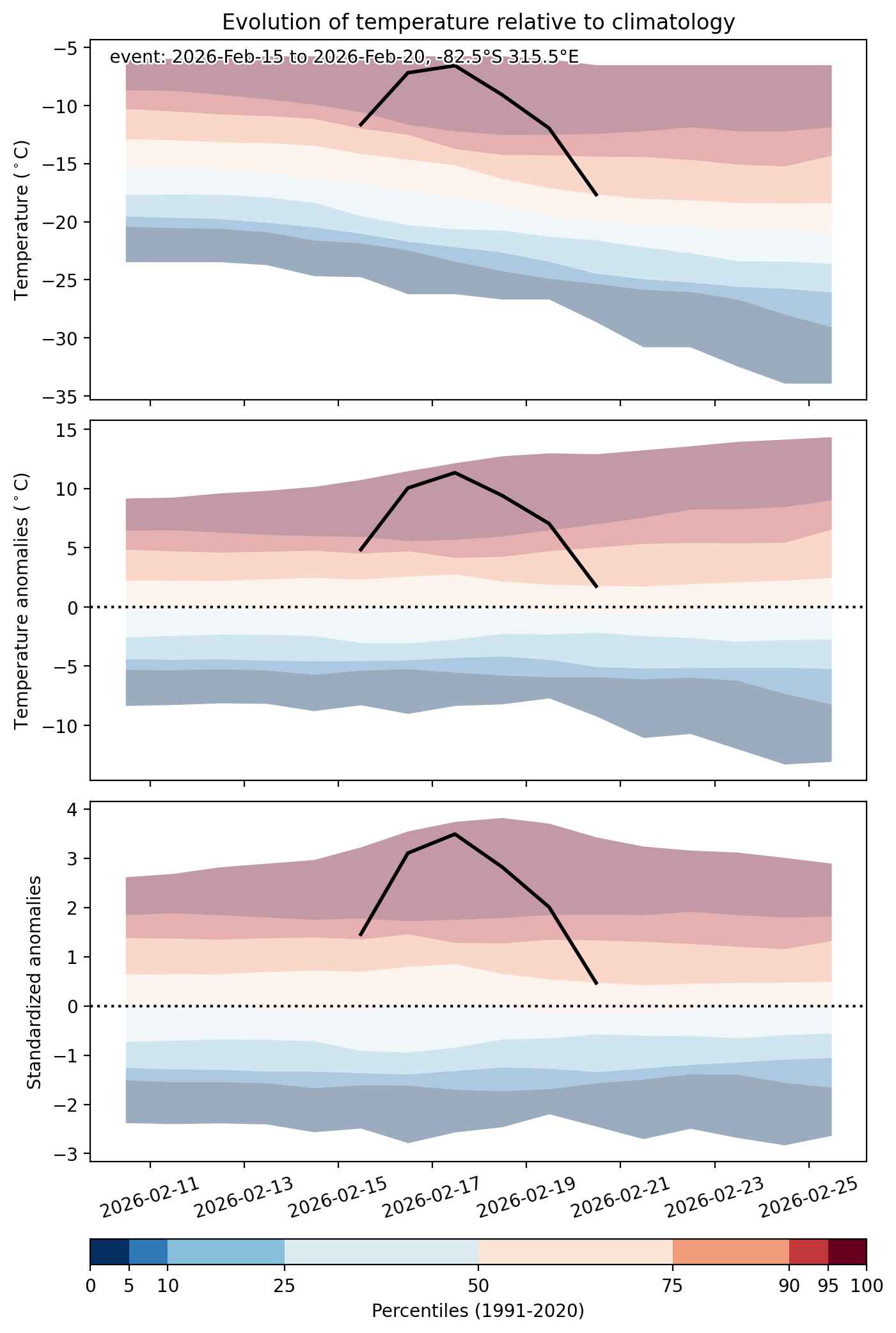
Heat wave occuring from February 15 2026 to February 20 2026 at -82.5°S 315.5°E

Download data: JSON

Event type: Heat wave

Countries affected (identified with ArcGIS Online; provided only for geographical reference):

  • Antarctica

Duration: 6 days

Time span: February 15 2026 to February 20 2026

Statistics over entire affected area:

  • Mean temperature anomaly: 6.5 °C
  • Mean temperature: -20.6 °C
  • Maximum temperature anomaly: 11.6 °C
  • Maximum temperature: -4.8 °C

Event center: -82.5°S 315.5°E

Area affected: 690641 km$^2$


Fig. 1: Map of most extreme temperature anomalies (standardized) experienced during the event. The purple star indicates the center of the extreme event. Green hatching illustrates all areas under the effect of extremes at some time during the event.


Fig. 2: Evolution of temperature at the center of the event. The climatological percentile distribution is illustrated with color shadings.


Fig. 3: Maps illustrating the evolution of standardized temperature anomalies during the event.

Event ID: Heat_wave_2026-Feb-15_to_2026-Feb-20_315.5_-82.5

Cold spell occuring from February 15 2026 to March 14 2026 at -2.5°S 36.0°E

Download data: JSON

Event type: Cold spell

Countries affected (identified with ArcGIS Online; provided only for geographical reference):

  • Cameroon
  • Central African Republic
  • Chad
  • Congo, The Democratic Republic of the
  • Egypt
  • Eritrea
  • Ethiopia
  • Kenya
  • Libya
  • Mozambique
  • Nigeria
  • Somalia
  • South Sudan
  • Sudan
  • Tanzania, United Republic of
  • Uganda

Duration: 28 days

Time span: February 15 2026 to March 14 2026

Statistics over entire affected area:

  • Mean temperature anomaly: -3.9 °C
  • Mean temperature: 22.8 °C
  • Minimum temperature anomaly: -8.2 °C
  • Minimum temperature: 7.9 °C

Event center: -2.5°S 36.0°E

Area affected: 6030435 km$^2$


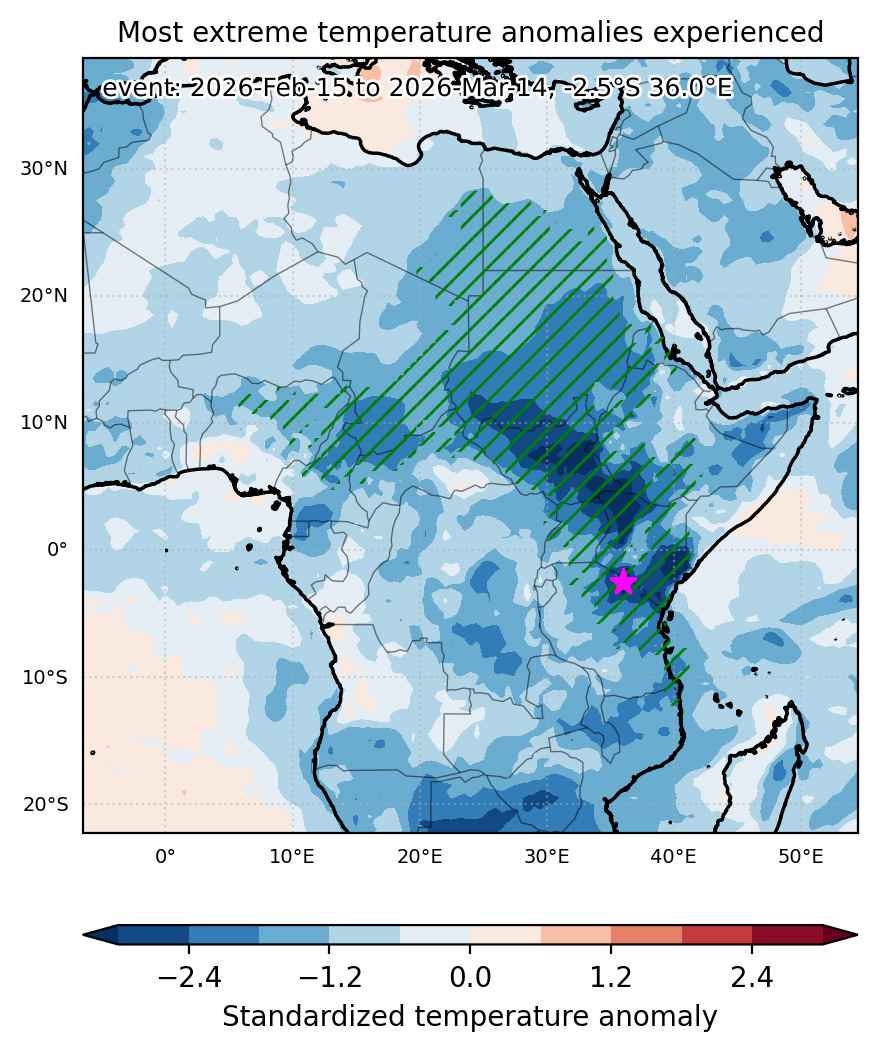
Fig. 1: Map of most extreme temperature anomalies (standardized) experienced during the event. The purple star indicates the center of the extreme event. Green hatching illustrates all areas under the effect of extremes at some time during the event.


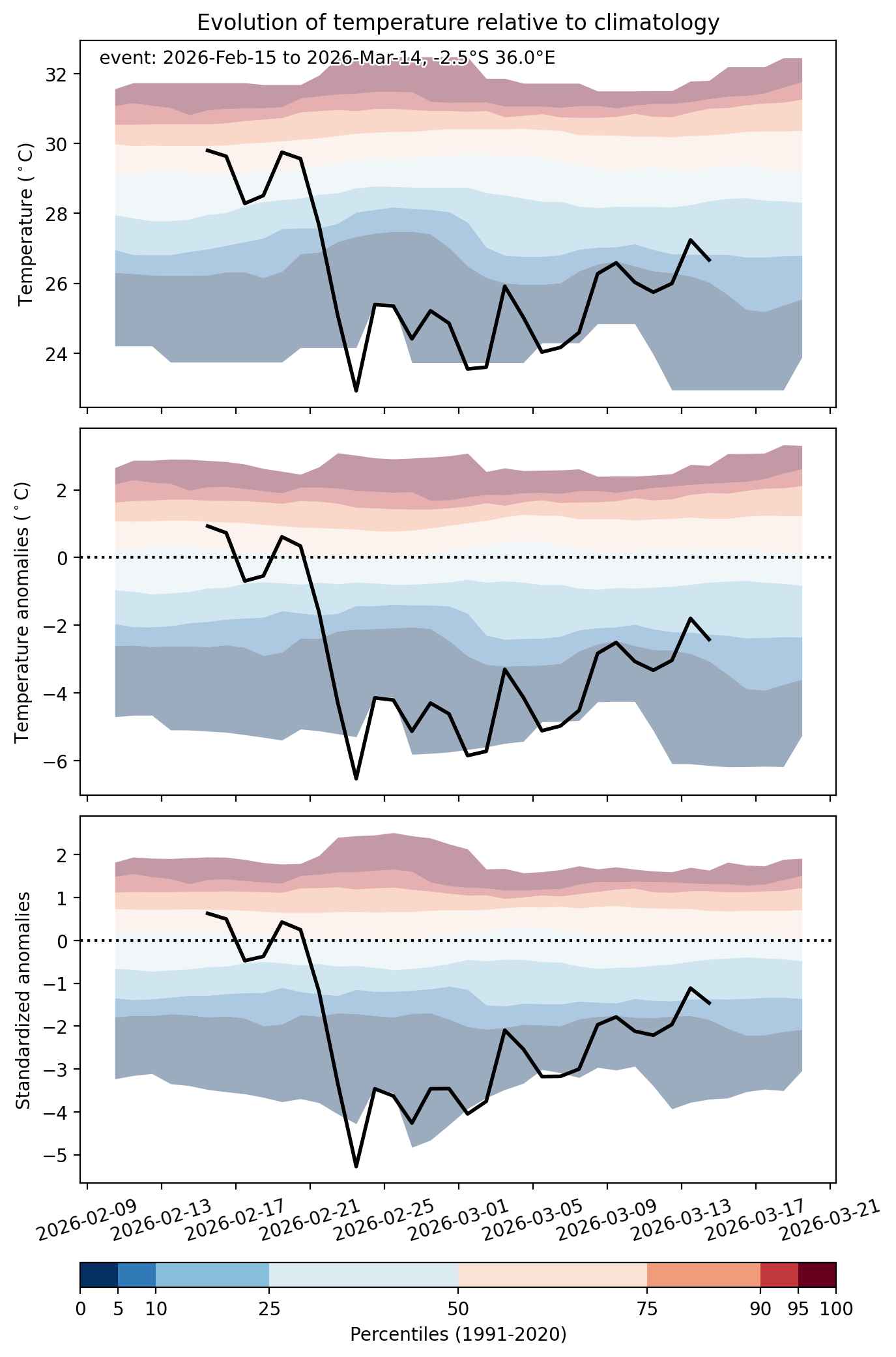
Fig. 2: Evolution of temperature at the center of the event. The climatological percentile distribution is illustrated with color shadings.


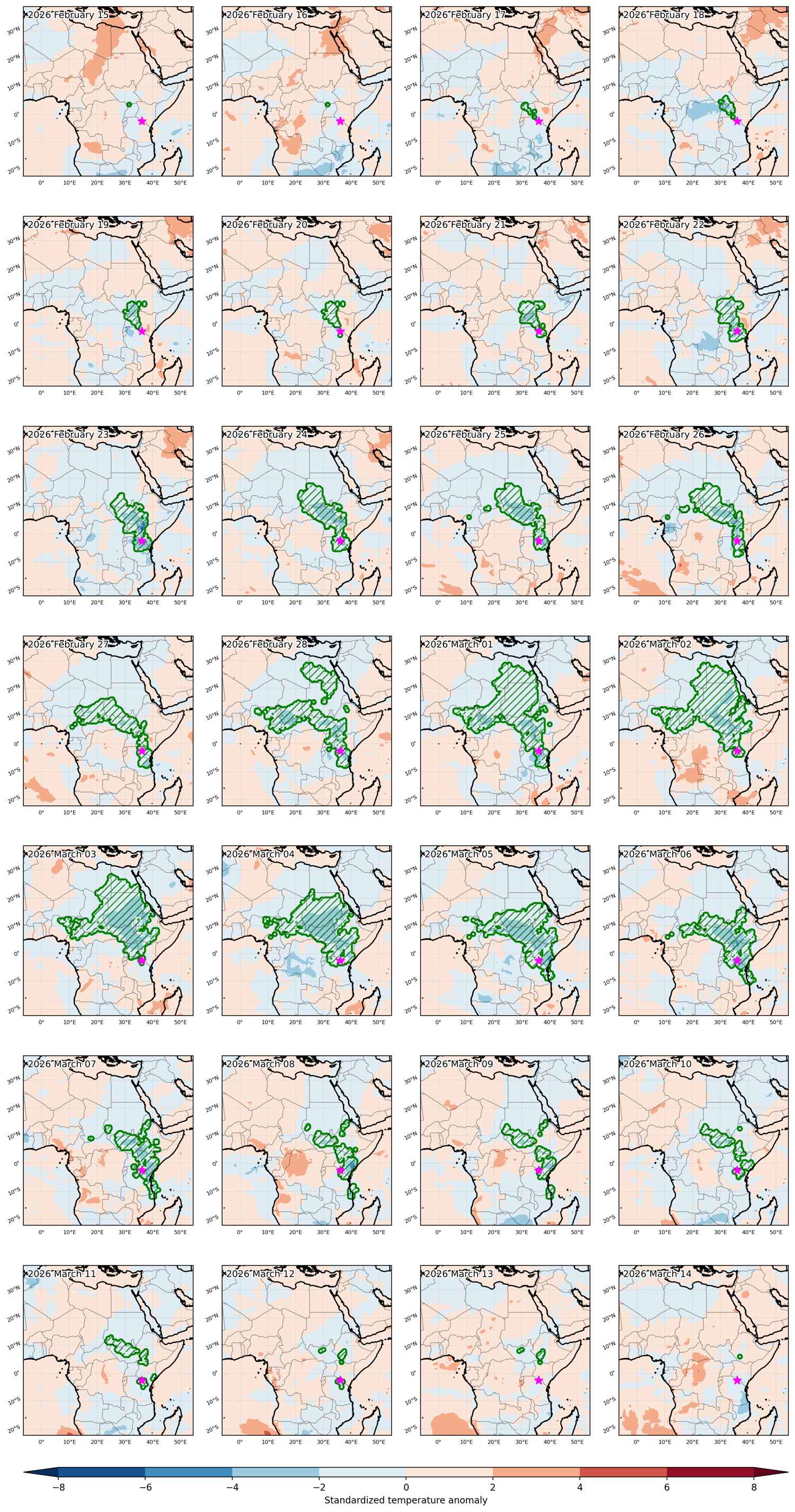
Fig. 3: Maps illustrating the evolution of standardized temperature anomalies during the event.

Event ID: Cold_spell_2026-Feb-15_to_2026-Mar-14_36.0_-2.5

Cold spell occuring from February 14 2026 to February 18 2026 at 72.5°N 52.5°E

Download data: JSON

Event type: Cold spell

Countries affected (identified with ArcGIS Online; provided only for geographical reference):

  • Russian Federation

Duration: 5 days

Time span: February 14 2026 to February 18 2026

Statistics over entire affected area:

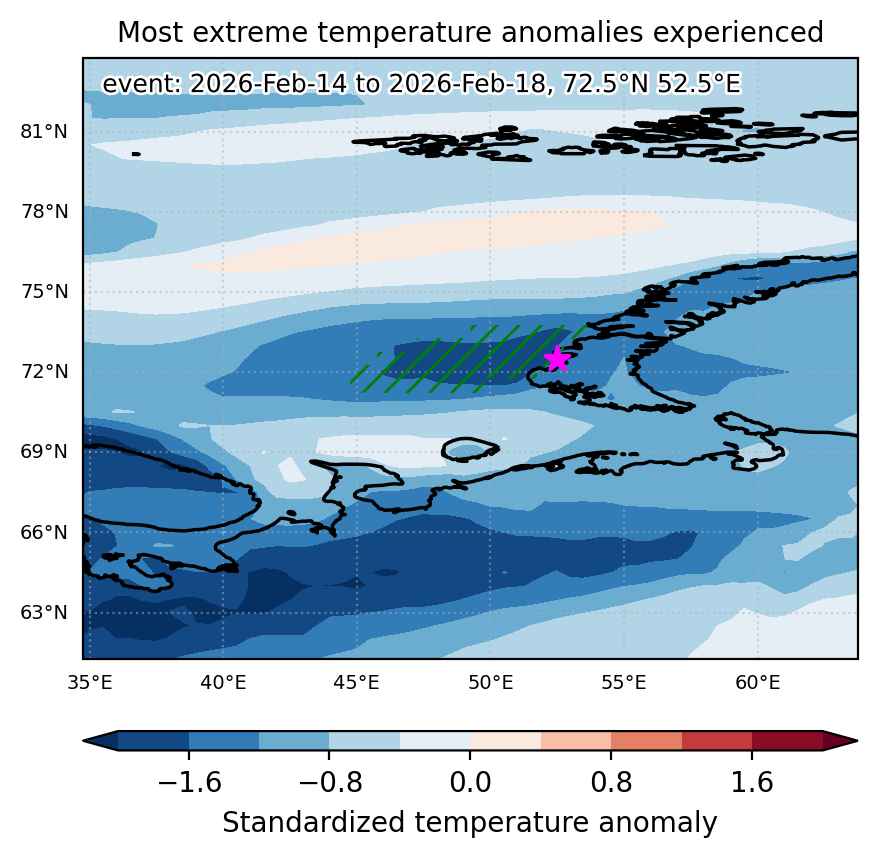
  • Mean temperature anomaly: -9.5 °C
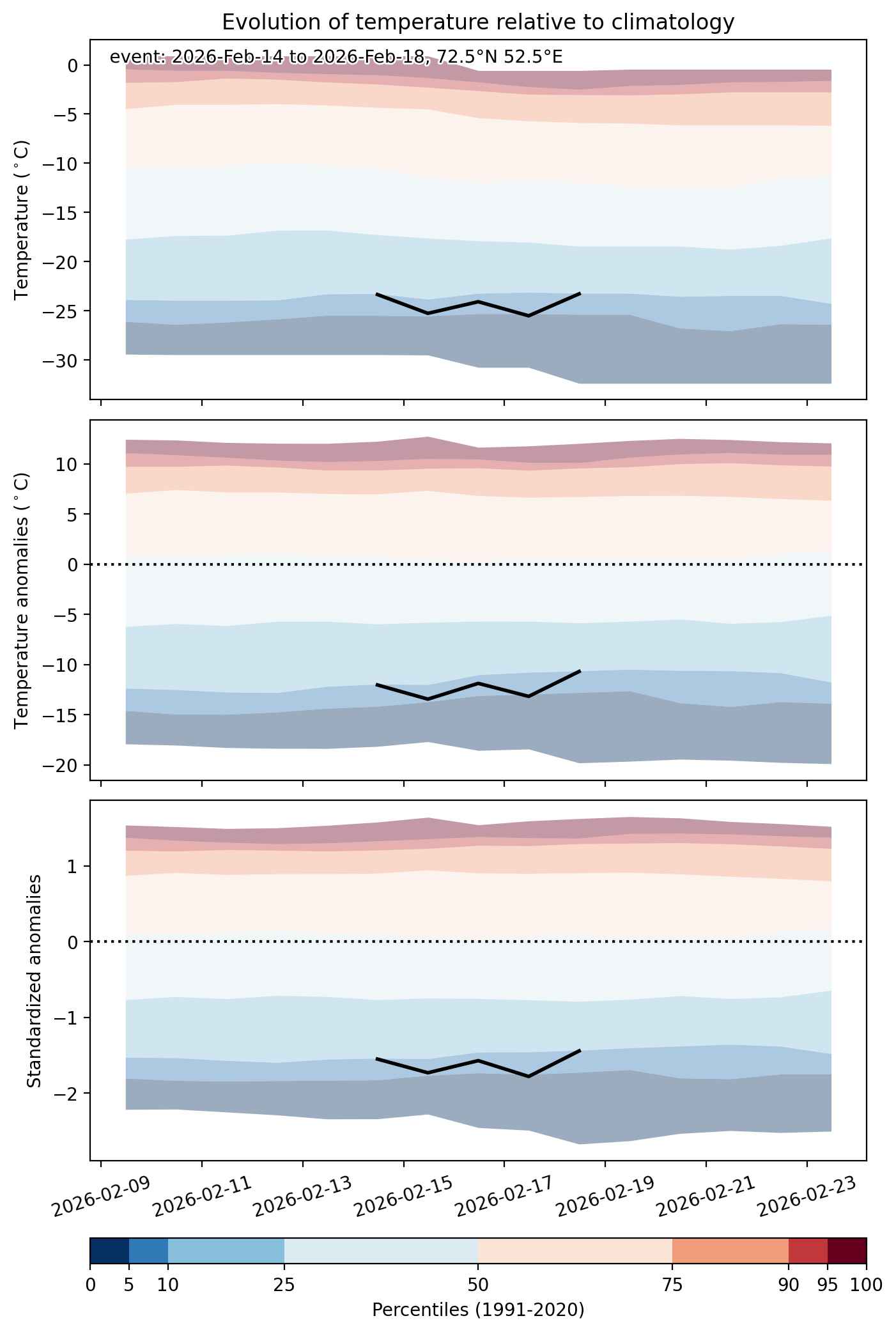
  • Mean temperature: -16.6 °C
  • Minimum temperature anomaly: -14.5 °C
  • Minimum temperature: -26.1 °C

Event center: 72.5°N 52.5°E

Area affected: 54036 km$^2$


Fig. 1: Map of most extreme temperature anomalies (standardized) experienced during the event. The purple star indicates the center of the extreme event. Green hatching illustrates all areas under the effect of extremes at some time during the event.


Fig. 2: Evolution of temperature at the center of the event. The climatological percentile distribution is illustrated with color shadings.


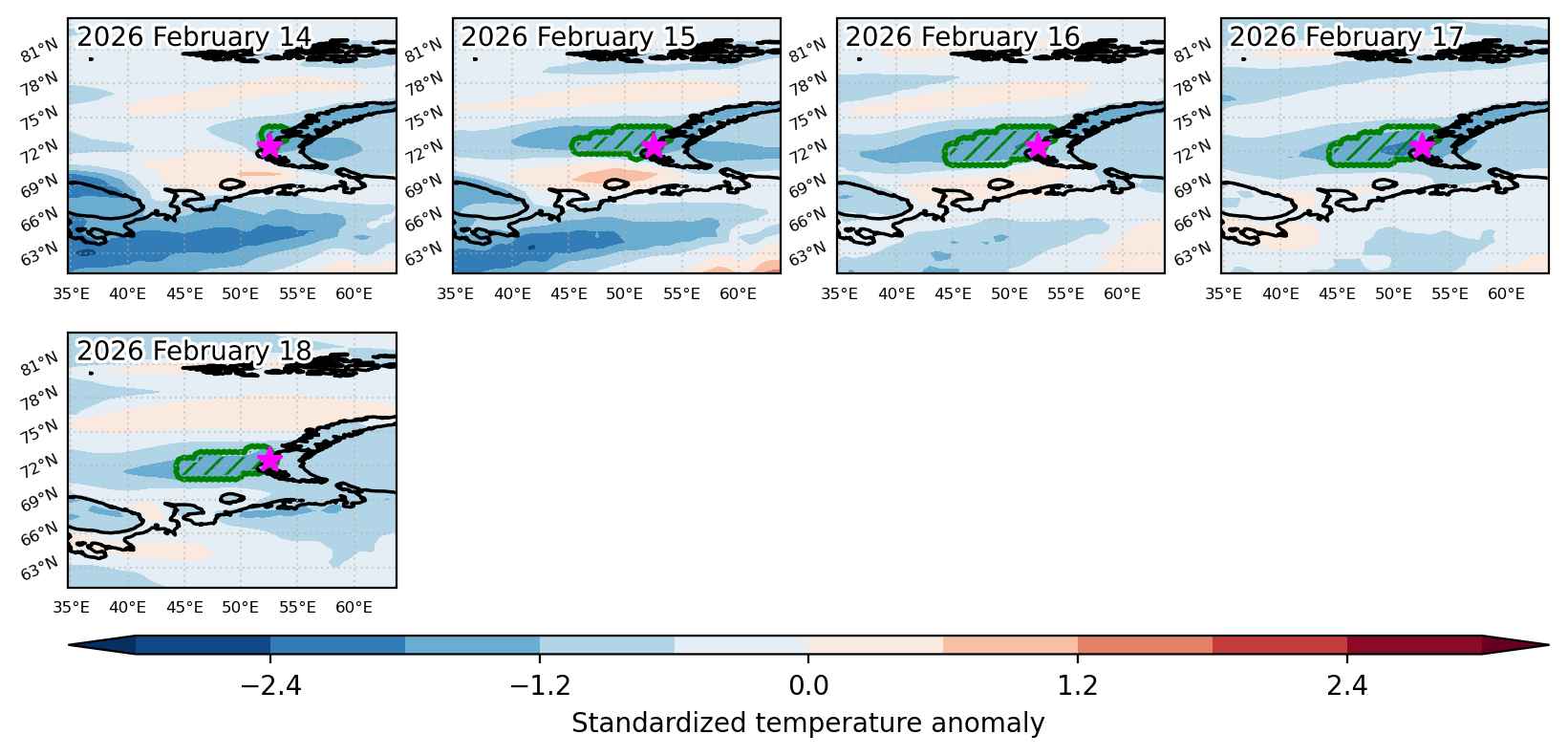
Fig. 3: Maps illustrating the evolution of standardized temperature anomalies during the event.

Event ID: Cold_spell_2026-Feb-14_to_2026-Feb-18_52.5_72.5

Cold spell occuring from February 14 2026 to February 24 2026 at 67.5°N 145.5°E

Download data: JSON

Event type: Cold spell

Countries affected (identified with ArcGIS Online; provided only for geographical reference):

  • Russian Federation

Duration: 11 days

Time span: February 14 2026 to February 24 2026

Statistics over entire affected area:

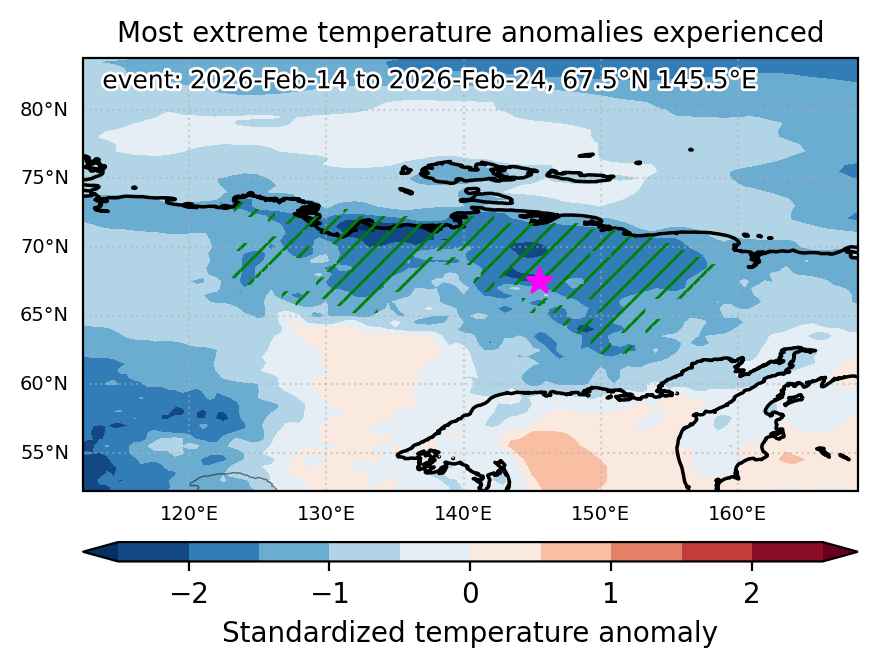
  • Mean temperature anomaly: -9.8 °C
  • Mean temperature: -42.7 °C
  • Minimum temperature anomaly: -19.3 °C
  • Minimum temperature: -51.2 °C

Event center: 67.5°N 145.5°E

Area affected: 746432 km$^2$


Fig. 1: Map of most extreme temperature anomalies (standardized) experienced during the event. The purple star indicates the center of the extreme event. Green hatching illustrates all areas under the effect of extremes at some time during the event.


Fig. 2: Evolution of temperature at the center of the event. The climatological percentile distribution is illustrated with color shadings.


Fig. 3: Maps illustrating the evolution of standardized temperature anomalies during the event.

Event ID: Cold_spell_2026-Feb-14_to_2026-Feb-24_145.5_67.5