Cold spell occuring from February 14 2026 to February 18 2026 at -12.5°S 36.0°E

Download data: JSON

Event type: Cold spell

Countries affected (identified with ArcGIS Online; provided only for geographical reference):

  • Malawi
  • Mozambique
  • Zambia

Duration: 5 days

Time span: February 14 2026 to February 18 2026

Statistics over entire affected area:

  • Mean temperature anomaly: -1.8 °C
  • Mean temperature: 21.5 °C
  • Minimum temperature anomaly: -3.2 °C
  • Minimum temperature: 17.6 °C

Event center: -12.5°S 36.0°E

Area affected: 246174 km$^2$
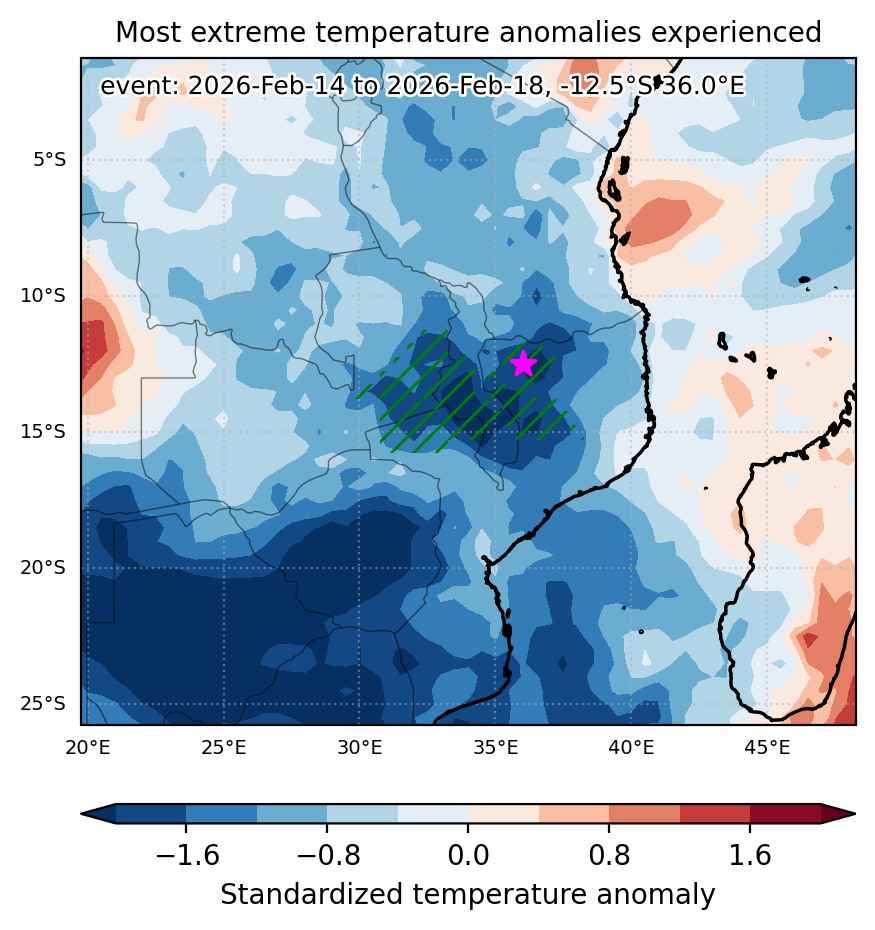

Fig. 1: Map of most extreme temperature anomalies (standardized) experienced during the event. The purple star indicates the center of the extreme event. Green hatching illustrates all areas under the effect of extremes at some time during the event.
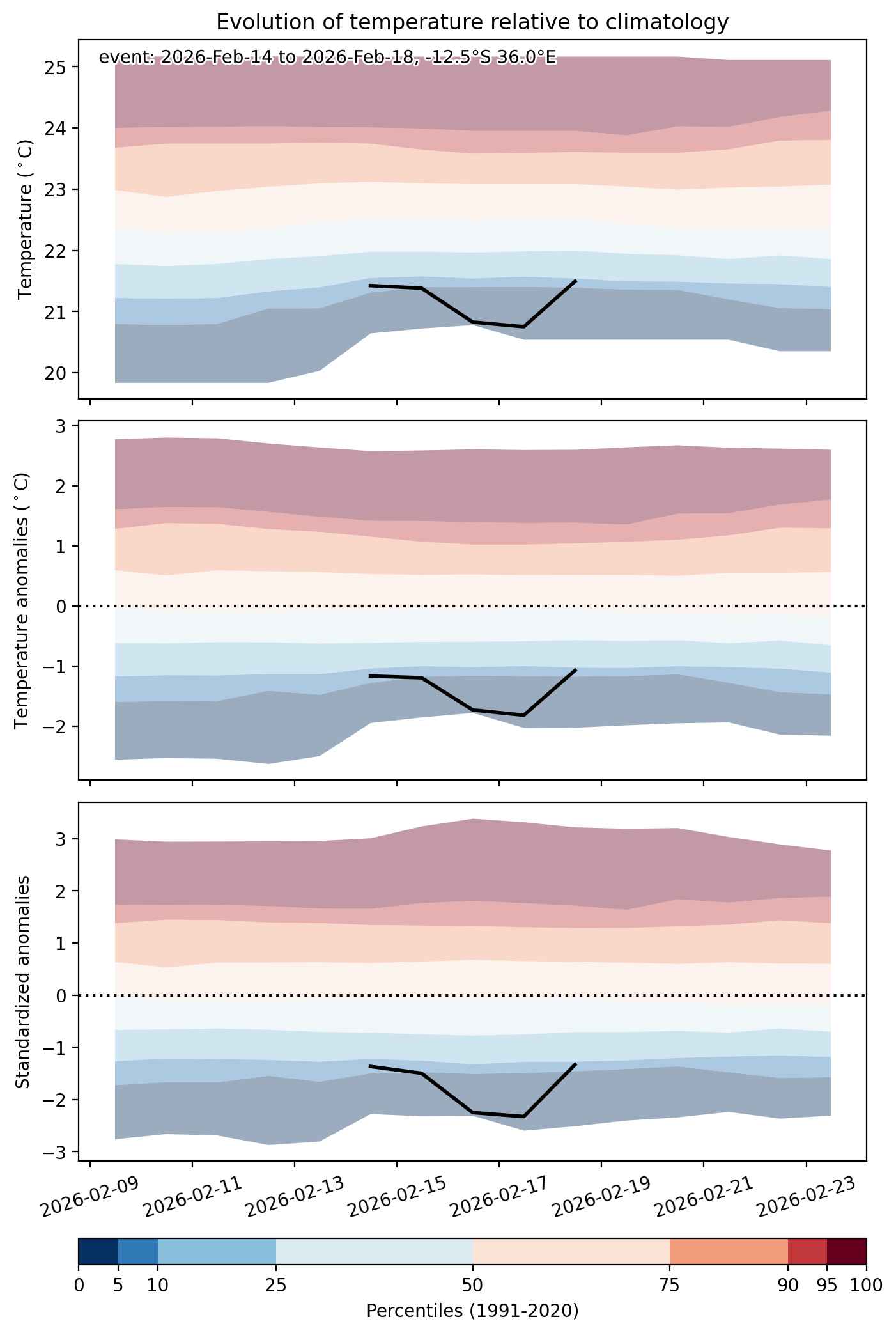


Fig. 2: Evolution of temperature at the center of the event. The climatological percentile distribution is illustrated with color shadings.
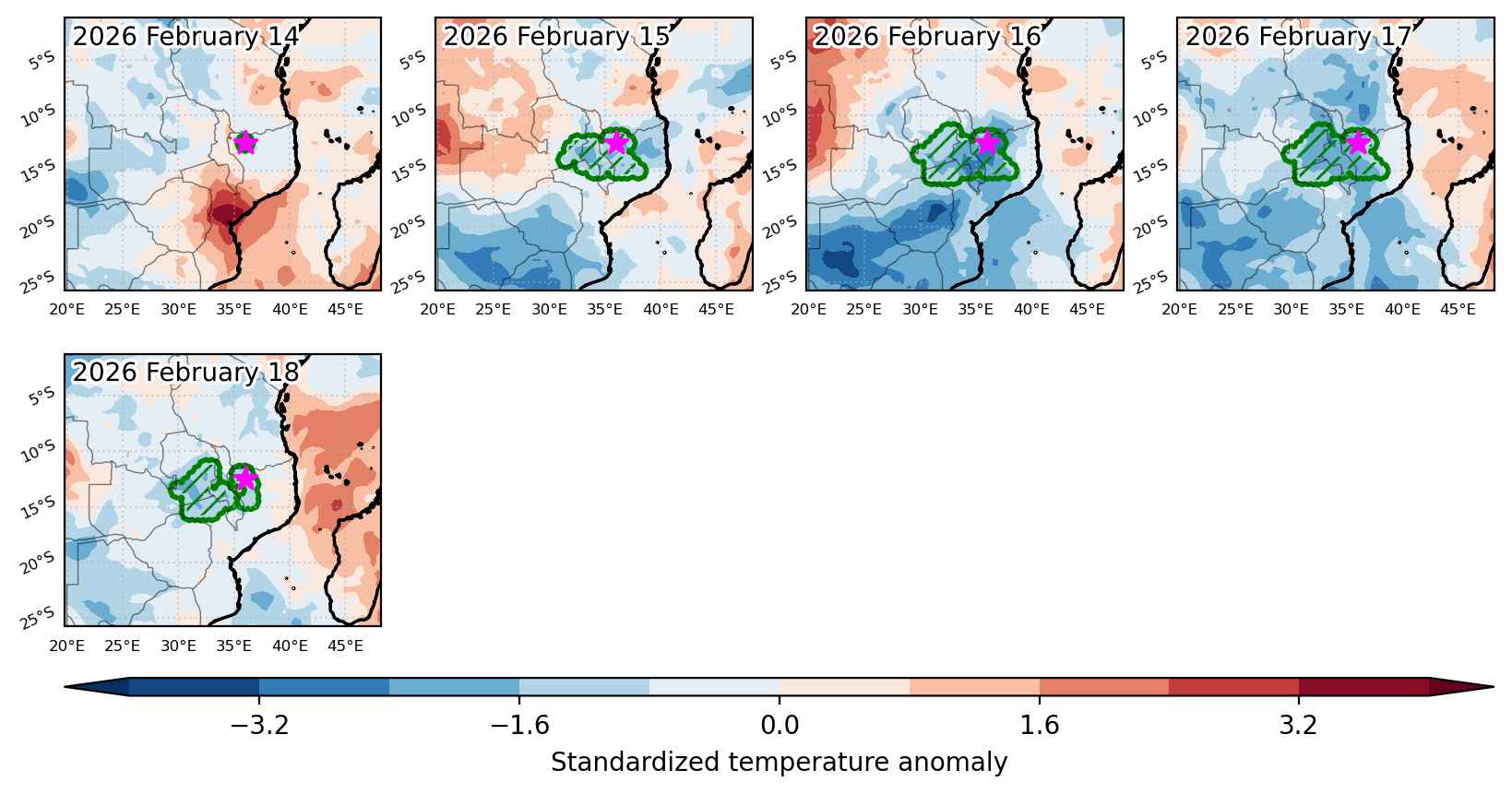


Fig. 3: Maps illustrating the evolution of standardized temperature anomalies during the event.

Event ID: Cold_spell_2026-Feb-14_to_2026-Feb-18_36.0_-12.5
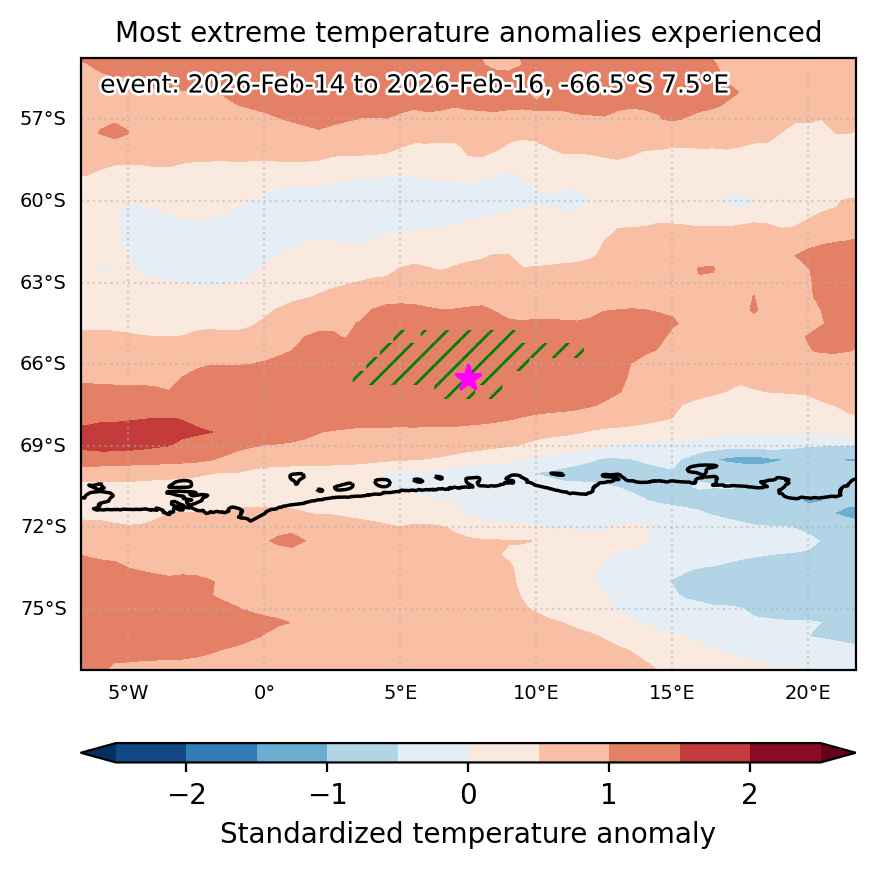
Heat wave occuring from February 14 2026 to February 16 2026 at -66.5°S 7.5°E

Download data: JSON

Event type: Heat wave

Countries affected (identified with ArcGIS Online; provided only for geographical reference):

  • Antarctica

Duration: 3 days

Time span: February 14 2026 to February 16 2026

Statistics over entire affected area:

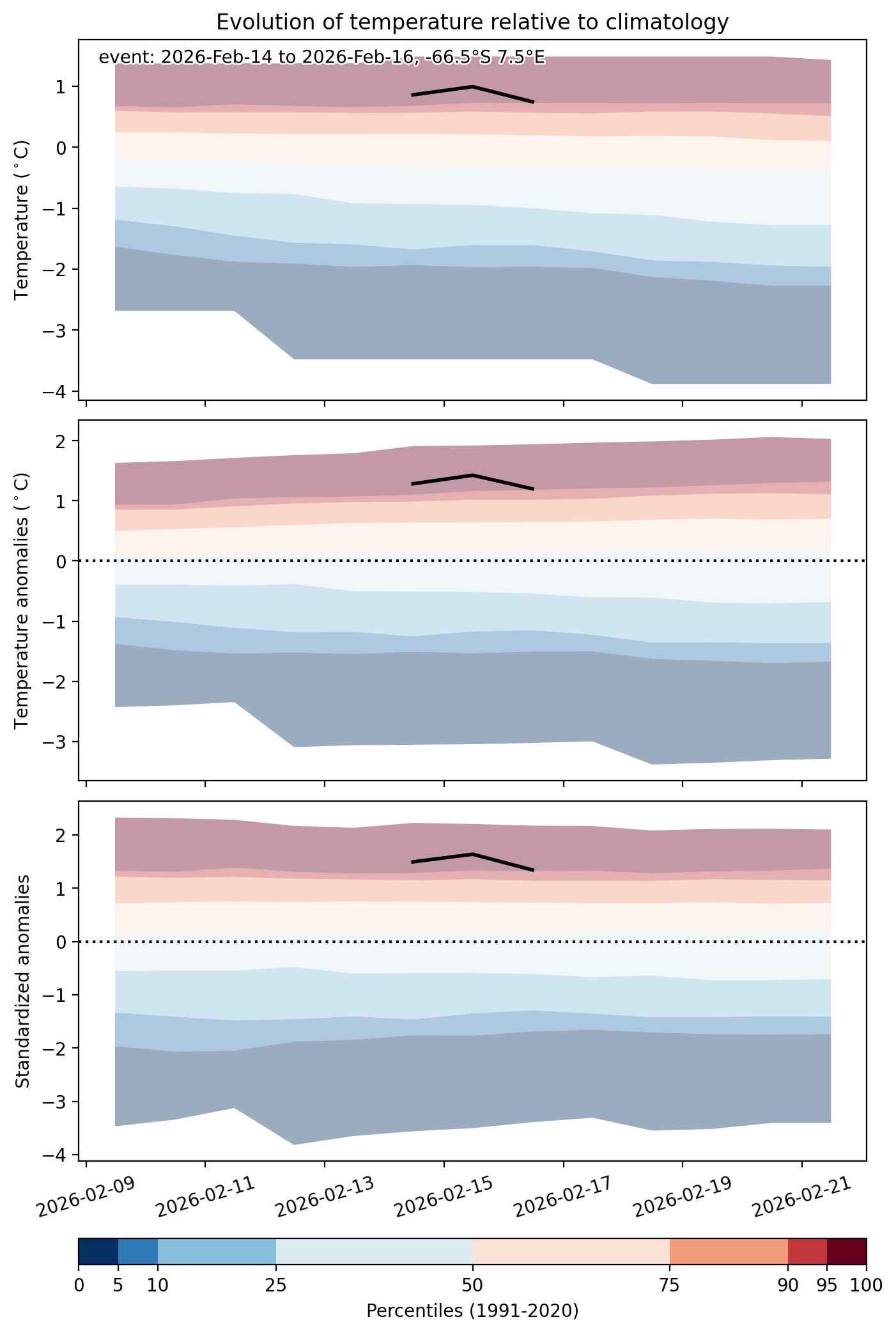
  • Mean temperature anomaly: 1.1 °C
  • Mean temperature: 0.8 °C
  • Maximum temperature anomaly: 1.6 °C
  • Maximum temperature: 1.1 °C

Event center: -66.5°S 7.5°E

Area affected: 63154 km$^2$


Fig. 1: Map of most extreme temperature anomalies (standardized) experienced during the event. The purple star indicates the center of the extreme event. Green hatching illustrates all areas under the effect of extremes at some time during the event.


Fig. 2: Evolution of temperature at the center of the event. The climatological percentile distribution is illustrated with color shadings.


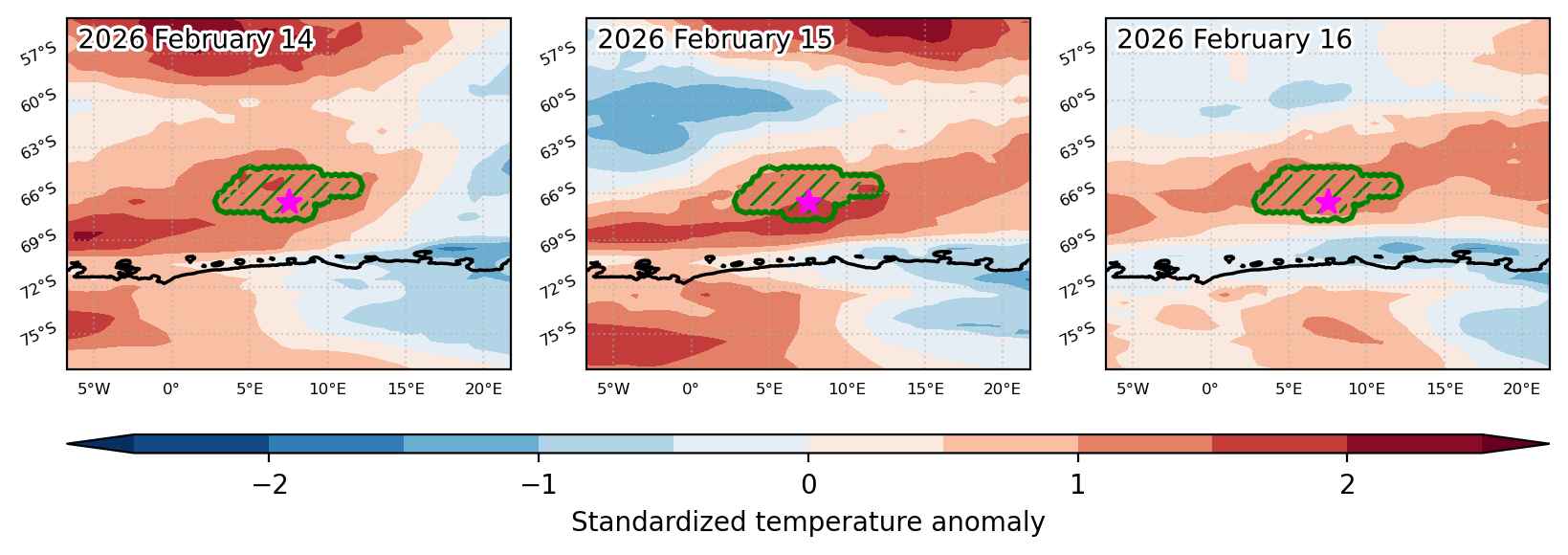
Fig. 3: Maps illustrating the evolution of standardized temperature anomalies during the event.

Event ID: Heat_wave_2026-Feb-14_to_2026-Feb-16_7.5_-66.5

Heat wave occuring from February 13 2026 to February 16 2026 at 24.5°N 117.0°E

Download data: JSON

Event type: Heat wave

Countries affected (identified with ArcGIS Online; provided only for geographical reference):

  • China

Duration: 4 days

Time span: February 13 2026 to February 16 2026

Statistics over entire affected area:

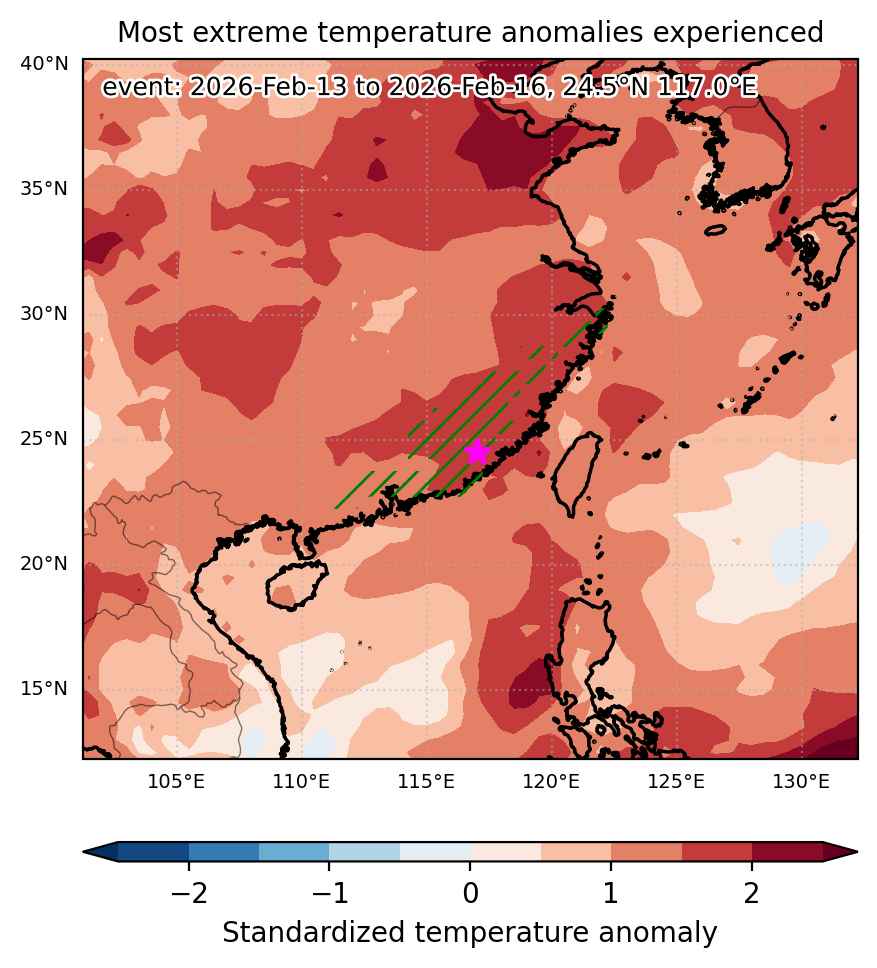
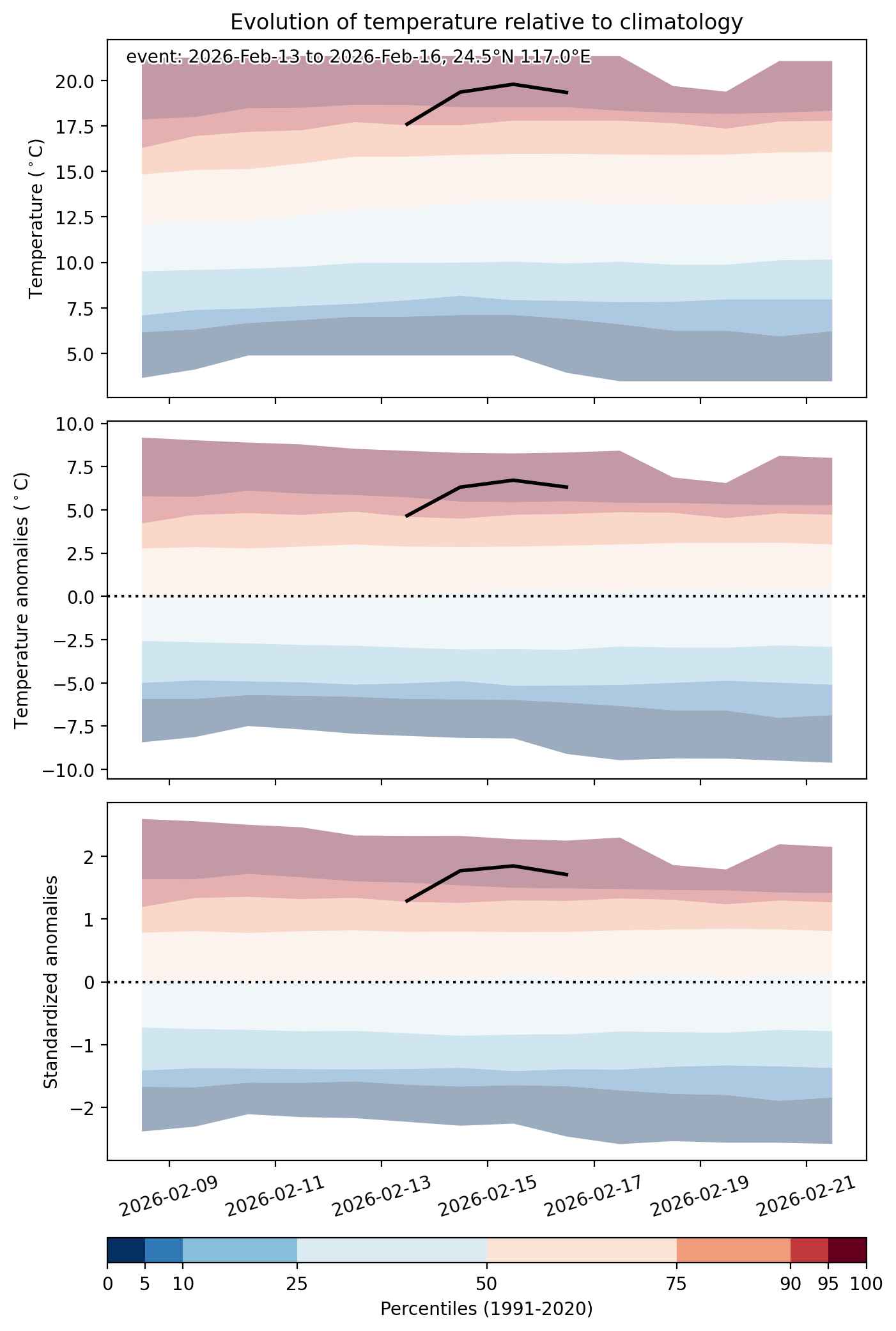
  • Mean temperature anomaly: 6.8 °C
  • Mean temperature: 19.3 °C
  • Maximum temperature anomaly: 10.7 °C
  • Maximum temperature: 23.1 °C

Event center: 24.5°N 117.0°E

Area affected: 214898 km$^2$


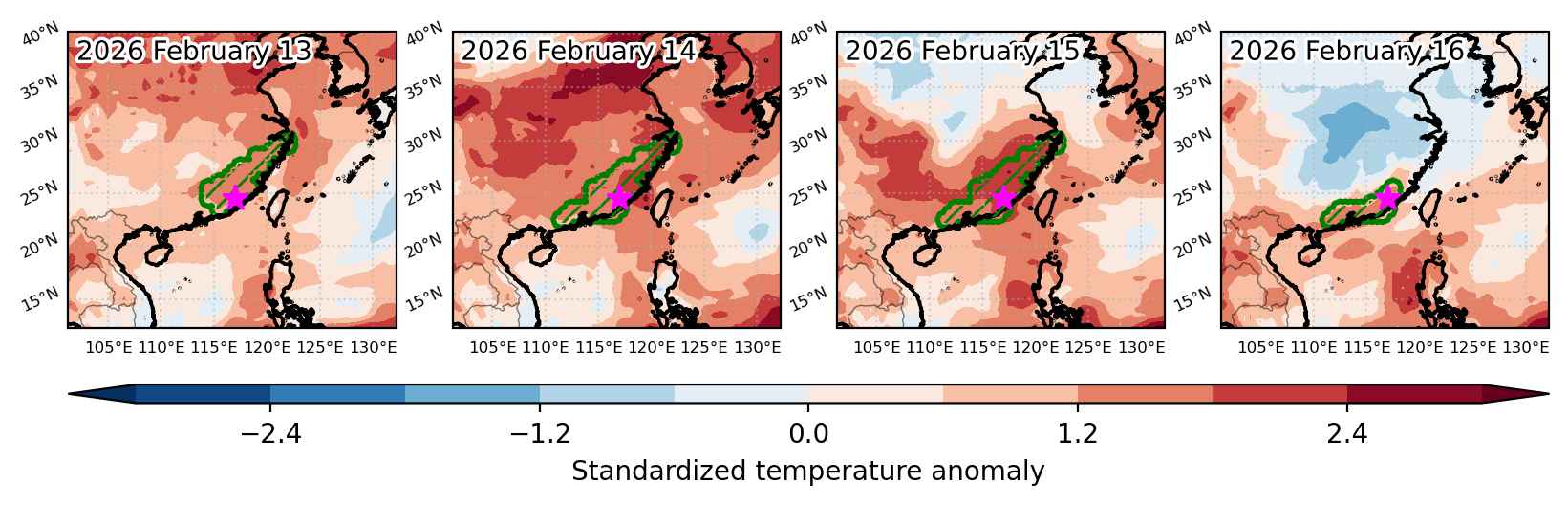
Fig. 1: Map of most extreme temperature anomalies (standardized) experienced during the event. The purple star indicates the center of the extreme event. Green hatching illustrates all areas under the effect of extremes at some time during the event.


Fig. 2: Evolution of temperature at the center of the event. The climatological percentile distribution is illustrated with color shadings.


Fig. 3: Maps illustrating the evolution of standardized temperature anomalies during the event.

Event ID: Heat_wave_2026-Feb-13_to_2026-Feb-16_117.0_24.5

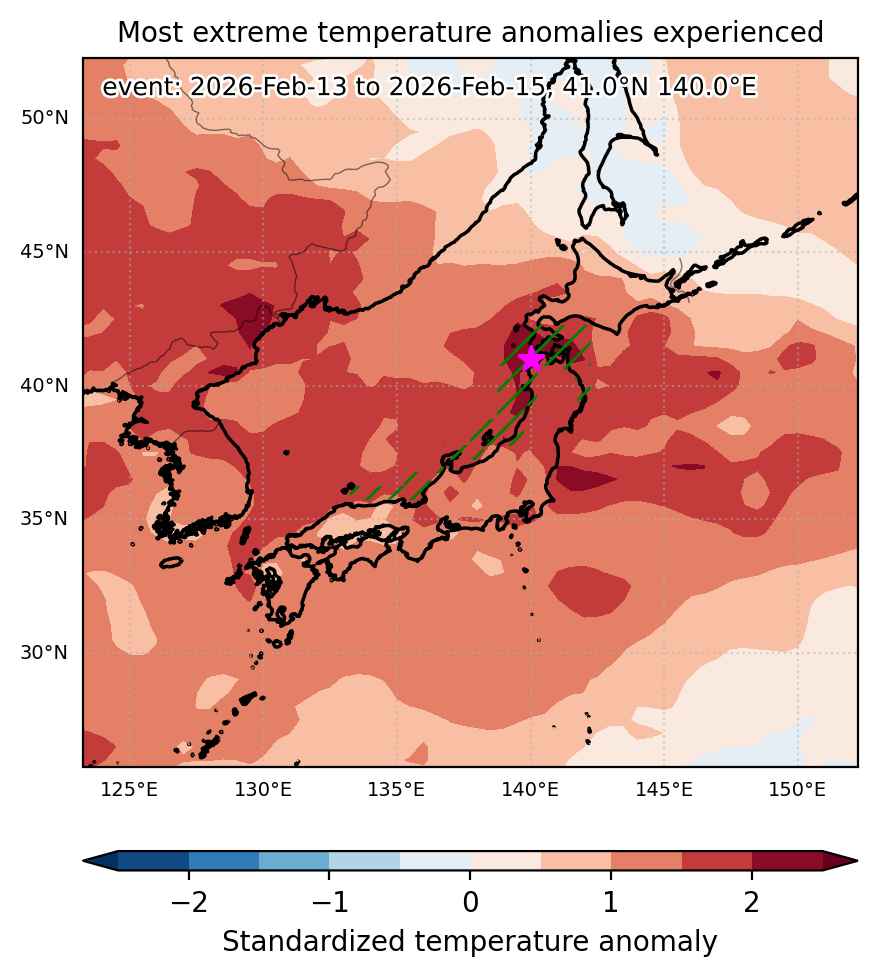
Heat wave occuring from February 13 2026 to February 15 2026 at 41.0°N 140.0°E

Download data: JSON

Event type: Heat wave

Countries affected (identified with ArcGIS Online; provided only for geographical reference):

  • Japan

Duration: 3 days

Time span: February 13 2026 to February 15 2026

Statistics over entire affected area:

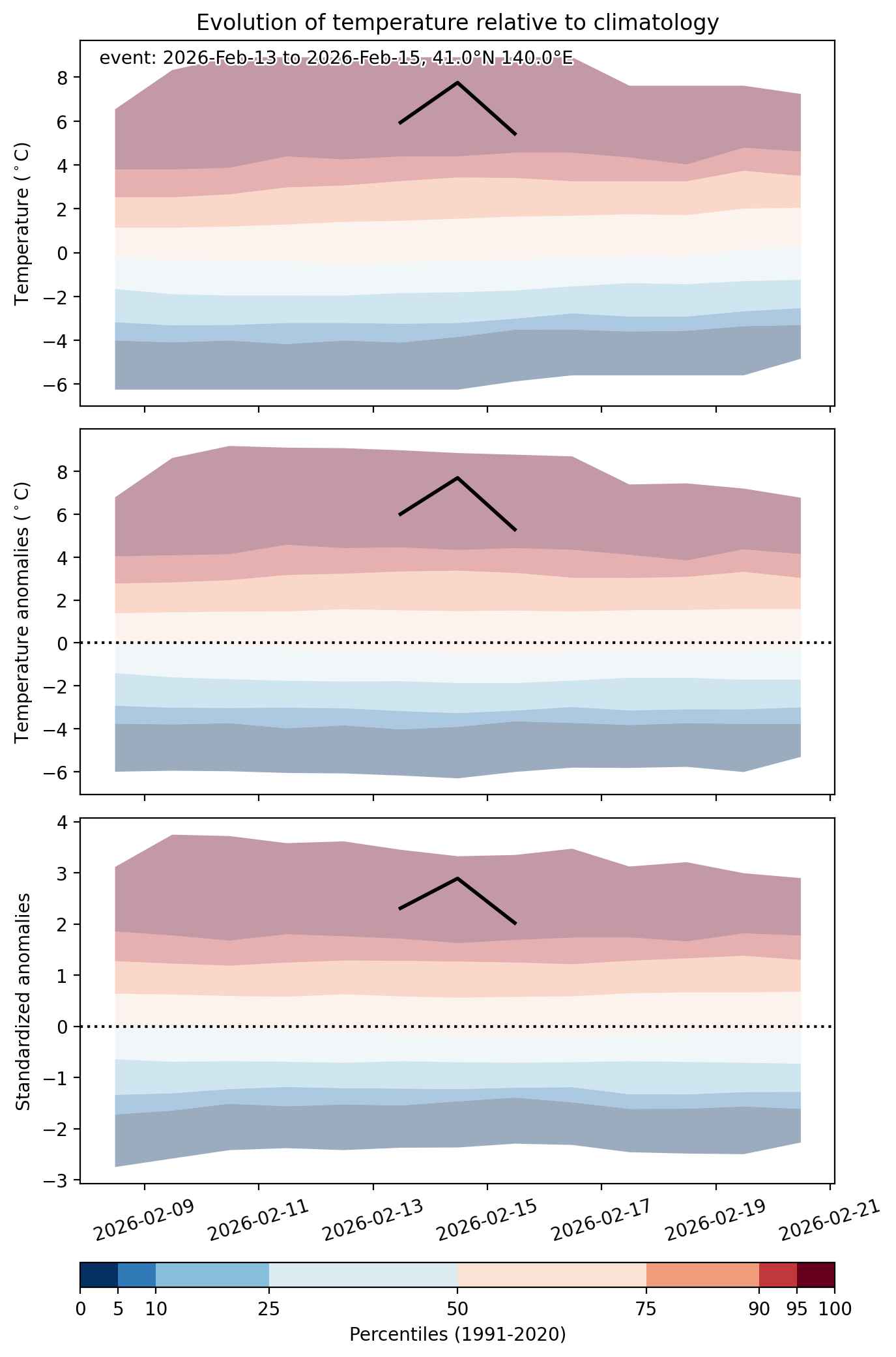
  • Mean temperature anomaly: 5.1 °C
  • Mean temperature: 7.2 °C
  • Maximum temperature anomaly: 8.7 °C
  • Maximum temperature: 12.4 °C

Event center: 41.0°N 140.0°E

Area affected: 121793 km$^2$


Fig. 1: Map of most extreme temperature anomalies (standardized) experienced during the event. The purple star indicates the center of the extreme event. Green hatching illustrates all areas under the effect of extremes at some time during the event.


Fig. 2: Evolution of temperature at the center of the event. The climatological percentile distribution is illustrated with color shadings.


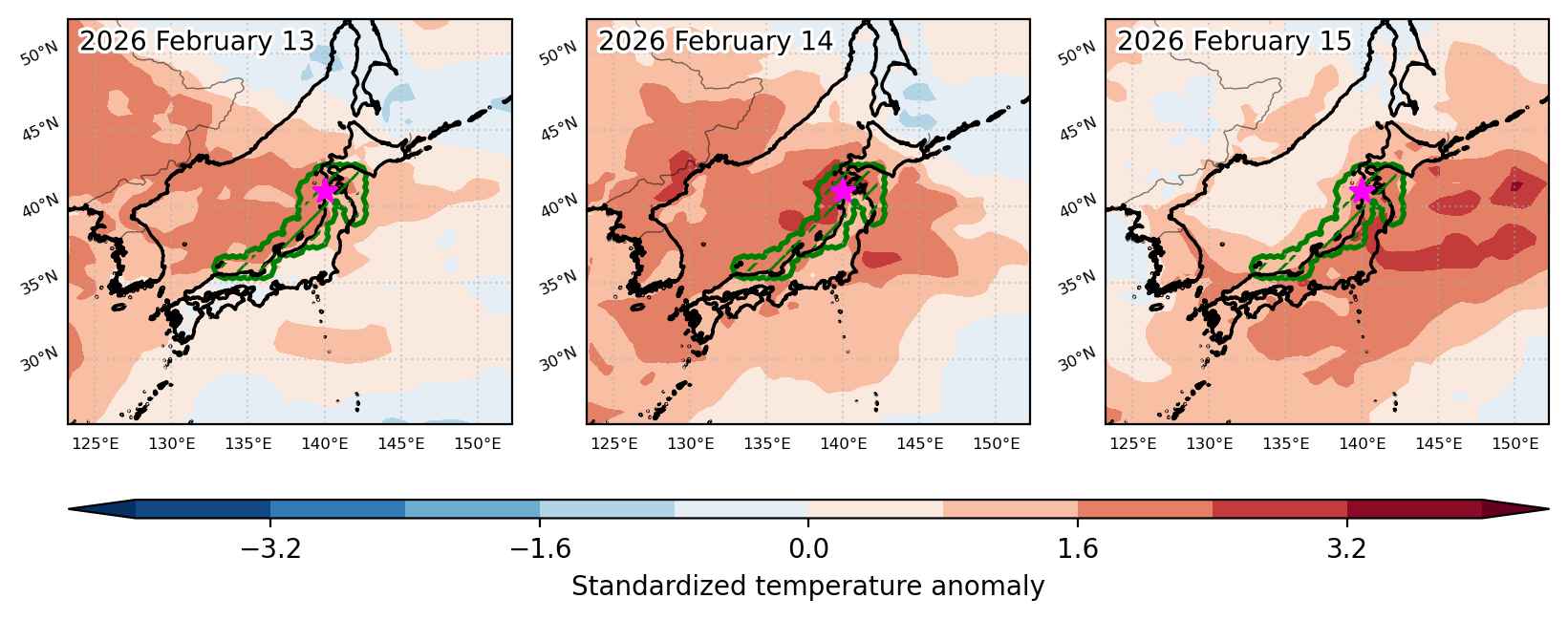
Fig. 3: Maps illustrating the evolution of standardized temperature anomalies during the event.

Event ID: Heat_wave_2026-Feb-13_to_2026-Feb-15_140.0_41.0

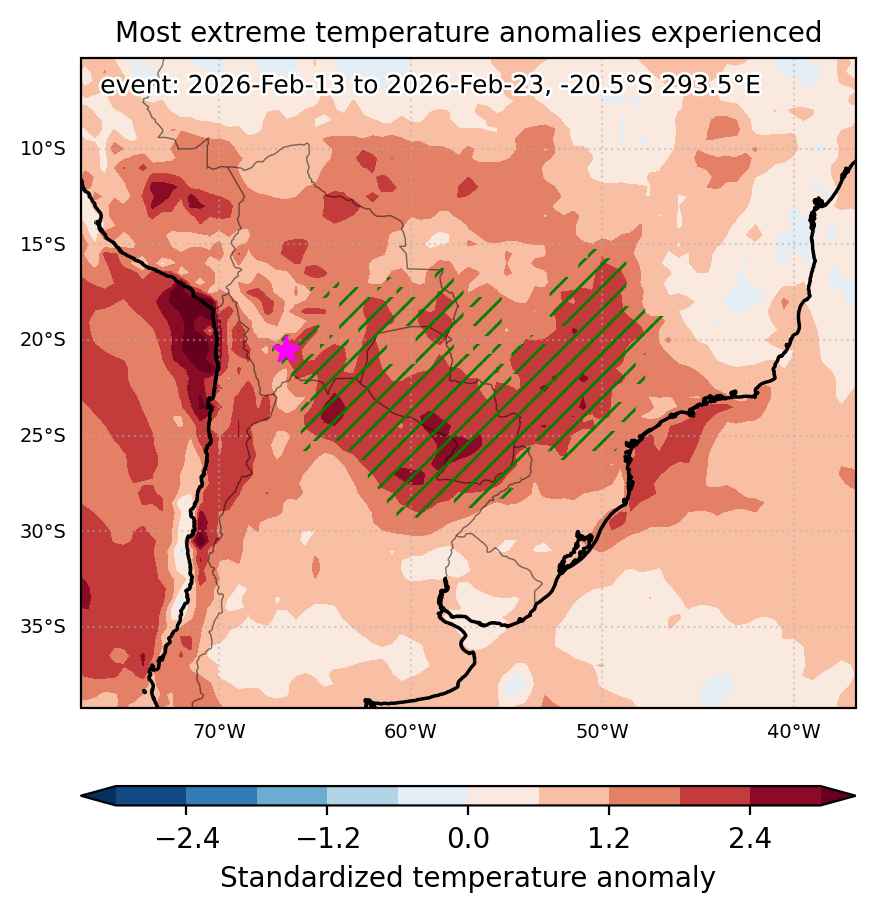
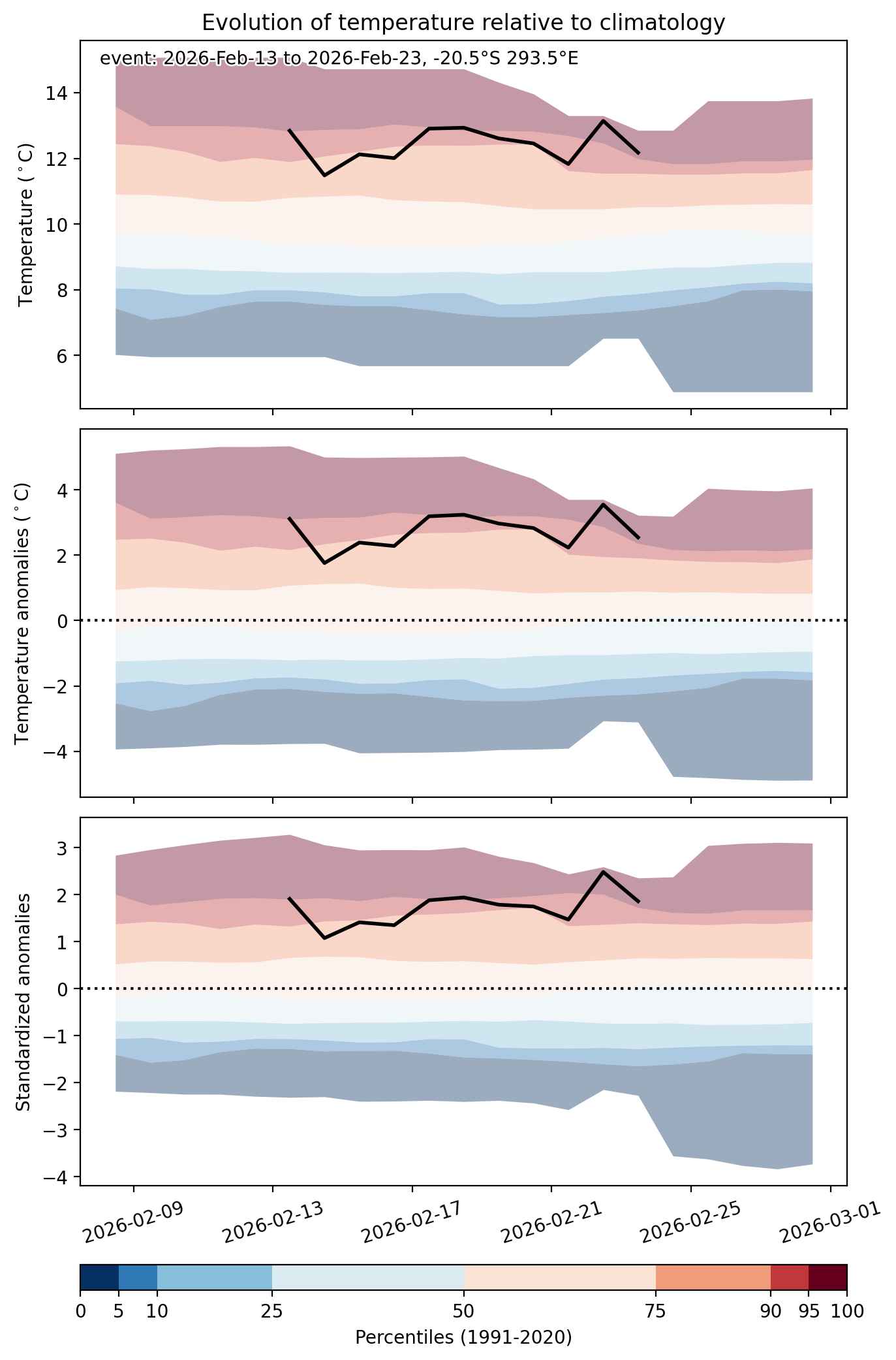
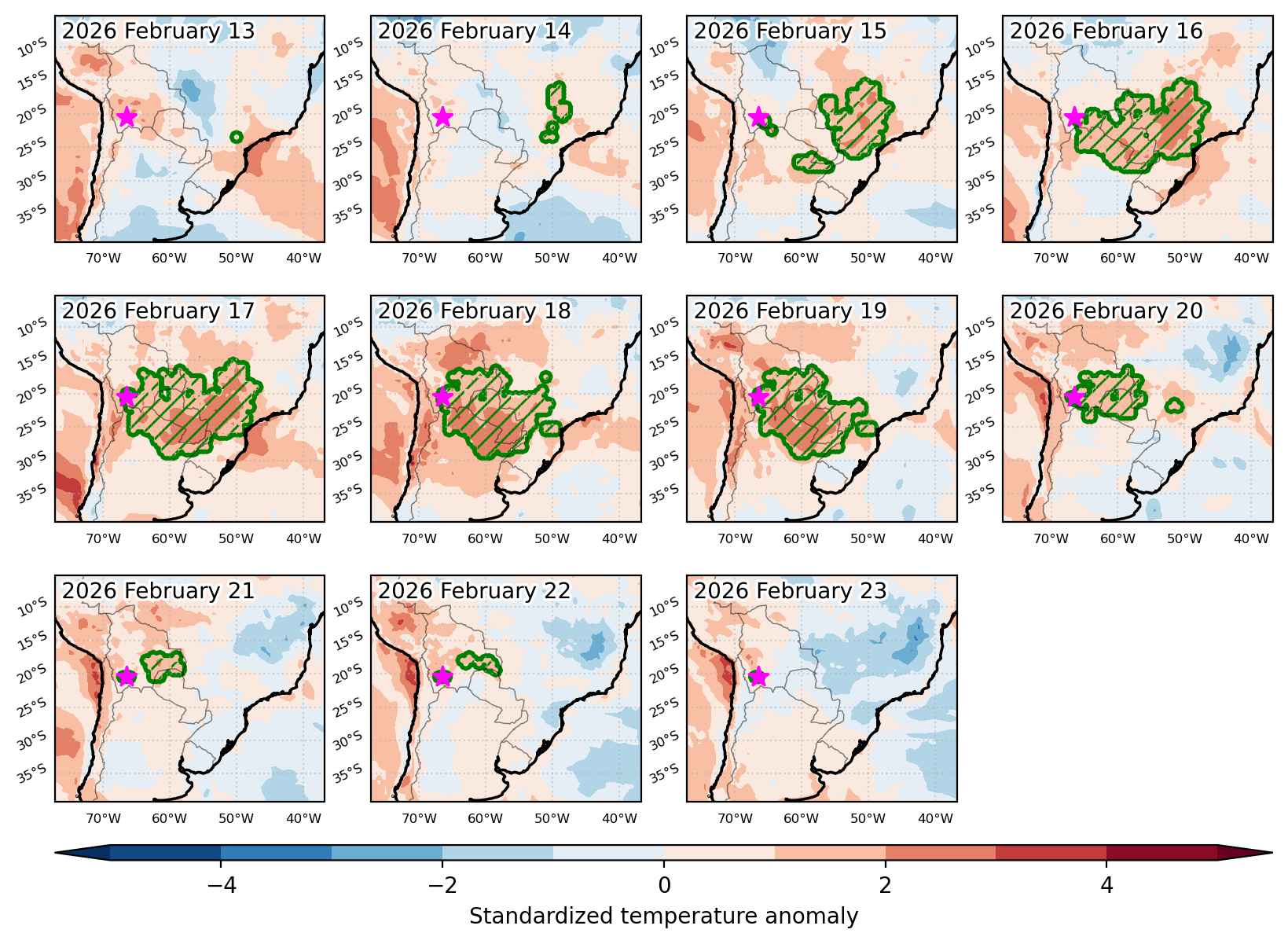
Heat wave occuring from February 13 2026 to February 23 2026 at -20.5°S 293.5°E

Download data: JSON

Event type: Heat wave

Countries affected (identified with ArcGIS Online; provided only for geographical reference):

  • Argentina
  • Bolivia, Plurinational State of
  • Brazil
  • Paraguay

Duration: 11 days

Time span: February 13 2026 to February 23 2026

Statistics over entire affected area:

  • Mean temperature anomaly: 3.8 °C
  • Mean temperature: 28.9 °C
  • Maximum temperature anomaly: 9.7 °C
  • Maximum temperature: 36.4 °C

Event center: -20.5°S 293.5°E

Area affected: 1757943 km$^2$


Fig. 1: Map of most extreme temperature anomalies (standardized) experienced during the event. The purple star indicates the center of the extreme event. Green hatching illustrates all areas under the effect of extremes at some time during the event.


Fig. 2: Evolution of temperature at the center of the event. The climatological percentile distribution is illustrated with color shadings.


Fig. 3: Maps illustrating the evolution of standardized temperature anomalies during the event.

Event ID: Heat_wave_2026-Feb-13_to_2026-Feb-23_293.5_-20.5

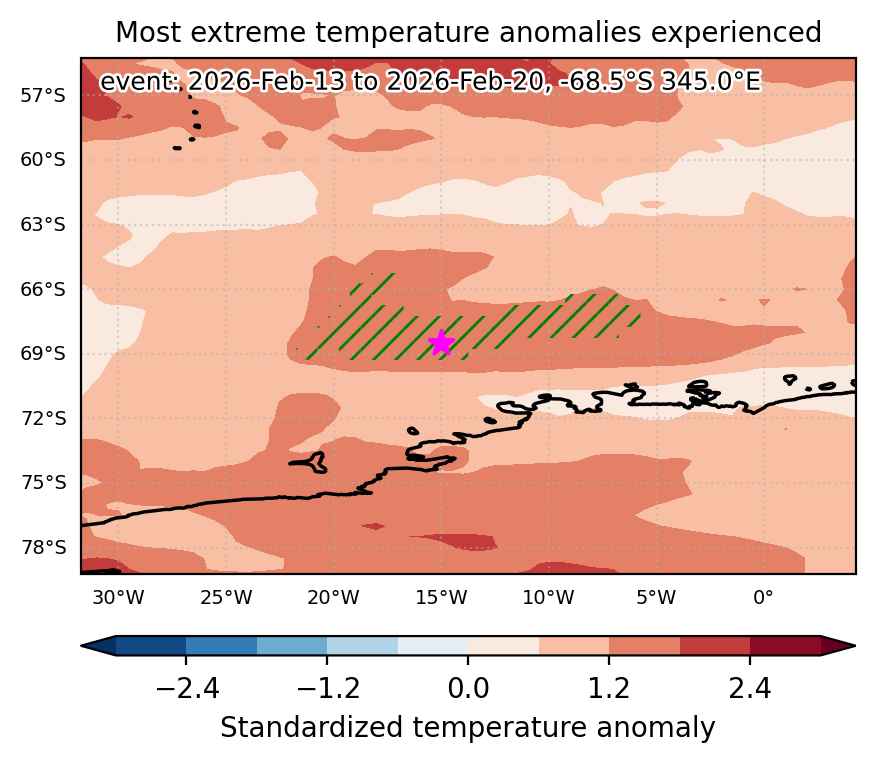
Heat wave occuring from February 13 2026 to February 20 2026 at -68.5°S 345.0°E

Download data: JSON

Event type: Heat wave

Countries affected (identified with ArcGIS Online; provided only for geographical reference):

  • Antarctica

Duration: 8 days

Time span: February 13 2026 to February 20 2026

Statistics over entire affected area:

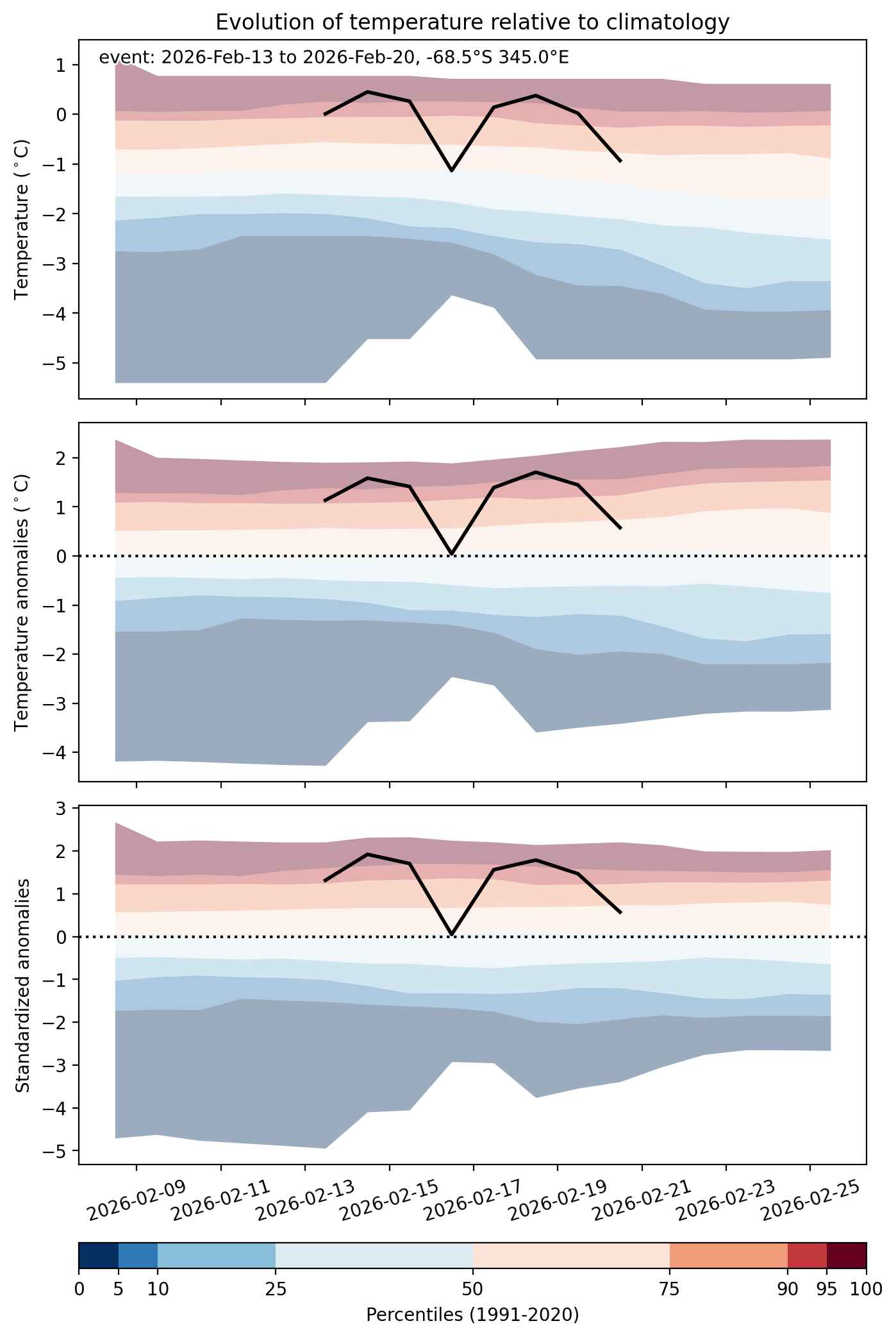
  • Mean temperature anomaly: 1.3 °C
  • Mean temperature: 0.2 °C
  • Maximum temperature anomaly: 1.9 °C
  • Maximum temperature: 0.7 °C

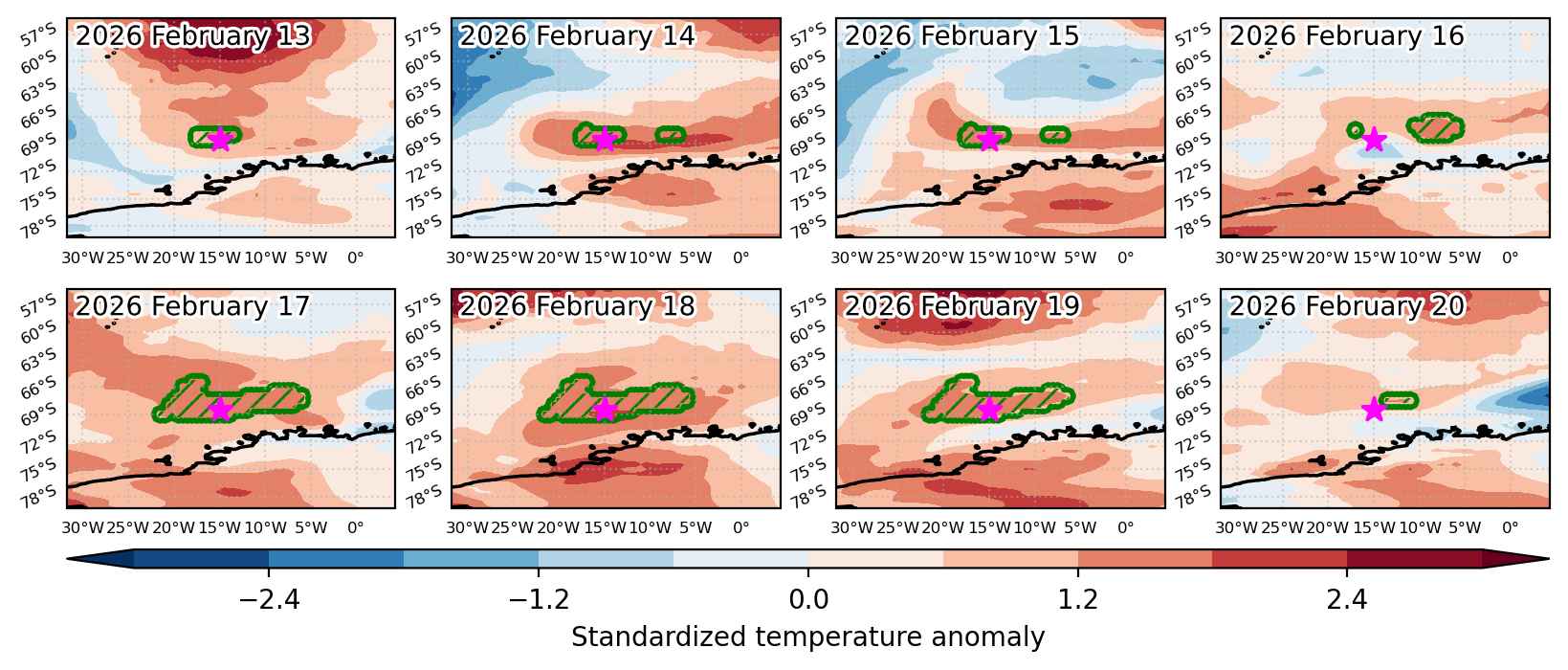
Event center: -68.5°S 345.0°E

Area affected: 143077 km$^2$


Fig. 1: Map of most extreme temperature anomalies (standardized) experienced during the event. The purple star indicates the center of the extreme event. Green hatching illustrates all areas under the effect of extremes at some time during the event.


Fig. 2: Evolution of temperature at the center of the event. The climatological percentile distribution is illustrated with color shadings.


Fig. 3: Maps illustrating the evolution of standardized temperature anomalies during the event.

Event ID: Heat_wave_2026-Feb-13_to_2026-Feb-20_345.0_-68.5

Heat wave occuring from February 13 2026 to February 19 2026 at -3.0°S 143.0°E

Download data: JSON

Event type: Heat wave

Countries affected (identified with ArcGIS Online; provided only for geographical reference):

  • Indonesia
  • Papua New Guinea

Duration: 7 days

Time span: February 13 2026 to February 19 2026

Statistics over entire affected area:

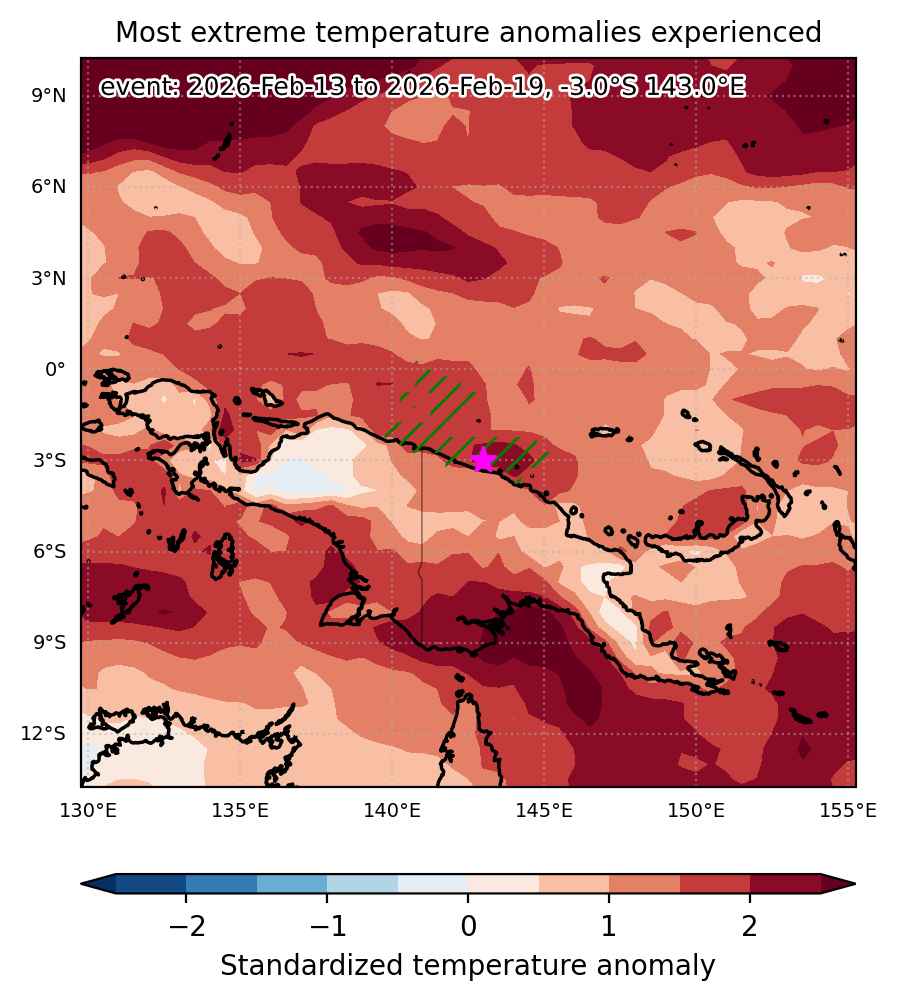
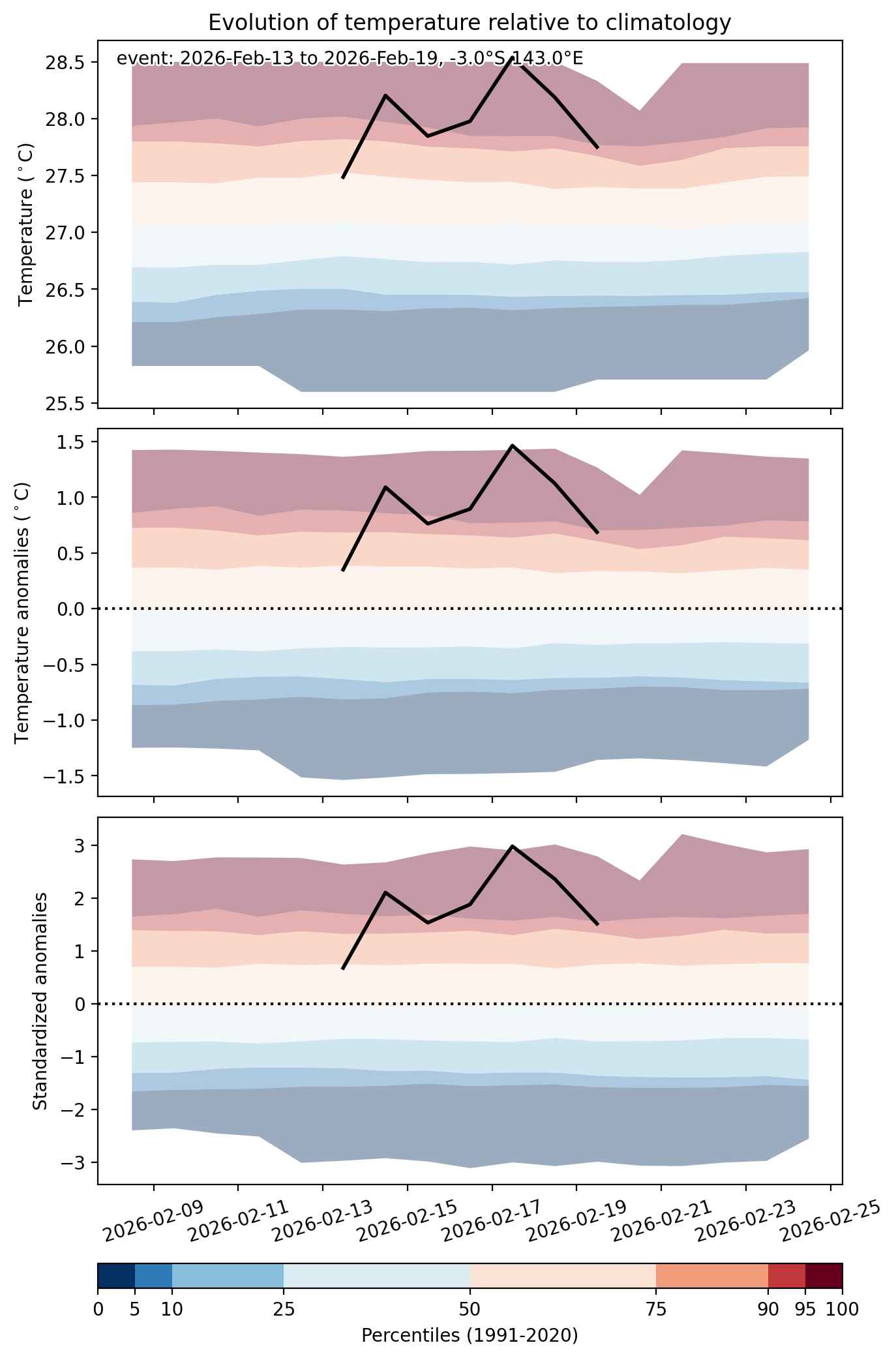
  • Mean temperature anomaly: 0.9 °C
  • Mean temperature: 28.0 °C
  • Maximum temperature anomaly: 1.5 °C
  • Maximum temperature: 28.5 °C

Event center: -3.0°S 143.0°E

Area affected: 92662 km$^2$


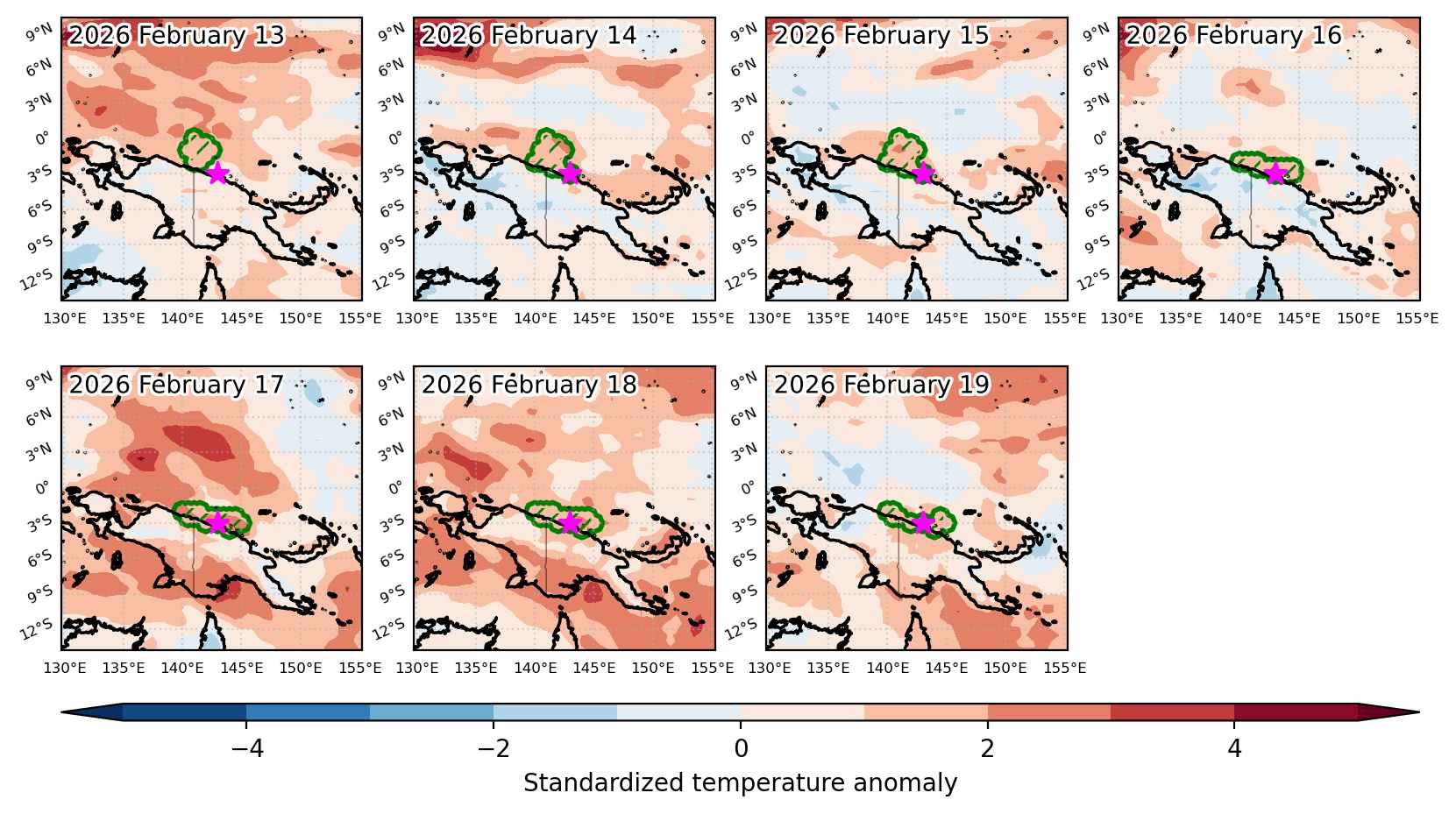
Fig. 1: Map of most extreme temperature anomalies (standardized) experienced during the event. The purple star indicates the center of the extreme event. Green hatching illustrates all areas under the effect of extremes at some time during the event.


Fig. 2: Evolution of temperature at the center of the event. The climatological percentile distribution is illustrated with color shadings.


Fig. 3: Maps illustrating the evolution of standardized temperature anomalies during the event.

Event ID: Heat_wave_2026-Feb-13_to_2026-Feb-19_143.0_-3.0

Heat wave occuring from February 13 2026 to February 26 2026 at -11.5°S 162.5°E

Download data: JSON

Event type: Heat wave

Countries affected (identified with ArcGIS Online; provided only for geographical reference):

  • Australia
  • Indonesia
  • Papua New Guinea
  • Solomon Islands
  • Vanuatu

Duration: 14 days

Time span: February 13 2026 to February 26 2026

Statistics over entire affected area:

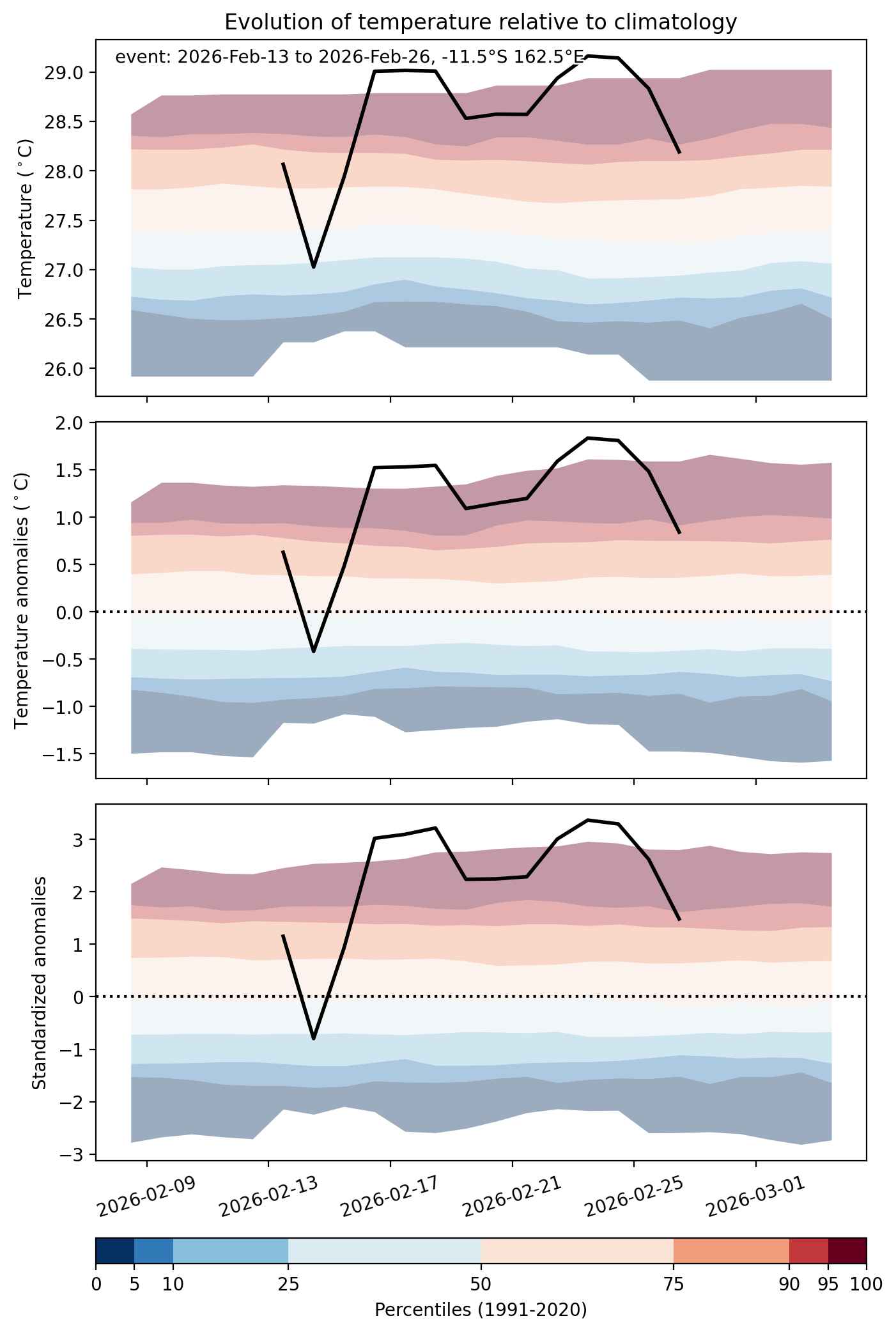
  • Mean temperature anomaly: 1.3 °C
  • Mean temperature: 28.6 °C
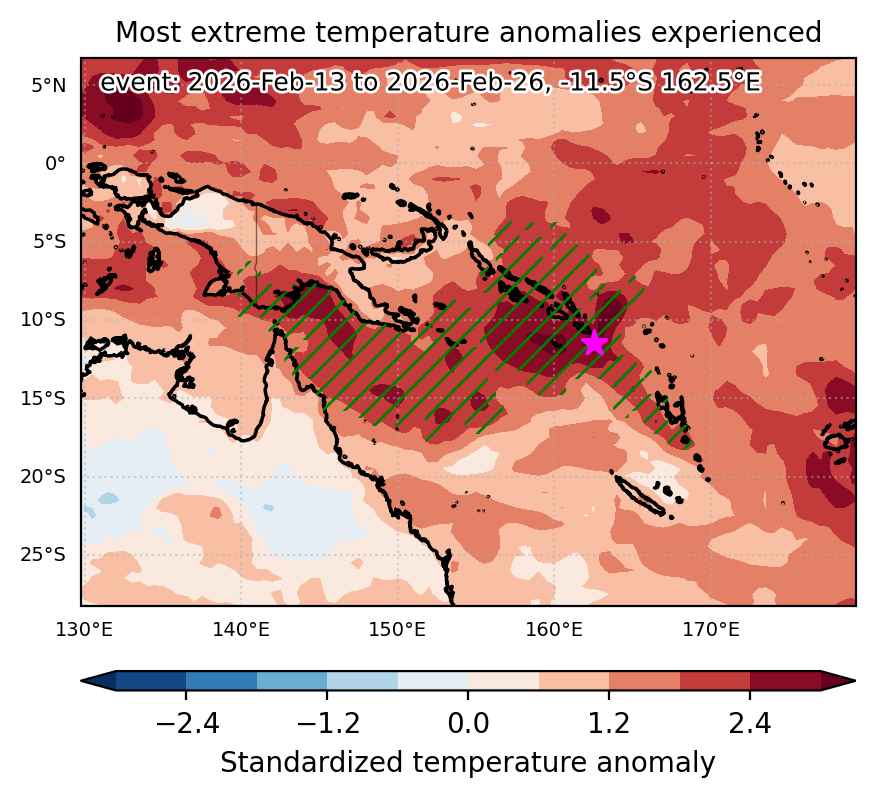
  • Maximum temperature anomaly: 2.8 °C
  • Maximum temperature: 29.9 °C

Event center: -11.5°S 162.5°E

Area affected: 2217442 km$^2$


Fig. 1: Map of most extreme temperature anomalies (standardized) experienced during the event. The purple star indicates the center of the extreme event. Green hatching illustrates all areas under the effect of extremes at some time during the event.


Fig. 2: Evolution of temperature at the center of the event. The climatological percentile distribution is illustrated with color shadings.


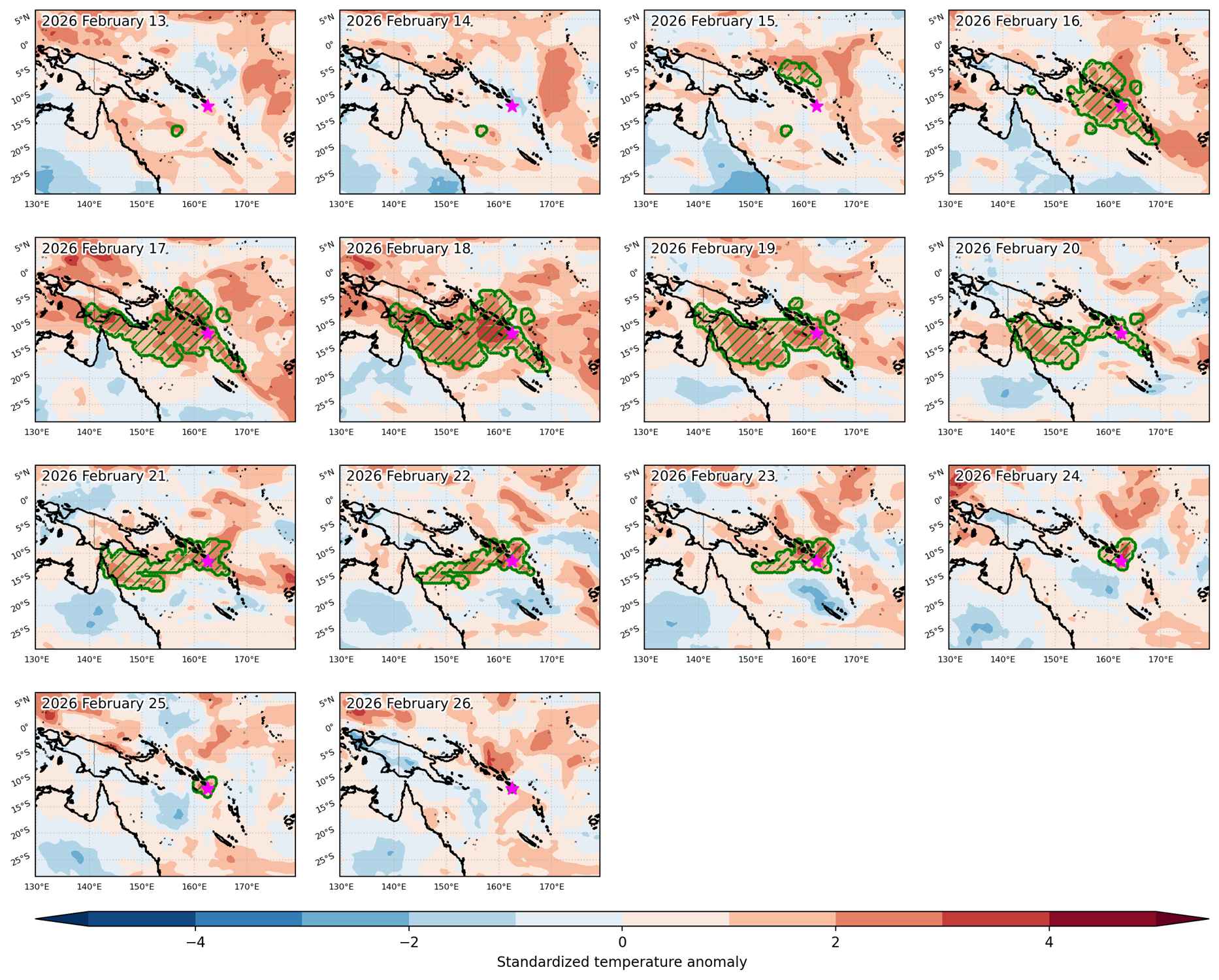
Fig. 3: Maps illustrating the evolution of standardized temperature anomalies during the event.

Event ID: Heat_wave_2026-Feb-13_to_2026-Feb-26_162.5_-11.5

Cold spell occuring from February 13 2026 to February 22 2026 at -66.0°S 56.0°E

Download data: JSON

Event type: Cold spell

Countries affected (identified with ArcGIS Online; provided only for geographical reference):

  • Antarctica

Duration: 10 days

Time span: February 13 2026 to February 22 2026

Statistics over entire affected area:

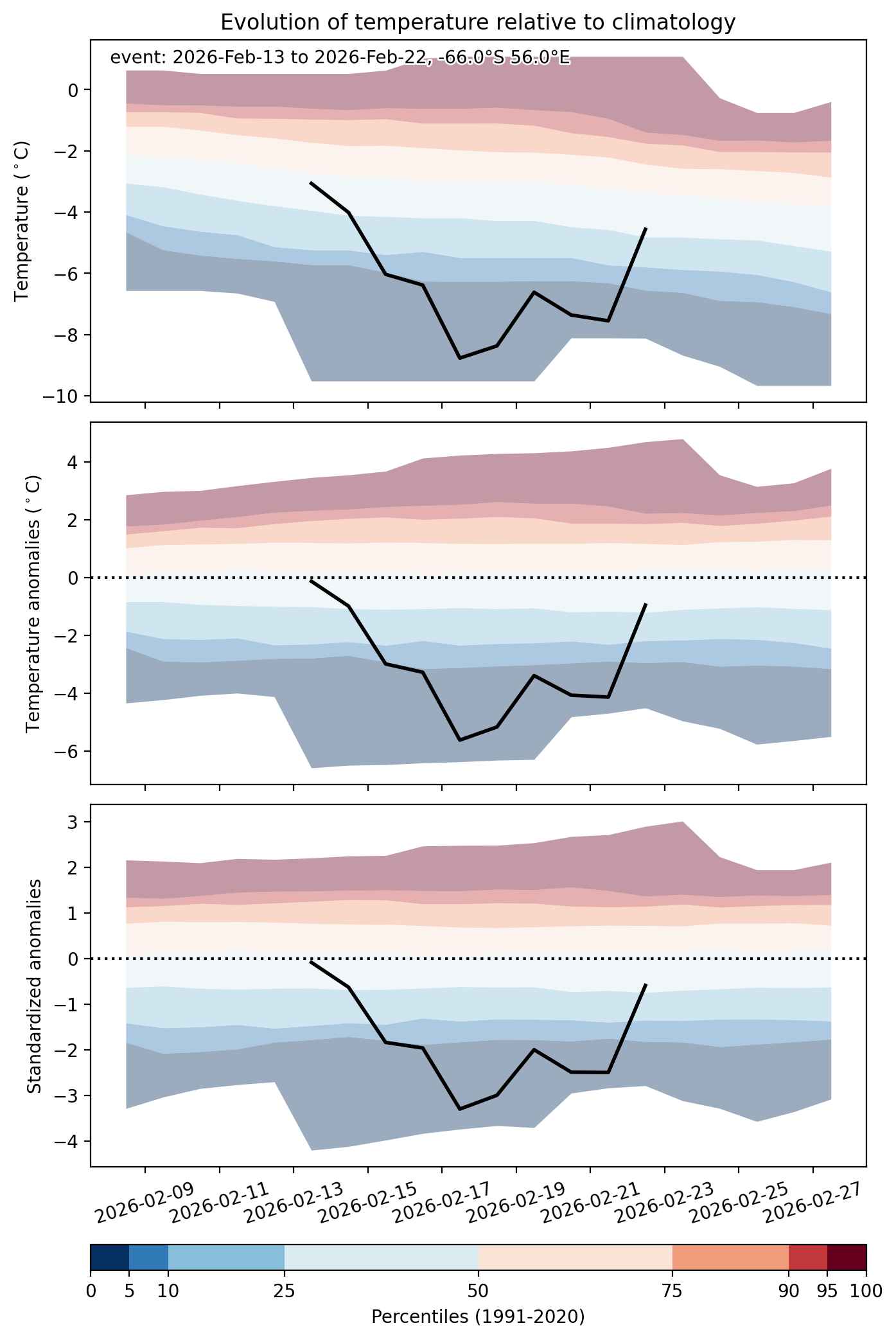
  • Mean temperature anomaly: -4.3 °C
  • Mean temperature: -13.9 °C
  • Minimum temperature anomaly: -7.9 °C
  • Minimum temperature: -33.5 °C

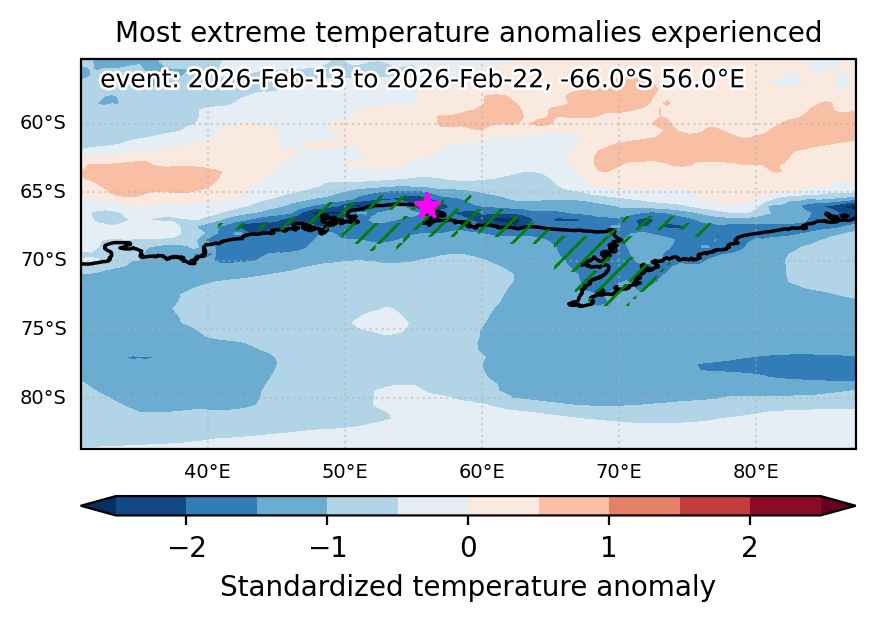
Event center: -66.0°S 56.0°E

Area affected: 335975 km$^2$


Fig. 1: Map of most extreme temperature anomalies (standardized) experienced during the event. The purple star indicates the center of the extreme event. Green hatching illustrates all areas under the effect of extremes at some time during the event.


Fig. 2: Evolution of temperature at the center of the event. The climatological percentile distribution is illustrated with color shadings.


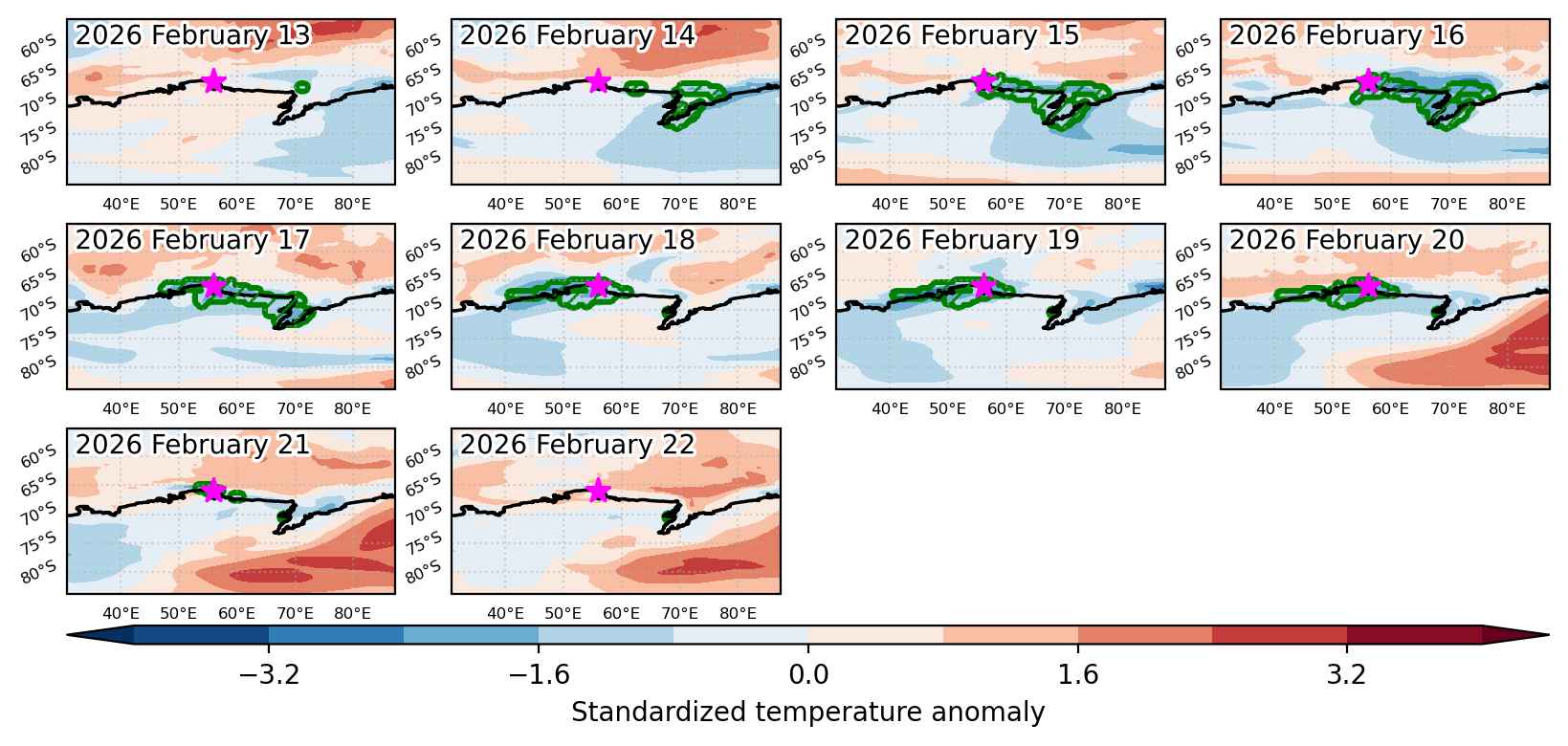
Fig. 3: Maps illustrating the evolution of standardized temperature anomalies during the event.

Event ID: Cold_spell_2026-Feb-13_to_2026-Feb-22_56.0_-66.0

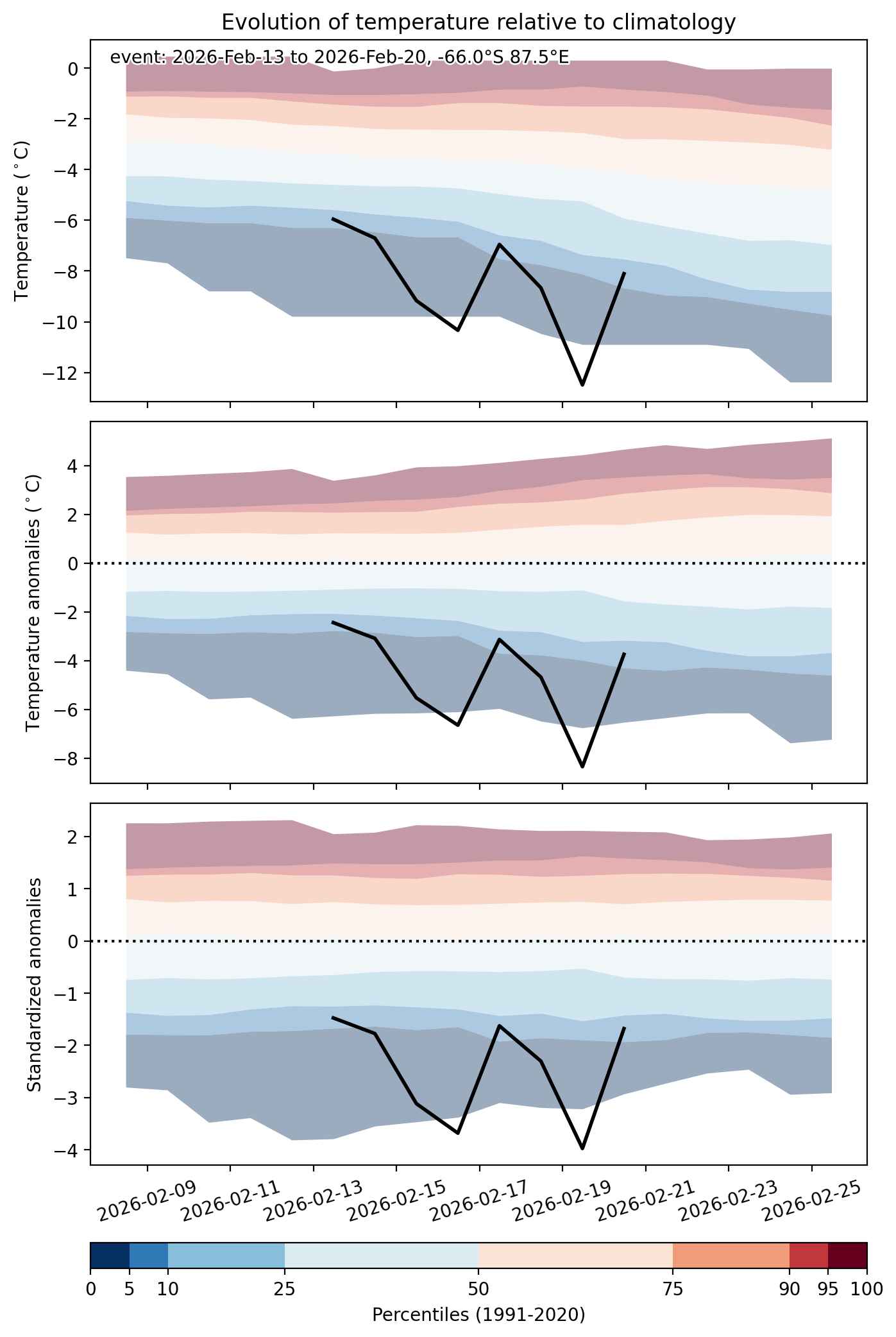
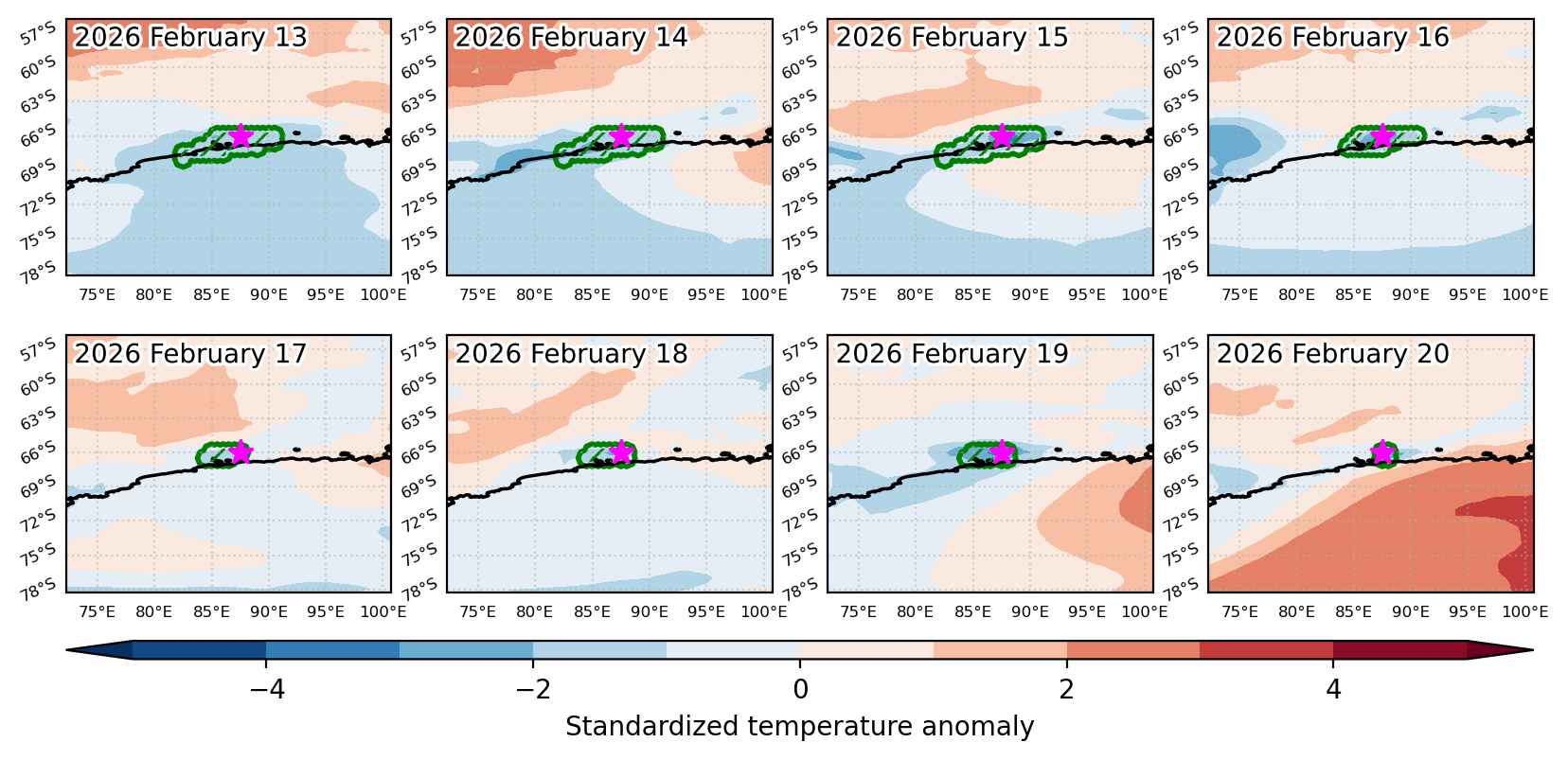
Cold spell occuring from February 13 2026 to February 20 2026 at -66.0°S 87.5°E

Download data: JSON

Event type: Cold spell

Countries affected (identified with ArcGIS Online; provided only for geographical reference):

  • Antarctica

Duration: 8 days

Time span: February 13 2026 to February 20 2026

Statistics over entire affected area:

  • Mean temperature anomaly: -4.6 °C
  • Mean temperature: -10.6 °C
  • Minimum temperature anomaly: -9.6 °C
  • Minimum temperature: -17.4 °C

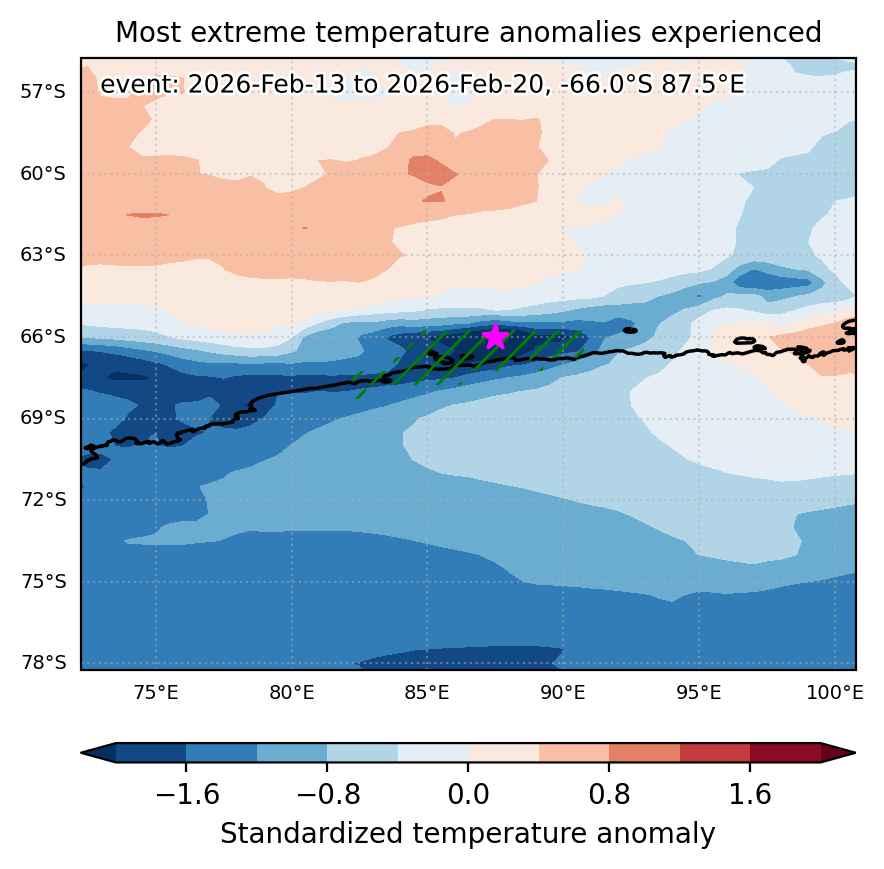
Event center: -66.0°S 87.5°E

Area affected: 53809 km$^2$


Fig. 1: Map of most extreme temperature anomalies (standardized) experienced during the event. The purple star indicates the center of the extreme event. Green hatching illustrates all areas under the effect of extremes at some time during the event.


Fig. 2: Evolution of temperature at the center of the event. The climatological percentile distribution is illustrated with color shadings.


Fig. 3: Maps illustrating the evolution of standardized temperature anomalies during the event.

Event ID: Cold_spell_2026-Feb-13_to_2026-Feb-20_87.5_-66.0